This post contains affiliate links. If you buy through our links we may earn a small commission — at no extra cost to you. This never influences our recommendations.
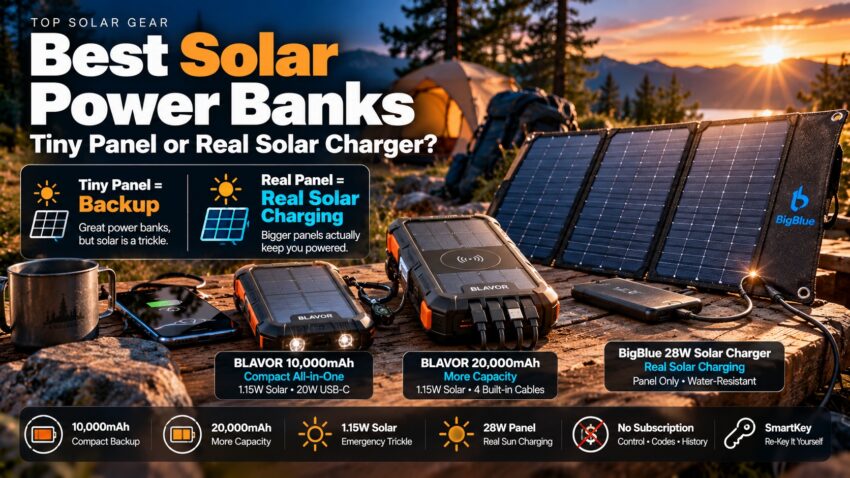
Here’s the part most solar power bank listings skip: the tiny panel on top barely charges the battery underneath. BLAVOR, one of the best-selling brands, says so itself. Its panel maxes out at 1.15 watts, and the company recommends charging from a cable, with solar as an emergency backup.
That doesn’t make these useless. It does change what to buy. Here are three picks for three different jobs.
| Pick | Type | Best For |
|---|---|---|
| BLAVOR Solar Power Bank 10,000mAh | All-in-one | Go-bags, glove boxes, outages |
| BLAVOR Solar Power Bank 20,000mAh | All-in-one, larger battery | Weekend trips with more devices |
| BigBlue 28W Solar Charger | Panel only | Sun charging that actually works |
The Math Behind the Panel
A 10,000mAh bank holds roughly 37Wh. At a 1.15W maximum, filling it from empty takes more than 30 hours of perfect direct sun. In real life, that means several days.
OutdoorGearLab’s 2026 test of 19 solar chargers points the same way. The best built-in-battery model it tested, a BLAVOR, scored 2.5 for direct solar charging speed. A plain 10W panel scored 4.5.
Heat is the second problem. The panel and battery sit together, and lithium cells lose charge as they warm in the sun. Outdoor Life’s testers noted it, and it’s why many hikers keep the bank in the shade.
All-in-One or Panel Plus Bank?
An all-in-one is a good power bank first. Charge it from the wall before you leave, and treat the panel as a backup for emergencies.
If you’ll rely on the sun, separate the two. A real foldable panel charges far faster, and the bank can sit in the shade. For trips longer than three or four days, that pairing is what works. For shorter trips, a full bank usually does the job.
Need more than phone power? Our guide to the best solar generator for camping covers the next step up. For trail-specific picks, see our solar power bank for backpacking guide.
Our Picks
BLAVOR Solar Power Bank 10,000mAh — Best All-in-One
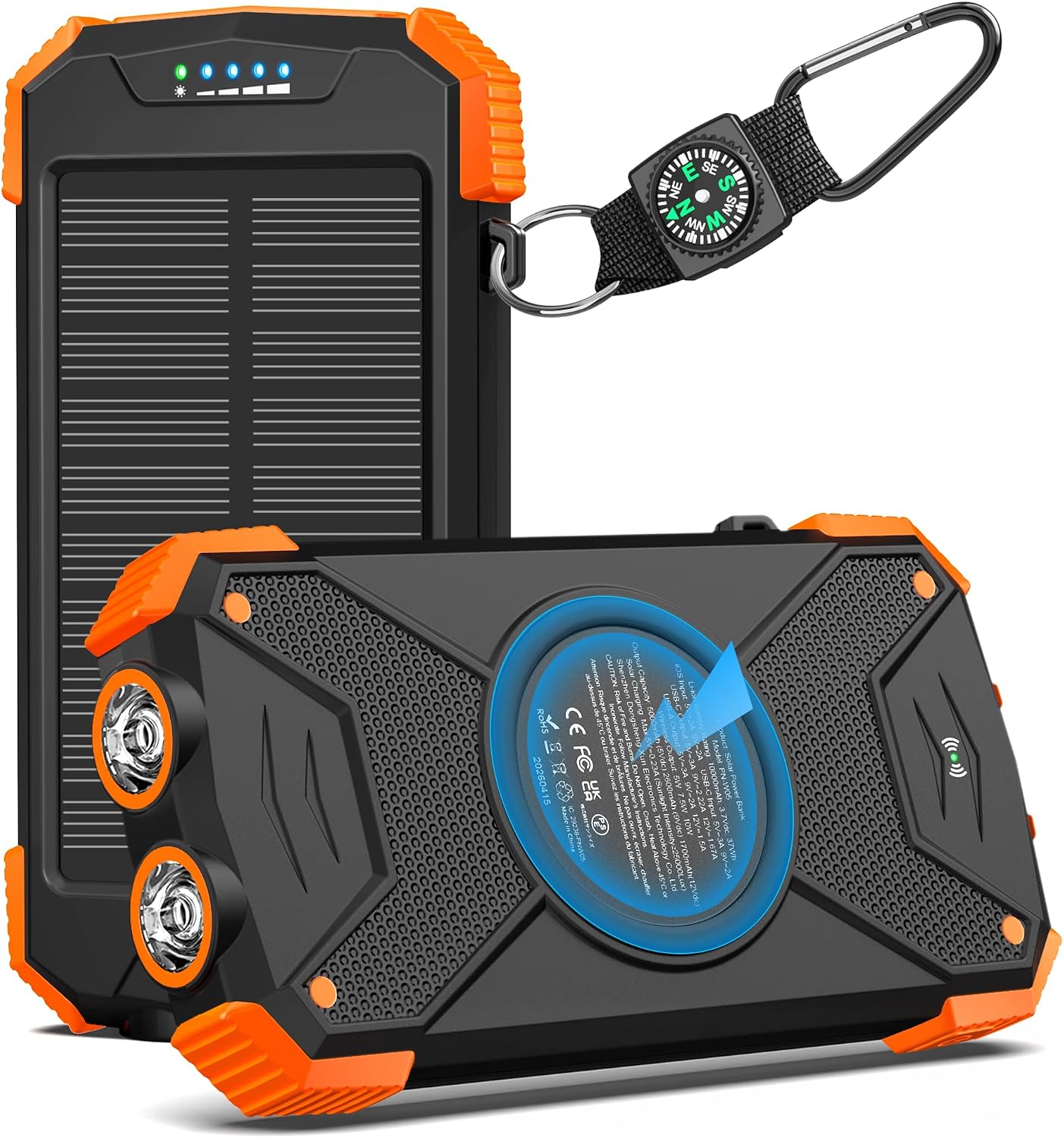
This is the one most people picture: a pocket-size bank with a panel on the back. It has 20W USB-C fast charging and Qi wireless charging. It can charge three devices at once, and it carries an IPX5 water rating, two flashlights, and a compass carabiner.
Amazon shows 4.3 stars from more than 45,000 ratings. Ten thousand mAh gives most phones about two to three charges.
| Pros | Cons |
|---|---|
| Works as a normal fast-charging power bank first | Panel maxes out at 1.15W, so solar is a trickle |
| Wireless charging, three outputs, flashlights, IPX5 | 10,000mAh covers only two to three phone charges |
| Small, light, and inexpensive | Battery warms in direct sun |
Best for: A go-bag, glove box, or outage kit. Charge it at home and keep solar as the backup.
Full details and current price: BLAVOR Solar Power Bank 10,000mAh on Amazon
BLAVOR Solar Power Bank 20,000mAh — Best for Capacity
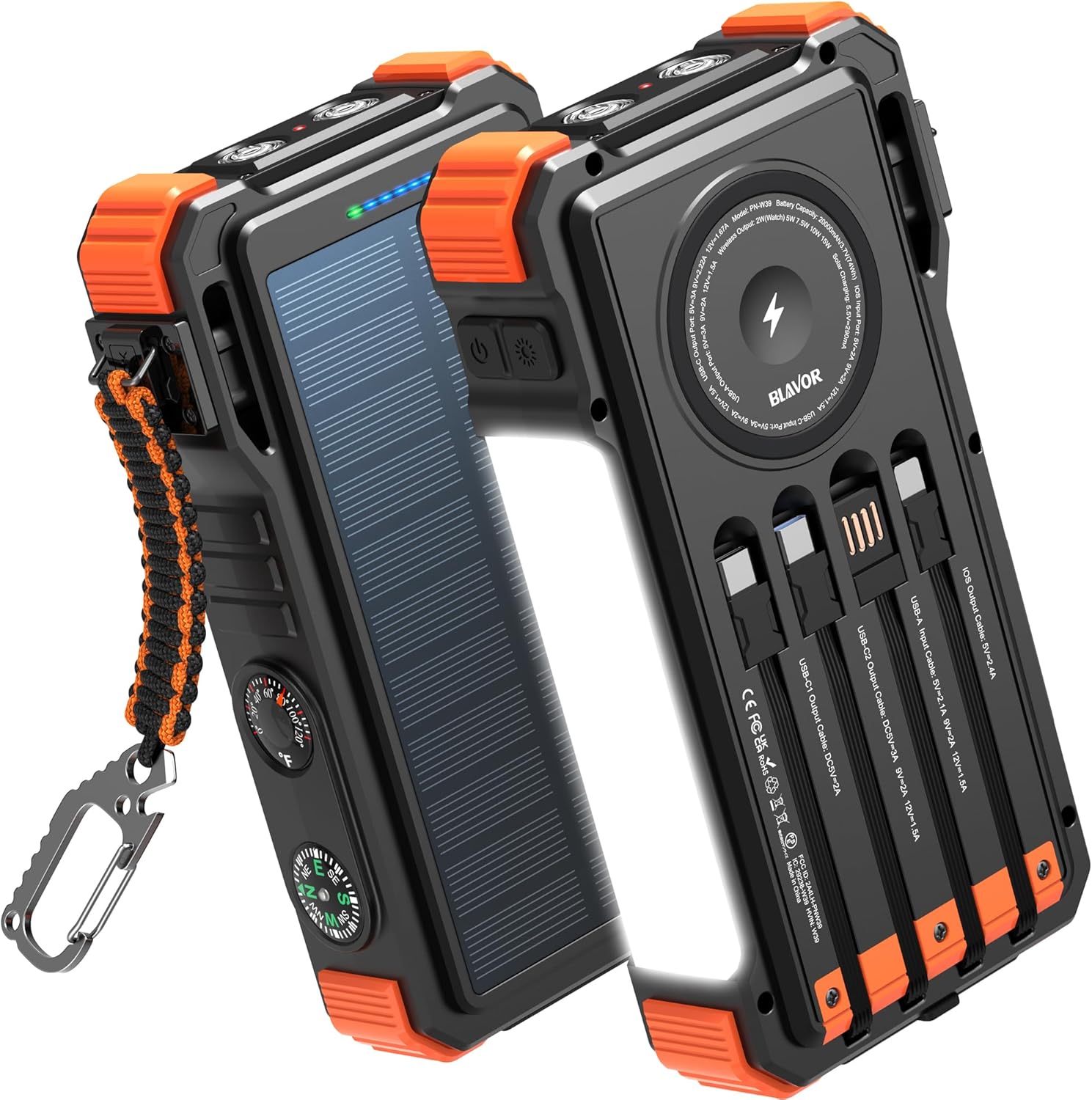
This is the bigger sibling of the 10,000mAh bank, with twice the battery and four built-in cables: two USB-C, one Lightning, and one USB-A. BLAVOR says it can charge up to six devices at once, including an Apple Watch on its wireless pad.
It also has 20W USB-C fast charging, an IPX5 water rating, and a flashlight. The solar caveat applies even more here. A larger battery behind a small built-in panel takes longer to fill from the sun, so charge it from a cable before you go. If you’ll be out for days, pair it with a real panel like the BigBlue below.
| Pros | Cons |
|---|---|
| Roughly twice the capacity of the 10,000mAh model | Built-in panel is still a trickle, and a bigger battery fills even slower |
| Four built-in cables, so nothing extra to carry | Heavier, at about 1.7 lbs |
| 20W USB-C fast charging, IPX5, and a flashlight | Needs a wall charge before you leave |
Best for: Weekend trips with several devices to keep topped up, charged from the wall beforehand.
Full details and current price: BLAVOR Solar Power Bank 20,000mAh on Amazon
BigBlue 28W Solar Charger — Best for Actual Sun Charging
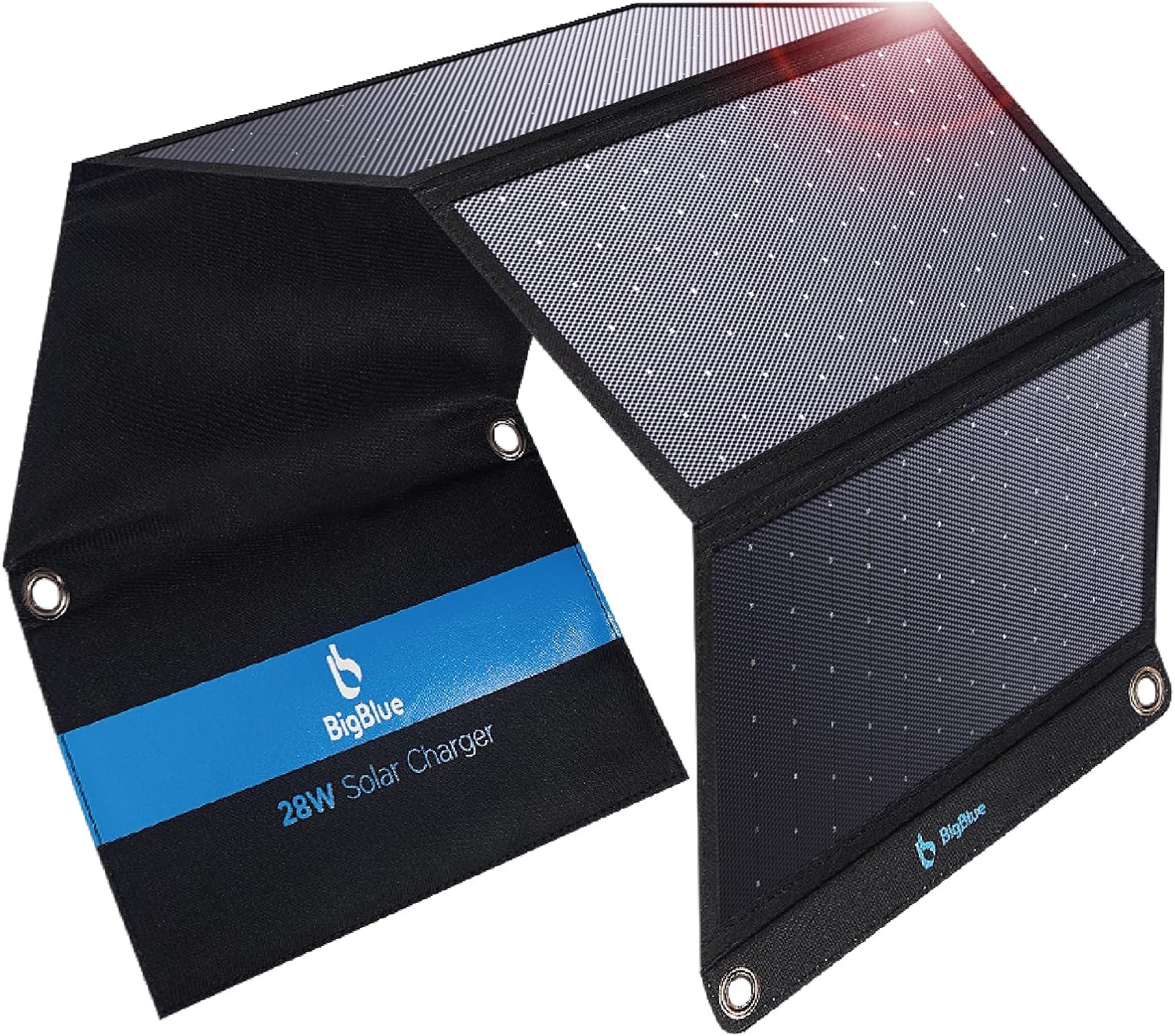
This is a panel with no battery, and that’s the point. It has far more cell area than any panel built into a power bank, so it charges a phone or your own power bank much faster in good sun.
It folds, resists water, clips to a pack with carabiners, and carries Amazon’s Choice badge. Pair it with any power bank you already own, including the 20,000mAh BLAVOR above. Our Goal Zero Nomad 5 review covers a smaller panel for light phone top-ups.
| Pros | Cons |
|---|---|
| Far more panel area than a built-in power bank panel | No battery, so it can’t store power |
| Foldable, water-resistant, carabiner-ready | Output swings with sun, angle, and temperature |
| Works with any power bank or device | Bulkier than a pocket-size bank |
Best for: Hikers and campers who already own a power bank and want sun charging that actually keeps up.
Full details and current price: BigBlue 28W Solar Charger on Amazon
Frequently Asked Questions
Do solar power banks really charge from the sun?
Barely. BLAVOR’s own listing says its built-in panel maxes out at 1.15W and recommends cable charging, with solar as an emergency backup.
How long does it take to charge a solar power bank in the sun?
For a 10,000mAh bank on a 1.15W panel, more than 30 hours of ideal direct sun, so several days in real conditions.
Is a power bank plus a separate panel better?
For sun charging, yes. A foldable panel is far faster, and the bank stays out of the heat.
How many phone charges does a 10,000mAh bank give?
Roughly two to three for most modern phones, depending on your phone’s battery size.
Can a solar power bank run a laptop or a fridge?
Not realistically. For that, you need a portable power station.
Final Verdict
| Pick | Best For |
|---|---|
| BLAVOR Solar Power Bank 10,000mAh | Emergency backup you charge from the wall |
| BLAVOR Solar Power Bank 20,000mAh | Longer trips with more devices, charged before you go |
| BigBlue 28W Solar Charger | Sun charging that keeps up |
Buy the all-in-one if you want a cheap emergency backup, and don’t count on the panel. If you’ll genuinely depend on the sun, buy a real panel and pair it with a power bank.