This post contains affiliate links. If you buy through our links we may earn a small commission — at no extra cost to you. This never influences our recommendations.
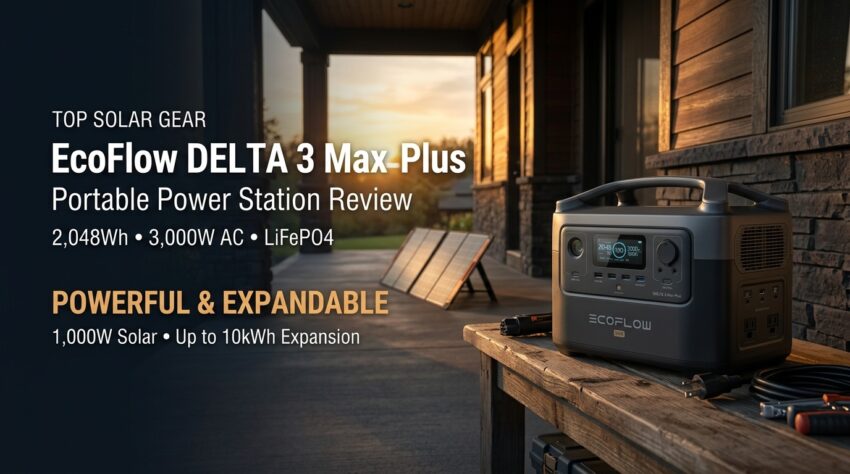
The EcoFlow DELTA 3 Max Plus is a 2,048Wh LiFePO4 power station with 3,000W of output and up to 1,000W of solar input. It can grow to 10kWh with extra batteries.
Two reviewers with measured results found it strong and efficient. They also found a few annoyances, and one real limit on big tools.
Specs at a Glance
| Spec | EcoFlow DELTA 3 Max Plus |
|---|---|
| Battery | 2,048Wh LiFePO4 |
| AC output | 3,000W continuous, 6,000W surge |
| X-Boost | Up to 3,800W for resistive loads |
| Solar input | Up to 1,000W (two 500W inputs, 11–60V each) |
| Wall charging | 80% in about 50–64 minutes in reviewer tests |
| Expansion | Up to 10kWh with extra batteries |
| UPS switchover | About 8 ms in reviewer tests |
| Weight and size | About 48.7 lb, 19.5 x 9.5 x 12 in |
| Warranty | 3 years, 5 with app registration |
What the Reviewers Measured
Gidon at The Technology Man measured usable AC output at 1,898Wh from the 2,048Wh battery, about 93%. AndroidGuys’ Scott Webster got about 1,740Wh, roughly 85%, in a less formal test. We’ll use that range.
Gidon’s mains charging reached 80% in about 50 minutes and 100% in about 70. Webster saw 0–80% in about 64 minutes. Noise was low in both tests, in the mid-20 dB range at light loads and low-40 dB near 3,000W, per Webster.
What 2kWh Will Run
At 1,740–1,900Wh of usable energy, here are our runtime estimates.
| Load | Approx. Runtime (our estimates) |
|---|---|
| Full-size refrigerator (1–2kWh a day) | About 0.9–1.9 days |
| CPAP (about 40W) | About 43–47 hours |
| Laptop and Wi-Fi router (about 80W) | About 22–24 hours |
| 8,000 BTU window air conditioner (about 700W) | About 2.5–2.7 hours |
| 1,500W space heater | About 1.2–1.3 hours |
For more fridge detail, see how big of a portable power station you need.
Solar Charging
Each of the two solar inputs takes 500W. As an estimate, 1,000W of panels gives about 3,250–4,000Wh on a good day (1,000W × 5 sun hours × 65–80%), enough to refill the battery in under a day. A single 400W panel adds about 1,300–1,600Wh, so a full refill takes about 1.3–1.6 days.
Webster saw 0–80% from solar in about 1.5 hours at 1,000W. See our EcoFlow solar panel guide for panel options.
EcoFlow DELTA 3 Max Plus Review
EcoFlow DELTA 3 Max Plus (2,048Wh, 3,000W)
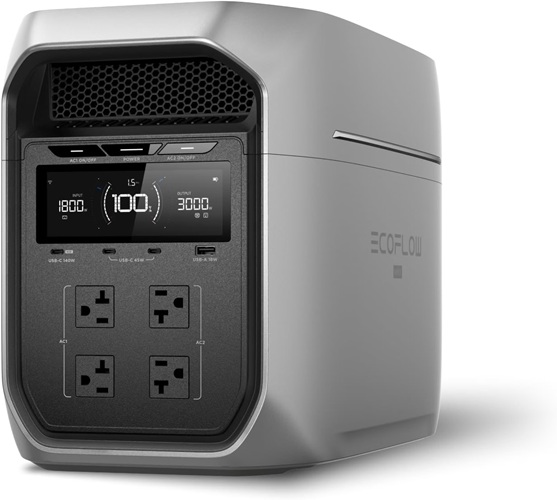
This is a strong home backup and workshop unit. In Gidon’s tests it ran a kettle at about 2,600W and an air conditioner, and idled at about 22W. Webster says the inverter held 3,000W and didn’t trip until roughly 3,800W.
The catch is big tools. Gidon’s table saw (about 7,000W startup) and planer (about 9,000W startup) wouldn’t run. Webster also warns the UPS mode may reboot sensitive PCs and NAS devices, though Gidon’s PC handled the switchover fine.
Other annoyances: the solar and car cables aren’t included, there are no wheels, it isn’t weather-resistant, and Webster notes community reports of firmware bugs. It costs about $1,149 (retailer price), roughly $0.56 per Wh (our math).
| Pros | Cons |
|---|---|
| 3,000W output, with headroom in testing | Can’t start very large tools |
| 85–93% efficiency in reviewer tests | Solar and car cables not included |
| 1,000W solar and 10kWh expansion | No wheels; about 48.7 lb |
| Quiet and fast wall charging | UPS mode may reboot sensitive PCs |
Best for: Home backup, remote offices and workshops that want 3,000W now and room to expand.
Full details and current price: EcoFlow DELTA 3 Max Plus on Amazon
Weighing it against a bigger unit? Read our EcoFlow DELTA Pro 3 review and DELTA 3 Plus review.
Frequently Asked Questions
How much does the DELTA 3 Max Plus weigh?
About 48.7 lb. It has handles but no wheels, per AndroidGuys.
How many extra batteries can I add?
Retailer pages list expansion up to 10kWh. Check EcoFlow for the exact battery count and compatibility.
Can it run a table saw or other big tools?
Not always. Gidon’s table saw and planer, with very high startup draw, didn’t run. A pressure washer and air conditioner did.
Is it a UPS?
Yes, with a switchover of about 8 ms in both tests. Sensitive PCs and NAS units may still reboot, per AndroidGuys.
Is it worth the price over the DELTA 3 Max?
If you need 3,000W, 1,000W of solar or expansion, yes. If not, the base DELTA 3 Max costs less and has the same 2,048Wh.
Final Verdict
The EcoFlow DELTA 3 Max Plus is a fast-charging, efficient 3,000W power station that can grow with you. Skip it if you need to start very large motors, or if you don’t need the expansion and extra solar.