This post contains affiliate links. If you buy through our links we may earn a small commission — at no extra cost to you. This never influences our recommendations.
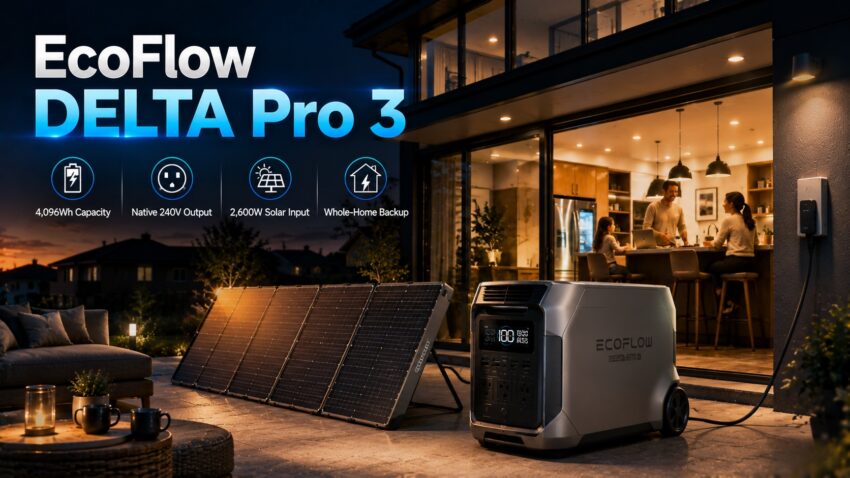
The DELTA Pro 3 isn’t really a portable power station in the traditional sense — it’s a home energy system that happens to have wheels. At 4,096Wh base capacity, 4,000W continuous output, and native 120V/240V dual voltage, it sits closer to a standby generator replacement than a camping accessory. This review covers the full spec sheet, what it can realistically power, and who should actually spend the money on EcoFlow’s flagship-adjacent unit.
Full Specifications
| Spec | EcoFlow DELTA Pro 3 |
|---|---|
| Capacity | 4,096Wh |
| Battery chemistry | LiFePO4 (LFP) |
| Cycle life | 4,000+ cycles to 80% capacity |
| AC output | 4,000W continuous, 120V/240V dual voltage |
| Surge output (X-Boost) | 8,000W |
| AC charge time (0–80%) | ~50 minutes with maximum combined input |
| Full AC charge | ~90 minutes to 2 hours (varies by input configuration) |
| Solar input (max) | 2,600W (dual MPPT) |
| Weight | ~113–115 lbs |
| Output ports | 7× AC (incl. 2× 240V), 2× USB-C (100W), 2× USB-A, 12V DC output, L14-30 generator plug, Anderson port |
| Expandability | Up to 48kWh with Smart Extra Batteries |
| Battery pack rating | IP65 |
| App control | Wi-Fi and Bluetooth |
| Home panel integration | Smart Home Panel 2 (sold separately) |
| Warranty | 5 years |
What 4,096Wh Actually Means for Home Backup
Nearly 4kWh isn’t an incremental step up from a 2kWh unit — it’s a categorical shift. In real-world testing running a fridge, two chest freezers, a gas furnace blower, and assorted lights and electronics, total continuous draw averaged around 430W with the fridge and freezers cycling, spiking to roughly 1,100W when the furnace blower kicked in. At that continuous draw, runtime math works out to roughly 8 hours per full charge (4,096Wh × 0.85 inverter efficiency ÷ 430W) — enough to comfortably bridge an overnight outage on the base unit alone, before any solar recharge or battery expansion.
One reviewer ran the DELTA Pro 3 as their primary backup source through a real 52-hour outage, successfully powering a fridge, TV, and space heater simultaneously for the duration — the kind of real-world stress test that separates genuine home backup capability from marketing claims.
120V/240V Dual Voltage — The Feature That Sets It Apart
Most portable power stations output 120V only. The DELTA Pro 3 outputs both 120V and 240V natively from a single unit — meaning it can run 240V appliances (central air conditioning, an electric dryer, a well pump) without needing to stack two units together, which is how most competitors handle 240V loads. For home backup scenarios where a well pump or central AC is a real consideration, this is a genuine structural advantage rather than a marketing bullet point.
Charging Speed
Using EcoFlow’s multi-charge technology, the DELTA Pro 3 goes from 0–80% in approximately 50 minutes using up to 7,000W of combined input, with a full charge completing in roughly 90 minutes to 2 hours depending on configuration. Compared to competing units with similar capacity that often take 4–6 hours for a full charge, this is a meaningful practical advantage — if a storm warning gives you a couple of hours’ notice, the DELTA Pro 3 can be fully topped off before the power goes out.
Solar input maxes out at 2,600W across dual MPPT ports, enabling a full solar charge in roughly 2–3 hours with a sufficiently large panel array — solid for off-grid recharging, sitting between the original DELTA Pro’s 1,600W ceiling and the DELTA Pro Ultra’s 5,600W.
Expandability — Up to 48kWh
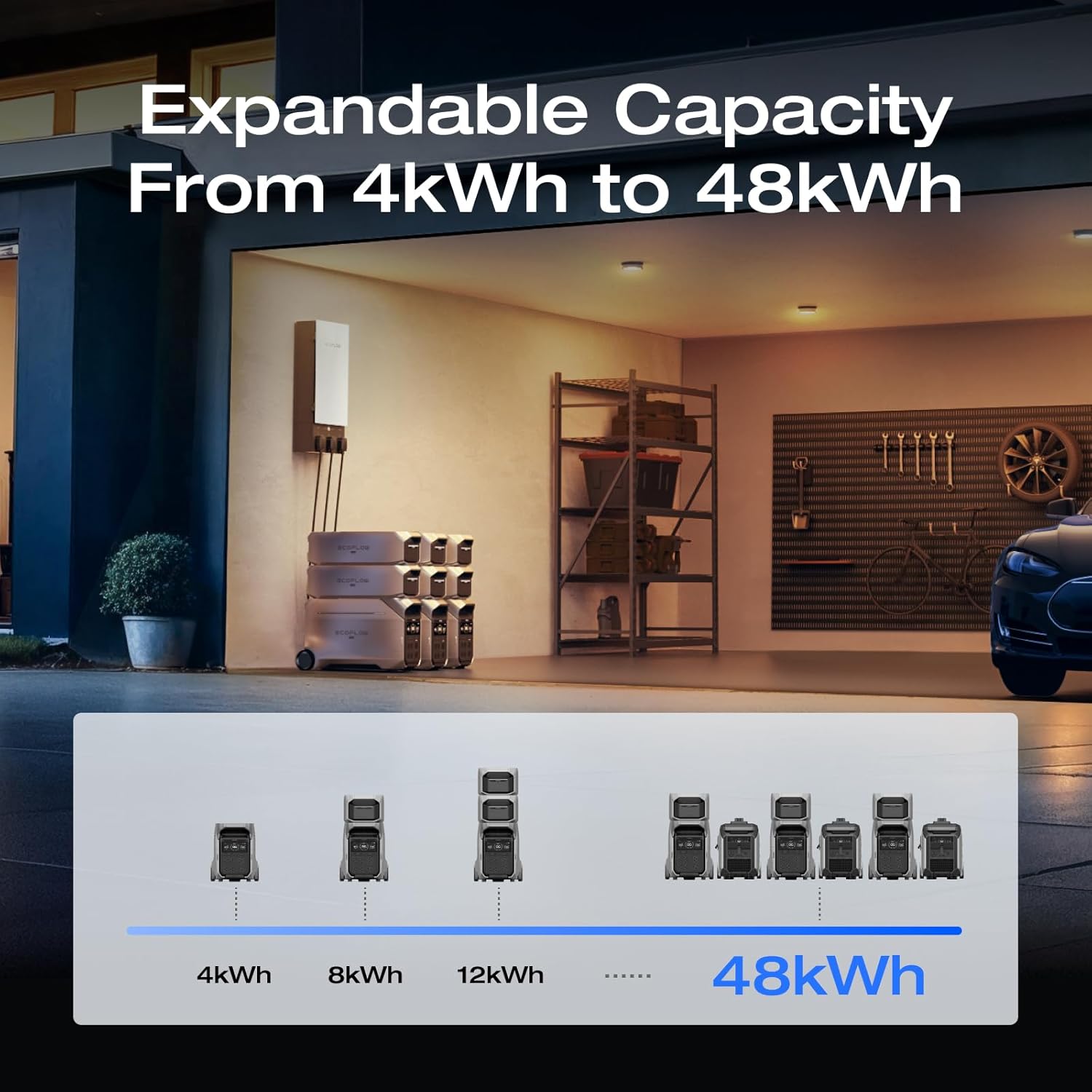
The base 4,096Wh is substantial on its own, but the DELTA Pro 3 supports expansion up to 48kWh through EcoFlow’s dedicated Smart Extra Battery packs, each adding roughly 4kWh to the system. At maximum configuration, that’s enough capacity to power essential home circuits for a full week during an extended outage — genuinely rare scalability in the portable power station category. This also means you can start with the base unit and grow into more capacity later without replacing the core inverter.
Combined with the Smart Home Panel 2 (an additional ~$999 purchase), the DELTA Pro 3 integrates directly into your home’s electrical panel across up to 10 circuits for automatic switchover during grid outages — genuine set-and-forget home backup rather than a unit you have to manually plug appliances into.
Real-World Trade-Offs Worth Knowing
Weight and portability: At 113–115 lbs, this is a two-person lift for stairs or vehicle loading. Rear wheels and a telescoping handle make it manageable to roll on flat surfaces, but this is fundamentally a stationary home-backup unit that happens to have some mobility, not a grab-and-go camping station.
No 12V car socket: A notable omission that several independent reviewers flagged — anyone relying on 12V DC output for camping accessories or car-style devices will need to use the 12V DC output ports instead, which function differently than a traditional car socket.
Newer ecosystem: Compared to the original DELTA Pro, which has been on the market since 2021 with an established accessory track record, the DELTA Pro 3’s ecosystem is newer and owner feedback is still accumulating. For buyers who want the most battle-tested infrastructure today, this is worth weighing against the Pro 3’s improved specs.
Solar input wiring complexity: A few reviewers noted that the dual solar input ports require different wiring configurations depending on setup, adding a layer of complexity compared to a single straightforward solar input.
DELTA Pro 3 vs the Original DELTA Pro
| Spec | DELTA Pro (original) | DELTA Pro 3 |
|---|---|---|
| Capacity | 3,600Wh | 4,096Wh |
| AC output | 3,600W | 4,000W |
| Solar input | 1,600W | 2,600W |
| Cycle life | 3,000+ | 4,000+ |
| 240V output | No (single unit) | Yes, native |
| Max expansion | 25kWh | 48kWh |
The DELTA Pro 3 beats the original on every meaningful metric — higher output, more solar input, longer cycle life, and native 240V support. For most buyers starting fresh, the Pro 3’s LFP chemistry and longer cycle life justify the premium. If you’re adding to an existing DELTA Pro setup, or want the lower entry price and the original’s more mature ecosystem, the original DELTA Pro remains a strong buy. See our best EcoFlow solar generator guide for the full lineup comparison, including the DELTA Pro Ultra above this tier.
Who Should Buy the DELTA Pro 3
Best for:
- Homeowners in storm-prone or outage-prone areas who want a genuine gas generator alternative
- Anyone needing native 240V output for central AC, an electric dryer, or a well pump
- Off-grid cabin owners and serious RV users with high power demands
- Buyers planning to scale toward whole-home backup with battery expansion over time
Consider alternatives if:
- You only experience occasional, brief outages — a DELTA 2 Max or similar 2kWh unit is likely more than sufficient at a substantially lower price
- Portability for camping is a priority — this is a stationary home-backup unit, not a grab-and-go station
- You want the most established, longest-proven EcoFlow ecosystem — the original DELTA Pro has several more years of real-world track record
Frequently Asked Questions
Can the EcoFlow DELTA Pro 3 run a whole house?
Not at full simultaneous draw — no portable battery system can economically power an entire home running everything at once. What it can do is back up your essential circuits (refrigerator, select lighting, fans, medical equipment, and even a well pump or central AC thanks to native 240V output) when paired with the Smart Home Panel 2, which lets you choose which circuits to protect during an outage.
How long will the DELTA Pro 3 run a refrigerator?
A standard refrigerator drawing roughly 100–150W average (accounting for compressor cycling) would run for well over 24 hours on the base 4,096Wh capacity alone. Real-world mixed-load testing (fridge, freezers, and a furnace blower cycling) showed roughly 8 hours of runtime at an average 430W draw — a more realistic estimate for households running multiple appliances simultaneously rather than a fridge in isolation.
Is the DELTA Pro 3 worth it over the DELTA 2 Max?
Only if your needs genuinely require whole-home backup capability, native 240V output, or multi-day outage coverage. The DELTA Pro 3 costs significantly more than the DELTA 2 Max, and for households experiencing occasional brief outages or primarily camping-focused use, the DELTA 2 Max delivers excellent value at a fraction of the price. Match your purchase to actual power requirements rather than worst-case scenarios you’re unlikely to face.
Does the DELTA Pro 3 support EV charging?
EcoFlow’s DELTA Pro lineup has offered EV charging station compatibility as a recharging method on the original DELTA Pro, allowing recharge at public EV stations. Confirm current compatibility for the Pro 3 specifically via EcoFlow’s official specifications before relying on this feature, as charging method support can vary by unit generation.
How much does the Smart Home Panel 2 cost, and is it necessary?
The Smart Home Panel 2 is sold separately, typically adding roughly $999 to the total investment. It’s not required to use the DELTA Pro 3 — you can plug devices directly into the unit’s outlets — but it’s the difference between manually connecting appliances during an outage and genuine automatic, set-and-forget whole-circuit backup integrated with your home’s electrical panel.
The Bottom Line
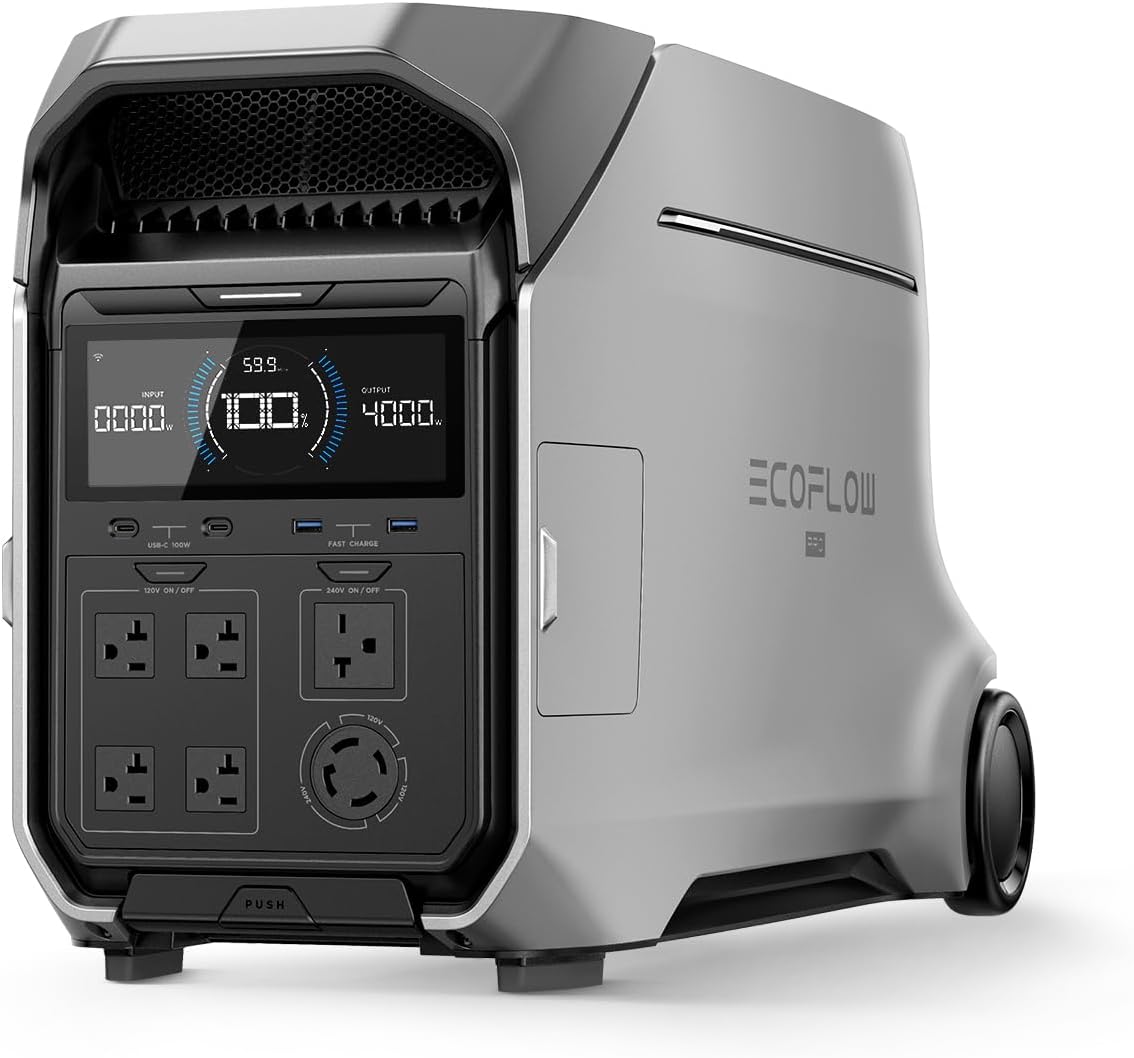
The DELTA Pro 3 is, by most independent testing, the most capable portable power station currently available for serious home backup — the combination of 4,000W native 120V/240V output, fast charging, and expansion to 48kWh puts it in a category of its own. The trade-offs are real: it’s heavy, expensive, and the full home integration system adds significant additional cost. For homeowners in storm-prone areas, RV owners who demand serious power, or anyone building a genuine off-grid energy system, it delivers on its flagship promises. For everyone else, a capable mid-range unit will serve better and cost considerably less.
Check the EcoFlow DELTA Pro 3 on Amazon →
For the full EcoFlow lineup comparison, see our best EcoFlow solar generator guide. For sizing a home backup system around your specific appliances, our solar generator for home backup guide covers the load math in detail, and our solar generator for refrigerator guide breaks down runtime for specific appliance types.