This post contains affiliate links. If you buy through our links we may earn a small commission — at no extra cost to you. This never influences our recommendations.
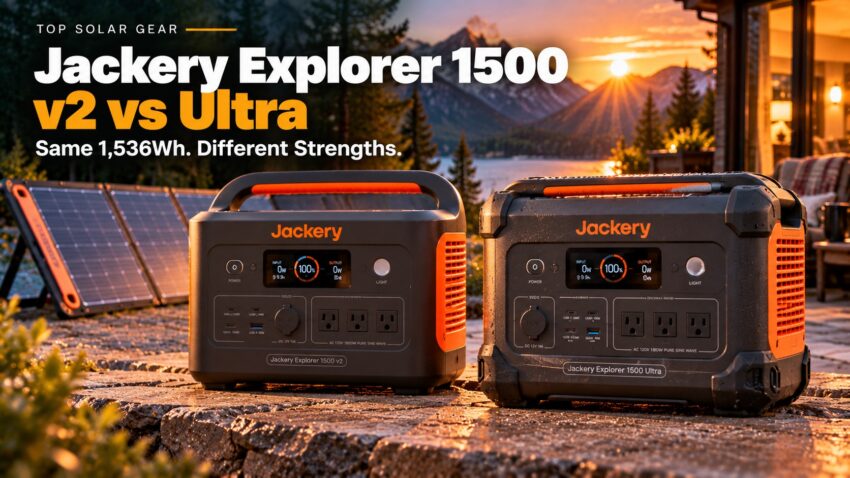
The Jackery Explorer 1500 name now covers two different current models: the Explorer 1500 v2 and the Explorer 1500 Ultra. Both pack a 1,536Wh LiFePO4 battery. They differ in output, weight, solar input and toughness.
The original 2021 Explorer 1500 doesn’t appear to be sold new on Amazon any more. Here’s how the two successors compare, and which one fits.
Explorer 1500 v2 vs Ultra at a Glance
| Spec | Explorer 1500 v2 | Explorer 1500 Ultra |
|---|---|---|
| Battery | 1,536Wh LiFePO4 | 1,536Wh LiFePO4 |
| AC output | 2,000W (4,000W surge) | 1,800W (3,600W surge) |
| Weight | About 32 lb | About 38.6 lb |
| Cycle life | 6,000+ cycles | 4,000 cycles to 70% |
| Solar input | Charge times quoted for 400W | 800W max (two 400W inputs) |
| AC charge time | About 80 minutes | About 1.5 hours |
| Water and dust rating | None listed | IP65 |
| Ports | 3 AC, 2 USB-C, 1 USB-A, 12V | 3 AC, 2 USB-C, 1 USB-A, 12V |
| Expandable | Not mentioned by Jackery | No |
What 1,536Wh Will Run
Real usable energy is lower than the label. Independent testing of the Ultra measured about 98% efficiency and an idle draw near 21W, so plan on roughly 1,250–1,500Wh of usable power from either model. That’s our estimate, and we’re assuming the v2 is a bit less efficient.
| Device | Approx. Runtime (our estimates) |
|---|---|
| Full-size refrigerator | 12–24 hours |
| CPAP (about 40W) | 20–25 hours |
| Laptop and monitor (about 60W) | 15–18 hours |
| 1,500W space heater | About 1 hour |
Our refrigerator runtime guide explains why a fridge draws less than its label.
For solar, a 400W array in good sun adds about 1,300–1,600Wh a day (400W × 5 sun hours × 65–80%). That’s roughly one sunny day for a full refill. The Ultra’s 800W input could refill in about half a day with enough panels.
Jackery Explorer 1500 Models
1. Jackery Explorer 1500 v2 — Best Value and Lightest
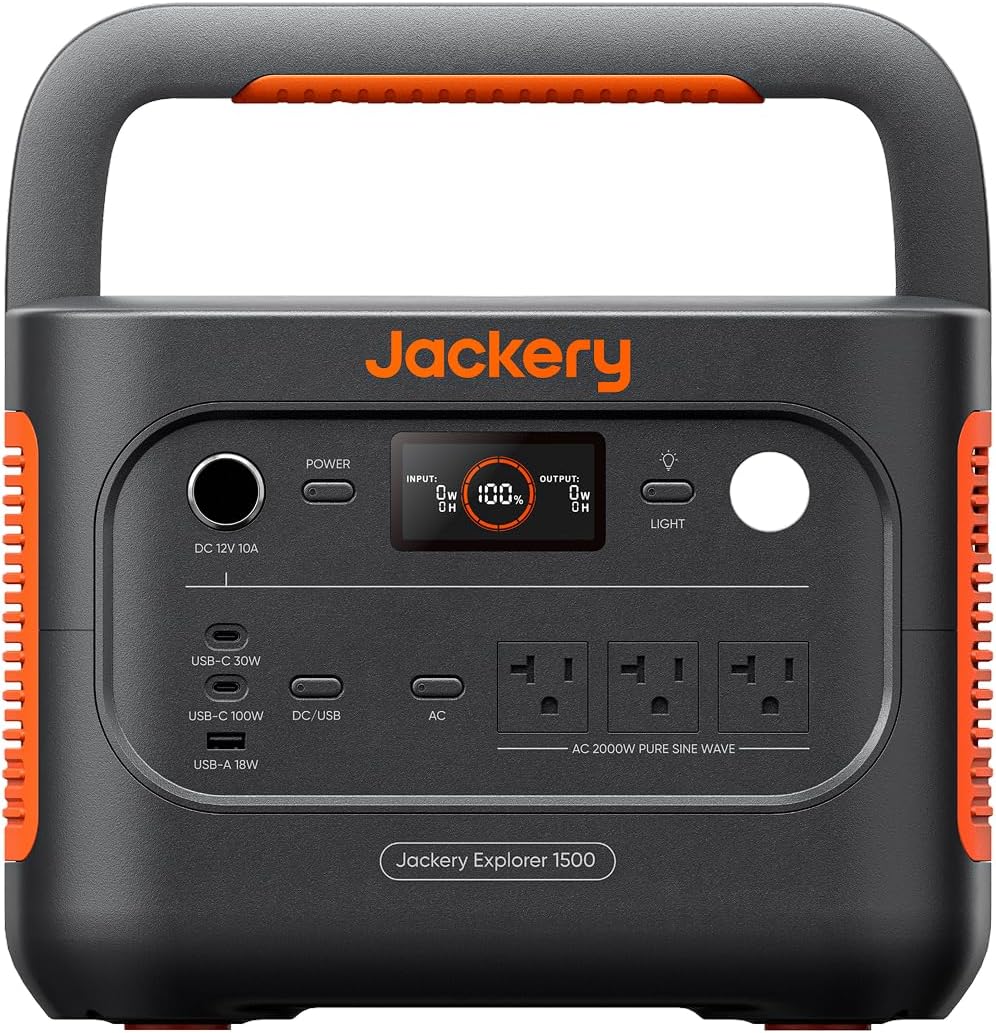
The v2 has the higher output of the two at 2,000W, a 6,000-cycle battery, and it weighs about 32 lb. Jackery rates its UPS switchover at 10ms, which suits routers and computers during outages.
The catch is that it’s new and barely reviewed. We couldn’t find an independent hands-on test, so these figures are Jackery’s own, and the base listing had no ratings yet. It also lists no water or dust rating, and Jackery quotes solar charging only for 400W.
Amazon also sells the v2 bundled with a 200W solar panel if you want to start charging right away.
| Pros | Cons |
|---|---|
| 2,000W output with 4,000W surge | No independent test found yet |
| About 32 lb for 1,536Wh | No IP rating listed |
| 6,000+ cycle LiFePO4 battery | Solar charging quoted at 400W |
| Fastest AC charge of the two | No expansion options listed |
Best for: Home backup and RV use where weight and price matter more than weatherproofing.
Full details and current price: Jackery Explorer 1500 v2 Power Station on Amazon
Full details and current price: Jackery Explorer 1500 v2 with 200W Solar Panel on Amazon
2. Jackery Explorer 1500 Ultra — Best for Rough Conditions and Solar
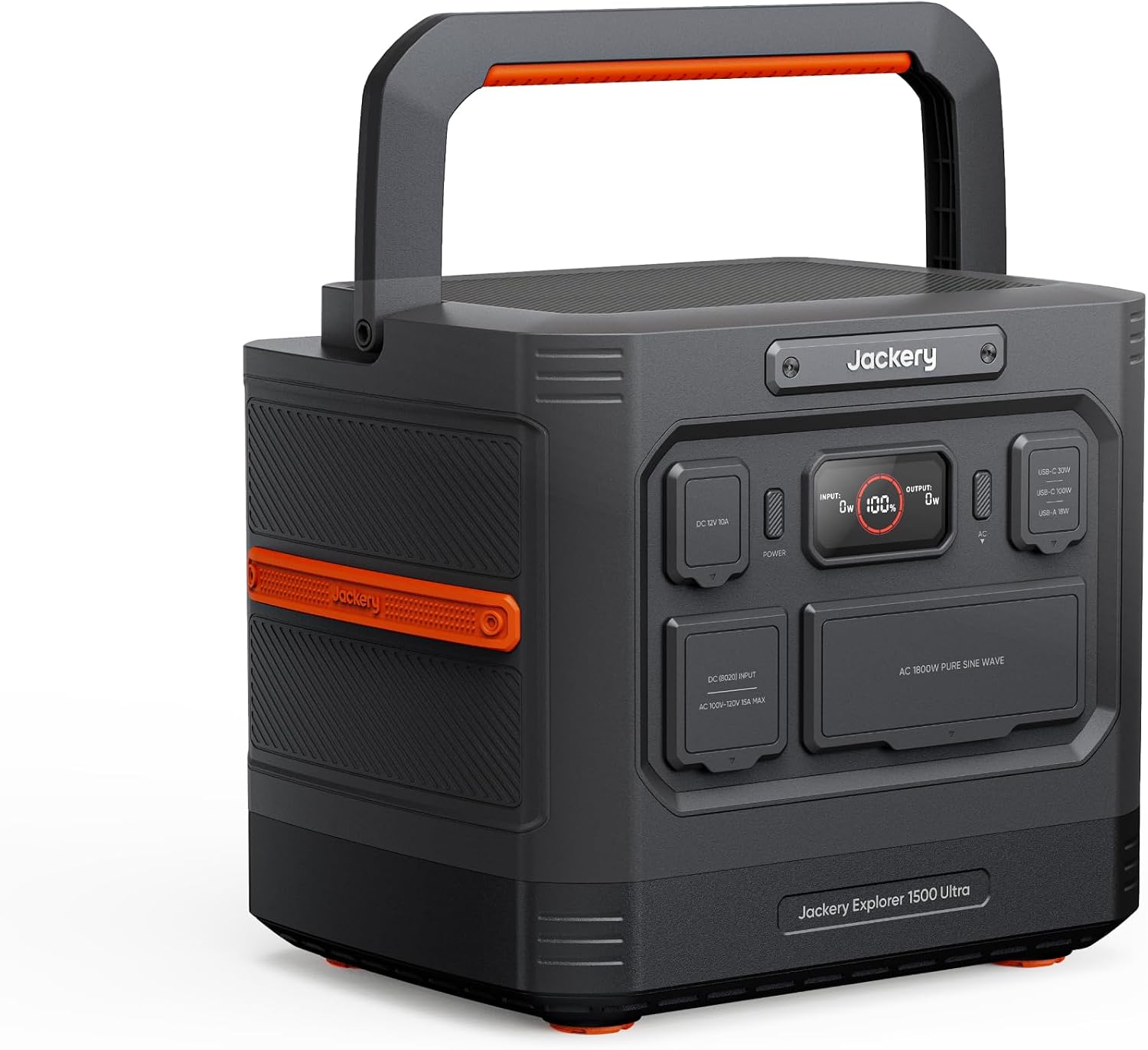
The Ultra is the rugged one. It’s IP65-rated for dust and water when the port covers are closed, survived 1-meter drops in testing, and accepts up to 800W of solar through two inputs. The Solar Lab measured 98% efficiency, which it called the highest it had recorded from any brand.
The catches are weight and price. At about 38.6 lb it’s roughly 6 lb heavier than the v2, and it costs more. There’s no built-in light, the idle draw is about 21W, and the bottom air intake can pull in dust and grit on sand or dirt.
Amazon shows only 3 ratings so far, all 5 stars, so treat that score as early.
| Pros | Cons |
|---|---|
| IP65, tested drops and hose-down | Heavier, at about 38.6 lb |
| 800W solar input | 1,800W output is below the v2’s 2,000W |
| 98% measured efficiency | No built-in light |
| Quieter than most Jackery units tested | Costs more and is not expandable |
Best for: Job sites, off-grid cabins and anyone running a large solar array in dusty or wet conditions.
Full details and current price: Jackery Explorer 1500 Ultra Portable Power Station on Amazon
Want more Jackery sizes? See our best Jackery solar generators, the smaller Jackery Explorer 1000 v2, or the larger Jackery Explorer 2000 Plus.
Frequently Asked Questions
What is the difference between the Explorer 1500 v2 and the Ultra?
Both have a 1,536Wh battery. The v2 has more output (2,000W) and is lighter, while the Ultra has IP65 protection, 800W solar input and is built tougher.
Is the original Jackery Explorer 1500 still available?
Not that we could find. An Amazon search only turned up replacement chargers for it. The v2 and Ultra are the current models.
Can the Explorer 1500 run a refrigerator?
Yes, for roughly 12–24 hours by our estimate. Pair it with solar panels to keep it going longer.
How many solar panels can I connect?
The Ultra accepts up to 800W (16–60V per input). Jackery quotes 400W charge times for the v2. To size panels and batteries, see our guide to sizing a portable power station.
Is it waterproof?
Only the Ultra. It has an IP65 rating with the port covers closed. The v2 lists no rating, so keep it dry.
Final Verdict
| Model | Best For |
|---|---|
| Jackery Explorer 1500 v2 | Lowest price, lightest weight and highest output |
| Jackery Explorer 1500 Ultra | Rough conditions and bigger solar arrays |
Choose the v2 if it will live indoors or in an RV, and the Ultra if it will see dust, rain or a large solar setup. Both are very new, so check recent reviews before you order.