This post contains affiliate links. If you buy through our links we may earn a small commission — at no extra cost to you. This never influences our recommendations.
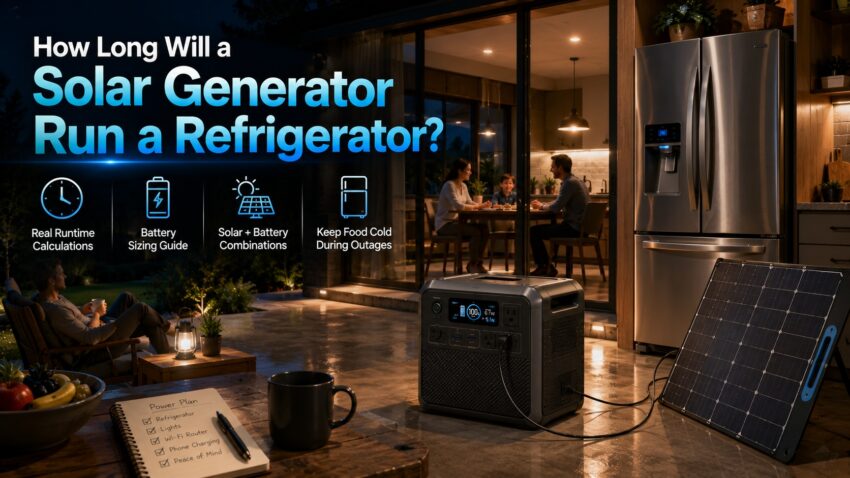
The honest answer is anywhere from 2 hours to indefinitely — and the reason for that huge range is that most online calculators skip the one factor that matters most: your refrigerator doesn’t run continuously. This guide covers the actual math, using your fridge’s real duty cycle rather than its nameplate wattage, plus a real tested example showing how solar input changes the equation entirely.
The Number Nameplate Wattage Doesn’t Tell You: Duty Cycle
A fridge rated at 150W doesn’t draw 150W continuously — the compressor cycles on and off to maintain temperature, typically running 30–50% of the time depending on the fridge’s age, efficiency, ambient temperature, and how often the door opens. This is called the duty cycle, and it’s the single biggest reason two people can plug the “same” fridge into the “same” battery and get wildly different runtime estimates.
The formula that actually matters: Rated Wattage × Duty Cycle % = Real Average Draw. A 150W fridge with a 40% duty cycle averages just 60W over a full day — less than half its nameplate rating. This is why “10 hours” and “20+ hours” estimates for the same battery and fridge combination aren’t necessarily contradicting each other; they’re often just using different duty cycle assumptions.
How to Find Your Fridge’s Actual Numbers
Check the Energy Guide label — the yellow sticker inside most US refrigerators (or in the manual) shows estimated annual kWh use. Divide by 8,760 (hours in a year) to get your fridge’s true average hourly draw, duty cycle already factored in.
Check the nameplate — usually on the back panel or inside the fridge, listing volts and amps. Multiply them together for running watts, but remember this is peak draw, not average draw across the day.
Use a Kill-A-Watt meter ($20–30) plugged in between the fridge and the wall for the most accurate real-world reading — this captures your specific fridge’s actual behavior rather than a generic estimate, including your home’s ambient temperature and how often the door gets opened.
Runtime by Battery Size — Realistic Ranges
| Battery Capacity | Fridge-Only Runtime (battery alone) |
|---|---|
| 500Wh | 2–4 hours |
| 1,000Wh | 8–20 hours (13–15 hours is a safe planning estimate) |
| 2,000Wh | 16–26+ hours |
| 3,000Wh+ | 24+ hours, often into a second day |
The wide range at every capacity level reflects real variation in fridge efficiency, age, size, and duty cycle — not calculation error. A newer, well-insulated fridge with a low duty cycle will land at the high end of its range; an older, less efficient unit or a full-size fridge with frequent door openings will land at the low end.
Don’t Forget Inverter Efficiency Losses
Every portable power station loses some energy converting stored DC battery power into the AC power a standard refrigerator needs. Real-world testing consistently shows 10–20% efficiency loss in this conversion — meaning a “1,000Wh” battery delivers closer to 800–900Wh of genuinely usable energy to your fridge. Build this into your planning rather than assuming the full rated capacity is available; it’s the difference between a comfortable estimate and an uncomfortable surprise at hour 12 of an outage.
Real Tested Example: How Solar Changes Everything
Battery-alone runtime is only half the story. Here’s a real tested scenario pairing a 1,000Wh generator with a 200W solar panel, running a 150W-rated fridge with a duty cycle bringing real average draw to roughly 67W:
- Peak sun (10am–2pm, 4 hours): Panel generates ~800Wh, the fridge uses ~268Wh over that period — the battery actually gains roughly 532Wh net during peak sun, even while powering the fridge simultaneously
- Partial sun (morning/afternoon shoulder hours): Panel output drops, but still meaningfully offsets fridge consumption rather than draining the battery at the full rate
- Overnight (no solar input): The battery draws down at the fridge’s real average rate, but starts the night with a meaningful surplus banked from the day’s solar charging
The practical result: with even a modest solar panel matched reasonably well to the fridge’s real average draw, runtime stops being a fixed number and becomes effectively indefinite — the battery recharges faster than the fridge depletes it during daylight hours, and the surplus carries through the night.
What Else Draws From the Same Battery
Every runtime estimate above assumes the fridge is the only load. In a real outage, you’re likely also running lights, a router, phone charging, and maybe a fan — each of these reduces total runtime proportionally. A rough guide for common additions:
| Additional Device | Typical Draw | Runtime Impact |
|---|---|---|
| Wi-Fi router | 10–15W | Minor — extends duty-cycle math only slightly |
| LED lighting (few bulbs) | 10–20W | Minor |
| Phone/laptop charging | 20–60W intermittent | Modest, especially with multiple devices |
| Box fan | 40–70W | Meaningful — can cut fridge-only runtime by 20–30% |
For a full sizing guide that factors in your complete household load — not just the fridge — see our solar generator for refrigerator buying guide.
Sizing Rule of Thumb
Aim for a solar generator rated at 1.5–2x your refrigerator’s calculated daily energy requirement (average watts × 24 hours). This margin accounts for real-world variability — hotter days increasing compressor duty cycle, more frequent door openings, or additional loads you hadn’t planned for — and ensures reliable performance rather than a system that just barely covers your theoretical best-case number.
Frequently Asked Questions
How long will a 1000Wh solar generator run a refrigerator?
Typically 8–20 hours on battery alone, with 13–15 hours being a realistic planning estimate once inverter efficiency losses are factored in. The wide range reflects real differences in fridge efficiency, size, and duty cycle — check your specific fridge’s Energy Guide label or use a Kill-A-Watt meter for an accurate number rather than relying on a generic estimate.
Does the fridge’s compressor really only run half the time?
Yes — most refrigerators run their compressor 30–50% of the time to maintain temperature, a pattern called the duty cycle. This is why nameplate wattage overstates actual average power draw significantly; a 150W-rated fridge might only average 60–90W across a full day depending on its specific duty cycle.
Can solar panels really make a refrigerator run indefinitely during an outage?
Yes, if the panel’s output reasonably matches or exceeds the fridge’s real average draw during daylight hours. In a real tested example, a 200W panel paired with a fridge averaging 67W produced a net battery surplus during peak sun — meaning the system recharges faster than the fridge depletes it, extending runtime well beyond what the battery alone could sustain.
Why do different runtime calculators give me completely different answers?
Almost always because they’re using different duty cycle assumptions, or one of them is using nameplate wattage as if it were continuous draw rather than peak draw. A calculator using 40% duty cycle and one assuming continuous 100% draw for the same fridge will produce answers that differ by more than double — check whether the tool you’re using accounts for cycling behavior at all.
What’s a safe margin when sizing a solar generator for a refrigerator?
Aim for 1.5–2x your refrigerator’s calculated daily energy requirement (real average watts × 24 hours), not just enough to theoretically cover it exactly. This margin absorbs real-world variability — hotter weather increasing duty cycle, more frequent door openings, or unplanned additional loads — without leaving you short during an actual outage.
The Bottom Line
The honest range for how long a solar generator runs a refrigerator is wide because refrigerators themselves are variable — duty cycle, age, size, and ambient conditions all matter more than the single number on the nameplate. Calculate your fridge’s real average draw using its Energy Guide label or a Kill-A-Watt meter, budget for 10–20% inverter losses, and size your battery at 1.5–2x your calculated daily need. Add even a modest solar panel, and the math shifts from “how many hours until it dies” to “does this recharge faster than it depletes” — the more useful question during an actual extended outage.
For specific product recommendations sized to refrigerator use, see our best solar generator for refrigerator guide. For pairing the right solar panel to your setup, our 200 watt solar panel guide and solar panels for off-grid living guide cover panel sizing in detail.