This post contains affiliate links. If you buy through our links we may earn a small commission — at no extra cost to you. This never influences our recommendations.
Off-grid living runs on three things: panels, batteries, and wiring. Get the panels right and everything downstream becomes easier. Get them wrong — undersized, wrong voltage, poor quality — and no amount of battery storage fixes it. This guide covers how to choose the right panels for an off-grid setup, how to size your array accurately, and which panels are worth buying on Amazon right now.
What “Off-Grid” Actually Means for Solar Panel Selection
Grid-tied solar sends excess power back to the utility grid. Off-grid solar stores every watt in batteries — which changes the requirements significantly.
Off-grid panels need: higher output reliability (no grid backup on cloudy days), lower temperature coefficient (maintains output in heat), compatibility with MPPT charge controllers, and a 25-year performance warranty minimum. Panel wattage matters less than daily energy production — a 400W panel in a poor location underperforms a 300W panel angled correctly.
The other key difference: off-grid systems are usually 12V, 24V, or 48V battery banks. The panel’s operating voltage (Vmp) must be compatible with your charge controller’s input range. N-Type panels at 24V output give MPPT controllers more efficient conversion headroom — another reason the 24V N-Type Renogy panels dominate this category.
How Much Solar Do You Need for Off-Grid Living?
Start with your real daily energy use — not a guess. Add up your actual loads:
| Load | Typical Draw | Daily Use | Daily Wh |
|---|---|---|---|
| 12V compressor fridge | 40–50W | 24 hrs cycling | 480–600Wh |
| LED lighting (5 bulbs) | 25–40W | 5 hrs | 125–200Wh |
| Laptop | 45–65W | 6 hrs | 270–390Wh |
| Phone charging (2×) | 20W | 2 hrs | 40Wh |
| Starlink (portable mode) | 65–75W | 8 hrs | 520–600Wh |
| Water pump (12V) | 60–80W | 0.5 hrs | 30–40Wh |
Add your loads, then divide by your location’s average peak sun hours (4–6 for most of the US). That gives you the raw panel wattage needed. Always add 25–30% safety margin for cloudy days, panel aging, and wiring losses. A system that barely covers sunny-day loads will leave you flat in winter.
Quick reference by lifestyle:
| Off-Grid Setup | Daily Load | Recommended Array | Battery Bank |
|---|---|---|---|
| Shed / workshop | 300–600Wh | 200–400W | 100Ah LiFePO4 |
| Cabin (basic) | 600–1,200Wh | 400–600W | 200Ah LiFePO4 |
| Cabin (fridge + Starlink) | 1,200–1,800Wh | 600–800W | 300–400Ah LiFePO4 |
| Full-time off-grid home | 3,000–8,000Wh | 2,000–5,000W+ | 10–30kWh battery bank |
N-Type vs P-Type Panels — Why It Matters More Off-Grid
Most panels sold five years ago used P-Type cells. N-Type (TopCon) is the current performance standard — and for off-grid use, the differences are meaningful.
N-Type advantages: 25% efficiency vs 22–23% for PERC, lower temperature coefficient (less output loss on hot days), lower degradation (≤0.4%/year vs ≤0.7% for P-Type), and 30-year rated lifespan vs 25 years. For a fixed off-grid array you’re counting on for decades, N-Type is the better long-term investment. The price premium over PERC has narrowed significantly — most quality 200W N-Type panels are now within $20–30 of equivalent PERC models.
See our 200 watt solar panel guide and 300 watt solar panel guide for detailed specs and comparisons across the most common off-grid wattages.
Best Solar Panels for Off-Grid Living — Verified Picks
| Product | Type | Efficiency | Voltage | Best For |
|---|---|---|---|---|
| Renogy 200W N-Type 16BB | Rigid mono N-Type | 25% | 12V/24V | Best single panel, most versatile |
| Renogy 2×100W N-Type 16BB | Rigid mono N-Type | 25% | 12V | Best starter array, shed/cabin entry point |
| Renogy 400W N-Type (2×200W) | Rigid mono N-Type | 25% | 24V | Best for serious off-grid builds, 24V systems |
| Renogy 200W E.Flex Portable | Foldable mono N-Type | 25% | 12V/USB | Best portable, temporary setups |
Best Single Panel: Renogy 200W N-Type 16BB Rigid
The most versatile off-grid panel available on Amazon. N-Type 16BB cells at 25% efficiency, compatible with both 12V and 24V systems, and backed by Renogy’s ecosystem of MPPT charge controllers, mounting hardware, and wiring kits. That ecosystem matters — fewer compatibility questions, well-documented wiring diagrams, and widely available replacement parts.
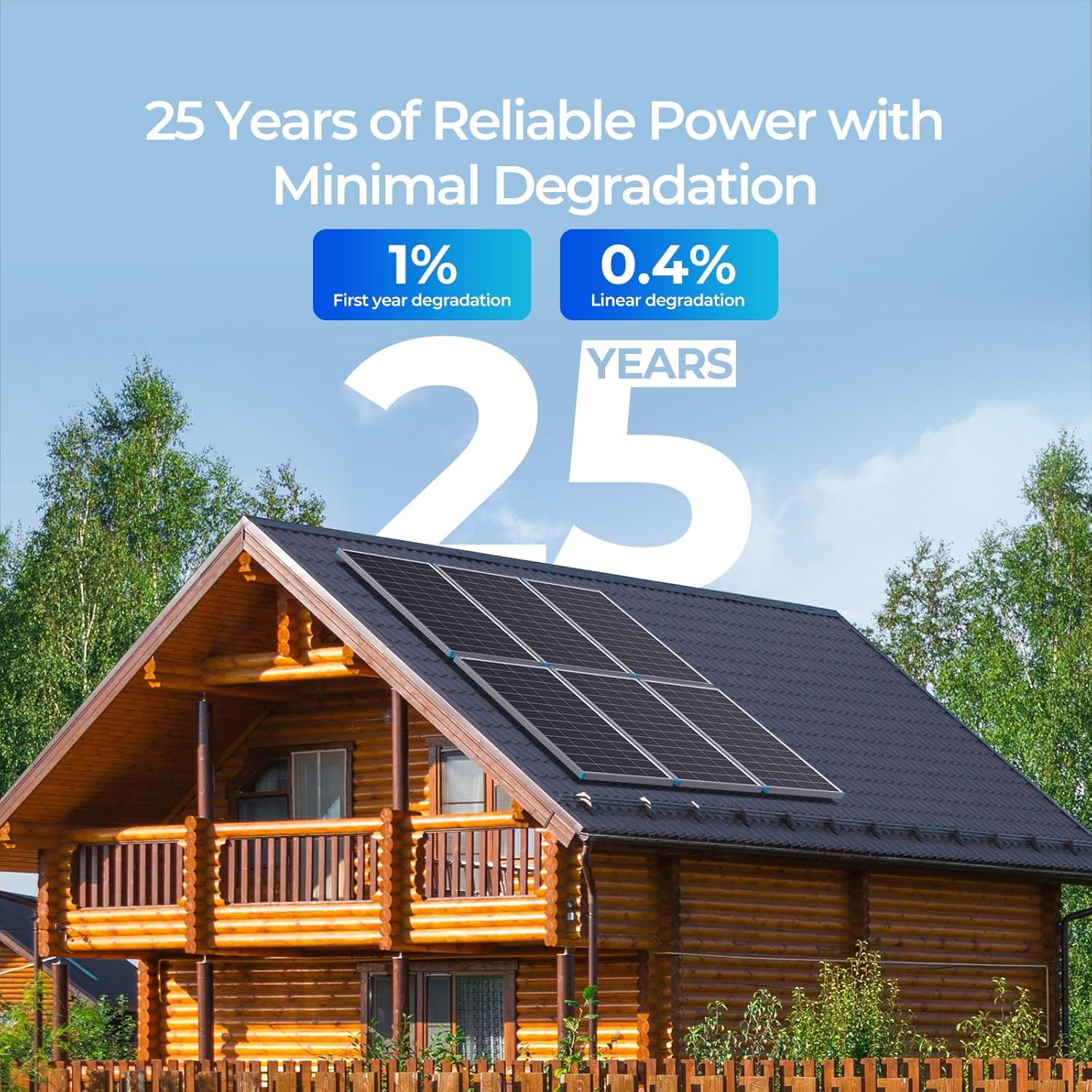
IP65 junction box, corrosion-resistant aluminium frame, and an operating temperature range of -40°F to 176°F. The 25-year performance guarantee (80% output at year 25, ≤0.4% annual degradation) is the strongest in this price range. For anyone building a DIY off-grid cabin or homestead system, this is the panel most YouTube builds and forum guides are designed around for a reason.
Pros: 25% N-Type efficiency, 12V/24V compatible, deep Renogy ecosystem support, 25-year output guarantee, IP65
Cons: Single panel — for larger arrays you’ll order multiple units, which adds shipping cost vs a 2-pack
Best for: DIY builders expanding an array panel by panel, 12V or 24V systems, anyone who wants the most documented off-grid panel on the market
Best Starter Array: Renogy 2×100W N-Type 16BB
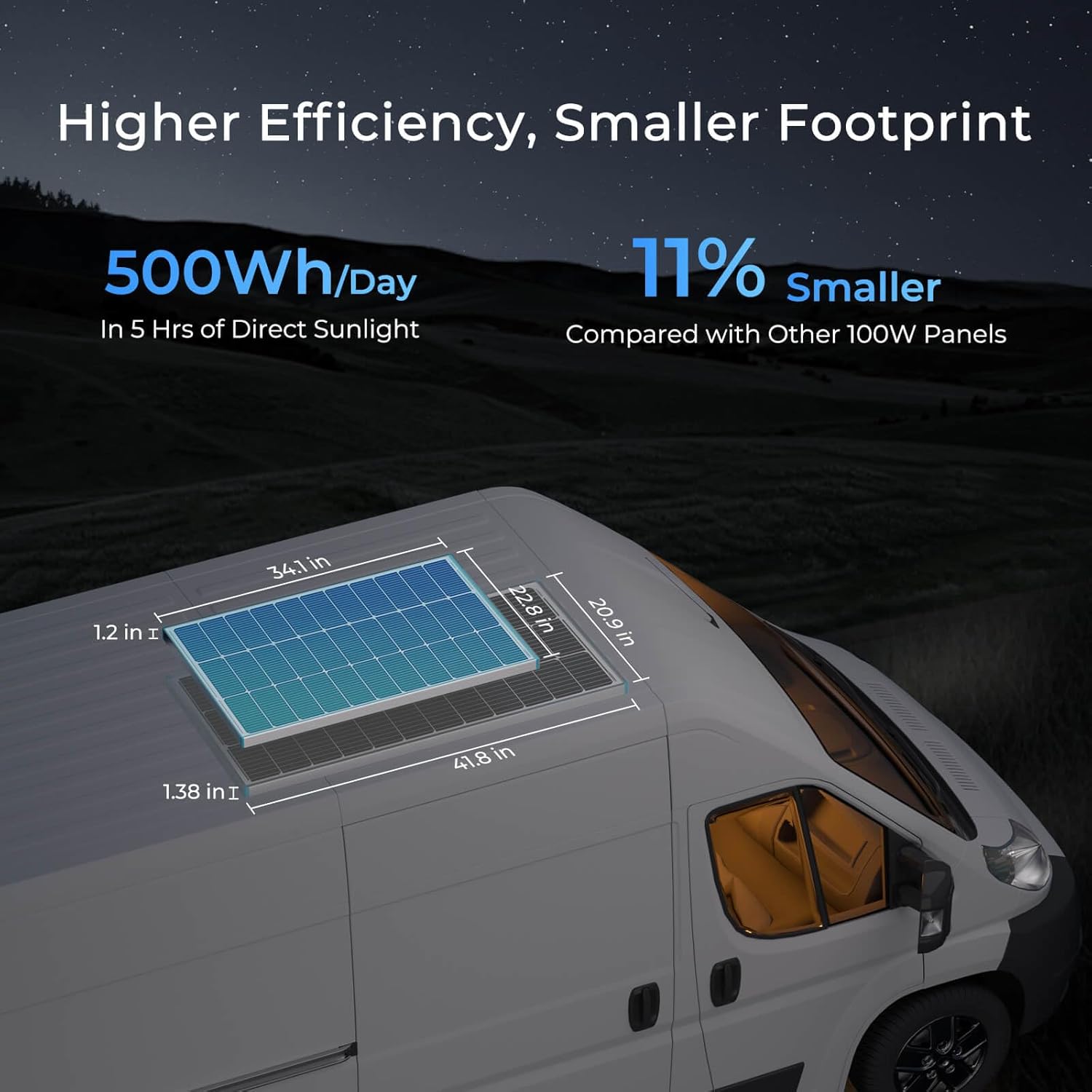
Two 100W N-Type panels in one purchase — the cleanest starting point for a shed, small cabin, or first off-grid system. Both panels are 25% efficiency N-Type with the same IP65 and 25-year guarantee as the 200W single panel. Wired in series, they produce a 24V array; in parallel, 12V with doubled current. This gives you sizing flexibility before you commit to a larger build.
The 2-pack pricing is more economical per watt than buying two singles, and the matched pair ensures balanced output. Add a 30A MPPT charge controller and a 100Ah LiFePO4 battery and you have a complete shed or workshop system for around $500 total — the most practical entry point into off-grid solar without overbuilding from the start.
Pros: 25% N-Type efficiency, economical 2-pack pricing, flexible series/parallel wiring, 12V or 24V compatible
Cons: 200W total — not enough for a fridge + Starlink combo without adding more panels
Best for: Sheds, workshops, first off-grid system, anyone who wants to start small and expand incrementally
Best for Serious Off-Grid Builds: Renogy 400W N-Type (2×200W)
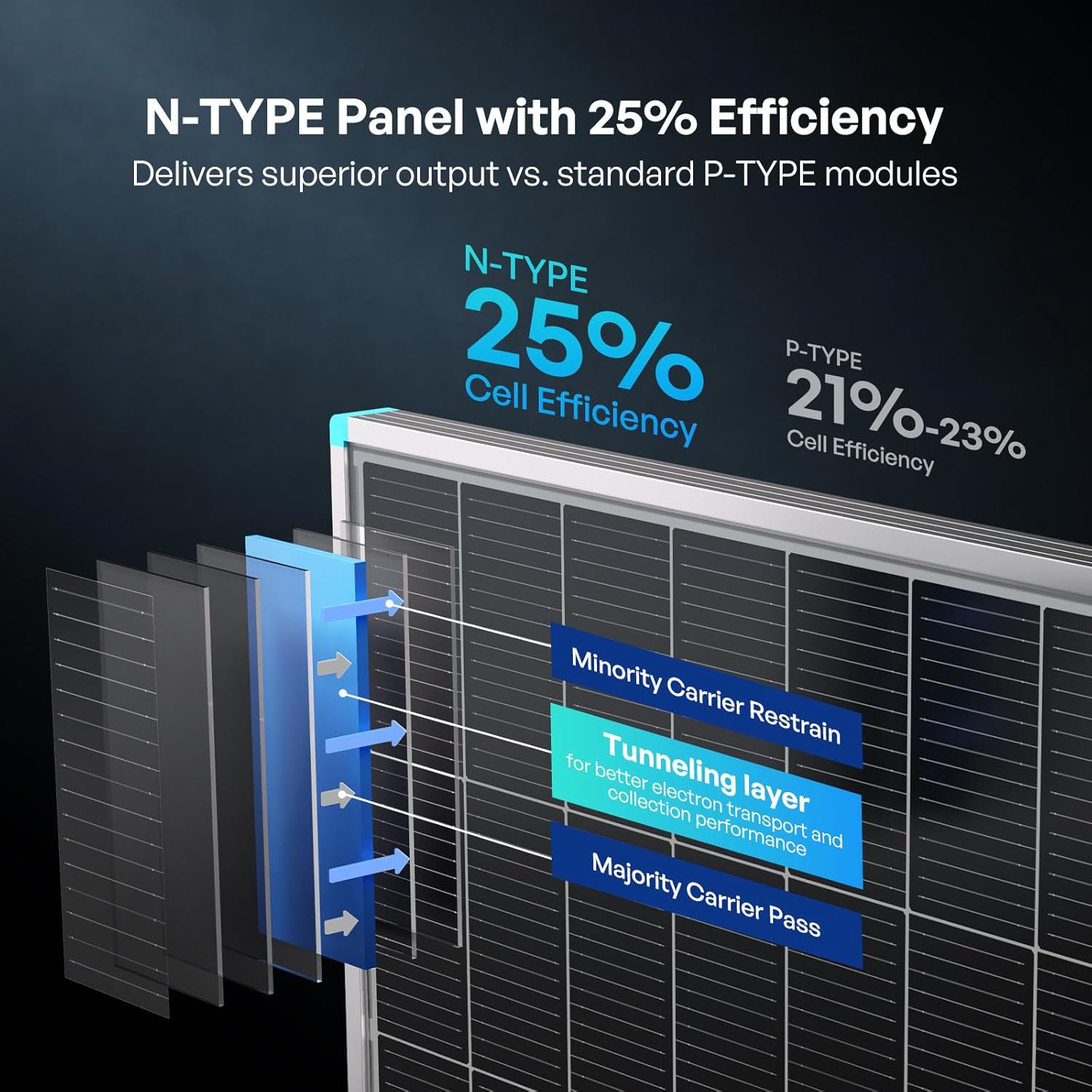
Two 200W N-Type 16BB panels at 25% efficiency, designed for 24V systems. This is the right starting point for a cabin with a fridge, lighting, device charging, and internet — the core off-grid load stack. Wired in series for 48V input to a quality MPPT controller, you can run a 24V or 48V battery bank with clean, efficient charging.
At 400W in 4–5 peak sun hours, expect 1,400–1,800Wh of usable daily energy after system losses — enough to cover the full cabin load table above with a reasonable buffer. Pair with 200Ah of LiFePO4 storage for two days of autonomy in cloudy conditions. For system design around this array, see our off-grid solar system guide.
Pros: 25% N-Type efficiency, 400W in two panels simplifies mounting and wiring vs four 100W panels, low degradation ≤0.4%/year, 25-year guarantee
Cons: 24V output — requires charge controller rated for 24V input
Best for: Cabin builds with full daily loads, homesteaders, anyone building a proper off-grid system from the ground up
Best Portable: Renogy 200W E.Flex Foldable
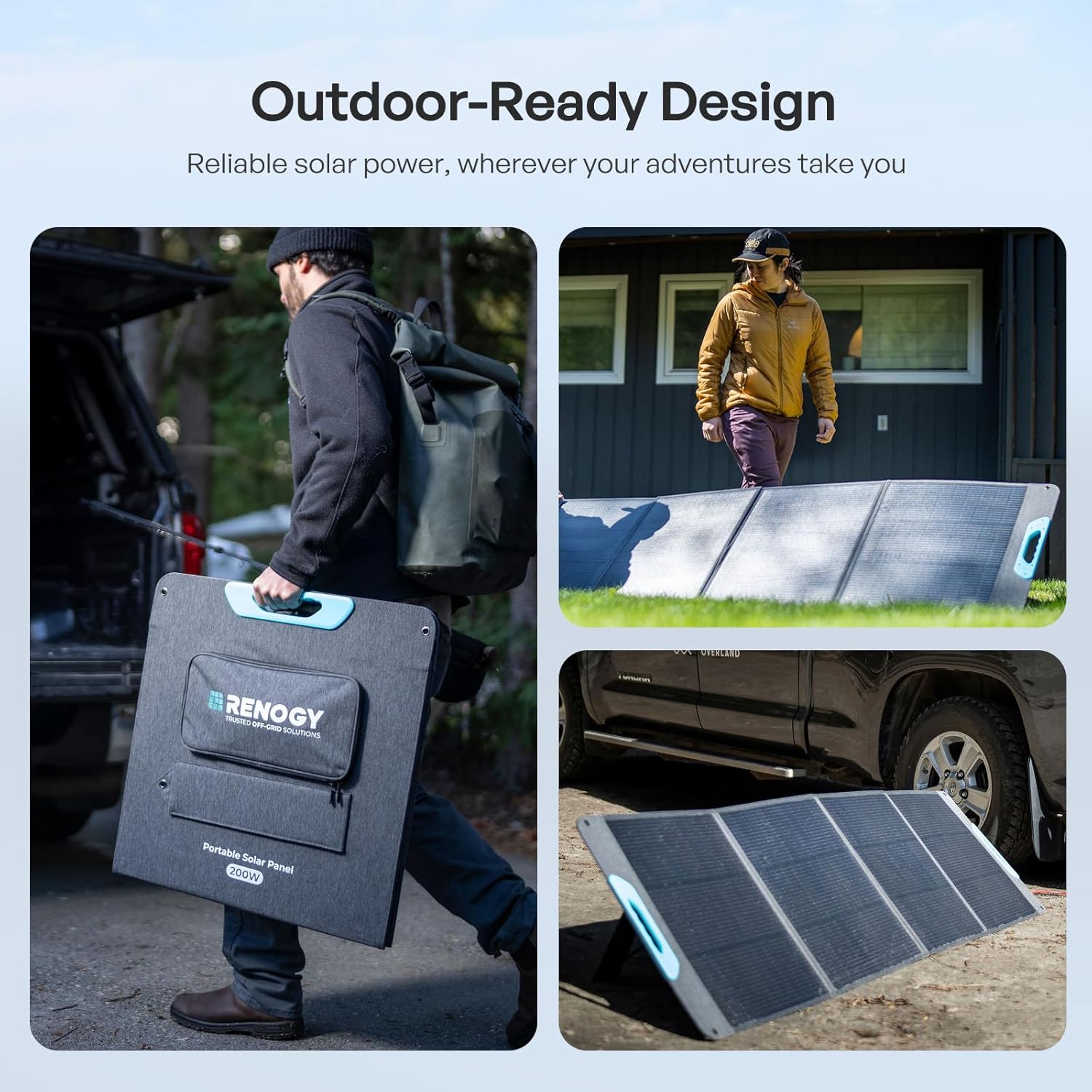
For off-grid setups that move — seasonal cabins, hunting camps, overlanding rigs, or temporary power before a permanent array is installed — the E.Flex 200W is the best portable panel at this wattage. At 13.89 lbs it’s the lightest 200W foldable panel on the market, with N-Type 16BB cells hitting 25% efficiency. Built-in USB-C PD (45W) and USB-A ports mean you can charge devices directly without a power station.
Four adjustable kickstands allow 3-angle positioning (40°/50°/60°) to track the sun through the day — a real output advantage over a panel laid flat. MC4 output means it connects to any MPPT charge controller or compatible power station. UL 61730 certified. For a permanent off-grid home, rigid panels are the better long-term investment. For everything else, this is the one.
Pros: 25% N-Type efficiency, lightest 200W foldable at 13.89 lbs, USB-C PD + USB-A + MC4 outputs, adjustable kickstands, UL 61730 certified
Cons: 2-year warranty only vs 25-year for rigid panels, not suited for permanent fixed installation
Best for: Seasonal cabins, overlanding, temporary off-grid setups, charging power stations
The Components You Need Beyond the Panels
Panels are one part of a complete off-grid system. Every setup also needs:
MPPT Charge Controller — converts the panel’s DC output to the correct charging voltage for your battery bank. Always use MPPT (not PWM) with N-Type panels — PWM wastes 20–30% of potential output. Size the controller for your total panel wattage plus a 25% safety margin. See our MPPT charge controller guide for sizing tables.
Battery Bank — LiFePO4 (lithium iron phosphate) is the right choice for new off-grid builds. 100% depth of discharge vs 50% for AGM, longer lifespan (3,000–5,000 cycles vs 500–800), and lighter weight. The extra upfront cost pays back within 2–3 years of use. See our solar battery guide for capacity sizing.
Inverter — converts DC battery power to 120V AC for standard appliances. Size the inverter for your largest simultaneous AC loads, not your average. A 1,000–2,000W pure sine wave inverter covers most cabin loads.
Wiring and Fusing — undersized wire is a fire risk and an efficiency loss. Use the cable sizing table in our off-grid solar system guide to match wire gauge to current and run length. Every circuit needs a correctly rated fuse or circuit breaker.
Panel Placement and Angle — Where Most Off-Grid Builds Lose 20% of Their Output
A misaligned panel can cost you 15–25% of daily production year-round — more than the efficiency difference between a cheap PERC panel and an N-Type. Get placement right before spending money on more panels.
Tilt angle: In the US, the optimal fixed tilt angle equals your latitude. For a cabin in Colorado (latitude ~40°), tilt panels at 40° from horizontal. Most ground mounts allow adjustment — tiltier in winter (add 15°), flatter in summer (subtract 15°) for a meaningful seasonal gain.
Orientation: Face panels true south (not magnetic south). Use a compass app adjusted for magnetic declination — the error varies by location and can be 5–20°.
Shading: Even partial shading of one panel in a series string collapses the output of the entire string. Map shadow patterns through the day in all seasons before mounting. A small obstruction in the wrong spot costs more output than you’d expect.
Frequently Asked Questions
How many solar panels do I need to live off-grid?
It depends entirely on your daily energy use and location’s peak sun hours. A basic off-grid cabin (fridge, lighting, devices) in a 5 peak sun hour location typically needs 400–600W of panels and 200Ah of LiFePO4 storage. A full-time off-grid home with all modern appliances (except AC and electric heat) needs 2,000–4,000W of panels and a substantial battery bank. Use the load table above to calculate your specific needs before buying.
Can I run a house completely on solar panels off-grid?
Yes — but high-draw appliances like electric heating, central air conditioning, and electric water heaters require very large arrays and battery banks that become expensive quickly. Most successful off-grid homes use propane or wood for heating and cooking, and solar for everything else. This keeps the required solar array in a realistic size and cost range.
Are rigid or portable solar panels better for off-grid living?
Rigid panels are better for permanent off-grid homes and cabins — they last 25+ years, cost less per watt, and produce more consistent output from a fixed optimal angle. Portable panels are ideal for temporary setups, seasonal camps, and supplemental charging. For most off-grid builds, start with rigid panels on a ground mount or roof and add a portable panel for flexibility if needed.
What’s the difference between 12V and 24V solar panels for off-grid use?
12V panels are simpler for small systems and direct battery charging. 24V panels produce higher voltage, which reduces current losses on long wire runs between panels and the charge controller — a real advantage on larger arrays where the controller is mounted away from the panels. Most serious off-grid builds use 24V or 48V battery banks for efficiency reasons. Check your charge controller’s input voltage range before buying.
Do solar panels work in winter and cloudy weather off-grid?
Yes, but output drops significantly — typically to 10–30% of rated wattage under heavy overcast. Winter off-grid planning should account for shorter days, lower sun angle, and potential snow coverage. The standard approach is to oversize your solar array by 25–30% beyond your average daily needs, and size your battery bank for 2–3 days of autonomy without sun. In severe winter climates, a backup generator is standard practice for bridging extended overcast periods.
Final Verdict
| Your Situation | Best Pick |
|---|---|
| Best single rigid panel, most versatile | Renogy 200W N-Type 16BB (B08CRJYJ22) |
| Best starter array — shed or small cabin | Renogy 2×100W N-Type 16BB (B0DG5TXGJ3) |
| Best for full cabin builds, 24V system | Renogy 400W N-Type 2×200W (B0DSG3J7TW) |
| Best portable / seasonal / temporary | Renogy 200W E.Flex Foldable (B0CNPHD4VY) |
For most people starting an off-grid build, the Renogy 2×100W N-Type is the cleanest entry point — 25% efficiency, expandable, and priced right for a first system. For a cabin with real daily loads, the Renogy 400W 2×200W gets you to a viable energy budget in two panels. For flexible or temporary setups, the Renogy E.Flex 200W portable is the best foldable at this wattage.
For complete system design — charge controller sizing, battery selection, wiring, and component pairing — see our off-grid solar system guide. For side-by-side wattage comparisons, our 100W, 200W, and 300W solar panel guides cover the options in detail.