This post contains affiliate links. If you buy through our links we may earn a small commission — at no extra cost to you. This never influences our recommendations.
What Can a 100 Watt Solar Panel Actually Power?
The 100W solar panel is the most popular entry point into solar — and the most commonly misunderstood. Before comparing specific products, the most useful thing is understanding what 100W of solar actually delivers in real conditions.
Daily output (Wh) = Panel wattage × Peak sun hours × System efficiency
For a 100W panel in 5 peak sun hours at 80% efficiency: 100W × 5 × 0.80 = 400Wh per day.
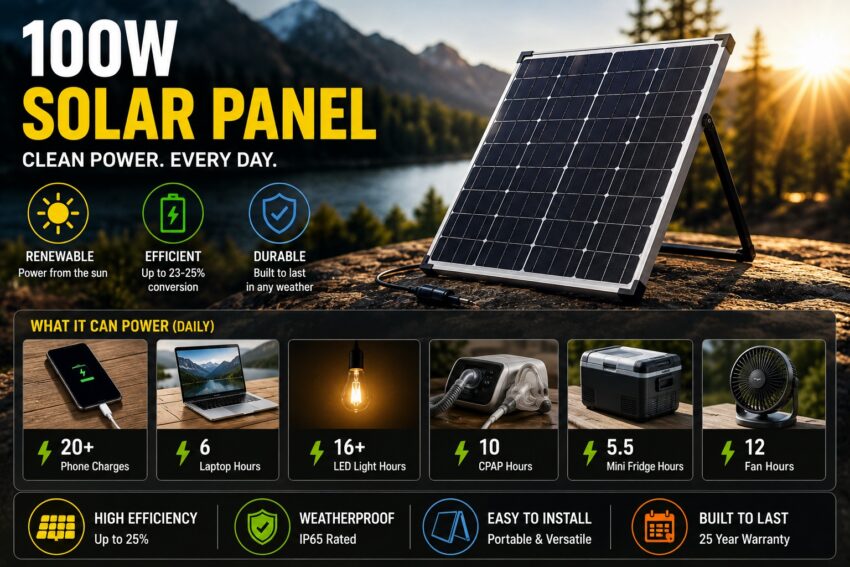
| Appliance | Draw | Runtime from 400Wh |
|---|---|---|
| Smartphone full charges | 15W | 20+ charges |
| Laptop (14-inch) | 45W | ~6 hours |
| LED lighting | 20W | 16+ hours |
| CPAP (no humidifier) | 30W | ~10 hours |
| Mini fridge (12V) | 45W avg | ~5.5 hours |
| Small fan | 25W | ~12 hours |
The honest picture: A single 100W panel covers light daily use for one person — device charging, lighting, and a CPAP. It cannot run a 12V camping fridge all day without depleting the battery overnight. For a fridge plus other loads, 200W is the practical minimum. Our 200 watt solar panel guide covers that next tier.
100W Solar Panel Output — Real-World vs. Rated
The “100 watts” rating is the panel’s output under Standard Test Conditions (STC) — 1,000W/m² irradiance, 25°C cell temperature. Real outdoor conditions are never precisely STC. Independent testing shows real-world output ranges from 65–75W in ideal conditions — approximately 70–75% of rated output. Budget panels tend toward the lower end; premium N-Type panels achieve the higher end. In cloud cover, expect 20–40W.
Temperature coefficient matters more than most buyers realise. Standard P-Type PERC panels lose approximately 0.35%/°C above 25°C. At 60°C cell temperature (common on a black RV roof in summer), a PERC panel loses approximately 12% of rated output. Renogy’s N-Type panels have a temperature coefficient of -0.29%/°C — losing approximately 10% at the same temperature. Independent monitoring confirmed Renogy’s N-Type 100W showed only 2.3% output loss after 18 months, compared to 8–12% for budget panels over the same period. See our how long solar panels last guide for the full degradation picture.
100W Solar Panel Formats — Choosing the Right Type
Rigid monocrystalline (most common): Aluminium-framed glass panels — most efficient, most durable, lowest cost per watt. Best for permanent roof installations on RVs, vans, cabins, and sheds. Standard 100W rigid panel dimensions: approximately 42″×20″×1.4″.
Foldable / portable: ETFE-laminated panels that fold for transport and deploy on kickstands. Higher cost per watt but genuinely portable — fold into a backpack or behind a car seat. Best for camping and power station charging.
Flexible panels: Ultra-thin panels that conform to curved surfaces — ideal for RV roofs with compound curves or van roofs where a rigid frame won’t sit flat. Covered in our flexible solar panels guide.
100W kit (panel + controller): Panel, charge controller, mounting hardware, and cables in one box. Simplest path to a working system for first-time buyers.
Key Specs — What Actually Matters at 100W
N-Type vs. P-Type cells: N-Type panels deliver 25% efficiency vs 22% for PERC, with no LID (Light-Induced Degradation), lower temperature coefficient, and slower degradation. Renogy’s N-Type 100W is also 11% smaller than an equivalent PERC panel — a genuine benefit on space-constrained van and RV rooftops.
16BB busbars: 16 busbars reduce resistive losses, improve low-light performance, and reduce microcrack propagation from mechanical stress — particularly important for panels on vehicles that vibrate.
Charge controller compatibility: A 100W panel typically has Voc of 22–24V and Vmp of 18–21V. Verify your controller’s maximum PV input voltage exceeds the panel’s Voc before connecting. See our MPPT charge controller guide for complete compatibility tables.
The Best 100 Watt Solar Panels on Amazon — Verified Picks
| Product | Cell Type | Efficiency | Format | Best For | Price |
|---|---|---|---|---|---|
| Renogy 100W N-Type 16BB (rigid) | N-Type mono | 25% | Rigid | Best efficiency, permanent install | ~$80–$90 |
| Renogy 100W E.Flex Foldable | N-Type 16BB | 25% | Foldable | Best portable, camping, power stations | ~$120–$150 |
| ECO-WORTHY 100W | Mono PERC | 22% | Rigid | Best budget, first system | ~$55–$65 |
| Jackery SolarSaga 100W | ETFE mono | 23.7% | Foldable | Jackery ecosystem, camping | ~$100 |
Renogy 100W N-Type 16BB Solar Panel — Best Rigid 100W Panel
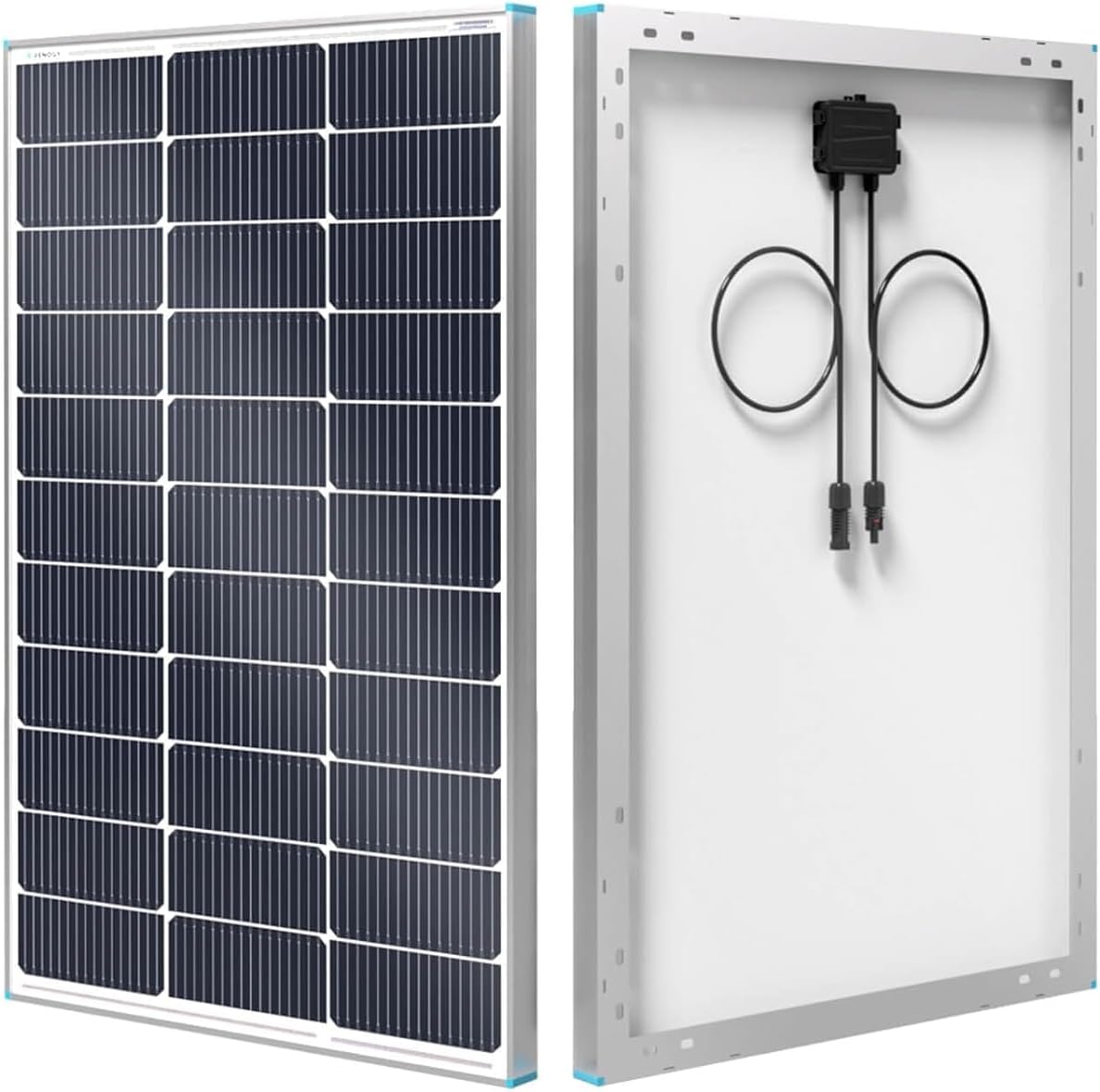
The Renogy 100W N-Type is the current benchmark for rigid 100W panels, replacing the previous PERC model with a meaningful technology upgrade. Featuring Grade A+ N-type solar cells achieving 25% conversion efficiency — delivering 20W more power output compared to standard PERC panels of the same design. The 16BB cell technology enhances photoelectric conversion while minimising hot spots and hidden cracks for a longer service life.
Independent testing confirms the real-world numbers: in 95°F weather, while cheaper panels were losing 25% efficiency, the Renogy maintained approximately 82% of its peak output — the low temperature coefficient of -0.29%/°C isn’t just marketing. After 18 months of monitoring, it showed only 2.3% output loss compared to 8–12% for budget panels tested over the same period. The N-Type 100W is also 8% lighter and 11% smaller than an equivalent PERC 100W panel — a genuine benefit for space-constrained RV and van rooftops. The 25-year output warranty (80% performance guarantee) is among the strongest in the consumer panel market.
Pros: 25% N-Type efficiency, 16BB technology, 11% smaller footprint than PERC, 2.3% degradation in 18-month independent test, 25-year output warranty, IP65, ~$80–$90
Cons: Panel only — controller, wiring, and mounting hardware sold separately; IP65 (not IP67 for marine)
Best for: RV rooftop, cabin, shed, van, and any fixed installation where maximum watts-per-square-foot and long-term durability matter
Renogy 100W E.Flex Foldable Solar Panel — Best Portable 100W Panel
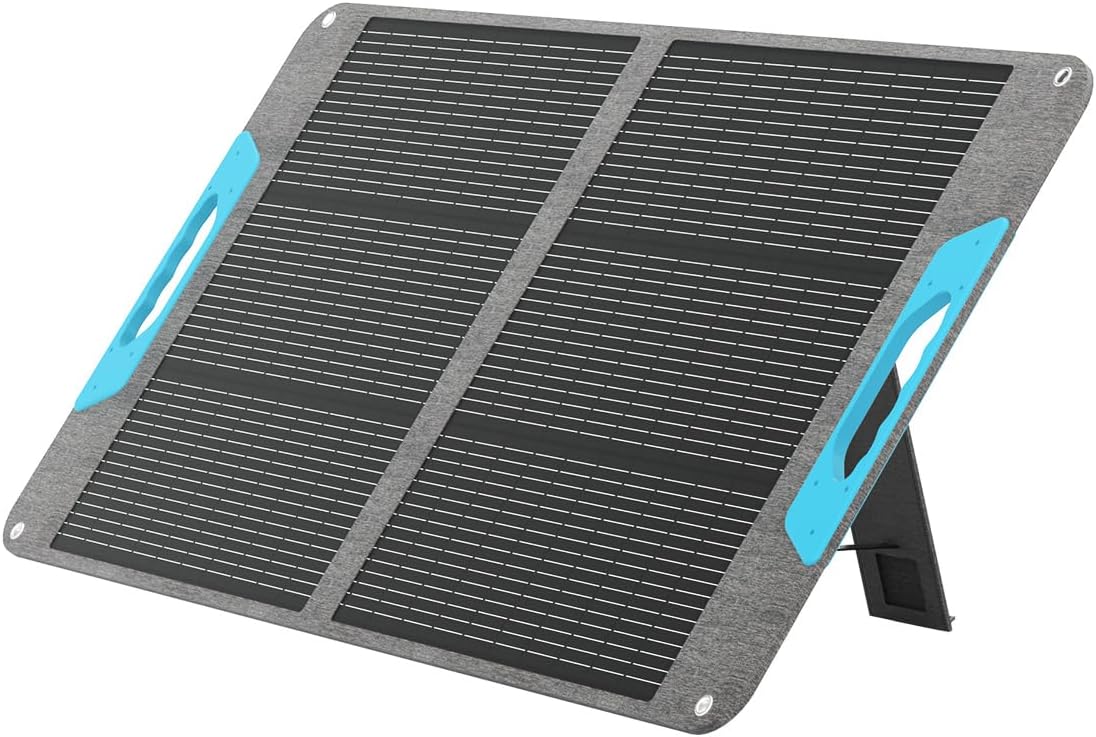
The Renogy E.Flex 100W foldable features 16BB N-Type cell technology at 25% efficiency, weighs only 7.28 lbs — the lightest in its class — and packs down to backpack size at 22.99×22.54×1.57 inches. The unique magnetic closure design makes setup and storage far easier than traditional snap or Velcro folding designs. Three simultaneous charging outputs: USB-C PD (45W max) and two USB-A ports (18W and 15W), plus MC4 output to charge power stations or 12V battery systems. The four kickstands adjust to three angles (40°/50°/60°) for optimal solar capture. UL 61730 certified, CE and RoHS compliant, IP65.
At 7.28 lbs with magnetic closure and direct 45W USB-C output, the E.Flex is the most practical portable 100W panel available — lighter and more elegantly designed than the Jackery SolarSaga 100W at a comparable price. The direct USB-C 45W output means you can charge a laptop without a power station as an intermediary.
Pros: 25% N-Type efficiency, lightest 100W foldable (7.28 lbs), magnetic closure, USB-C 45W + USB-A direct charging, MC4 for power station/battery, 3-angle kickstands, IP65, UL certified
Cons: 2-year material warranty (shorter than rigid’s 25-year output warranty), higher cost per watt than rigid panels
Best for: Camping, van life, portable power station charging (EcoFlow, Jackery Explorer 300/500), anyone who needs the panel to travel with them
ECO-WORTHY 100W Monocrystalline — Best Budget Rigid Panel
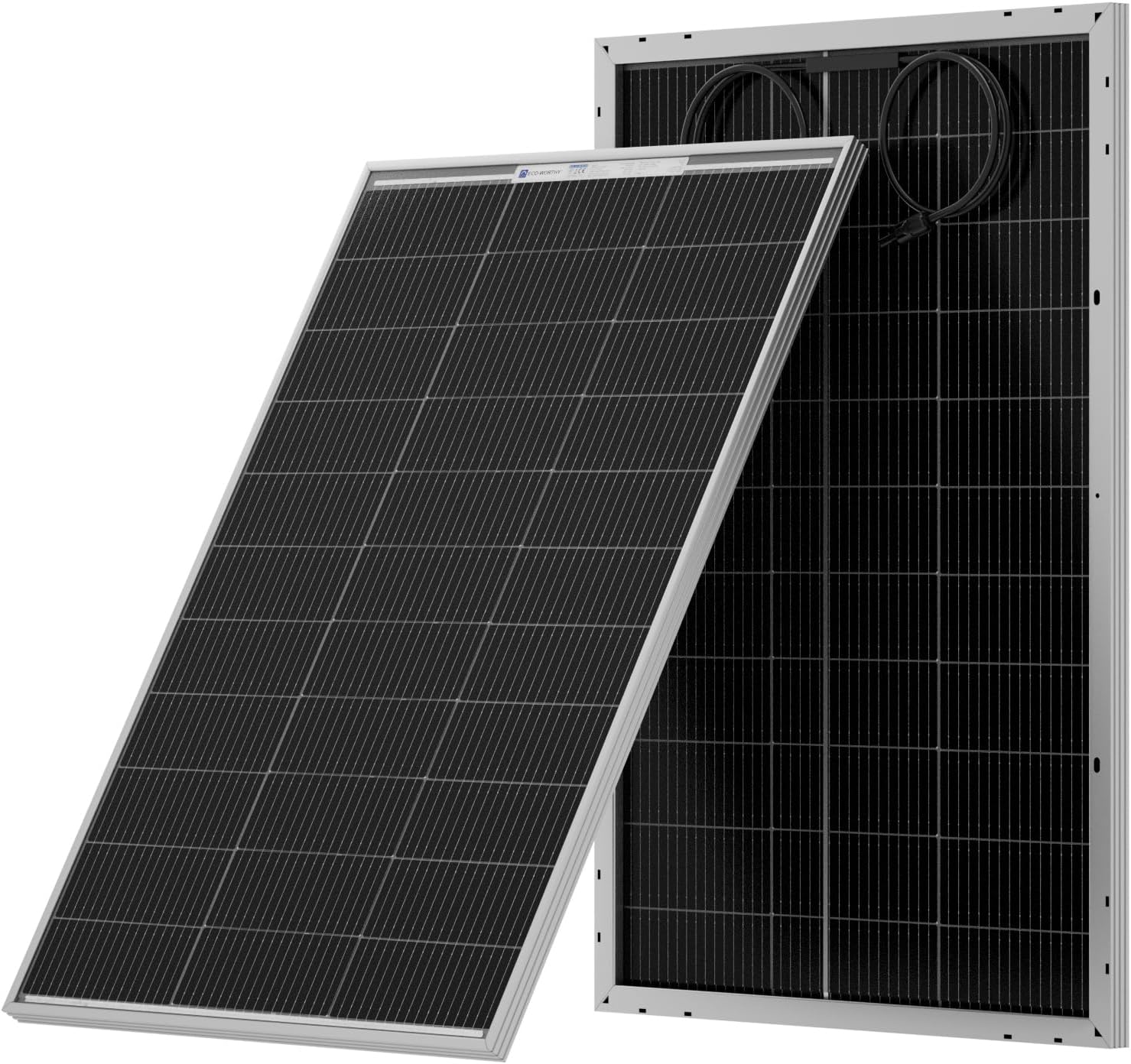
At ~$55–$65, the ECO-WORTHY 100W panel delivers a working 100W solar installation at the lowest credible price point. ECO-WORTHY is a legitimate solar manufacturer — their panels appear consistently in independent comparison articles as the recommended budget option, with actual measured output that tracks reasonably close to rated spec. The 22% PERC efficiency means slightly larger physical dimensions than the Renogy N-Type for the same output — approximately 47″×21″ versus the Renogy’s 40″×22″.
The 12-month warranty is the most significant honest limitation. Renogy’s equivalent carries a 25-year output warranty — ECO-WORTHY’s 12-month coverage is short for a component intended to last 25+ years. For a starter system where you want to experiment with solar at minimal cost before committing to a larger installation, ECO-WORTHY makes sense. For a system intended to run for a decade, the Renogy N-Type’s warranty terms justify the $20–$25 premium.
Pros: Best price at ~$55–$65, ECO-WORTHY brand reliability, 22% efficiency, IP65, adequate for basic 12V charging systems
Cons: 12-month warranty (significantly shorter than Renogy), slightly lower efficiency means larger size, older PERC technology
Best for: Budget-first buyers, first solar experiments, shed lighting, supplemental panel additions
Jackery SolarSaga 100W — Best for the Jackery Ecosystem
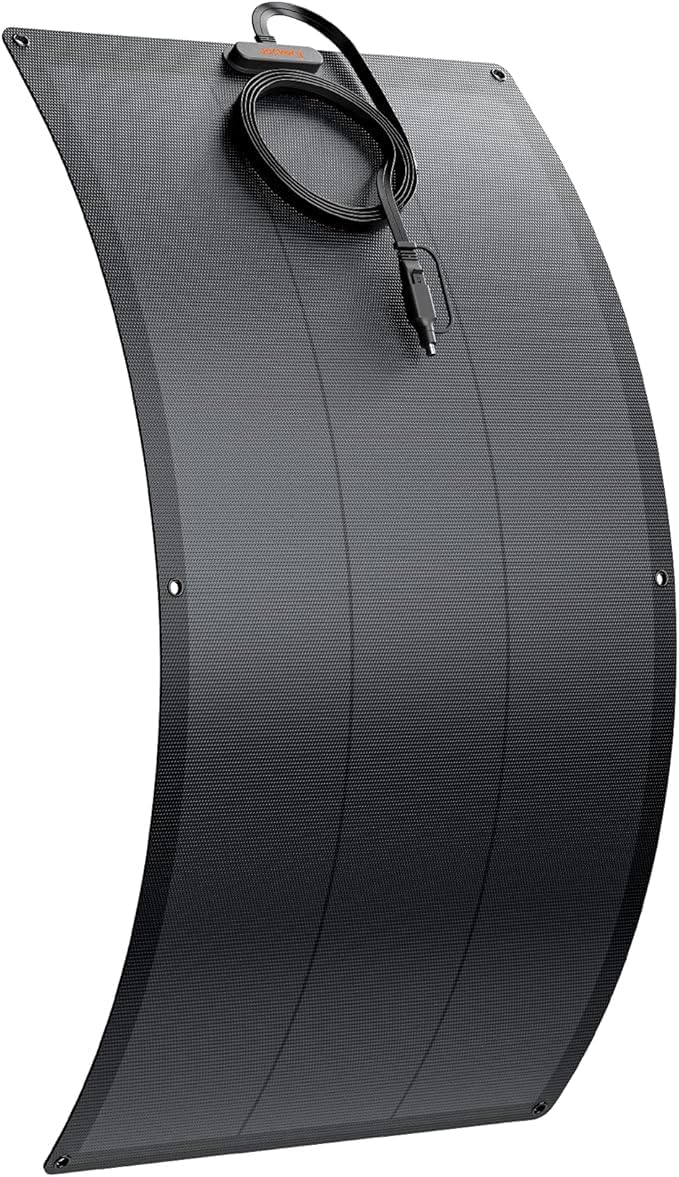
The Jackery SolarSaga 100W is the most compatible panel for Jackery Explorer power stations — Anderson connector for direct plug-and-play connection to Explorer 300, 500 v2, and 1000 v2 without adapters. At 23.7% efficiency, IP65, and ~$100, it’s positioned between the ECO-WORTHY and the Renogy N-Type foldable. For buyers already in the Jackery ecosystem, it’s the no-adapter guaranteed-compatible option. For buyers without a Jackery power station, the Renogy E.Flex provides superior performance (25% vs 23.7%), lighter weight, and better direct device charging.
Important compatibility note: The SolarSaga 100W is available in multiple versions — the original (B07Q71LX84), Bifacial (B0D5CCY5Y2), and Air (B0FX8P4JST). The Air is NOT compatible with Explorer 300/300 v2. See our Jackery solar panel guide for the complete compatibility table before purchasing.
Pros: Plug-and-play with Jackery Explorer power stations, 23.7% efficiency, foldable with kickstands, USB-A + USB-C direct output, Jackery warranty and ecosystem support
Cons: Higher cost than ECO-WORTHY, lower efficiency than Renogy N-Type, Air version incompatible with Explorer 300/300 v2
Best for: Jackery Explorer 300, 500 v2, and 1000 v2 owners who want the simplest compatible panel
How to Size a 100W Solar System
Step 1 — Confirm 100W meets your daily load
Total daily consumption ÷ (peak sun hours × 0.80) = required panel wattage.
If your daily load is 350Wh and you have 5 peak sun hours: 350 ÷ 4 = 87.5W → one 100W panel covers this comfortably.
If your daily load is 600Wh: 600 ÷ 4 = 150W minimum → two 100W panels or step up to 200W.
Step 2 — Size the battery
For 1 day of autonomy: 400Wh ÷ 0.95 = 420Wh minimum → one 50Ah 12V LiFePO4 (600Wh).
For 2 days: 800Wh → one 100Ah 12V LiFePO4 (1,280Wh).
See our solar battery guide for full sizing and product recommendations.
Step 3 — Choose the charge controller
Single 100W panel at 12V: Renogy Rover 20A MPPT handles up to 240W at 12V — correct match with room for a second panel.
Two 100W panels in series (24V): Rover 20A or 40A depending on future expansion plans.
See our MPPT charge controller guide for the full sizing table.
Step 4 — Plan for expansion from day one. One of the most common regrets in solar: buying a single 100W panel and soon wanting more. Use a charge controller with headroom (20A rather than 10A), run wire gauge appropriate for double the current, and choose a battery bank that accommodates parallel expansion.
100W Solar Panel Use Cases — Which Setup Fits
RV weekend warrior: One Renogy 100W N-Type rigid on the roof, Renogy Rover 20A MPPT, 100Ah LiFePO4 battery. Powers lighting, device charging, and a small 12V fan. Complete system budget: ~$250–$350.
Van life starter: One Renogy 100W N-Type rigid on the van roof (compact footprint matters), same MPPT and battery. Adequate for one person’s phone, laptop, and LED lighting. Most van lifers expand to 200W within a season.
Camping with a portable power station: Renogy E.Flex 100W foldable or Jackery SolarSaga 100W paired with an Explorer 300 or 500 v2. No separate charge controller needed. The most plug-and-play camping solar option.
Shed or cabin: One Renogy 100W N-Type rigid on a south-facing roof section, 20A MPPT, 100Ah LiFePO4. Powers LED lights, phone charger, and a small fan. See our solar power for shed guide for the full system walkthrough.
Frequently Asked Questions
How many watts does a 100 watt solar panel actually produce?
In real-world conditions, expect 65–75W in ideal direct sun — approximately 70–75% of the rated 100W due to real vs. STC conditions. In cloud cover, 20–40W. Over a 5-hour peak sun day, total daily output is approximately 325–375Wh. For sizing purposes, use 400Wh/day as a conservative and realistic daily output estimate for most US locations.
Can a 100 watt solar panel charge a 12V battery?
Yes — a 100W panel with an MPPT charge controller charges a 12V battery at approximately 5–7A in good sun. A fully depleted 100Ah 12V battery (1,280Wh) takes approximately 2–3 days of good sun to charge from a single 100W panel. For daily cycling, size your battery bank so daily consumption doesn’t exceed the panel’s ~400Wh daily output.
Can I run a refrigerator on a 100 watt solar panel?
A 12V compressor fridge draws approximately 1,080Wh per day — well above a single 100W panel’s 400Wh daily output. Two 100W panels (800Wh/day) in combination with a 100Ah LiFePO4 battery provides a more practical fridge system in sunny climates. See our 200 watt solar panel guide for fridge-capable sizing.
What charge controller do I need for a 100 watt solar panel?
For a 12V system with a single 100W panel: a 20A MPPT controller (Renogy Rover 20A) handles up to 240W at 12V — adequate for one 100W panel with room for a second. MPPT is worth the upgrade over PWM — it recovers 10–20% more energy from the same panel. See our MPPT charge controller guide for full specs and pricing.
Can I connect two 100 watt solar panels together?
Yes — two 100W panels wired in parallel (same voltage, doubled current) doubles output to 200W for a 12V system. A Y-branch MC4 connector handles the parallel wiring simply. Ensure your charge controller’s maximum PV input current and voltage handle the combined output. See our off-grid solar system guide for complete wiring diagrams.
How long will a 100 watt solar panel last?
Quality panels from reputable manufacturers are warranted for 25 years. Annual degradation is approximately 0.4–0.5% for premium panels, 1–2% for budget brands. After 25 years, a quality 100W panel today produces approximately 88–90W. For the full longevity picture, see our how long solar panels last guide.
Final Verdict
| Your Situation | Best Pick |
|---|---|
| Best efficiency, permanent install | Renogy 100W N-Type 16BB (~$80–$90) |
| Best portable / camping | Renogy 100W E.Flex Foldable (~$120–$150) |
| Best budget, first system | ECO-WORTHY 100W (~$55–$65) |
| Jackery Explorer owner | Jackery SolarSaga 100W (~$100) |
| Van roof, compact footprint | Renogy 100W N-Type (11% smaller than PERC) |
| Shed / cabin, lowest cost | ECO-WORTHY 100W |
For most buyers starting their first solar system, the Renogy 100W N-Type is the correct choice — 25% efficiency, 16BB technology, compact footprint, and a 25-year output warranty make it the best long-term value despite a modest premium over budget alternatives. For camping and portable use, the Renogy E.Flex Foldable at 7.28 lbs with direct USB-C output is the most practical portable 100W panel on the market. For the lowest upfront cost on a fixed installation, the ECO-WORTHY 100W delivers a working system for under $65.
For the next step up, see our 200 watt solar panel guide and 400 watt solar panel guide. For the complete system design around any 100W panel — battery sizing, charge controller selection, inverter matching, and wiring — see our off-grid solar system guide.