This post contains affiliate links. If you buy through our links we may earn a small commission — at no extra cost to you. This never influences our recommendations.
The Jackery SolarSaga Lineup — What’s Available in 2026
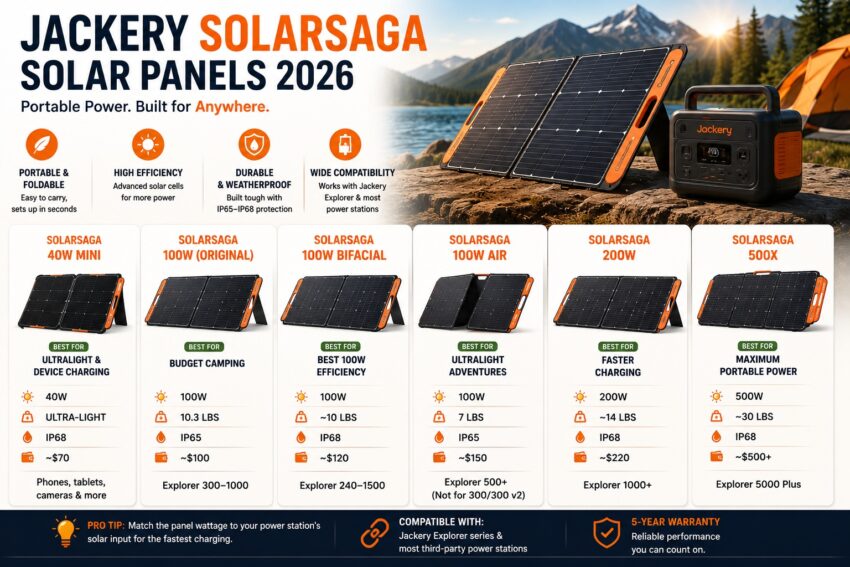
Jackery’s solar panel line is called SolarSaga. Every panel in the range is a portable, foldable unit designed to pair with a Jackery Explorer power station — though most also work with third-party power stations via MC4 connectors or adapters.
The lineup now runs from a book-sized 40W to a high-output 500W suitcase panel. Understanding what each model is actually for — and which Explorer power station it pairs with — is the most important information before you buy.
The compatibility issue that trips up most buyers: Not all SolarSaga panels work with all Explorer power stations. The SolarSaga 100W Air, for example, is incompatible with the Explorer 300 and Explorer 300 v2 due to voltage mismatch. Always verify panel-to-power-station compatibility before purchasing.
The Complete Jackery SolarSaga Range — 2026
| Panel | Wattage | Weight | Efficiency | IP Rating | Price | Best For |
|---|---|---|---|---|---|---|
| SolarSaga 40W Mini | 40W | Ultra-light | 23% | IP68 | ~$70 | Phones, tablets, small devices |
| SolarSaga 100W (original) | 100W | 10.3 lbs | 23.7% | IP65 | ~$100 | Budget camping, Explorer 300–1000 |
| SolarSaga 100W Bifacial | 100W | ~10 lbs | 24.3% | IP68 | ~$120 | Better efficiency, Explorer 240–1500 |
| SolarSaga 100W Air | 100W | 7 lbs | 23% | IP65 | ~$150 | Ultralight, Explorer 500+ only |
| SolarSaga 200W | 200W | ~14 lbs | 26.7% | IP68 | ~$220 | Faster charging, Explorer 1000+ |
| SolarSaga 500X | 500W | ~30 lbs | 25% | IP68 | ~$500+ | Explorer 5000 Plus |
SolarSaga 40W Mini — Best for Ultralight and Device-Direct Charging
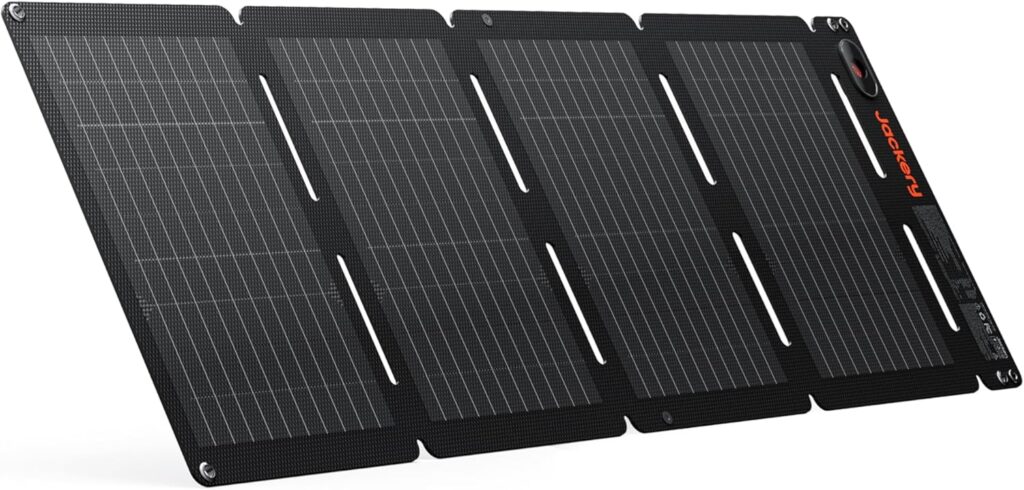
The SolarSaga 40W Mini is book-sized when folded, with USB-C and USB-A ports and a multifunctional solar charging cable. The kit includes two carabiners for attaching to a pack or hanging from a branch, and carries IP68 waterproof rating with a 5-year warranty. At 23% PERC bifacial efficiency in a pocket-sized form, it’s Jackery’s answer for hikers and backpackers who need a featherweight solar charger for phones, tablets, cameras, and small electronics directly via USB — no power station required.
Compatible with the Explorer 100 Plus, 240 v2, and 300 Plus. A DC8020-to-DC7909 adapter is required for older models like the Explorer 290/300/500. The two carabiners are a practical detail — hang it from a backpack, a tent guy-line, or a tree branch while you explore.
Pros: Book-sized when folded, IP68, USB-C + USB-A direct device charging, two carabiners included, 5-year warranty, ~$70
Cons: 40W limits charging speed (adequate for devices, very slow for power stations), adapter required for older Explorer models
Best for: Backpacking, hiking, hammock camping, anywhere weight and packability are the primary concerns
SolarSaga 100W (Original) — Best Budget and Most Compatible
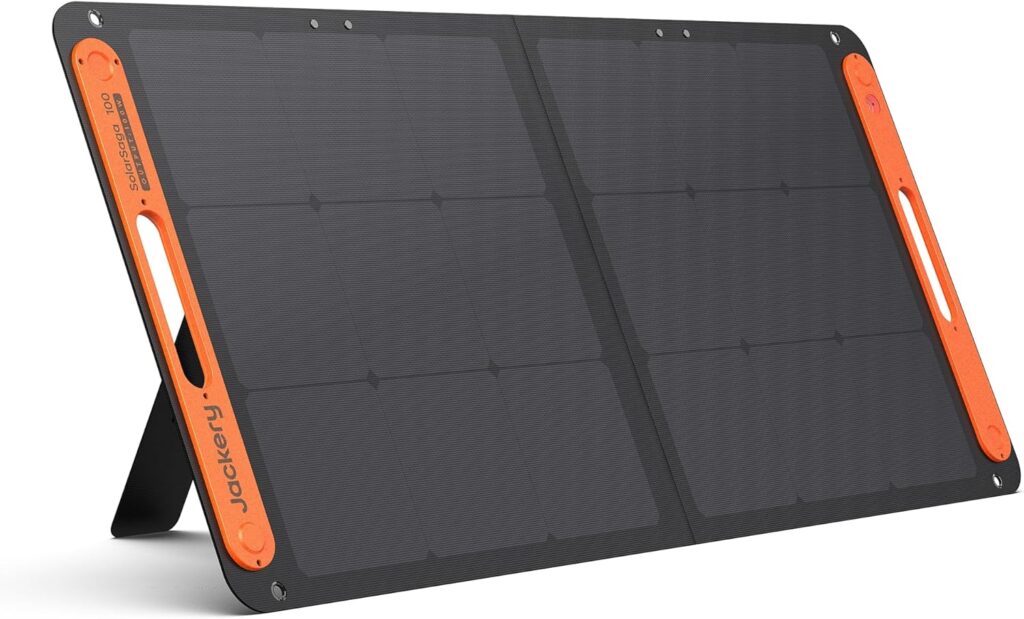
The original SolarSaga 100W is compatible with the Jackery Explorer 300/500/1000/1500 power stations and features one USB-C (5V, 3A) and one USB-A (5V, 2.4A) output port, allowing direct charging of two small devices simultaneously. Two adjustable kickstands can be placed firmly on any surface, and the panel folds flat for easy transport with a TPE rubber handle.
This is the panel that established Jackery’s portable solar reputation — it’s been the top-selling foldable solar panel on Amazon for years and has the most documented real-world use data of any panel in the lineup. At ~$100, it’s the entry point to the Jackery ecosystem for most buyers.
One important limitation: A single 100W panel takes approximately 17 hours to charge the Explorer 1000 v2. For power stations above 500Wh, two SolarSaga 100W panels or the 200W model is the practical minimum. One 100W panel is appropriate paired with the Explorer 300 or Explorer 500 v2.
Pros: Most compatible with the widest range of Explorer power stations, ~$100 best value in lineup, USB-A + USB-C direct charging, Anderson connector plug-and-play, proven track record, dual kickstands
Cons: 10.3 lbs (heavier than Air), IP65 (not IP68), 100W alone too slow for Explorer 1000+
Best for: First-time Jackery buyers, Explorer 300 and Explorer 500 v2 owners, budget camping solar
SolarSaga 100W Bifacial — Best 100W for Efficiency
The newer SolarSaga 100W Bifacial generates solar energy from both sides of the panel, significantly boosting output at dawn, dusk, and in diffuse conditions. Rated at 24.3% efficiency and compatible with the Explorer 240/300/500/1000/1500 with IP68 waterproofing — an upgrade over the original’s IP65 that makes it suitable for coastal and wet weather use without concern.
At ~$120, it’s a $20 premium over the original 100W for meaningful real-world improvements: better low-light performance, better weather resistance, and the higher 24.3% efficiency rating. For most buyers choosing between the original 100W and the bifacial version, the bifacial is worth the $20 difference.
Pros: Bifacial cells for better low-light output, IP68 waterproof (upgrade over original), 24.3% efficiency, compatible with Explorer 240–1500, same plug-and-play Anderson connector
Cons: ~$20 more than original, still 10+ lbs (not as light as Air), slower to charge larger stations than the 200W
Best for: Buyers who want the best 100W foldable in the lineup, campers in coastal or wet climates needing IP68, Explorer 500 v2 owners wanting maximum 100W performance
SolarSaga 100W Air — Best for Ultralight Camping
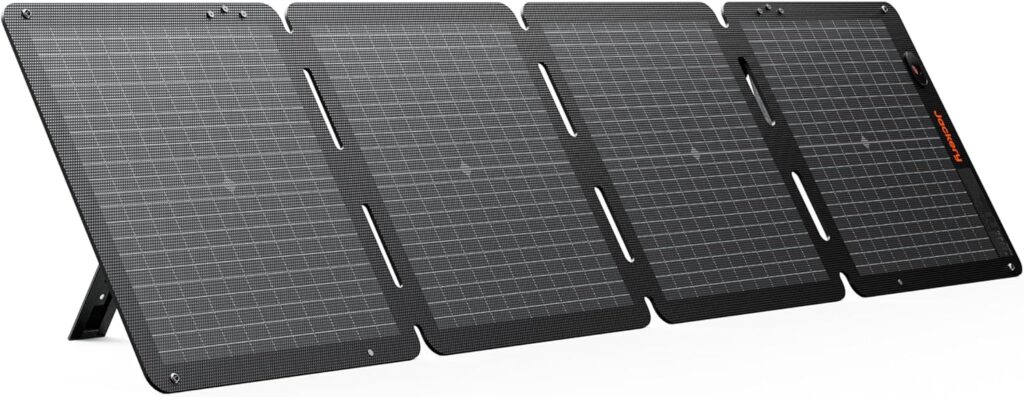
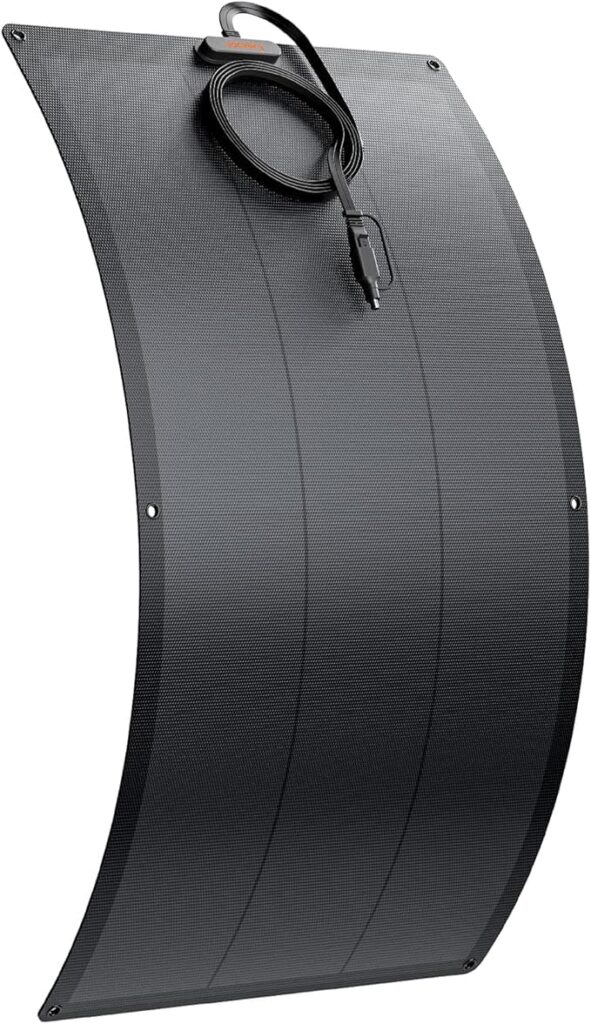
The SolarSaga 100W Air is Jackery’s lightest 100W panel at just 7 lbs — 27% lighter than the previous SolarSaga. The W-fold design collapses smaller than A2 paper, fitting in a daypack alongside other gear rather than requiring dedicated space. The built-in sun indicator shows in real time whether the panel is optimally aimed. Bifacial 23% efficiency and 60-second setup via integrated kickstands.
Critical compatibility note: The SolarSaga 100W Air is NOT compatible with the Explorer 300 or Explorer 300 v2 due to voltage mismatch. Verify your power station before ordering. Compatible with Explorer 500 v2, 1000 v2, HomePower 3600 Plus, and newer models.
Pros: Lightest 100W foldable at 7 lbs, W-fold ultra-compact, sun indicator for optimal aiming, bifacial, 60-second setup, MC4 + USB-C/USB-A output, ~$150
Cons: Incompatible with Explorer 300/300 v2, IP65 (not IP68), 23% efficiency slightly below bifacial 100W’s 24.3%, more expensive than both 100W models
Best for: Backpackers, ultralight campers, Explorer 500 v2 and newer owners who want the lightest quality Jackery panel
SolarSaga 200W — Best for Faster Charging
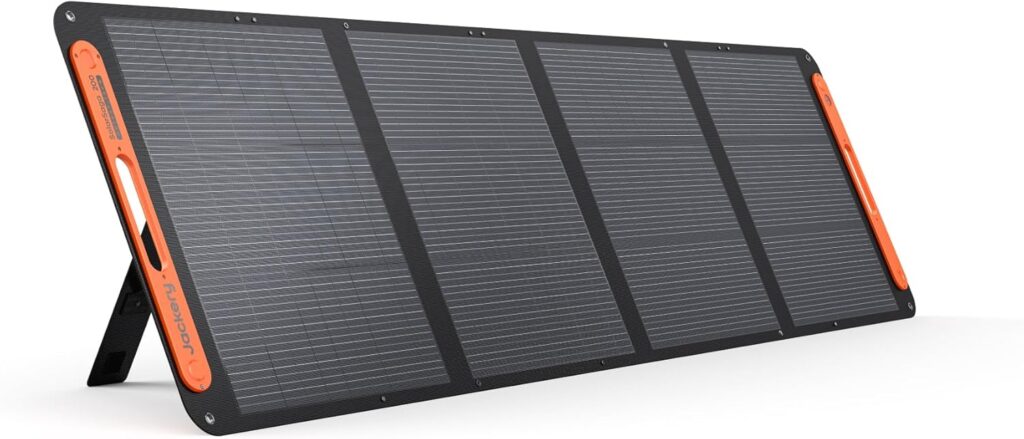
The SolarSaga 200W features bifacial IBC (Interdigitated Back Contact) technology at 26.7% efficiency — the highest in the portable Jackery panel lineup. IBC eliminates front-side metal contacts that block incoming light, producing genuinely higher efficiency than standard PERC or bifacial designs. IP68 waterproof, compatible with Jackery Explorer power stations via MC4.
The charge time math is compelling: the Explorer 1000 v2 charges from solar in approximately 3–4 hours with a 200W panel versus 12+ hours with a single 100W panel. If you have an Explorer 1000 v2 or larger and want daily solar recharging in practice rather than in theory, the 200W makes the difference between a system that works and one that frustrates. At ~$220, it delivers better value than buying two 100W panels at the same cost — same total wattage, simpler setup, more compact storage.
Pros: 26.7% IBC efficiency (highest in portable Jackery lineup), IP68, 200W provides practical daily recharging for Explorer 1000+, bifacial, ~$220
Cons: No built-in USB output (MC4 only), heavier than 100W models, not necessary for Explorer 300/500 owners
Best for: Explorer 1000 v2 owners who want daily solar self-sufficiency, Explorer 2000 v2 and HomePower 3600 Plus owners for faster recharge
SolarSaga 500X — Best for Maximum Portable Output
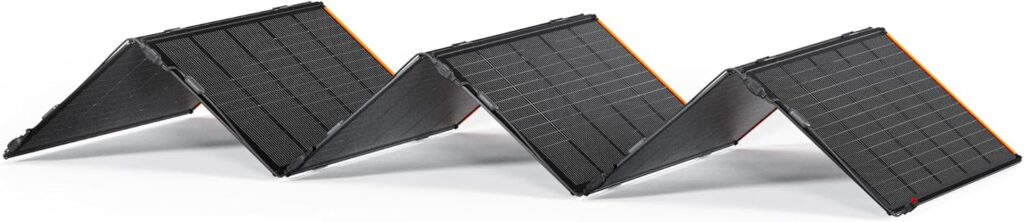
The SolarSaga 500X delivers 500W of solar output at 25% bifacial efficiency, IP68 waterproofing, and is designed specifically for the Explorer 5000 Plus. At ~$500, it’s priced for serious off-grid users: van lifers running full home loads, RV owners who want a single panel that can charge a large power station in one day. Two 200W SolarSaga panels provide 400W at slightly lower cost with more placement flexibility, but the 500X’s single-unit convenience and maximum compatibility with the Explorer 5000 Plus make it the right choice for that specific pairing.
Pros: 500W maximum portable output in one unit, 25% bifacial efficiency, IP68, purpose-built for Explorer 5000 Plus, MC4 universal connector
Cons: ~$500+ price point, suitcase-class weight (~30 lbs), overkill for Explorer 1000 or smaller
Best for: Explorer 5000 Plus owners, serious off-grid van life, overlanding with large power requirements
Jackery Solar Panel Compatibility — The Critical Table
| Explorer Power Station | Compatible Panels | Notes |
|---|---|---|
| Explorer 100 Plus / 240 v2 | SolarSaga 40W Mini, 100W | Check adapter requirements |
| Explorer 300 | SolarSaga 100W (original), 100W Bifacial | ⚠️ NOT compatible with 100W Air |
| Explorer 300 v2 | SolarSaga 100W (original), 100W Bifacial | ⚠️ NOT compatible with 100W Air |
| Explorer 500 v2 | SolarSaga 100W, 100W Bifacial, 100W Air | Max solar input 100W |
| Explorer 1000 v2 | SolarSaga 200W (recommended) | Max 400W; single 100W is too slow |
| Explorer 2000 v2 | SolarSaga 200W (recommended) | Multiple panels for fastest charge |
| HomePower 3600 Plus | SolarSaga 100W Air, 200W (recommended) | Max input 1,000W; see our HomePower 3600 Plus review |
| Explorer 5000 Plus | SolarSaga 500X | Designed for this pairing |
The general rule: Match panel wattage to the power station’s maximum solar input. Running a 200W panel into a 100W-max station wastes capacity. Running one 100W panel into a 1,000W-capable station works but is very slow — add more panels or step up to 200W.
Are Jackery Solar Panels Worth It vs. Third-Party Alternatives?
The case for Jackery panels: Guaranteed plug-and-play compatibility with Explorer power stations — no adapter uncertainty. The SolarSaga ecosystem warranty covers panel-to-power-station issues holistically. The 200W model’s 26.7% IBC efficiency is genuinely among the highest available in portable format. 5-year warranty across the lineup.
The case for third-party panels: Significantly lower cost per watt — a quality third-party 100W panel from Renogy or ECO-WORTHY costs $60–$80 vs $100–$150 for Jackery equivalents. MC4 connectors provide universal compatibility with adapters. Renogy’s N-Type panels at 25% efficiency provide comparable real-world performance at lower cost.
The honest verdict: If you’re in the Jackery ecosystem and want the simplest experience — plug Jackery panel into Jackery power station, everything works — Jackery panels justify the premium. If budget matters or you already own non-Jackery panels, quality third-party alternatives with MC4 adapters work well. See our foldable solar panels guide for the full third-party comparison, and our high efficiency solar panels guide for the best alternatives at every price point.
Getting the Most From a Jackery Solar Panel
Aim directly at the sun. The difference between a panel 20° off-axis and one aimed directly can be 15–25% of output. The SolarSaga 100W Air’s sun indicator removes the guesswork; for other models, aim for the smallest shadow from any object on the panel surface.
Use multiple panels in parallel for larger power stations. Two SolarSaga 100W panels connected via a Y-branch connector doubles the charging rate. This is the most cost-effective upgrade for Explorer 1000 v2 owners who want faster daily recharge.
Connect the panel before turning on the power station. This allows the MPPT controller inside the power station to detect and begin tracking the panel before the inverter load is applied — more efficient startup.
Keep the ETFE surface clean. Pollen, dust, and fingerprints reduce output by 5–15%. Wipe with a damp cloth before extended trips and after vehicle transport.
Frequently Asked Questions
Which Jackery solar panel should I buy for camping?
For Explorer 300 or 500 v2 owners: the SolarSaga 100W Bifacial at ~$120 offers the best balance — 24.3% efficiency, IP68, compatible with these stations. For ultralight backpackers with Explorer 500 v2 or newer: the SolarSaga 100W Air at 7 lbs. For Explorer 1000 v2 owners: the SolarSaga 200W — a single 100W panel charges it too slowly for daily use.
Can Jackery solar panels work with non-Jackery power stations?
Yes — most Jackery panels include or are compatible with MC4 adapters that connect to any power station with MC4 input. Verify the voltage range of your power station matches the panel’s output voltage before connecting. The SolarSaga 100W Air has MC4 output built in, making it the most universally compatible model.
How many solar panels do I need to charge an Explorer 1000 v2 in a day?
The Explorer 1000 v2 accepts up to 400W of solar input. One SolarSaga 200W charges it in approximately 6+ hours of sun; two 200W panels charge it in 3–4 hours. Four SolarSaga 100W panels via Y-branch connectors achieve the same 400W input. For daily self-sufficiency, the 200W model is the practical minimum — a single 100W panel takes 12+ hours of sun to fully charge the Explorer 1000 v2.
What is the difference between the SolarSaga 100W and 100W Air?
Weight (10.3 lbs vs 7 lbs), fold design (standard vs W-fold), and compatibility — the Air is NOT compatible with Explorer 300/300 v2. The Air is meaningfully lighter and more compact; the original works with a wider range of older Explorer models. If you have an Explorer 300, buy the original 100W. If you have an Explorer 500 v2 or newer and weight matters, buy the Air.
Are Jackery solar panels compatible with other brands?
With adapters, yes. The SolarSaga 100W Air’s MC4 output is universal. Older Anderson-connector models need an Anderson-to-MC4 adapter (available from Jackery). Once adapted, they work with EcoFlow, Bluetti, Anker, and other power stations within the panel’s voltage range.
Final Verdict
| Your Situation | Best Pick |
|---|---|
| Backpacking / ultralight / small devices | SolarSaga 40W Mini (~$70) |
| Explorer 300 or 500 v2, budget first | SolarSaga 100W original (~$100) |
| Explorer 500 v2, want best 100W | SolarSaga 100W Bifacial (~$120) |
| Ultralight + Explorer 500 v2 or newer | SolarSaga 100W Air (~$150) |
| Explorer 1000 v2 or HomePower 3600 Plus | SolarSaga 200W (~$220) |
| Explorer 5000 Plus / maximum output | SolarSaga 500X (~$500+) |
The most common buying mistake is choosing a panel too small for the power station — a single 100W panel paired with an Explorer 1000 v2 produces a frustratingly slow system. Match the panel to the power station’s solar input capacity, and Jackery’s solar ecosystem works exactly as advertised.
For the power stations that pair with these panels, see our full review of the Jackery HomePower 3600 Plus and our solar power for camping guide for the Explorer camping lineup. For complete off-grid system design beyond portable solar, our off-grid solar system guide covers everything from panels to batteries to wiring. For how Jackery panels compare to the best third-party alternatives, see our foldable solar panels guide.