This post contains affiliate links. If you buy through our links we may earn a small commission — at no extra cost to you. This never influences our recommendations.
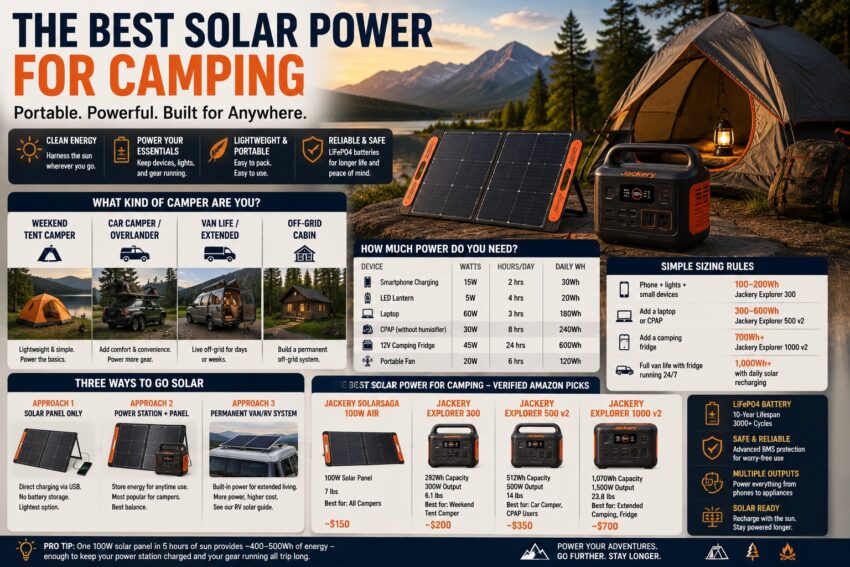
What Kind of Camper Are You? Start Here.
The right solar setup for camping depends almost entirely on how you camp. Get this question wrong and you’ll either underpower your trip or drag unnecessary equipment into the backcountry.
Weekend tent camper — You’re packing light, and your power needs are mostly phone charging, a headlamp, and maybe a small speaker. A foldable solar panel or a compact power station is everything you need. Weight matters most.
Car camper or overlander — You’re driving to the site and want comfort: a camping fridge, decent lighting, device charging, and maybe a CPAP. A mid-size power station (300–600Wh) with a 100W solar panel handles this well.
Van life or extended camping — You’re living out of your vehicle for days or weeks. A larger power station (700Wh–1,200Wh) or a permanent van solar setup is appropriate. See our RV solar panel kit guide for permanent van and RV installations.
Off-grid cabin — You need a properly sized permanent system. See our complete off-grid solar system guide for that.
This article focuses on portable camping solar — where a quality power station and a foldable solar panel solve the problem.
How Much Solar Power Do You Actually Need for Camping?
The honest answer: less than most people think, if you plan it out.
| Device | Watts | Hours/Day | Daily Wh |
|---|---|---|---|
| Smartphone charging | 15W | 2 hrs | 30Wh |
| LED lantern | 5W | 4 hrs | 20Wh |
| Laptop | 60W | 3 hrs | 180Wh |
| CPAP (without humidifier) | 30W | 8 hrs | 240Wh |
| 12V camping fridge | 45W | 24 hrs | 600Wh |
| Portable fan | 20W | 6 hrs | 120Wh |
Simple sizing rules:
- Phone + lights + small devices: 100–200Wh — Jackery Explorer 300
- Add a laptop or CPAP: 300–600Wh — Jackery Explorer 500 v2
- Add a camping fridge: 700Wh+ — Jackery Explorer 1000 v2
- Full van life with fridge running 24/7: 1,000Wh+ with daily solar recharging
A solar panel roughly doubles the effective capacity of any power station by recharging it during the day. One 100W panel in 5 hours of sun gives approximately 400–500Wh of recharge — enough to keep a 500Wh power station running indefinitely through daily cycles in good weather.
The Three Approaches to Camping Solar
Approach 1 — Solar panel only: A foldable solar panel connected directly to your devices via USB. Charges phones, tablets, and small devices while the sun is shining. No battery storage — when clouds come in or the sun sets, charging stops. Lightest option, best for backpackers and minimalist campers.
Approach 2 — Solar power station + panel (most popular): A portable power station charges during the day from the solar panel and stores that energy for evening use. The power station handles everything from phones to laptops to small fridges. Moderate weight, maximum convenience. This is what most car campers and overlanders use.
Approach 3 — Permanent van/RV solar system: Rigid panels mounted on the roof, connected to a battery bank and inverter permanently installed in the vehicle. More power, better for extended living, higher cost. See our RV solar panel kit guide for this approach.
For most campers, Approach 2 is the answer. A quality power station and a 100W portable panel give you solar power that genuinely works — rechargeable during the day, usable all evening, compact enough to travel with.
The Best Solar Power for Camping Right Now — Verified Amazon Picks
Every product below is verified on Amazon with specs confirmed from official listings. All power stations use LiFePO4 batteries — longer lifespan, safer chemistry, and better performance in outdoor temperature extremes.
| Product | Capacity | Output | Weight | Best For | Price |
|---|---|---|---|---|---|
| Jackery SolarSaga 100W Air | — (panel) | 100W solar | 7 lbs | All campers | ~$150 |
| Jackery Explorer 300 | 292Wh | 300W AC | 6.1 lbs | Weekend tent camper | ~$200 |
| Jackery Explorer 500 v2 | 512Wh | 500W AC | 14 lbs | Car camper, CPAP users | ~$350 |
| Jackery Explorer 1000 v2 | 1,070Wh | 1,500W AC | 23.8 lbs | Extended camping, fridge | ~$700 |
Jackery SolarSaga 100W Air — Best Solar Panel for Camping
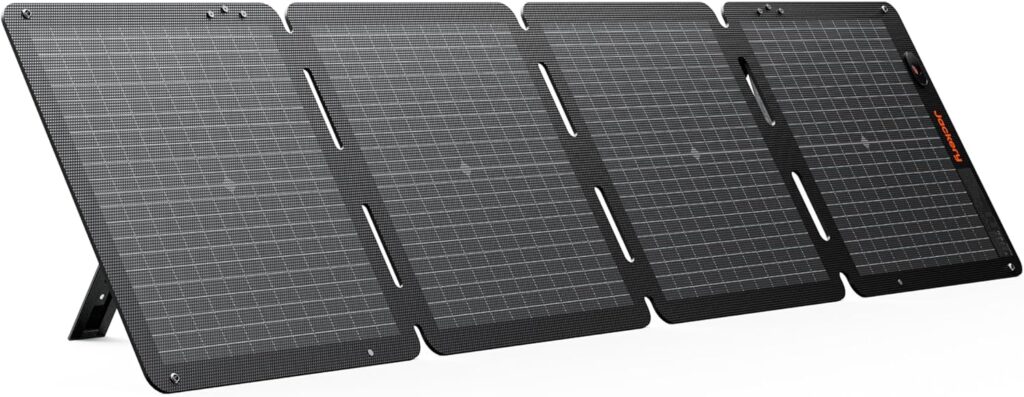
The SolarSaga 100W Air is Jackery’s latest-generation camping solar panel — 27% lighter than the previous version at just 7 lbs. The W-fold design folds smaller than A2 paper, fitting in a daypack. Bifacial PERC cells at 23% efficiency generate power from both sides, capturing reflected light for additional output at dawn, dusk, and in diffuse light.
The built-in sun indicator is a genuinely useful camping feature — it tells you in real time whether the panel is optimally angled for maximum output. IP68 waterproofing handles rain, dew, and camping conditions reliably. Setup takes 60 seconds with the integrated aluminium stand. The dual USB ports let you charge two devices directly from the panel without a power station — useful for top-up charging during the day.
Pros: Lightest 100W panel in its class (7 lbs), bifacial cells for better low-light performance, sun indicator for optimal positioning, IP68, W-fold compact design, 60s setup
Cons: Not compatible with Explorer 300/300 v2 due to voltage mismatch — check compatibility before ordering
Best for: Campers who want the lightest, most packable quality solar panel — pairs optimally with Explorer 500 v2 and 1000 v2
Jackery Explorer 300 — Best for Weekend Tent Campers
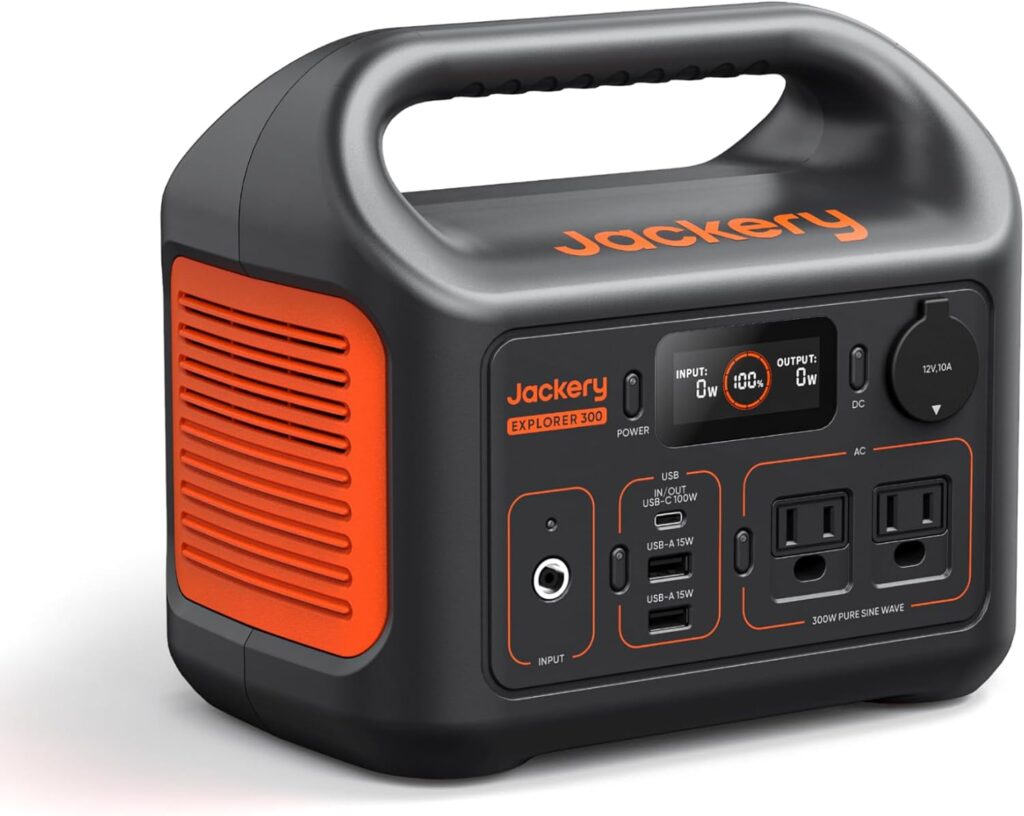
The most portable power station in our picks. At 6.1 lbs and the size of a small handbag, it travels as carry-on luggage, fits in a daypack, and handles all the charging needs of a minimalist weekend camper. The 292Wh LiFePO4 battery charges a smartphone 21 times, an LED camp light for 150+ hours, and a camera 13 times — plus two AC outlets for anything that needs a standard plug.
The 300W AC output handles most small camping appliances. The 60W USB-C PD port charges modern laptops at full speed. Charging from the SolarSaga 100W takes approximately 3.5 hours — a morning of sun gives you a full battery for the evening. At ~$200, it’s the most affordable complete camping power solution in our picks.
Pros: Lightest power station in our picks (6.1 lbs), 292Wh LiFePO4, 300W AC, 60W USB-C PD, affordable, pairs well with SolarSaga 100W
Cons: 292Wh not enough for camping fridges or full-night CPAP, 300W AC limits heavier appliances
Best for: Weekend tent campers, backpackers who car-camp, anyone who wants the lightest possible solar power setup
Jackery Explorer 500 v2 — Best for Car Campers
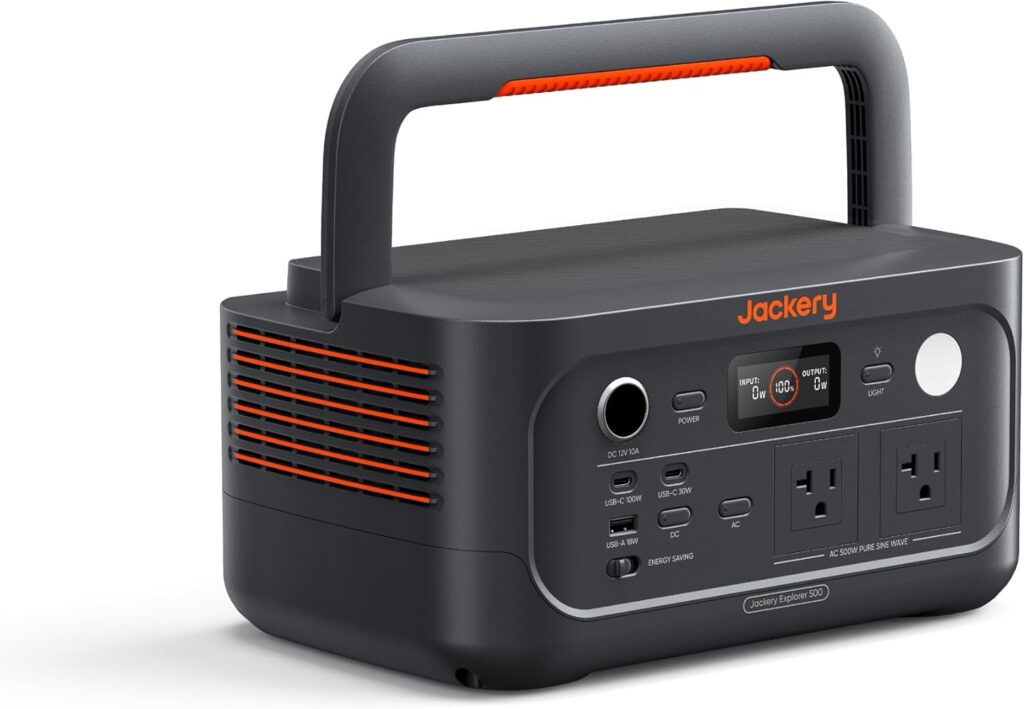
The sweet spot for most car campers. At 14 lbs it’s still genuinely portable, but the 512Wh LiFePO4 capacity and 500W AC output handle a meaningful range of camping devices — mini-fridges, CPAP machines, laptops, cameras, LED lighting, and all device charging simultaneously. At 6,000 charge cycles, it’s the longest-lasting power station in our picks — translating to 10+ years of daily use. The built-in LED light is a thoughtful camping feature.
Paired with the SolarSaga 100W Air, the system charges in approximately 5–6 hours of good sun, giving you continuous camping power through daily solar cycles.
Pros: 512Wh covers a full day of moderate camping use, lightest LiFePO4 500Wh station at 14 lbs, 6,000 cycles (10+ years), built-in LED, pure sine wave AC
Cons: Not quite enough for a full-size fridge running 24/7 — step up to the 1000 v2 for that
Best for: Car campers and overlanders, CPAP users, anyone running a mini-fridge, couples camping for 2–4 nights
Jackery Explorer 1000 v2 — Best for Extended Camping and Fridges
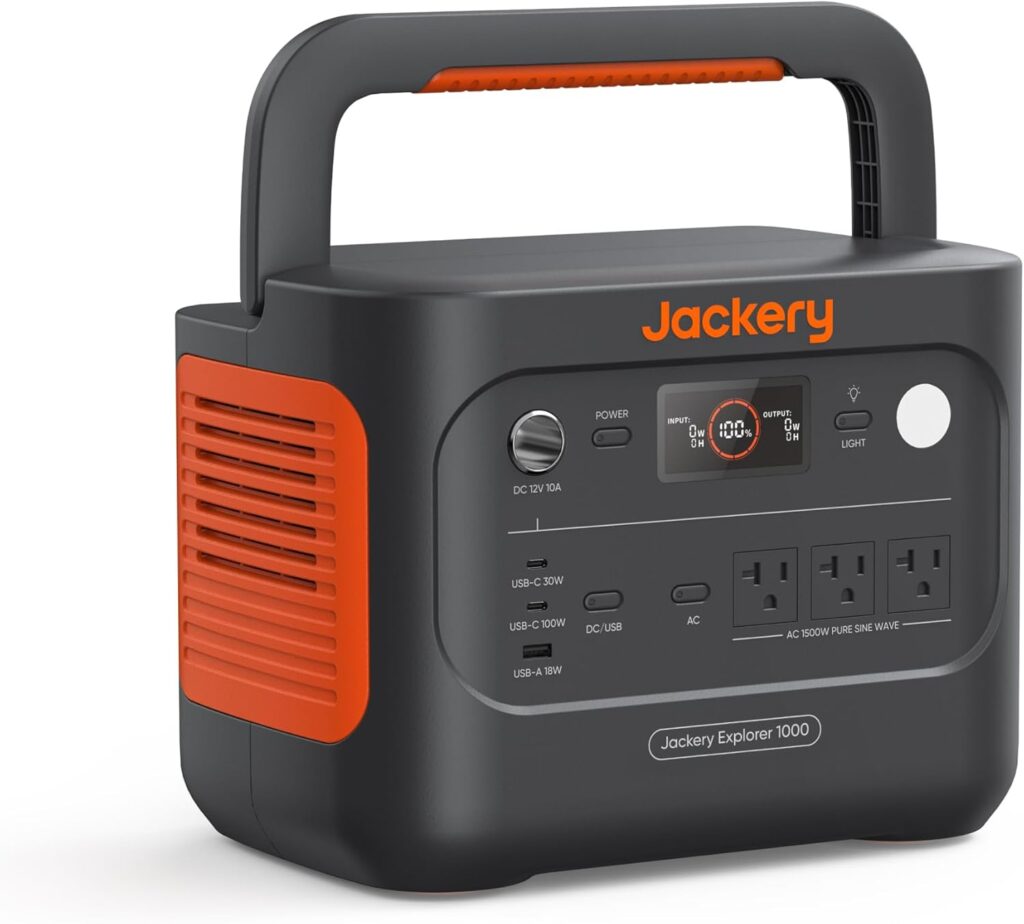
The power station for serious campers — extended trips, van life stints, and anyone running a camping fridge continuously. The 1,070Wh LiFePO4 battery with 1,500W AC output (3,000W peak) handles virtually any camping appliance including full-size portable fridges and electric cooking equipment. The 1-hour emergency fast charge (via the Jackery app) gets you from flat to full when you find a power point. Up to 400W solar input recharges it fully in about 3 hours of good sun.
ChargeShield 2.0 technology manages 62 layers of battery protection — important for a battery cycling through outdoor temperature extremes. The Jackery app provides remote monitoring and a 30dB quiet overnight charging mode.
Pros: 1,070Wh handles fridges and heavy loads, 1,500W AC, 400W solar input, 1hr emergency charge, quiet overnight mode, 4,000 LFP cycles, app control
Cons: Heavier at 23.8 lbs — manageable but not for ultralight camping
Best for: Extended camping, van life trips, running a camping fridge continuously, families who want to cook and live comfortably off-grid
Solar Chargers for Camping — When a Panel Alone Is Enough
If your camping power needs are genuinely minimal — charging a phone, running a USB light, keeping a camera topped up — you may not need a power station at all.
The original Jackery SolarSaga 100W (~$100) includes two USB outputs (USB-C 5V/3A and USB-A 5V/2.4A) that let you charge small devices directly from the panel while the sun is shining. At 10.3 lbs and $50 cheaper than the Air version, it’s a solid budget option that still delivers 23% efficiency and IP65 waterproofing.
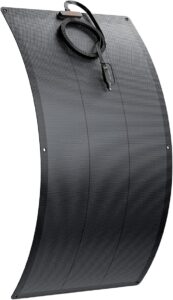
For ultra-light backpacking, a smaller foldable panel in the 20–60W range weighs under 3 lbs. For our full guide to flexible and lightweight portable options, see our flexible solar panels guide.
How to Set Up Solar Power for Camping
Position the panel for maximum output. Aim it directly at the sun — south-facing in the Northern Hemisphere, angled to match the sun’s elevation. The SolarSaga 100W Air’s sun indicator removes the guesswork. Move the panel every few hours as the sun tracks, or prop it at an angle that covers the peak solar window (10am–2pm) if you’re leaving camp.
Start charging early. Connect the solar panel to the power station as early in the morning as possible. 6 hours of good summer sun gives you 400–500Wh of recharge from a 100W panel — front-loading the charging day ensures a full battery by late afternoon.
Prioritise loads. In the morning while the station is charging, run power-hungry tasks (laptop work, camera charging). In the evening, switch to lower-draw activities (LED lighting, phone top-up). This stretches the battery through the night without stressing the charge cycle.
Shade is the enemy. Even 10% of the panel surface in shadow can reduce output by 30–50%. Prioritise any position that gives the panel unobstructed direct sun even if it’s 15 feet from where you’re sitting.
For more on maximising solar output in different environments, see our guide to solar charge controllers — the MPPT controllers in these power stations use the same principles as standalone charge controllers.
Solar Power for Camping vs. Gas Generator
| Factor | Solar Power Station | Gas Generator |
|---|---|---|
| Noise | Near silent (0–30dB) | Very loud (65–75dB) |
| Weight | 6–24 lbs | 30–50 lbs |
| Fuel cost | $0 — sun is free | $20–$50+ per multi-day trip |
| Indoor/tent use | ✅ Safe — no fumes | ❌ Never |
| Runtime | Battery-limited (solar recharges) | Unlimited with fuel |
| Maintenance | None | Oil changes, spark plugs, fuel treatment |
| Starting reliability | Instant — press button | Can fail after sitting |
| Campsite rules | ✅ Allowed everywhere | ❌ Banned in many parks |
For camping specifically, solar wins on almost every practical dimension. Gas generators are banned in many national parks and campgrounds, are intrusive in natural environments, and require fuel logistics. Solar power stations are silent, fume-free, and safe inside a tent. The only scenario where gas wins: extended camping in consistently overcast conditions where solar recharging is unreliable.
Frequently Asked Questions
How many watts of solar do I need for camping?
A 100W portable solar panel handles most camping scenarios when paired with a quality power station. In 5 hours of good sun, a 100W panel delivers approximately 400–500Wh of usable charge — enough to fully recharge a 300–500Wh power station daily. For heavier loads (camping fridge, power tools), two 100W panels or a single 200W foldable panel give faster recharging and more daily energy.
Can I run a camping fridge on solar?
Yes — with the right setup. A 12V camping fridge draws 30–60W continuously, consuming 700–1,400Wh per day. The Jackery Explorer 1000 v2 (1,070Wh) paired with the SolarSaga 100W Air handles this on good solar days with energy management. With a 100W panel providing ~450Wh daily and the fridge consuming ~700Wh, the net 250Wh daily draw runs down the battery slowly — fine for multi-day trips in good weather.
Do solar panels work on cloudy days for camping?
Yes, at reduced output. A 100W panel might produce 20–40W on a fully overcast day — enough for phone and device charging but not for serious battery recharging. Partially cloudy days (typical summer camping weather) typically produce 50–70% of full output. The bifacial design of the SolarSaga 100W Air helps here — it captures diffuse and reflected light more effectively than standard panels.
What is the best portable solar power station for camping?
For most campers, the Jackery Explorer 500 v2 is the best balance of capacity, weight, and price — 512Wh, 14 lbs, 500W output, 10+ years LiFePO4 lifespan. For campers running a fridge or extended off-grid living, step up to the Jackery Explorer 1000 v2. For weekend minimalists, the Explorer 300 is all you need.
How long does it take to charge a solar power station?
With a 100W solar panel in good conditions: Explorer 300 in ~3.5 hours, Explorer 500 v2 in ~5–6 hours, Explorer 1000 v2 in ~12 hours (or ~3 hours with 400W combined solar input). AC wall charging is faster — the Explorer 1000 v2 charges in 1.7 hours from a wall outlet, useful when packing for the trip at home.
Final Verdict — Quick Picks by Camper Type
| Camper Type | Solar Panel | Power Station |
|---|---|---|
| Weekend tent camper (light needs) | SolarSaga 100W Air | Explorer 300 |
| Car camper (laptop, lights, small fridge) | SolarSaga 100W Air | Explorer 500 v2 |
| Extended camping / van life (fridge running) | SolarSaga 100W Air ×2 | Explorer 1000 v2 |
| Backpacker (phones and lights only) | SolarSaga 100W (original) | Not needed |
The Jackery ecosystem — SolarSaga panels paired with Explorer power stations — is the most proven, most documented, and best-supported portable camping solar ecosystem on Amazon. The combination of purpose-built compatibility, strong warranty support, and app-based monitoring makes it the default recommendation for anyone building a camping solar setup from scratch.
Start with the Explorer 500 v2 and a SolarSaga 100W Air. That combination covers most camping scenarios at a reasonable weight and price. Add a second panel or step up to the Explorer 1000 v2 when your needs grow.
For permanent van and RV installations beyond what portable power stations can provide, see our RV solar panel kit guide and our best solar generator for home backup guide for larger capacity options.