
This post contains affiliate links. If you buy through our links we may earn a small commission — at no extra cost to you. This never influences our recommendations.
“Solar panel kit” is one of the more confusingly used terms in the entire off-grid category. Some kits include only panels and a charge controller — you supply your own battery and inverter. Others bundle everything, including a lithium battery and pure sine wave inverter, into one box. Buying the wrong type of kit means either paying for components you already own, or discovering after the fact that you need to source another $500-1,000 in parts before your system actually works.
The Three Types of “Solar Panel Kit” — Know Which You’re Buying
Panels + charge controller only. This is the most common and least expensive kit type — typically two or four monocrystalline panels wired together with an MPPT or PWM charge controller, mounting brackets, and cabling. You supply the battery and, if you need AC power, a separate inverter. Right for anyone already running a battery bank or building around an existing power station.
Complete starter systems. These add a small lithium battery (typically 50-100Ah) and a basic inverter to the panel-and-controller combination, giving you a genuinely plug-and-play system for light use — small cabin, shed, or basic RV setup. The included components are usually sized modestly; don’t expect to run a full-size refrigerator on a “complete” 200W starter kit.
Full off-grid systems. The largest, most expensive kits bundle 400W+ of panels, a proper 40-60A MPPT controller, a substantial lithium battery bank (100Ah+), and a 2,000-3,000W pure sine wave inverter — everything needed to run a genuine off-grid cabin, including a refrigerator, power tools, and multiple appliances simultaneously.
Real-World Output vs Rated Wattage — What Testing Actually Shows
This is worth knowing before you buy: independent testing of complete solar kits consistently finds real-world peak output falls short of the rated nameplate figure. One thorough test of a 1,170W-rated system measured a peak of 720W in strong sun — about 60% of the rated capacity. This isn’t necessarily a defect; it reflects real conditions (panel angle, temperature, and atmospheric losses) versus the ideal laboratory conditions used for the nameplate rating.
The practical takeaway: budget your expected daily energy production at roughly 60-75% of the kit’s rated wattage × your local peak sun hours, not the full rated number. A “400W” kit producing an advertised 1.6kWh/day in ideal conditions might realistically deliver 1.0-1.3kWh/day accounting for real-world losses — still very usable, just worth planning around the honest number rather than the marketing figure.
MPPT vs PWM in Kit Pricing — Why It Matters
Budget kits often ship with a PWM charge controller to hit a lower price point; premium kits include MPPT. The difference is real: MPPT technology can extract roughly 30% more power from the same panels compared to PWM, particularly in cold weather or partial shade — see our MPPT vs PWM charge controller guide for the full breakdown of when each makes sense. For any kit above 200W, MPPT is worth the price premium; for very small, budget-constrained systems under 200W with voltage-matched panels, PWM remains a reasonable choice.
Best Solar Panel Kits — Verified Picks
| Product | Wattage | Includes Battery/Inverter | Controller | Best For |
|---|---|---|---|---|
| ECO-WORTHY 200W Complete Kit | 200W | Yes — 100Ah lithium + 1,100W inverter | 30A | Complete beginner system |
| ECO-WORTHY 400W Premium Kit | 400W | No — panels and controller only | 40A MPPT | Adding to an existing battery bank |
| ECO-WORTHY 1.6kWh Complete 400W System | 400W | Yes — 100Ah lithium + inverter | 40A MPPT | Serious off-grid cabin/RV build |
Best Complete Starter Kit: ECO-WORTHY 200W Complete Solar Panel Kit
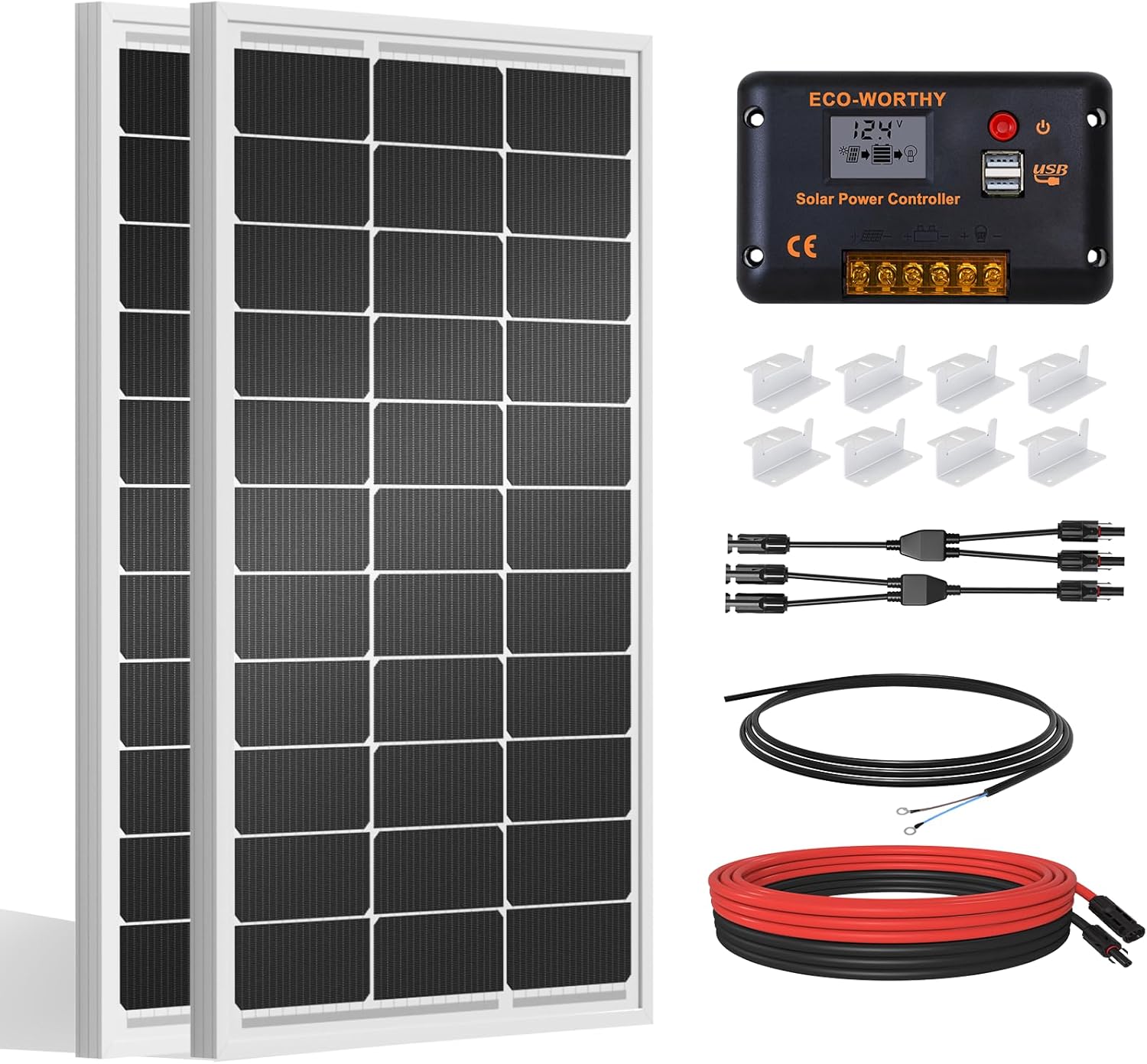
For genuine beginners who want everything in one box, this kit bundles two 100W monocrystalline panels, a 30A charge controller, a 100Ah lithium battery, and a 1,100W pure sine wave inverter — a complete, ready-to-run system straight out of the packaging. This is the right starting point for a shed, small cabin, or basic RV setup running lights, device charging, and light electronics, without needing to source a single additional component.
The built-in BMS protects the lithium battery from overcharge, over-discharge, and short circuit, and the pure sine wave inverter output is clean enough for sensitive electronics. At 200W, expect roughly 500-700Wh of real daily output in decent sun — enough for the essentials, not a full refrigerator running around the clock.
Best for Adding to an Existing Battery Bank: ECO-WORTHY 400W Premium Kit
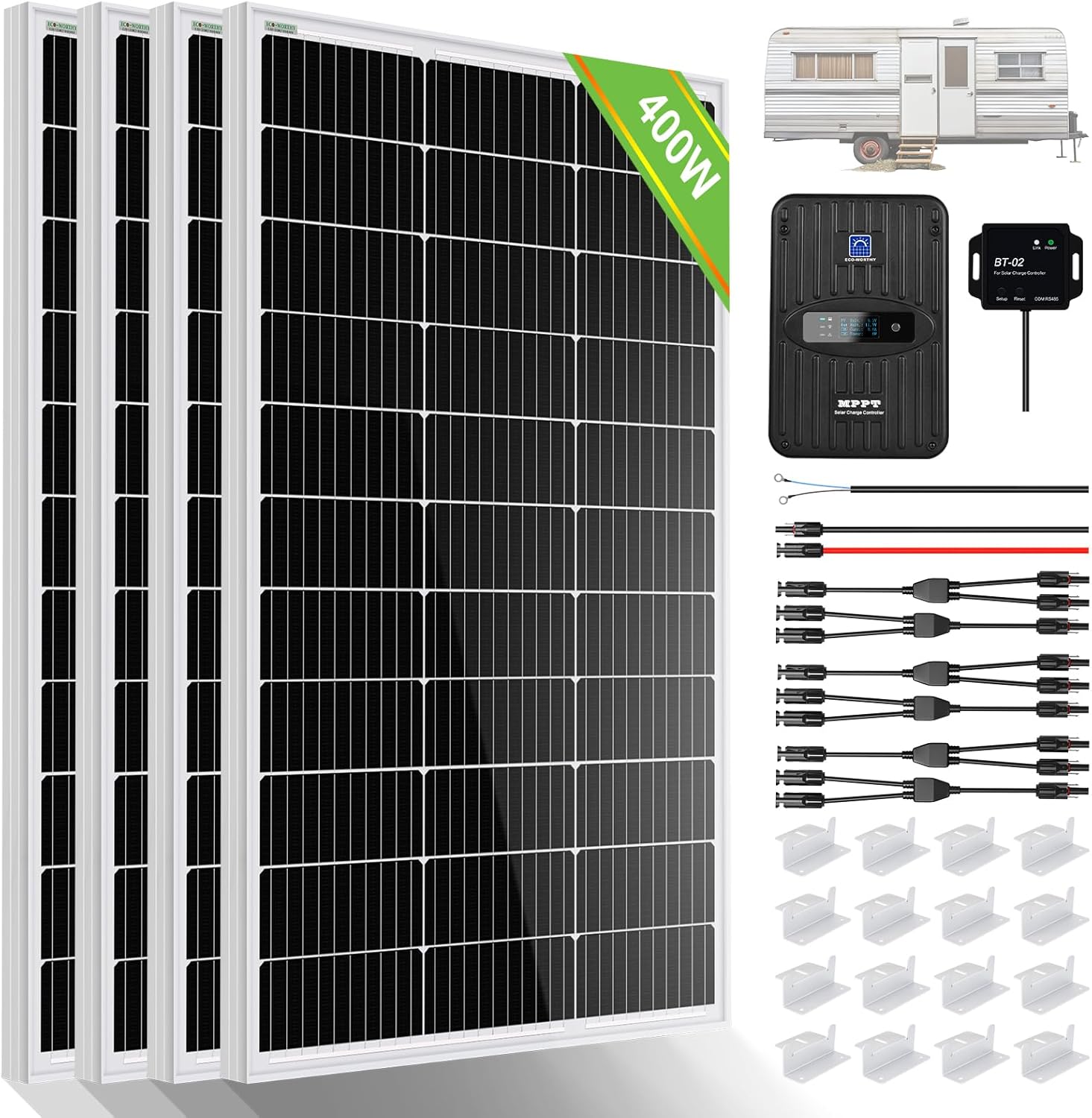
If you already have a battery bank or power station and just need the panel and charge controller side of the equation, this kit delivers four 100W monocrystalline panels with a 40A MPPT controller — 99% tracking efficiency, 40% more efficient than a comparable PWM setup. Bypass diodes in each panel’s waterproof junction box minimize power loss from partial shading, and the 3.2mm low-iron glass and 35mm aluminum frame are built to handle 2,400Pa wind and 5,400Pa snow loads.
At 400W, this produces a realistic 1.0-1.3kWh of usable daily energy in 4-5 peak sun hours — enough to keep a 100Ah battery bank topped off for moderate daily use. No battery or inverter included, so budget separately if you don’t already have those components.
Best Complete System for Serious Off-Grid Use: ECO-WORTHY 1.6kWh Complete 400W System
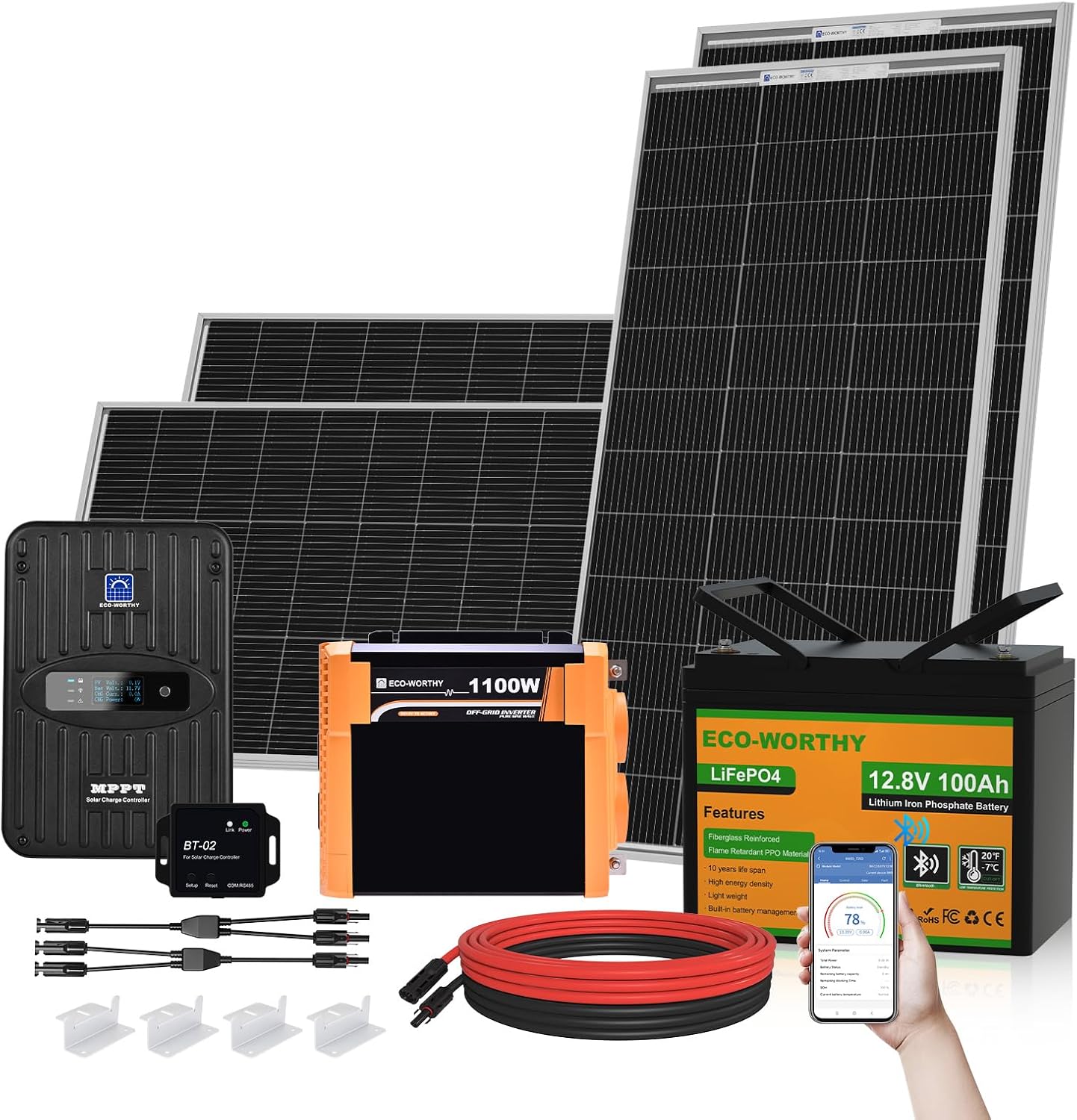
This is the step up for anyone who wants a genuinely capable off-grid system in one purchase — four 100W panels, a 40A MPPT controller with Bluetooth monitoring, a 100Ah lithium battery (1.28kWh), and a proper solar power inverter, all bundled together. The 99% tracking efficiency MPPT controller maintains stable charging current even on cloudy days, and the lithium battery’s 3,000+ deep cycle rating gives this system a genuinely long service life compared to lead-acid alternatives.
At 400W with a 100Ah battery, this system comfortably runs a 12V fridge, lighting, and device charging for a small cabin or RV, with enough battery buffer to handle a cloudy day without running flat. For larger loads — a full-size fridge, power tools, or multiple simultaneous appliances — step up to an 800W+ system with a larger battery bank.
What to Check Before Buying Any Kit
What’s actually included: Read the listing carefully — “solar kit” alone doesn’t tell you whether a battery and inverter are in the box. Cross-reference against your existing components before assuming compatibility.
Battery chemistry: Lithium (LiFePO4) batteries included in complete kits offer far more usable capacity and a much longer cycle life than lead-acid — see our best solar battery guide for the full comparison.
Inverter type: Confirm the included inverter is pure sine wave, not modified sine wave — modified sine wave power can damage sensitive electronics and motors like refrigerator compressors.
MPPT vs PWM: For any system above 200W, prioritize kits with MPPT controllers for meaningfully better real-world efficiency, especially in cold or partly shaded conditions.
Frequently Asked Questions
What’s included in a typical solar panel kit?
It varies significantly by listing. Basic kits include only panels, a charge controller, mounting brackets, and cabling. Complete kits add a battery (usually lithium) and an inverter. Always check the specific product description rather than assuming based on the general “kit” label.
How much power will a solar panel kit actually produce?
Less than the rated wattage suggests. Real-world testing consistently shows actual peak output around 60-75% of nameplate rating due to panel angle, temperature, and atmospheric losses. Budget your daily energy expectations using this realistic range multiplied by your local peak sun hours, not the full rated wattage.
Do I need MPPT or is PWM good enough for a starter kit?
For systems under 200W with properly voltage-matched panels and battery, PWM performs reasonably well and saves money. For anything larger, MPPT’s roughly 30% efficiency advantage — especially in cold weather — justifies the added cost. See our MPPT vs PWM guide for the full breakdown.
What size solar panel kit do I need for a cabin?
It depends entirely on your daily energy use. A basic cabin running lights, device charging, and a small fridge typically needs 200-400W with a 100Ah battery. A cabin running a full-size fridge, power tools, and multiple appliances needs 800W+ with a larger battery bank. See our off-grid solar system guide for detailed sizing.
Can I expand a solar panel kit later?
Usually yes, provided your charge controller has headroom beyond your initial panel wattage. Buying a controller rated somewhat above your starting panel count gives room to add panels later without replacing the whole system. Check your specific controller’s maximum input rating before assuming expansion is possible.
Final Verdict
| Your Situation | Best Pick |
|---|---|
| Complete beginner, want everything included | ECO-WORTHY 200W Complete Solar Panel Kit |
| Already have a battery/inverter, need panels only | ECO-WORTHY 400W Premium Kit |
| Serious off-grid cabin or RV system from scratch | ECO-WORTHY 1.6kWh Complete 400W System |
The Bottom Line
Match the kit type to what you actually need: panels-and-controller-only if you already have a battery and inverter, a complete starter kit for a first basic system, or a full off-grid bundle if you’re building serious cabin or RV power from scratch. Whatever you choose, plan your expected daily output around real-world testing figures (60-75% of rated wattage) rather than the marketing number on the box.
For complete system design guidance, see our off-grid solar system guide and best solar battery guide. For RV-specific kits, our RV solar panel kit guide covers that use case specifically, and our 100W, 200W, and 400W solar panel guides cover individual panels in detail.