This post contains affiliate links. If you buy through our links we may earn a small commission — at no extra cost to you. This never influences our recommendations.
Why LiFePO4 Is the Only Solar Battery Chemistry Worth Buying in 2026
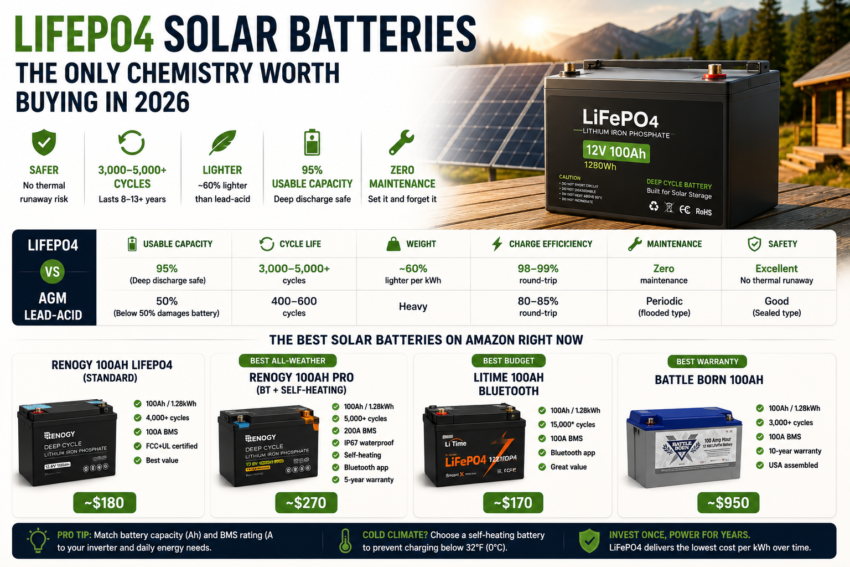
The solar battery market has effectively converged on one chemistry: LiFePO4 — lithium iron phosphate. Entry-level LiFePO4 batteries from reputable manufacturers have reached price points that make AGM hard to justify for any new installation.
| Factor | LiFePO4 | AGM Lead-Acid |
|---|---|---|
| Usable capacity | 95% (deep discharge safe) | 50% (below 50% damages battery) |
| Cycle life | 3,000–5,000+ cycles | 400–600 cycles |
| Weight | ~60% lighter per kWh | Heavy |
| Charge efficiency | 98–99% round-trip | 80–85% round-trip |
| Maintenance | Zero | Periodic (flooded type) |
| Safety | Excellent — no thermal runaway | Good — sealed type |
The maths on cycle life closes the argument: an AGM rated for 500 cycles at 50% DoD delivers 250Wh per cycle over its life. A LiFePO4 rated for 4,000 cycles at 95% DoD delivers 3,800Wh per cycle. The LiFePO4 delivers 15× more energy over its lifetime — typically at 2–3× the upfront cost, making it dramatically cheaper per kWh delivered.
LiFePO4 vs. NMC lithium-ion: LiFePO4 is safer (no thermal runaway risk), has longer cycle life (3,000–5,000 vs 500–1,000 cycles), and performs better in temperature extremes. For stationary solar storage, LiFePO4 is the correct chemistry.
The Five Specs That Actually Matter
1. Usable capacity (kWh). Total rated capacity × depth of discharge = usable capacity. A 100Ah 12V LiFePO4 stores 1.28kWh. At 95% usable DoD, you get 1.22kWh per cycle. For system sizing, usable capacity is the only number that matters.
2. Cycle life at rated depth of discharge. How many full charge-discharge cycles before degrading to 80% original capacity. At one cycle per day: 3,000 cycles = ~8 years, 5,000 cycles = ~13.7 years. Always check what DoD the cycle rating is measured at — comparing raw cycle numbers between manufacturers without knowing this is a common mistake.
3. Continuous discharge current (amps). Determines what loads the battery can power simultaneously. 100A from a 12V battery = 1,200W maximum sustained output. For a 1,000W inverter: minimum 100A BMS. For a 2,000W inverter: 200A BMS or two parallel batteries. This spec is the most commonly overlooked and regretted.
4. BMS quality. The Battery Management System protects cells from over-charge, over-discharge, over-current, short circuit, and temperature extremes. A weak BMS is the most common cause of premature LiFePO4 failure — the most important quality differentiator between cheap and quality batteries.
5. Operating temperature — especially charging. LiFePO4 batteries cannot be charged below 32°F (0°C) without a self-heating function — attempting to do so causes permanent lithium plating damage to the cells. For RV, van life, or any cold-climate use, a self-heating battery is essential, not optional.
The Best Solar Batteries on Amazon Right Now — Verified Picks
| Battery | Capacity | Cycles | BMS | Key Feature | Price |
|---|---|---|---|---|---|
| Renogy 100Ah LiFePO4 (standard) | 100Ah / 1.28kWh | 4,000+ | 100A | FCC+UL certified, best value | ~$180 |
| Renogy 100Ah Pro (BT + Self-Heat) | 100Ah / 1.28kWh | 5,000+ | 200A | IP67, self-heating, Bluetooth | ~$270 |
| LiTime 100Ah Bluetooth | 100Ah / 1.28kWh | 15,000* | 100A | Best budget with Bluetooth | ~$170 |
| Battle Born 100Ah | 100Ah / 1.28kWh | 3,000+ | 100A | 10-year warranty, USA assembled | ~$950 |
*LiTime’s 15,000-cycle rating is measured at shallower DoD than Renogy’s 4,000–5,000 cycle ratings — direct cycle count comparison is misleading without matching test conditions.
Renogy 12V 100Ah LiFePO4 (Standard) — Best Value Solar Battery
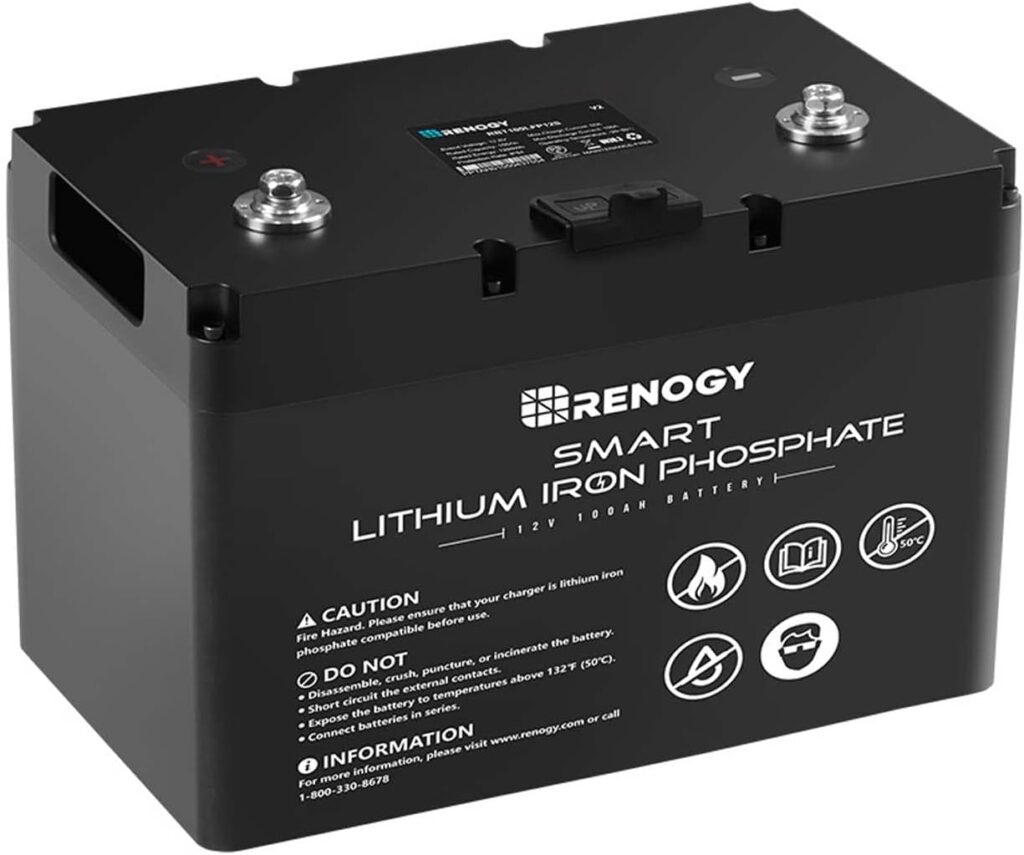
The standard Renogy 100Ah is the most proven mid-range LiFePO4 solar battery on Amazon — FCC and UL certified, 4,000+ cycle life, and a 100A BMS with comprehensive protection against over-voltage, under-voltage, over-current, short circuit, high temperature, and low temperature. The integrated smart BMS monitors and manages the charging/discharging process, with state-of-the-art cells ensuring long cycle life and exceptional discharge performance.
The RS485 communication port enables integration with the Renogy DC Home app and ONE monitor for real-time battery status. At ~$180, four of these batteries (400Ah / 5.12kWh) costs approximately $720 — a genuinely capable off-grid battery bank for a cabin or RV at a price that makes the system economics work.
Note on warranty: The standard model carries a 2-year warranty. Keep purchase documentation carefully and verify terms before purchase.
Pros: FCC+UL certified, 4,000+ cycles, 100A BMS, RS485 monitoring compatible, proven track record, scalable in parallel, ~$180
Cons: 2-year warranty (shorter than premium brands), 100A BMS limits inverter to ~1,000W per battery, no self-heating
Best for: Off-grid cabins, RV builds, shed power systems, and any 12V solar application where building a multi-battery bank at reasonable cost is the priority
Renogy 12V 100Ah Pro (Bluetooth + Self-Heating, IP67) — Best All-Weather Solar Battery
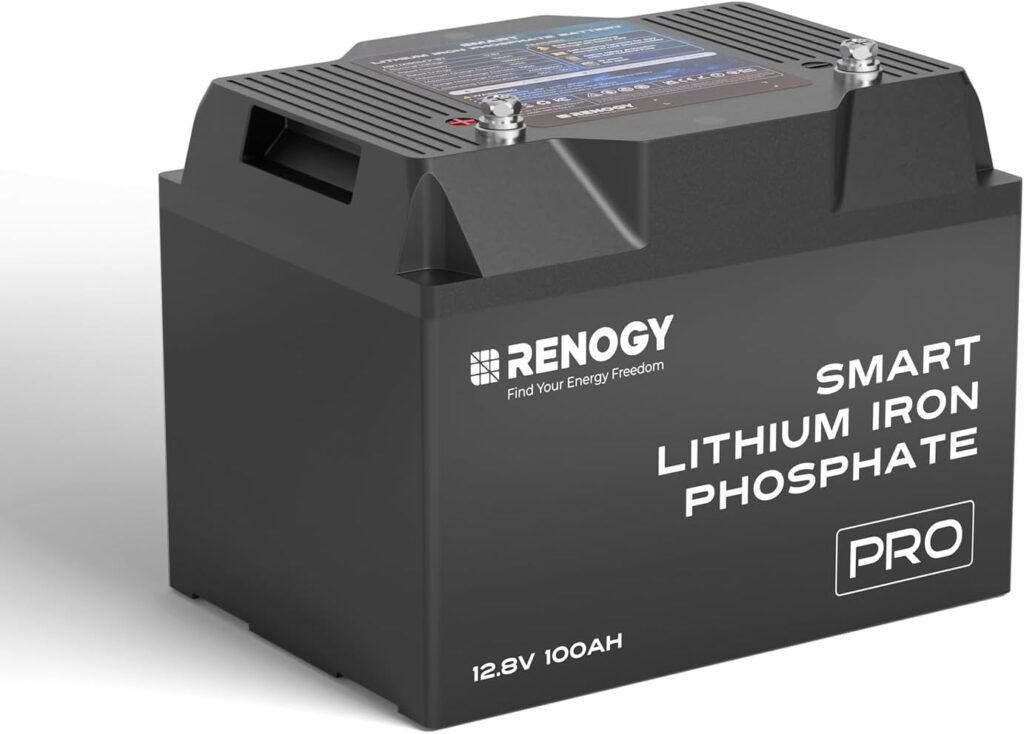
The Pro series is a meaningfully different product from the standard Renogy 100Ah. The Renogy 12V 100Ah Pro Series boasts over 60 BMS protection functions for safety monitoring and precise control, with Active Backup Protection integrated as a second line of defence against ongoing overheating in case of hardware failures. The 2-in-1 self-heating and Bluetooth design allows cell temperature to rise 20% faster for resuming charging in cold conditions.
Key differentiators over the standard model: 5,000+ cycles (vs 4,000+), 200A BMS (enables larger inverters and faster discharge), IP67 waterproofing, self-heating for cold-climate use, Bluetooth monitoring built in, V0 fire-retardant casing with UL94 V-0 rating, and 5-year warranty (vs 2-year standard). At ~$270, the $90 premium over the standard model is justified for cold climates, marine applications, or any system where maximum protection and Bluetooth monitoring are priorities.
Pros: 5,000+ cycles, 200A BMS (supports up to 2,000W inverter per battery), IP67, self-heating for cold climates, Bluetooth monitoring, 5-year warranty, V0 fire-retardant casing
Cons: ~$270 (50% more than standard), self-heating draws some battery capacity
Best for: RV and van builds in cold climates, marine installations, systems where Bluetooth monitoring and maximum BMS protection are required
LiTime 12V 100Ah LiFePO4 Bluetooth — Best Budget Option
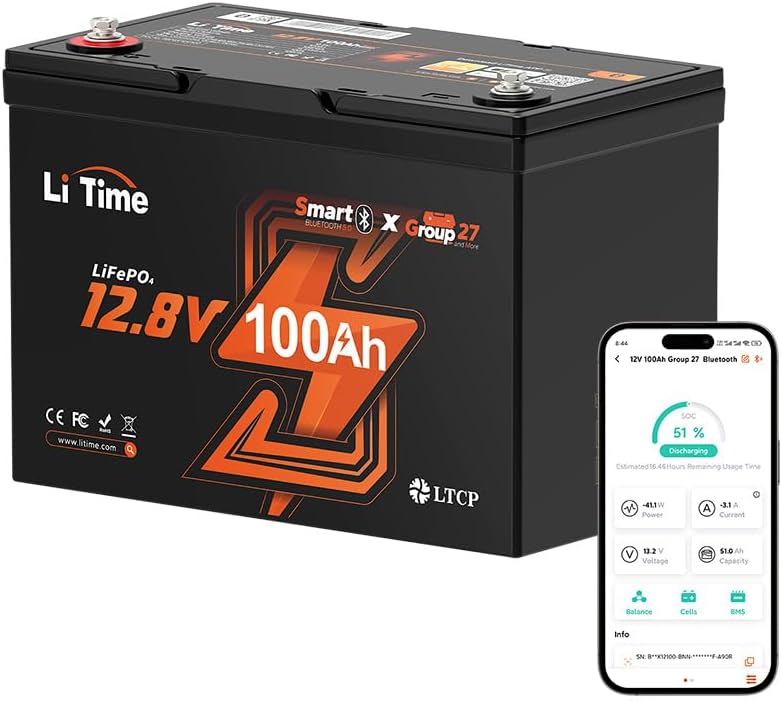
LiTime’s 12V 100Ah Bluetooth battery uses Grade A prismatic LFP cells and independent testing confirms the batteries perform to spec in real-world conditions. Built-in Bluetooth enables monitoring via the LiTime app, the Group 27 form factor fits standard battery boxes, and the 100A BMS covers standard solar system loads. At ~$170, LiTime is the most affordable quality Bluetooth-equipped LiFePO4 battery on Amazon.
The 15,000-cycle claim requires context: this rating is measured at shallower depth of discharge than the 4,000–5,000 cycle ratings on Renogy batteries (which are rated at 80–95% DoD). Comparing raw cycle numbers between manufacturers without matching test conditions is a common mistake. What’s real: Grade A cells, working BMS, Bluetooth monitoring, and competitive real-world performance.
Pros: Best value with Bluetooth at ~$170, Grade A prismatic cells, Bluetooth monitoring, Group 27 form factor, strong performance data from real-world users
Cons: Cycle count claim uses different test conditions than Renogy ratings — direct comparison misleading; warranty and support less established than Renogy or Battle Born; no self-heating
Best for: Budget-conscious buyers who want Bluetooth monitoring, first-time LiFePO4 purchasers, secondary batteries for expanding an existing bank
Battle Born 100Ah 12V LiFePO4 — Best Warranty and RV/Marine Confidence
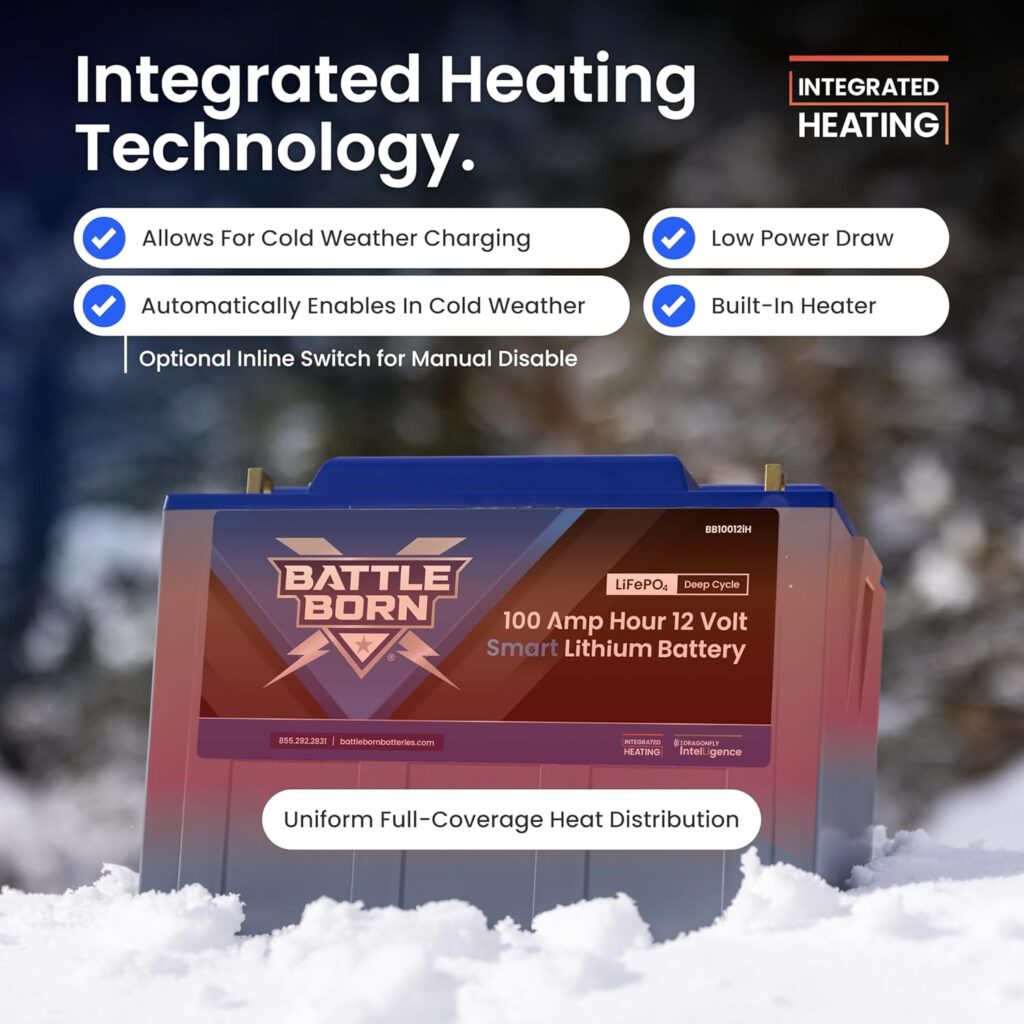
Battle Born remains the RV standard for good reason. For stationary off-grid banks needing 400Ah or more, the cost adds up quickly and better value options exist. But if you are building a single- or dual-battery RV or marine system, value the 10-year warranty and USA-based support, and want a product with the largest documented install base and proven track record, Battle Born is the safe choice.
Battle Born batteries are sold fully charged for instant installation, with unlimited mounting capability and a 100A BMS providing comprehensive protection. The heated version (Smart Heated, ASIN: B0DN73S746, ~$1,100) adds self-heating for cold-climate use. At ~$950 per 100Ah, the premium buys 10-year warranty coverage, US assembly and support, and peace of mind for a system you don’t want to troubleshoot — the most expensive option at $9.00/Ah, but the most supported.
Pros: 10-year warranty, USA assembled, largest documented RV/marine install base, reliable through thousands of verified real-world cycles, heated version available
Cons: ~$950 per 100Ah — 5× the cost of Renogy standard; 3,000+ cycle rating lower than Renogy Pro’s 5,000+
Best for: RV and van life builds where warranty confidence and US support matter most, marine installations, buyers who want proven reliability above all else
How to Size a Solar Battery Bank
Step 1 — Calculate daily consumption in Wh:
| Appliance | Watts | Hours/Day | Daily Wh |
|---|---|---|---|
| 12V fridge | 45W avg | 24 hrs | 1,080Wh |
| LED lighting | 20W | 5 hrs | 100Wh |
| Phone charging (×2) | 30W | 2 hrs | 60Wh |
| Laptop | 60W | 4 hrs | 240Wh |
| Fan | 25W | 8 hrs | 200Wh |
| Typical RV total | ~1,680Wh |
Step 2 — Calculate battery capacity needed:
For 2 days of autonomy: 1,680Wh × 2 = 3,360Wh.
At 95% usable DoD: 3,360 ÷ 0.95 = 3,537Wh needed.
At 12V: 3,537Wh ÷ 12V = 295Ah — approximately three 100Ah batteries.
Step 3 — Match to solar panel charging:
A 300Ah 12V bank needs 3,600Wh of daily recharge. At 5 peak sun hours with 80% efficiency: 3,600 ÷ 5 ÷ 0.80 = 900W of solar panels to keep up with daily consumption in good weather. See our complete off-grid solar system guide for the full system design walkthrough.
Wiring Solar Batteries — Series vs. Parallel
Parallel wiring (adds capacity, keeps voltage): Two 12V 100Ah batteries in parallel = 12V 200Ah. Standard for increasing capacity while keeping a 12V system.
Series wiring (adds voltage, keeps capacity): Two 12V 100Ah batteries in series = 24V 100Ah. For building a 24V bank — preferable for larger systems (above 400W solar) because it halves the current, reducing wire sizing and losses.
Series-parallel: Four 12V 100Ah batteries — two pairs in series (24V), then the pairs in parallel = 24V 200Ah. For substantial off-grid systems needing both higher voltage and higher capacity.
For complete wiring guidance, fusing requirements, and charge controller compatibility, see our MPPT charge controller guide — the controller must match both battery bank voltage and panel array voltage.
Solar Battery Maintenance — Keeping LiFePO4 Healthy Long-Term
Never charge below 0°C (32°F) without a self-heating battery. Charging a LiFePO4 below freezing causes permanent lithium plating on the anode — irreversible cell damage that reduces capacity and cycle life. A quality BMS will prevent charging in this condition, but this means the system goes down in cold weather without a self-heating battery.
Store at 50–60% charge for long-term storage. Long-term storage at 100% state of charge increases calendar aging. The shelf mode on Renogy batteries helps manage this during winter storage.
Keep connections clean and properly torqued. Loose or corroded terminal connections cause resistance, heat, and voltage drop. Inspect annually and torque to specification.
Monitor state of charge. The most common cause of premature battery failure is inadvertent over-discharge. A shunt-based battery monitor or BMS Bluetooth gives real-time state of charge so you can manage loads before the battery is stressed.
For more on solar component longevity, see our guide to how long solar panels last — the same maintenance principles of monitoring and seasonal care apply to batteries.
Frequently Asked Questions
How long does a LiFePO4 solar battery last?
At 4,000 cycles and one cycle per day, a Renogy standard battery lasts approximately 11 years. At 5,000 cycles (Pro series), approximately 13.7 years. Battle Born’s 10-year warranty reflects confidence in real-world longevity. In practice, most solar applications cycle less than once per day, extending actual lifespan beyond the cycle-based calculation.
How many 100Ah batteries do I need for solar?
Depends entirely on your daily consumption and desired autonomy. As a rough guide: for a basic RV or cabin system (fridge + lights + device charging ≈ 1,200Wh/day), two 100Ah 12V LiFePO4 batteries provide approximately 1.5 days of autonomy — appropriate when paired with adequate solar charging.
Can I mix different brands of LiFePO4 batteries in parallel?
Technically possible but not recommended. Batteries from different manufacturers may have slightly different cell voltages and BMS characteristics. When wired in parallel, this can cause one battery to charge or discharge faster, stressing the more active unit and reducing total system lifespan. Stick to the same brand, model, and age for parallel battery banks.
What size inverter can I run from a 100Ah 12V LiFePO4 battery?
A single 100Ah battery with a 100A BMS provides 100A × 12V = 1,200W maximum sustained output — so a 1,000W inverter is the practical maximum. For a 2,000W inverter, use the Renogy Pro (200A BMS) or two standard batteries in parallel. See our off-grid solar system guide for inverter matching guidance.
Is LiFePO4 safe for indoor installation?
Yes — LiFePO4 is the safest lithium chemistry for indoor installation. It produces no toxic gases during normal operation, has no thermal runaway risk under normal conditions, and doesn’t require ventilation. It can be installed in living spaces, under beds in RVs, and inside vans. Follow the manufacturer’s temperature guidelines and keep connections properly protected.
Final Verdict
| Your Situation | Best Pick |
|---|---|
| Best value, cabin / off-grid system | Renogy 100Ah Standard (~$180) |
| Best for cold climates / marine | Renogy 100Ah Pro Bluetooth + Self-Heat (~$270) |
| Best budget with Bluetooth | LiTime 100Ah Bluetooth (~$170) |
| Best warranty, RV/marine confidence | Battle Born 100Ah (~$950) |
| Building a large bank (400Ah+) | Renogy Standard (best cost per Ah) |
| Cold climate RV, budget-conscious | Renogy Pro (self-heating at reasonable cost) |
For the vast majority of solar applications, the Renogy 12V 100Ah standard at ~$180 is the correct starting point — proven performance, UL certification, and 4,000+ cycle life at a price that makes building a proper battery bank financially realistic. Step up to the Renogy Pro for cold climates, marine use, or applications where self-heating and the 200A BMS are worth the premium. Battle Born is the right choice for buyers who want maximum warranty confidence and US-based support regardless of cost.
For complete off-grid system design — solar panels, MPPT charge controllers, inverters, and wiring — see our off-grid solar system guide. For the solar panels that charge these batteries, see our high efficiency solar panels guide and our 400 watt solar panel guide. For the MPPT charge controllers that connect them, our MPPT solar charge controller guide covers every sizing calculation and product recommendation.