The Short Answer — And Why It’s More Nuanced Than “25 Years”
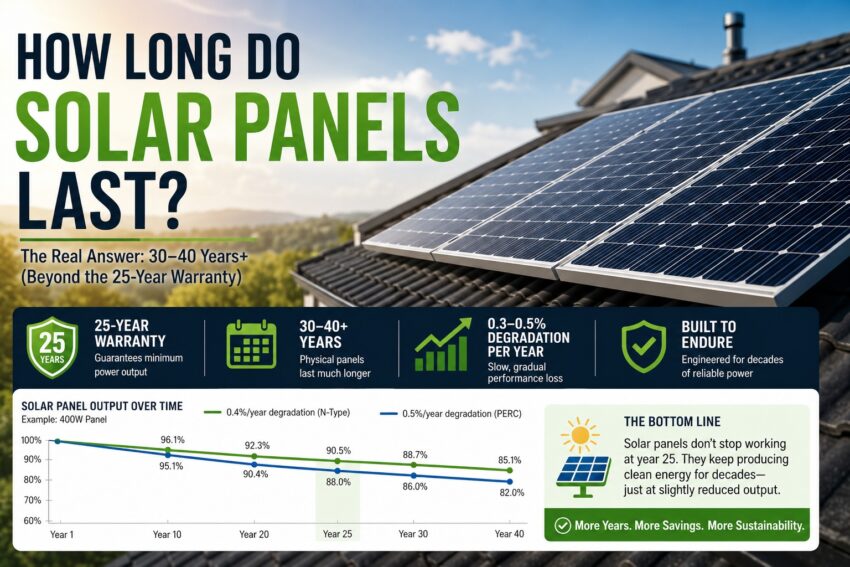
Ask any solar salesperson how long solar panels last and you’ll get “25 years” within about three seconds. That number comes from the industry-standard 25-year power output warranty — and it’s not wrong, but it tells you less than you might think.
Solar panels don’t stop working at year 25. They don’t switch off. What actually happens is more gradual and, in many ways, more encouraging: panels slowly lose a small percentage of their output each year through a process called degradation. A well-made panel at year 25 is still generating electricity — just somewhat less than it did on day one.
The more accurate answer is: the physical panels typically last 30–40 years or more. The warranty guarantees a minimum output level at year 25. The real question isn’t when they stop working — it’s when their output drops enough that replacement makes economic sense.
Solar Panel Degradation — What Actually Happens Over Time
Degradation is the gradual reduction in a solar panel’s output over time, caused by UV exposure breaking down encapsulant materials, thermal cycling creating microscopic mechanical stress, and chemical processes within the silicon reducing electron mobility.
The National Renewable Energy Laboratory (NREL) — the US government’s primary solar research institution — has tracked degradation across thousands of real-world installations. Their data shows a median degradation rate of 0.5% per year for crystalline silicon panels. More recent NREL data shows some modern panels degrading at as little as 0.3–0.4% per year.
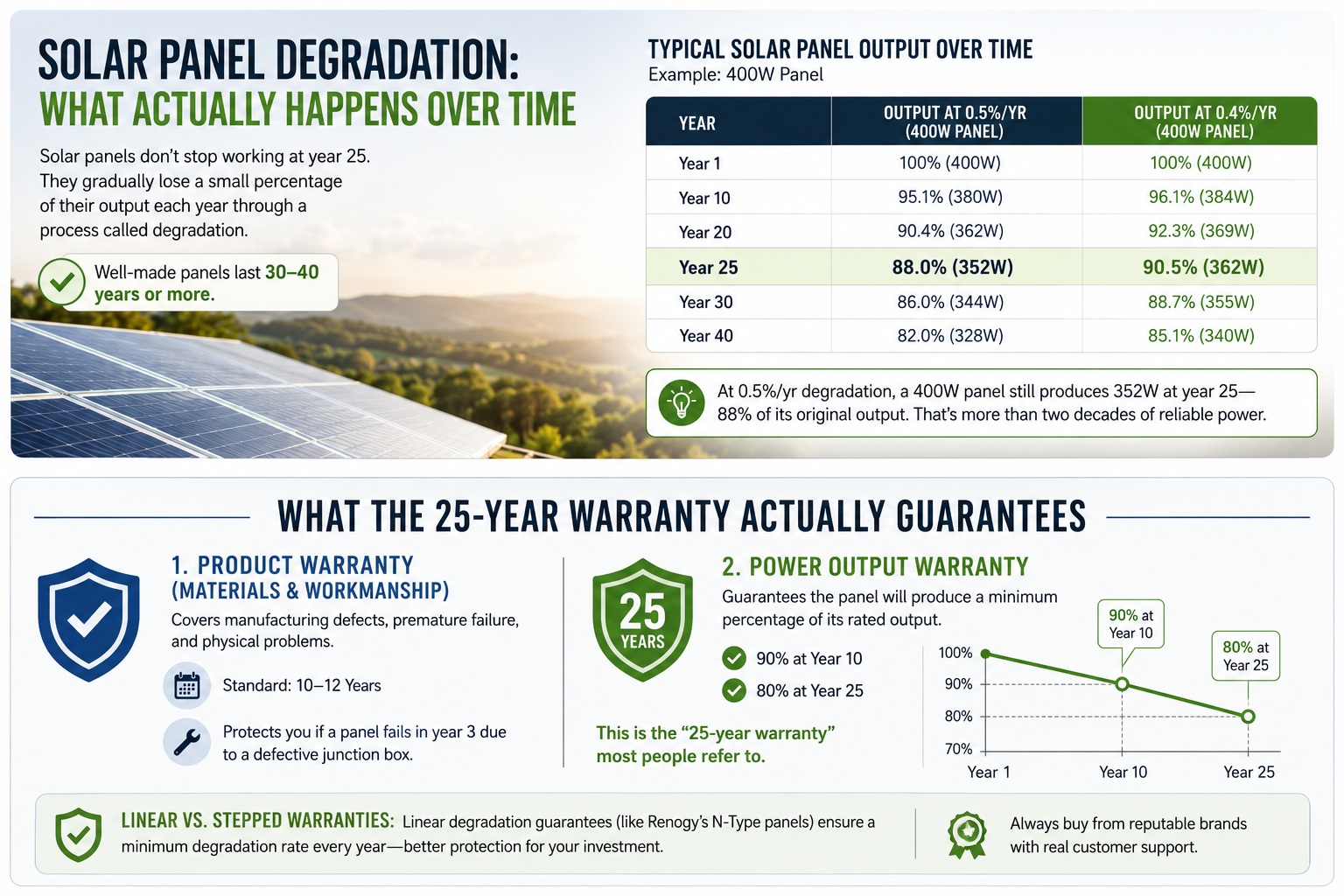
| Year | Output at 0.5%/yr (400W panel) | Output at 0.4%/yr (400W panel) |
|---|---|---|
| Year 1 | 100% (400W) | 100% (400W) |
| Year 10 | 95.1% (380W) | 96.1% (384W) |
| Year 20 | 90.4% (362W) | 92.3% (369W) |
| Year 25 | 88.0% (352W) | 90.5% (362W) |
| Year 30 | 86.0% (344W) | 88.7% (355W) |
At 0.5%/yr degradation, a 400W panel still produces 352W at year 25 — 88% of its original output. That’s not dramatic decline. That’s a system that still works well more than two decades after installation.
PERC vs. N-Type degradation: Current PERC monocrystalline panels typically degrade at 0.5%/yr. N-Type TOPCon panels — the current premium technology — degrade at 0.4%/yr or better. Over 25 years, that 0.1%/yr difference compounds to approximately 2.5% more lifetime energy from N-Type panels. See our high efficiency solar panels guide for the full N-Type vs. PERC comparison.
Light-induced degradation (LID): In the first few weeks of sun exposure, PERC panels experience a one-time efficiency drop of 1–3% from LID — caused by boron-oxygen defects in P-type silicon. N-Type silicon doesn’t contain boron and doesn’t experience LID, which is one of its meaningful technical advantages. This initial drop is factored into manufacturer ratings, so no practical action is needed.
What the 25-Year Warranty Actually Guarantees
Most panels come with two separate warranties:
The product (materials and workmanship) warranty covers manufacturing defects, premature failure, and physical problems. Standard product warranties are 10–12 years for quality brands. This is the warranty that protects you if a panel fails in year 3 due to a defective junction box.
The power output warranty guarantees the panel will produce a minimum percentage of its rated output at specific milestones — typically 90% at year 10 and 80% at year 25. This is the “25-year warranty” most people refer to.
Linear vs. stepped warranties: Older warranties used a stepped structure — guarantee 90% at year 10, then 80% at year 25, with no guarantees in between. Better modern warranties use a linear degradation guarantee — the panel must maintain a minimum degradation rate every year. Renogy’s N-Type panels carry a linear warranty. This is meaningfully better protection.
The practical reality of warranty claims: Most legitimate manufacturers honour claims straightforwardly for panels that fail within the product warranty period. Power output warranty claims are harder — they require testing equipment to prove output below the guaranteed level. Buying from established brands with real US customer support matters here. A no-name panel that appeared on Amazon in 2023 may not exist as a company when you try to make a claim in 2033.
Factors That Affect How Long Solar Panels Last
Climate and temperature extremes
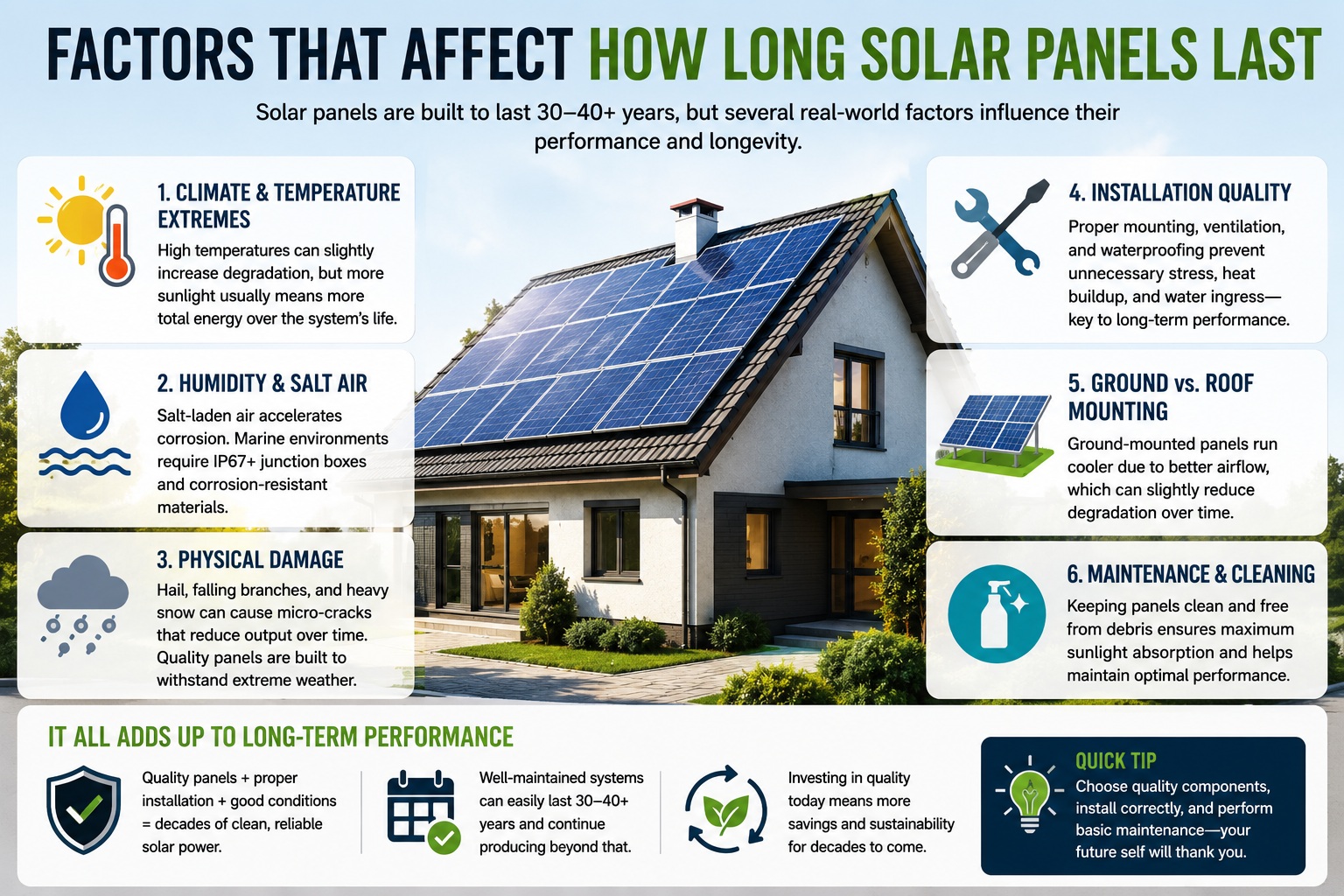
High ambient temperatures accelerate degradation slightly — panels in the desert Southwest degrade marginally faster than panels in the Pacific Northwest. However, hotter climates usually mean more sun hours, so additional degradation is often offset by higher total lifetime energy production.
Humidity and salt air
Marine environments are the most demanding for panel longevity. Salt-laden air accelerates corrosion of aluminium frames and junction box hardware. Panels used on boats and coastal installations should have IP67+ junction boxes and stainless steel mounting hardware. See our guide to flexible solar panels for marine-rated options.
Physical damage
Hail, falling branches, and heavy snow loads can cause micro-cracks in cells that aren’t immediately visible but gradually worsen output. Most quality panels are rated to withstand hail at 25mm diameter at 23m/s and snow loads of 5,400Pa. The glass surface is the most vulnerable component — chips or scratches compromise the UV-protective coating and accelerate encapsulant degradation.
Installation quality
Poor installation is probably the most common cause of premature panel problems. Incorrect mounting hardware torque creates stress points that crack glass or frames. Inadequate ventilation traps heat beneath panels and increases operating temperature. Poor waterproofing at cable entry points allows water to wick into junction boxes.
Ground vs. roof mounting
Ground-mounted panels generally run cooler than roof-mounted panels — better airflow beneath them and no heat-absorbing roof surface. Cooler operating temperature means slower degradation. Ground mounting also makes cleaning and inspection easier, which means it actually gets done. See our ground mounted solar panels guide for installation factors that affect longevity.
Panel quality
Quality brands using established cell manufacturers cluster at the lower end of the degradation range (0.3–0.5%/yr). Budget brands with unverified manufacturing can degrade at 0.7–1.0%/yr or worse — meaning 22–28% output loss by year 25 rather than 12%. See our cheap solar panels guide for how to identify quality budget panels vs. risky no-name alternatives.
Do Solar Panels Ever Just Stop Working?
Yes — but it’s rare for quality panels and usually involves a specific failure mode rather than general wear.
Junction box failure — The junction box on the rear of the panel is where internal wiring connects to MC4 connectors. Water ingress into a poorly sealed junction box corrodes connections and causes complete or intermittent failure. This is why IP rating matters. A failed junction box can often be repaired without replacing the whole panel.
Delamination — The clear encapsulant bonding cells to glass can separate over time with heat cycling and moisture. Shows as bubbles or separation between glass and the cell layer. Once significant, it can’t be reversed. Most common in lower-quality panels or panels exposed to sustained extreme heat.
Micro-cracks — Silicon solar cells are brittle. Physical stress from hail, foot traffic on roof panels, or poor handling creates hairline cracks that gradually expand and reduce output as broken cell portions stop contributing. Electroluminescence testing can map micro-cracks invisible to the naked eye.
Potential-Induced Degradation (PID) — A voltage-related phenomenon where high system voltages cause ion migration within the cell structure, reducing output. Manageable through proper system grounding and anti-PID charge controller features.
Catastrophic failure — A panel simply stopping entirely is relatively rare in quality panels within 25 years unless there’s specific physical damage or complete junction box failure. Most panels die slowly rather than suddenly.
How Long Do Solar Panels Last by Type?
PERC Monocrystalline (most common in off-grid consumer market)
Expected lifespan: 25–35 years of meaningful output. Degradation: 0.45–0.55%/yr. The benchmark for consumer off-grid solar — Renogy RNG-100D-SS and ECO-WORTHY 100W panels use this technology. Covers the full warranty period comfortably and continues producing useful power well beyond.
N-Type TOPCon Monocrystalline (current premium technology)
Expected lifespan: 30–40 years. Degradation: 0.3–0.4%/yr. No light-induced degradation. Better heat performance. Renogy N-Type 16BB and ECOBOSS panels use this technology — likely to outlast PERC equivalents by 5+ years of useful production.
Polycrystalline (older technology, rarely sold new)
Expected lifespan: 20–30 years. Degradation: 0.55–0.70%/yr. Multi-crystal grain boundaries accelerate degradation. If you have a pre-2015 system, these panels have less remaining life than monocrystalline equivalents of the same age.
Flexible Solar Panels
Expected lifespan: 5–15 years — significantly shorter than rigid alternatives. The flexible substrate degrades faster than tempered glass under UV. Appropriate where rigid panels physically won’t work — curved van roofs, boat decks — but shouldn’t be chosen over rigid panels when rigidity is an option. See our flexible solar panels guide for more detail.
Real-World Solar Panel Lifespan — What Studies Actually Show
NREL’s analysis of 54,500 solar systems found a median degradation rate of 0.5%/yr — but with meaningful variation. The best-performing panels showed rates below 0.3%/yr; the worst exceeded 1%/yr. Manufacturer quality matters enormously for actual long-term performance.
Perhaps the most striking real-world data comes from the oldest photovoltaic installations still operating. The Solar Electric Power Association has tracked systems from the 1970s and 1980s — panels now over 40 years old — and found many still producing 70–80% of their original rated output. These were early-generation panels using lower-efficiency technology than today’s monocrystalline cells. That modern silicon solar cells maintain useful output across four decades is genuinely remarkable.
A Lawrence Berkeley National Laboratory study tracking over 50,000 residential solar systems found median system performance ratio remained stable for the first 10+ years — confirming that well-installed systems don’t experience sharp early-life decline.
The conclusion from decades of field data: quality solar panels routinely outlast their warranties and can remain economically productive for 35–40 years in many installations.
When Should You Actually Replace Solar Panels?
Signs panels may need replacing:
- Output has dropped more than 20% from original rated output (verifiable by comparing monitored output to historical data)
- Visible delamination covering significant cell area
- Junction box damage, burning, or sustained moisture ingress
- Physical glass damage affecting large areas
- Panel producing significantly less than others in the same array under identical conditions
When replacement makes financial sense: At 0.5%/yr degradation, a panel at year 25 still produces 88% of its original output. If current panel prices are low (they’ve fallen dramatically over the past decade), replacing a 25-year-old panel with a new 25% efficient N-Type panel may make economic sense even if the old panel still works — the new panel produces significantly more from the same mounting position.
When cleaning or repair is enough: Dirty panels can reduce output by 10–25% — easily misidentified as degradation. Before assuming a panel needs replacement, clean it thoroughly and retest. Junction box failures are often repairable by a qualified solar technician for $50–$150 per panel — considerably cheaper than replacement.
How to Make Solar Panels Last Longer
Clean regularly. Dust, pollen, and bird droppings reduce output by 10–25%. Ground-mounted panels are easy to clean from ground level. Roof panels require more effort but the recovered output justifies it. Clean every 4–6 weeks during pollen season and at the start of each season.
Monitor output. A charge controller with Bluetooth monitoring gives you real-time and historical output data. Gradual output decline that deviates from weather-expected patterns indicates emerging problems — micro-cracks, junction box issues, shading from new growth — that are far easier to address early. Our solar charge controller guide covers monitoring features in detail.
Ensure adequate ventilation. Panels run hotter when heat can’t dissipate from the rear. Roof-mounted panels should have at least 3–4 inches of clearance beneath them. Every 10°C increase in operating temperature accelerates cell degradation.
Inspect annually. Walk the array once a year and look for cracked glass, discoloured or bubbling encapsulant, loose or corroded hardware, damaged MC4 connectors, and any new shading from vegetation. A 15-minute annual inspection catches problems before they become expensive.
Protect against shading. Shading a single cell in a string-wired panel can reduce output across the whole string. Trim vegetation annually to maintain clearance. If shading is unavoidable, module-level power electronics (microinverters or power optimisers) limit the impact to the shaded panel only.
Solar Panel Lifespan vs. Other System Components
| Component | Expected Lifespan | Notes |
|---|---|---|
| Solar panels (PERC) | 25–35 years | Gradual degradation, not sudden failure |
| Solar panels (N-Type) | 30–40 years | Lower degradation, no LID |
| MPPT Charge controller | 10–15 years | Replace when efficiency drops or features obsolete |
| String inverter (grid-tied) | 10–15 years | Most common replacement in residential systems |
| LiFePO4 battery | 10–15 years | 3,000–5,000 cycles to 80% capacity |
| AGM battery | 3–7 years | Far shorter than LiFePO4 at same daily cycling |
| Flexible solar panels | 5–15 years | Substrate degrades faster than glass |
| MC4 connectors | 20–25 years | Replace if corrosion visible |
| Wiring (UV-rated) | 25–30 years | Replace if cracking evident |
In most solar systems, the panels outlast everything else. The inverter or charge controller will need replacement at 10–15 years. The batteries will need replacement at 10–15 years (LiFePO4) or 3–7 years (AGM). The panels just keep producing. This is why the long-term economics of solar are so favourable — the primary energy-generating component has a multi-decade useful life.
For RV and off-grid battery sizing alongside your solar panels, see our RV solar battery charger guide and our off-grid solar system guide for complete system design.
Frequently Asked Questions
Do solar panels degrade faster in hot climates?
Yes, slightly — higher sustained temperatures accelerate chemical degradation processes within the silicon and encapsulant. However, the effect is modest: panels in Phoenix, AZ degrade perhaps 0.05–0.1%/yr faster than panels in Seattle, WA. The additional sun hours in hot sunny climates usually more than compensate for the marginally faster degradation rate in terms of total lifetime energy production.
Can solar panels last 40 years?
Based on field data from early installations, yes. Several installations from the late 1970s and early 1980s are still operational, producing 70–80% of original output. Modern monocrystalline panels degrade more slowly than those early generation panels, so there’s good reason to expect modern N-Type TOPCon panels to remain productive at 40+ years in suitable conditions.
Do solar panels lose efficiency every year?
Yes — degradation is ongoing, not a one-time event. But at 0.4–0.5%/yr, the annual loss is imperceptible in day-to-day monitoring. You’d need to compare output in year 1 to year 10 under identical conditions to see a clear difference. The cumulative effect over 25 years — roughly 12–13% total output reduction for quality panels — is meaningful but not dramatic.
What happens to solar panels after 25 years?
They keep working. The 25-year warranty expires, but the panel doesn’t. Output at year 25 is typically 87–90% of original rated output for quality panels. Many homeowners and off-grid users continue operating panels well past year 25 without replacement — particularly when the economics of replacement depend on panel prices and the actual measured output of existing panels.
Is it worth buying used solar panels?
With significant caution. Used panels from legitimate decommissioned installations can be excellent value — particularly from known brands with documented age and output history. The risks: unknown degradation history, possible hidden micro-cracks, no warranty coverage, and potential compatibility issues with modern charge controllers. If buying used, insist on brand identification and age documentation, test output before committing, and factor in that a 10-year-old panel has perhaps 15–20 years of meaningful life remaining rather than 25–30.
Final Thoughts
Solar panels last longer than almost anything else you’ll put on a roof or in a field. The 25-year warranty is a guaranteed floor — not a ceiling. Quality PERC panels routinely produce meaningful power at year 30. N-Type TOPCon panels are on track to push that to 35–40 years based on their superior degradation characteristics and accumulating field data.
The real lifespan questions aren’t about the panels — they’re about the rest of the system. Plan to replace your charge controller and batteries at 10–15 years. Budget for those replacements when calculating the long-term economics of a solar installation.
And maintain the panels. Clean them regularly. Monitor their output. Inspect annually. A solar panel that’s well-maintained will outlast the owner’s expectation — and in most cases, the building it’s mounted on.
For guidance on choosing the right panels for longevity — PERC vs. N-Type, brands worth trusting, and specs that predict long-term performance — see our high efficiency solar panels guide and our cheap solar panels guide for the full comparison. And if you’re starting a new off-grid system build, our monocrystalline solar panels guide covers everything you need to choose the right technology from day one.