
This post contains affiliate links. If you buy through our links we may earn a small commission — at no extra cost to you. This never influences our recommendations.
A hot attic isn’t just uncomfortable — it drives your AC to work harder, ages your roofing materials faster, and in humid climates can contribute to mold and mildew. A solar attic fan addresses all three problems at zero ongoing electricity cost, running entirely off its own panel. This guide covers how to size one correctly to your attic, what features actually matter, and the best fans for different attic sizes and climates.
How Much Cooling Difference Does a Solar Attic Fan Actually Make?
Real installation testing consistently shows meaningful results. One tester running a 42W unit in a 1,500 sq ft South Florida attic saw temperatures drop from 135°F to around 105°F during peak afternoon heat — noticeable within the first day of operation. Another test in Phoenix saw a 2,339 CFM fan drop attic temperature from 138°F to 102°F within 90 minutes of installation. As a general rule, expect a 15-20°F reduction in attic temperature with a properly sized fan — enough to measurably reduce how hard your AC works to cool the rooms below.
CFM Sizing — The Number That Actually Matters
CFM (cubic feet per minute) tells you how much air the fan moves, and matching it to your attic’s square footage is the single most important sizing decision you’ll make. The standard rule: 1 CFM per square foot of attic space as a minimum, 1.5 CFM per square foot in hot climates (Southwest, Deep South) where maximum air exchange matters more.
| Attic Size | Minimum CFM Needed | Recommended CFM (Hot Climate) |
|---|---|---|
| 800-1,000 sq ft | 800-1,000 CFM | 1,200-1,500 CFM |
| 1,500-2,000 sq ft | 1,500-2,000 CFM | 2,250-3,000 CFM |
| 2,500-3,000 sq ft | 2,500-3,000 CFM | 3,750-4,500 CFM (may need 2 fans) |
Don’t oversize by default. A high-CFM fan in a small attic doesn’t just waste money — it can overwhelm the space and create more noise than necessary, which matters if a bedroom sits directly beneath the attic. Match the fan to your actual square footage rather than assuming more CFM is automatically better.
Thermostat, Humidistat, and Hybrid Power — What Each Feature Does
Thermostat control is close to essential on any quality fan — it activates the fan automatically once attic temperature crosses a set point (typically 75-90°F, adjustable), rather than running constantly regardless of need. Without this, a fan can run pointlessly on cool days or through winter, adding wear with zero cooling benefit.
Humidistat control adds moisture-based activation on top of temperature — genuinely valuable in humid climates where mold and mildew are a real concern, since the fan can respond to humidity spikes even when temperature alone wouldn’t trigger it.
Hybrid (AC/DC dual power) models switch to a wall-powered backup at night or during extended cloudy periods, enabling 24/7 ventilation rather than solar-only daytime operation. This adds a small amount to your electric bill during backup operation but ensures continuous ventilation regardless of weather — worth it specifically for humid climates or homes with persistent attic moisture issues.
Brushless DC Motors — Why This Spec Matters
Brushless DC motors last 2-3x longer than older brushed motor designs and run noticeably quieter — this has become close to a standard feature on mid-range and premium solar attic fans as of 2026, and it’s worth confirming on any fan you’re considering rather than assuming all motors are equivalent.
Best Solar Attic Fans — Verified Picks
| Product | Wattage | CFM | Coverage | Best For |
|---|---|---|---|---|
| Remington Solar 30W | 30W | ~1,200 CFM | Up to ~1,500-2,000 sq ft | Best overall for most homes |
| VEVOR 42W | 42W | 2,800 CFM | Up to ~2,800 sq ft | Max airflow, larger attics |
| iLIVING HYBRID 40W | 40W | 1,150 CFM | Up to 2,900 sq ft | 24/7 hybrid operation, humid climates |
Best Overall: Remington Solar 30 Watt Roof Mount
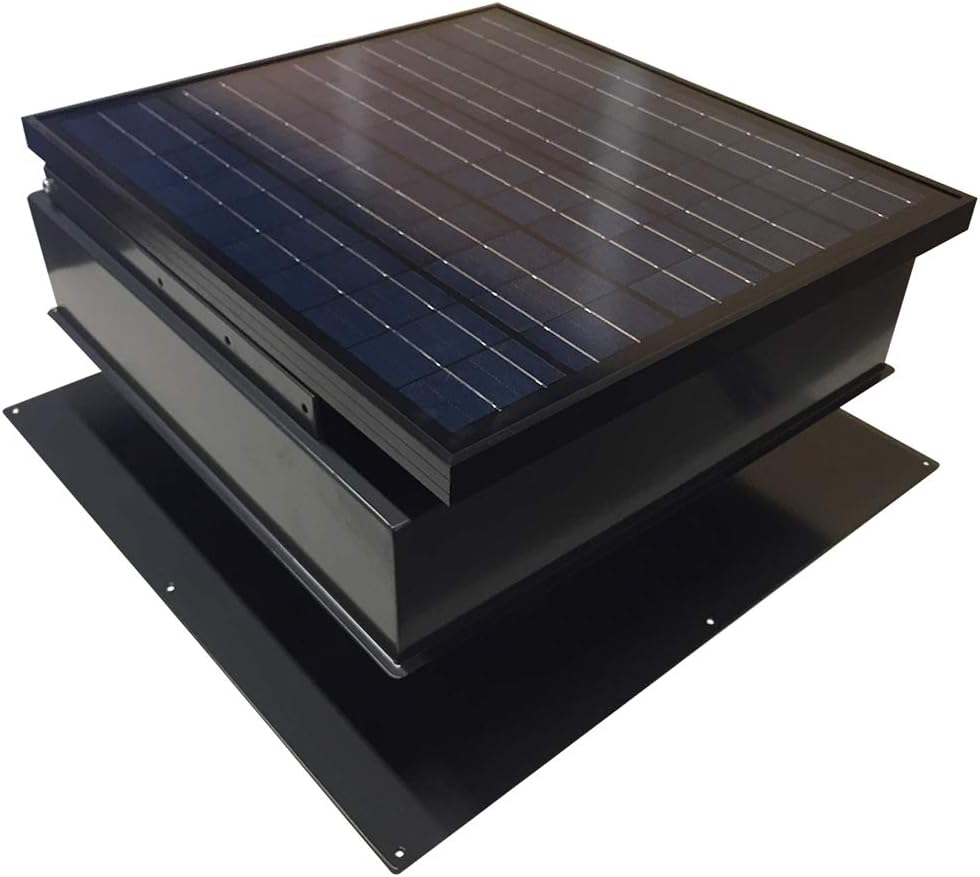
Remington’s 30W fan has earned five-star reviews from Arizona homeowners for over a decade, and it remains the most consistently recommended pick across independent testing for good reason — proven brushless DC motor technology, built-in automatic thermostat, and genuinely quiet operation that won’t bother anyone sleeping in a room below the attic. This is the fan you install once and don’t think about again for 15 years.
At roughly 1,200 CFM, it comfortably covers most 1,500-2,000 sq ft residential attics — the size range most single-family homes actually fall into. A 15-year warranty backs the build quality, and the roof-mount design suits hip-roof or segmented attic layouts common in most home construction.
Pros: Proven decade-plus track record, quiet brushless motor, automatic thermostat included, 15-year warranty, right-sized for most homes
Cons: Lower CFM ceiling than larger units — not sufficient for attics above ~2,000 sq ft; solar-only unless paired with the optional 110V night adapter
Best for: Most single-family homes with a standard-sized attic, buyers who want the most proven, lowest-risk option
Best Maximum Airflow: VEVOR 42W Solar Attic Fan
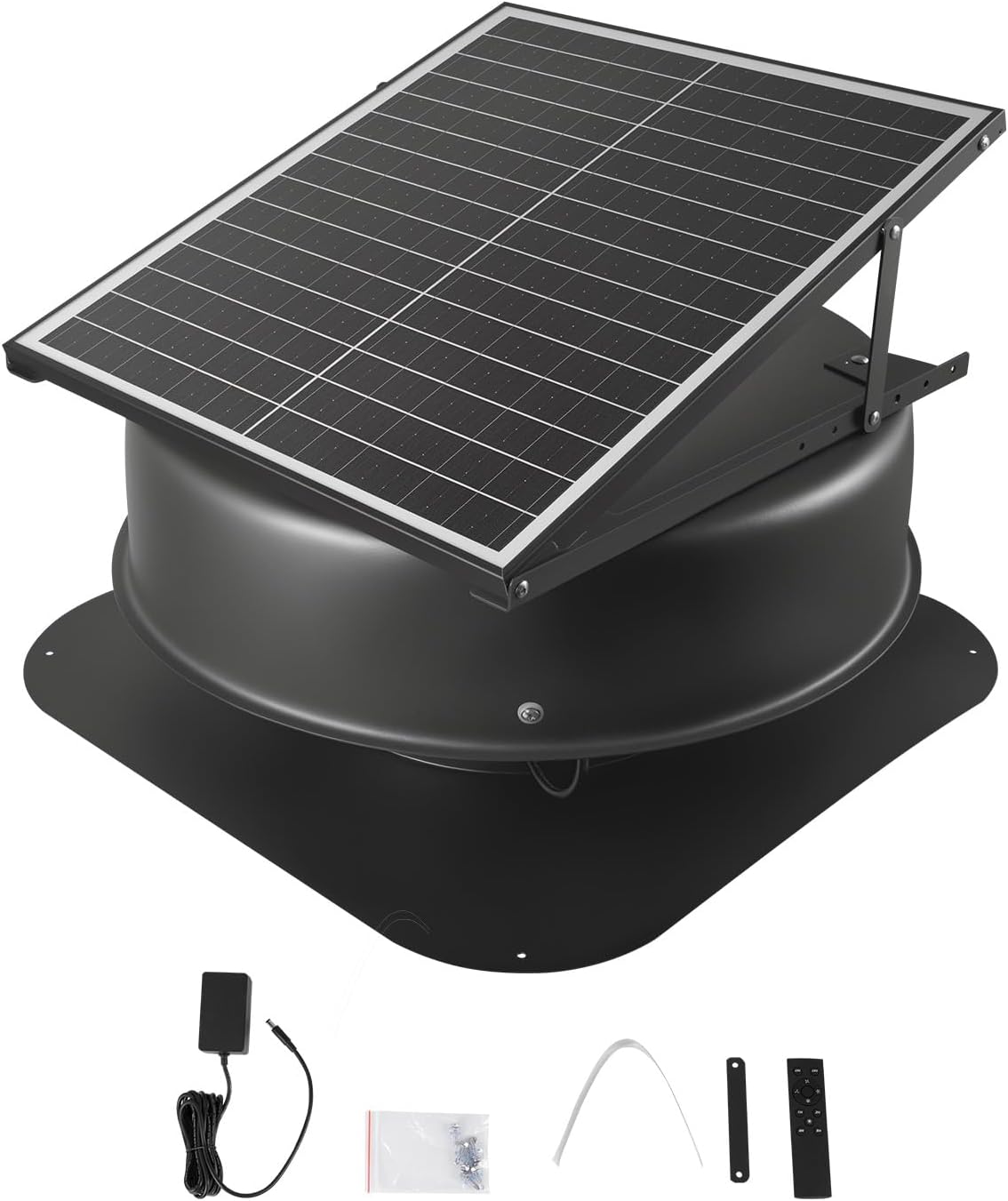
Nothing else at this price bracket moves as much air — 2,800 CFM makes the VEVOR 42W the clear choice for larger attics or homes in genuinely brutal summer climates where maximum air exchange matters more than quiet operation. Real-world testing in South Florida saw attic temperatures drop 30 degrees within the first day of use. The integrated MPPT solar regulator squeezes more usable power out of partly cloudy days than simpler PWM-based competitors, and built-in smoke detection automatically shuts the fan off if smoke is detected — a genuine safety feature most competitors skip.
The included 110V smart adapter enables night-time operation, and remote control lets you adjust settings without climbing into the attic. The trade-off for all this airflow: it can be overkill — and audibly louder — in smaller attics where a lower-CFM fan would do the job more quietly.
Pros: Highest CFM in this comparison (2,800), MPPT solar regulator for better cloudy-day performance, smoke detection auto-shutoff, remote control, 110V night adapter included
Cons: Can be excessive and noisier than necessary in smaller attics; higher price than the Remington
Best for: Large attics (2,000+ sq ft), hot climates (Southwest, Deep South), homes with genuinely severe attic heat problems
Best for Humid Climates and 24/7 Operation: iLIVING HYBRID 40W
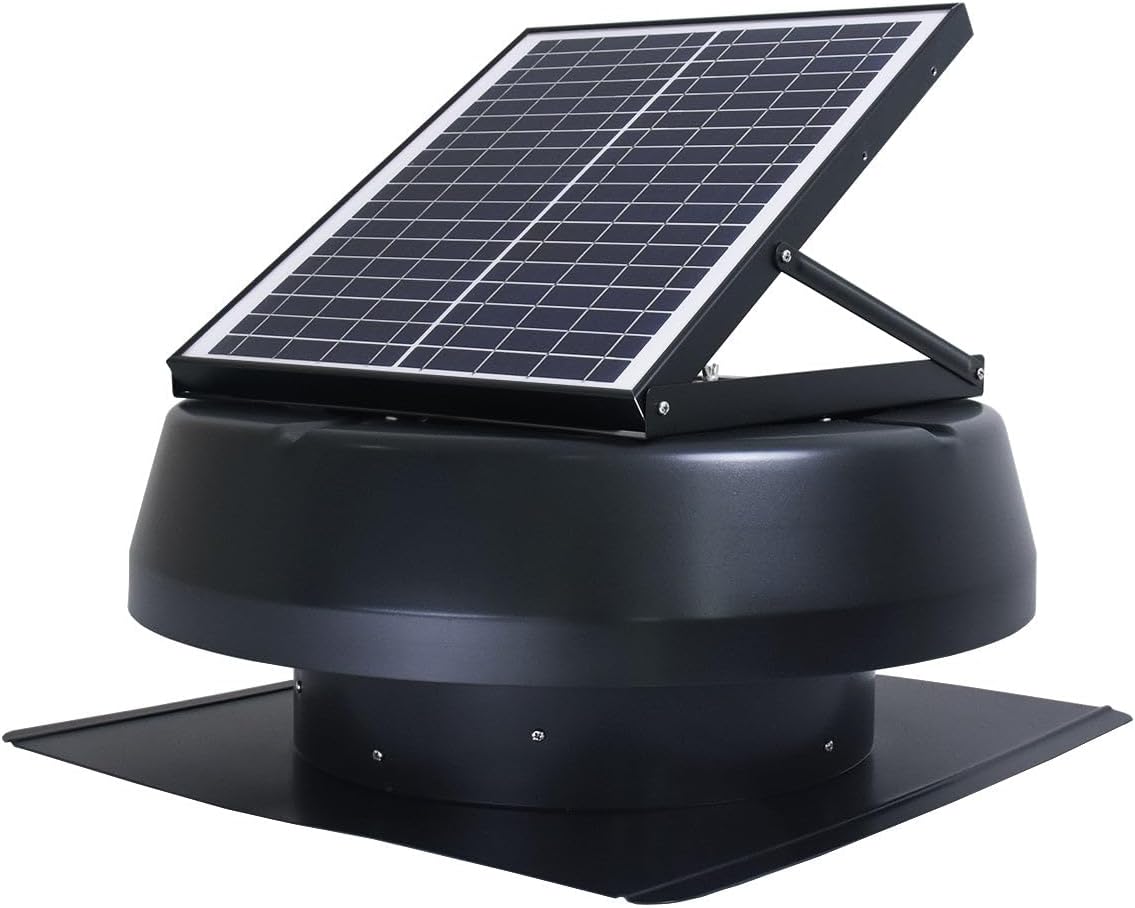
The iLIVING HYBRID earns its “Editor’s Choice” reputation across multiple independent reviews for balancing strong airflow with genuine round-the-clock capability — the included AC/DC adapter automatically switches to wall power at night or during extended cloudy stretches, so ventilation never simply stops when the sun goes down. This matters significantly in humid climates where nighttime moisture buildup is often the bigger mold and mildew risk, not just daytime heat.
The IP68 waterproof brushless motor and smart thermostat work together to keep the fan running only when needed, and the adjustable solar panel lets you optimize positioning for your specific roof angle. At 1,150 CFM covering up to 2,900 sq ft, it’s rated for a genuinely large coverage area relative to its wattage — a reflection of efficient motor design rather than just raw power.
Pros: True 24/7 hybrid operation via automatic AC/DC switching, IP68 waterproof brushless motor, adjustable solar panel, large coverage area relative to wattage, smart thermostat
Cons: Hybrid AC backup adds a small amount to your electric bill during backup operation; higher complexity than a solar-only fan
Best for: Humid climates prone to mold/mildew, homes needing genuine round-the-clock ventilation regardless of weather
Roof Mount vs Gable Mount
Roof-mounted fans install directly on the roof deck and suit hip-roof or segmented attic layouts — the more common configuration in modern residential construction, and what all three fans above use. Gable-mounted fans install in the triangular wall section at the end of a gable roof and work better for wide, open rectangular attic layouts where a gable vent already exists. Confirm which layout your home has before purchasing, since the mounting hardware differs between the two types.
Installation Basics
Proper installation requires adequate intake ventilation — typically soffit or gable vents — for the system to work as intended. A powerful exhaust fan without sufficient intake air simply struggles against itself, pulling conditioned air from your living space through ceiling gaps instead of pulling in fresh outside air through the intended intake vents. If your attic currently has limited soffit ventilation, address that alongside installing the fan itself for the system to perform as rated.
Frequently Asked Questions
How much does a solar attic fan actually lower attic temperature?
Real installation testing consistently shows a 15-20°F reduction in attic temperature with a properly sized fan, with some documented cases showing drops of 30°F or more under intense summer heat. The exact number depends on your fan’s CFM rating relative to your attic size, local climate, and existing intake ventilation.
What size solar attic fan do I need?
Use 1 CFM per square foot of attic space as a minimum baseline, and 1.5 CFM per square foot in hot climates where maximum air exchange matters. A 1,500 sq ft attic needs at least 1,500 CFM, or up to 2,250 CFM in a very hot climate. Check the sizing table above for common attic size ranges.
Do solar attic fans work at night?
Solar-only fans stop once the panel loses sunlight. Hybrid models with an AC/DC adapter switch to wall power automatically at night or during extended cloudy periods, enabling continuous 24/7 ventilation at a small electricity cost during backup operation. If nighttime ventilation matters for your climate (particularly humid regions), a hybrid model is worth the modest added complexity.
How long do solar attic fans last?
Solar attic fans typically last 15-25 years with proper maintenance. The solar panel itself usually lasts 20-25 years, gradually losing efficiency over time, while brushless DC motors are rated for significantly longer service life than older brushed motor designs.
Can a solar attic fan be too powerful for my attic?
Yes — an oversized fan in a small attic doesn’t provide proportionally better cooling and can create more noise than necessary, which matters if a bedroom sits directly below. Match the fan’s CFM rating to your actual square footage using the sizing guidance above rather than defaulting to the highest-CFM model available.
Final Verdict
| Your Situation | Best Pick |
|---|---|
| Standard-sized attic, want the most proven option | Remington Solar 30W Roof Mount |
| Large attic or brutally hot climate | VEVOR 42W Solar Attic Fan |
| Humid climate, need round-the-clock ventilation | iLIVING HYBRID 40W |
The Bottom Line
For most homes with a standard-sized attic, the Remington Solar 30W delivers proven, quiet, reliable cooling with a decade-plus track record behind it. Larger attics or severe summer heat call for the VEVOR 42W’s maximum airflow, while humid climates prone to nighttime moisture buildup benefit most from the iLIVING HYBRID’s true 24/7 operation. Whichever you choose, match CFM to your actual square footage and confirm adequate intake ventilation before installing — both matter more than any single feature on the fan itself.
For related off-grid and solar system content, see our off-grid solar system guide. For other solar accessories around the home, see our solar motion sensor lights guide.