This post contains affiliate links. If you buy through our links we may earn a small commission — at no extra cost to you. This never influences our recommendations.
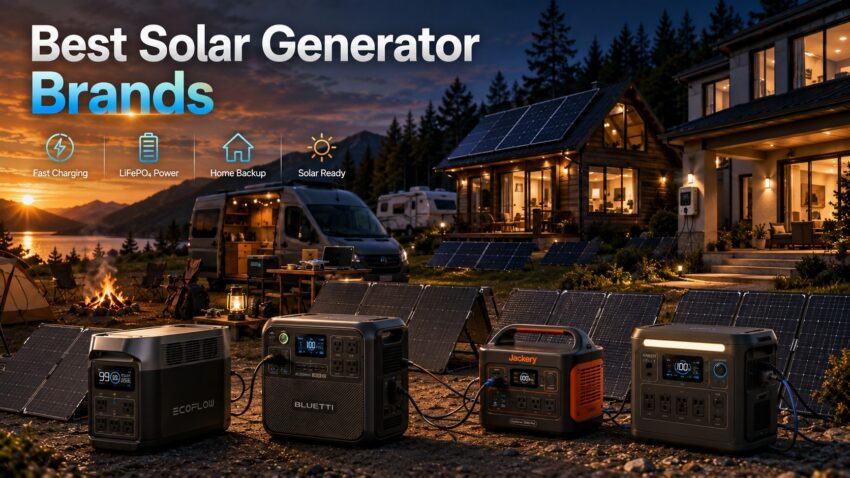
Four brands account for roughly 70% of all portable power stations sold today, and each has staked out a genuinely different philosophy rather than competing on identical specs. EcoFlow chases charging speed and software polish. Bluetti chases maximum capacity and expandability. Jackery chases simplicity and portability. Anker chases performance-per-dollar with newer engineering. This guide synthesizes independent testing, real owner data, and even first-party retailer return statistics to help you pick the right brand — not just the right model — for your situation.
The Core Philosophy of Each Brand
| Brand | Core Strength | Trade-Off |
|---|---|---|
| EcoFlow | Fastest charging, most polished app, best software ecosystem | Premium pricing at the high end |
| Bluetti | Highest capacity ceiling, best expandability, strong value at scale | Bulkier units, sometimes slower recharge than EcoFlow |
| Jackery | Simplest setup, lightest weight, easiest for beginners | Some models still use older NMC chemistry with lower cycle life |
| Anker | Best performance-per-dollar, fastest charging tech at mid-range | Newer to the category, less established track record |
Battery Chemistry — Read the Fine Print
This is genuinely important and easy to miss: not every model from every brand uses the same battery chemistry, even within a single brand’s current lineup. EcoFlow and Anker SOLIX consistently use LiFePO4 (LFP) chemistry across their current models, rated for 3,000+ cycles with sub-80-minute AC recharge times. Bluetti’s higher-capacity models (AC200MAX and similar) also use LiFePO4, though with somewhat slower recharge speeds than EcoFlow’s fastest units.
The one honest exception worth flagging: some Jackery models — including certain configurations of the Explorer 3000 Pro — still use NMC lithium chemistry rated for roughly 800-1,000 cycles, meaningfully lower than the 3,000+ cycle LFP standard the rest of the market has moved toward. Always confirm the specific battery chemistry on the exact model you’re considering rather than assuming “Jackery” automatically means LFP — the brand’s lineup includes both.
Real Return-Rate Data From a Retailer Stocking All Four
One especially useful data point comes from an outdoor gear retailer that carries all four brands and tracked actual 18-month return rates and failure modes across their customer base. Their findings: EcoFlow’s DELTA 3 Max Plus showed a notably low return rate, with the specific failure patterns they’d seen from Jackery and Bluetti units largely absent from that particular EcoFlow line. That same retailer added Anker SOLIX to their catalog specifically because of what their return data and customer feedback showed — not because of Anker’s marketing — a meaningful signal from a source with no incentive to favor one brand over another beyond what actually sells and doesn’t come back.
Real-World Solar Charging Performance
Independent hands-on testing found genuine gaps in real-world solar input performance that don’t always show up clearly on spec sheets. In one documented comparison, a Jackery unit’s solar input maxed out around 100-120W in cloudy conditions despite a higher rated ceiling, while a Bluetti AC200P exceeded 700W of solar input with two panels on a clear day. This kind of real-condition testing — rather than ideal-lab-condition marketing figures — is exactly why independent, hands-on reviews matter more than spec sheets alone when comparing solar charging speed across brands.
App Quality and Smart Features
Independent reviewers consistently rank EcoFlow’s app as the most polished and feature-complete in the category — real-time monitoring, granular charge-limit settings, and the deepest smart home integration of the four brands. Jackery’s app was specifically noted as functional but simpler, “lacking the polish and depth of EcoFlow” in direct comparison. Bluetti and Anker sit in between, covering the essentials without either the software depth of EcoFlow or the bare-bones simplicity of Jackery.
If app-based monitoring and smart automation genuinely matter to your use case — TOU (time-of-use) rate optimization, granular circuit monitoring, remote diagnostics — EcoFlow’s software advantage is real and consistently confirmed across independent sources.
Expandability and Home Backup Ceiling
For anyone planning to scale into serious whole-home backup, Bluetti and EcoFlow currently offer the most aggressive expansion ceilings — Bluetti’s higher-tier models scale to 8kWh+, while EcoFlow’s DELTA Pro 3 expands to 48kWh with additional battery packs. Anker’s SOLIX F3800 and Jackery’s newer flagship models (like the Explorer 3000 Pro with 120V/240V dual-voltage output) are closing this gap, but Bluetti and EcoFlow remain the reference points for maximum scalability as of current lineups.
240V Output — Increasingly a Dealbreaker Feature
By 2026, 240V dual-voltage output has become a genuine differentiator for home backup shoppers specifically — it’s what enables running a well pump, electric water heater, or central AC compressor directly from the unit rather than being limited to standard 120V outlets. Flagship models across all four brands (EcoFlow DELTA Pro 3, Jackery’s newer Explorer 3000 Pro-class units, and Anker’s SOLIX F3800) now offer this, but it’s notably absent from most mid-range models — confirm this specifically if a well pump or central AC is part of your backup plan, since it’s easy to assume a “flagship-adjacent” model has it when only the true top tier does.
Which Brand for Which Use Case
| Your Priority | Best Brand |
|---|---|
| Fastest charging, best app, apartment/rolling-outage backup | EcoFlow |
| Maximum capacity, best expandability for whole-home backup | Bluetti |
| Simplicity, lightest weight, easiest for a first-time buyer | Jackery |
| Best performance-per-dollar, fast mid-range charging | Anker |
| 240V well pump, electric water heater, or central AC | Flagship tier from any brand — confirm 240V support specifically |
| Camping and portability above all else | Jackery or Anker (lightest mid-range units) |
Frequently Asked Questions
Which solar generator brand is most reliable?
Independent retailer return-rate data specifically highlighted EcoFlow’s DELTA 3 Max Plus for notably low returns and an absence of failure patterns seen in some Jackery and Bluetti units during the same period. This is one data point from one retailer rather than industry-wide data, but it’s a genuinely useful real-world signal beyond marketing claims.
Do all four brands use the same battery chemistry?
Mostly, but not entirely. EcoFlow and Anker SOLIX consistently use LiFePO4 across current models. Bluetti’s higher-capacity models also use LiFePO4. Some Jackery models, including certain Explorer 3000 Pro configurations, still use older NMC chemistry with a meaningfully lower cycle life — always confirm the specific chemistry on the exact model you’re considering.
Which brand has the best app?
EcoFlow consistently ranks highest across independent reviews for app polish, monitoring depth, and smart home integration. Jackery’s app is functional but simpler. If software features and granular control matter to your use case, EcoFlow’s advantage here is real and well-documented.
Which brand charges fastest from solar panels?
This varies significantly by specific model rather than brand alone, and real-world testing sometimes contradicts spec sheets — one documented comparison found a Bluetti unit exceeding 700W of solar input with two panels on a clear day, while a comparably-rated Jackery unit maxed around 100-120W in cloudy conditions. Check independent hands-on reviews for your specific model rather than relying on rated maximums alone.
Which brand is best for whole-home backup?
Bluetti and EcoFlow currently offer the most aggressive expansion ceilings for scaling into whole-home backup, with EcoFlow’s DELTA Pro 3 reaching up to 48kWh with additional battery packs. If 240V output for a well pump or central AC matters, confirm this specifically on the exact flagship model — it’s not universal even within a brand’s top tier.
The Bottom Line
There’s no single “best” brand — each of the four dominant players built their product around a different priority, and the right choice depends entirely on what you’re optimizing for. Choose EcoFlow for charging speed and software polish, Bluetti for maximum capacity and expandability, Jackery for simplicity and portability (while confirming battery chemistry on the specific model), and Anker for the strongest performance-per-dollar with newer but well-reviewed engineering.
For the complete lineup breakdown of each brand, see our best Jackery solar generator guide, Anker solar generator guide, best EcoFlow solar generator guide, and best Bluetti solar generator guide. For use-case-specific sizing, see our solar generator for home backup guide, solar generator for camping guide, and solar generator for RV guide.