This post contains affiliate links. If you buy through our links we may earn a small commission — at no extra cost to you. This never influences our recommendations.
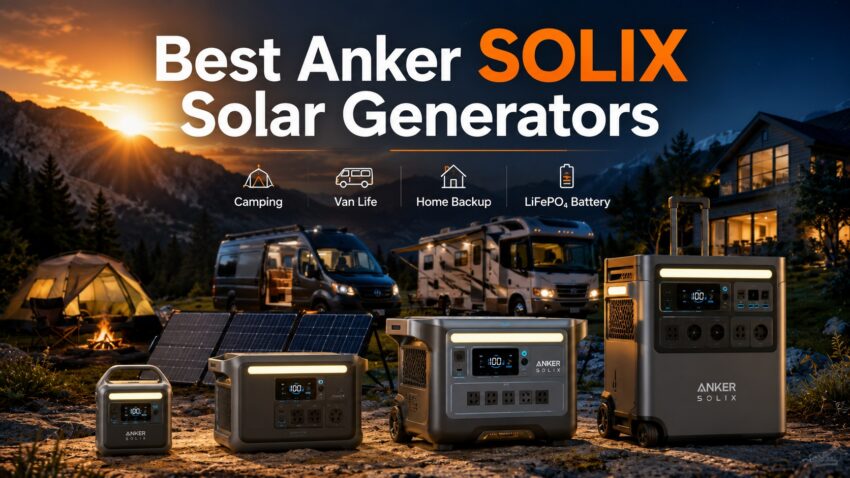
Anker’s SOLIX lineup has become one of the most competitive solar generator ranges on the market — but the number of models is genuinely confusing. C300, C800, C1000, C1000 Gen 2, F3000, F3800 — and that’s before you get into the expansion batteries and home backup kits. This guide maps the full lineup clearly, explains the difference between the Camping and Home series, and makes it straightforward to pick the right Anker solar generator for your actual use case.
The SOLIX Lineup Explained — Camping Series vs Home Series
Anker SOLIX breaks into two distinct product families with different purposes.
The C Series (Camping): C300, C800, C800 Plus, C1000, C1000 Gen 2, C2000 Gen 2. Portable power stations designed for camping, outdoor use, van life, and home backup for essential devices. Compact, carry-handle portable, capacity from 288Wh to 2,048Wh. All run on LiFePO4 batteries with 3,000–4,000 cycle ratings. Solar input maxes at 600W. The right choice for anyone who wants portable power they can move around.
The F Series (Home): F3000, F3800, F3800 Plus. High-capacity home backup systems with expandable battery packs, 120V/240V output, and solar input up to 3,200W. These are semi-portable units (wheels, but heavy) intended to replace a gas generator for whole-home backup. Capacity from 3,072Wh to 3,840Wh base, expandable to 24–53kWh with additional battery packs. For most camping and outdoor use cases, the F Series is overkill and the price reflects it.
Most people searching “Anker solar generator” are looking at the C Series. If you want whole-home backup power, jump to the F3800 section below.
Which Anker Solar Generator Is Right for You?
| Model | Capacity | AC Output | Solar Input | Charge Time | Best For |
|---|---|---|---|---|---|
| SOLIX C300 + Panel | 288Wh | 300W / 600W surge | 100W max | 50 min (AC) | Camping, day trips, travel |
| SOLIX C1000 | 1,056Wh | 1,800W / 2,400W surge | 600W max | 58 min (AC) | Weekend camping, RV, home backup |
| SOLIX C1000 Gen 2 | 1,024Wh | 2,000W / 3,000W surge | 600W max | 49 min (AC) | Van life, heavy camping, home backup |
| SOLIX F3800 | 3,840Wh | 6,000W / 120V+240V | 2,400W max | ~2 hrs (AC) | Whole-home backup, RV full hookup |
Best Anker Solar Generators — Verified Picks
Best Entry Kit: Anker SOLIX C300 + 60W Solar Panel
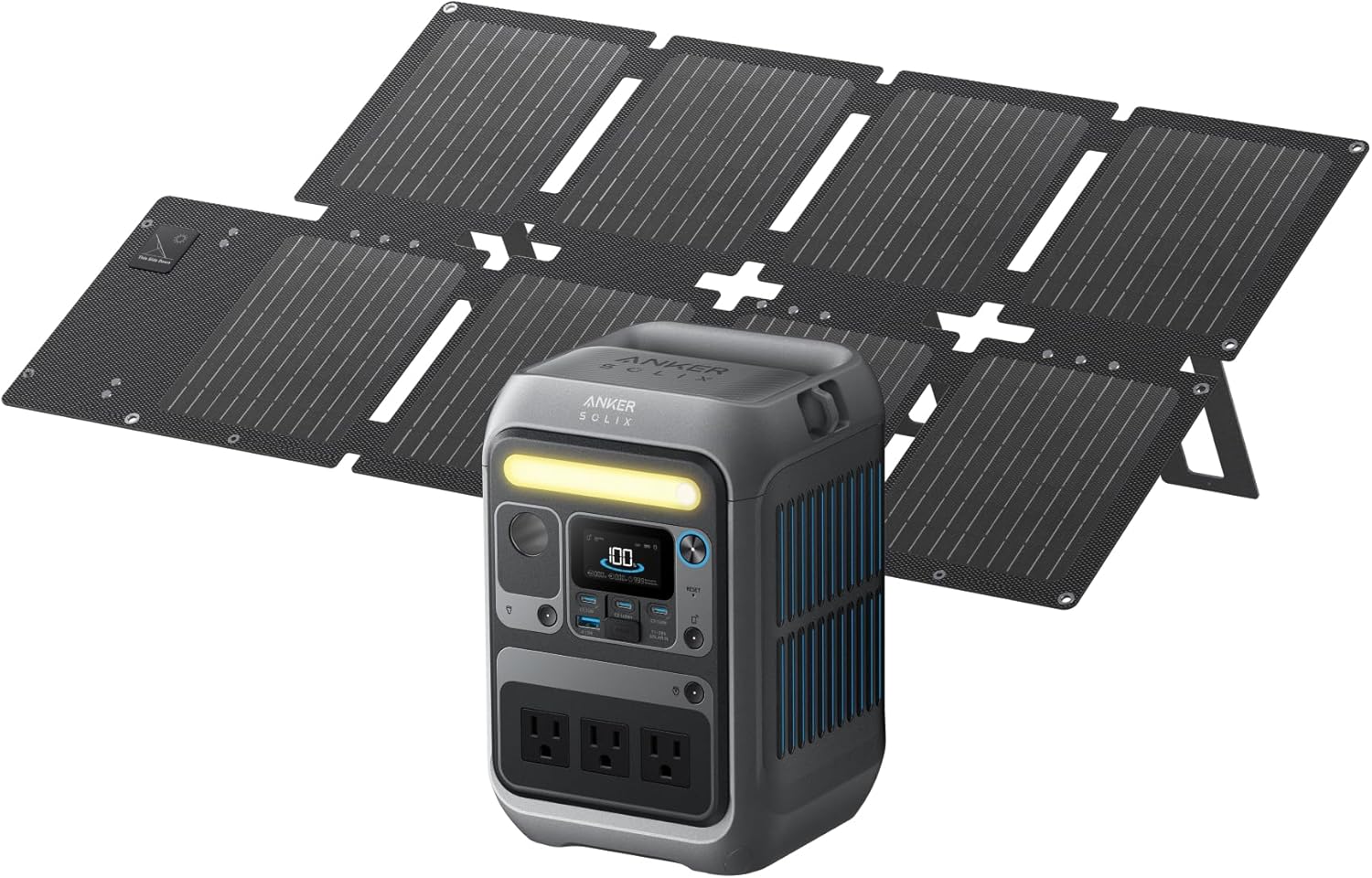
The cleanest starting point in the Anker lineup. 288Wh of LiFePO4 capacity, 300W continuous output (600W surge via SurgePad), and a 60W solar panel included in the box — everything you need to get started for under $300. At 25dB operating noise, it’s genuinely quiet enough to sit next to a sleeping bag. Weight is light enough to carry in a backpack on longer trips.
The 50-minute AC charge time is the standout spec for this capacity class — most 300Wh competitors take 4–5 hours via AC. The C300 goes to 80% in 50 minutes, making it practical to top up before leaving home even if you forgot to charge the night before. LiFePO4 battery rated for 3,000 cycles — roughly 10 years of regular use before capacity drops to 80%.
What it won’t do: run anything above 300W continuously, or power appliances for extended periods. A mini fridge (45W) runs about 5 hours; a laptop charges 3–4 times fully. For a weekend trip covering devices, lighting, and a portable fan — exactly right.
Pros: Complete kit with panel, 50-min AC charge, 600W surge capacity, 3,000 LFP cycles, 5-year warranty, genuinely quiet
Cons: 288Wh limits multi-day camping without solar recharge; 60W panel is slow recharge (5–6 hrs) — step up to a 100W panel for faster solar
Best for: Day trips, weekend camping, travel, emergency device charging at home
Best Mid-Range: Anker SOLIX C1000
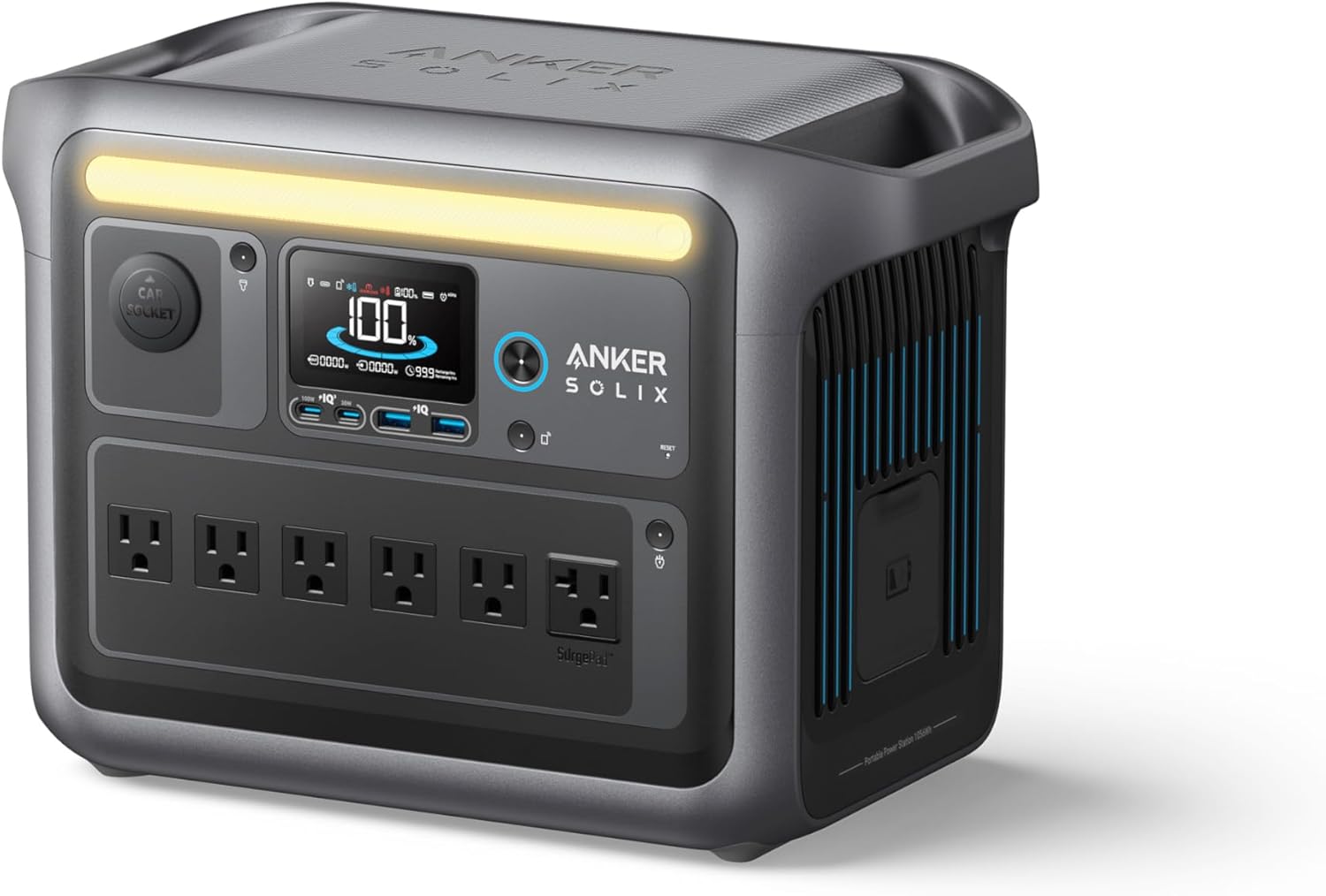
The C1000 is the sweet spot of the Anker lineup — 1,056Wh of capacity with 1,800W continuous output (2,400W surge via SurgePad) and 600W solar input that fully recharges in just 1.8 hours of good sun. At this capacity and output combination, it covers a compressor fridge running overnight, a CPAP for multiple nights without humidifier, a TV and laptop simultaneously, and meaningful home backup for essentials through a typical outage.
The 58-minute full AC charge sets it apart from competitors at this price — most 1kWh units take 90–120 minutes via AC. SurgePad technology means 99% of appliances can be powered without tripping the overload protection, including appliances with high startup surge. 11 output ports cover every real-world need: two AC outlets, two USB-C (100W), two USB-A, car outlet, and DC barrel ports. The Anker app gives real-time power monitoring and charging control.
The C1000 is the version to buy if you want a proven, well-reviewed model at this wattage class. The Gen 2 below is the upgrade if you specifically need the higher 2,000W continuous output or the improved 4,000-cycle battery rating.
Pros: 1,056Wh, 1,800W output, 600W solar input, 58-min AC charge, 11 ports, SurgePad, 10ms UPS, app control, 5-year warranty
Cons: 3,000-cycle battery — Gen 2 steps up to 4,000 cycles; 1,800W output slightly below Gen 2’s 2,000W
Best for: Weekend to week-long camping, RV use, CPAP users, home backup for essential devices
Best Upgrade: Anker SOLIX C1000 Gen 2
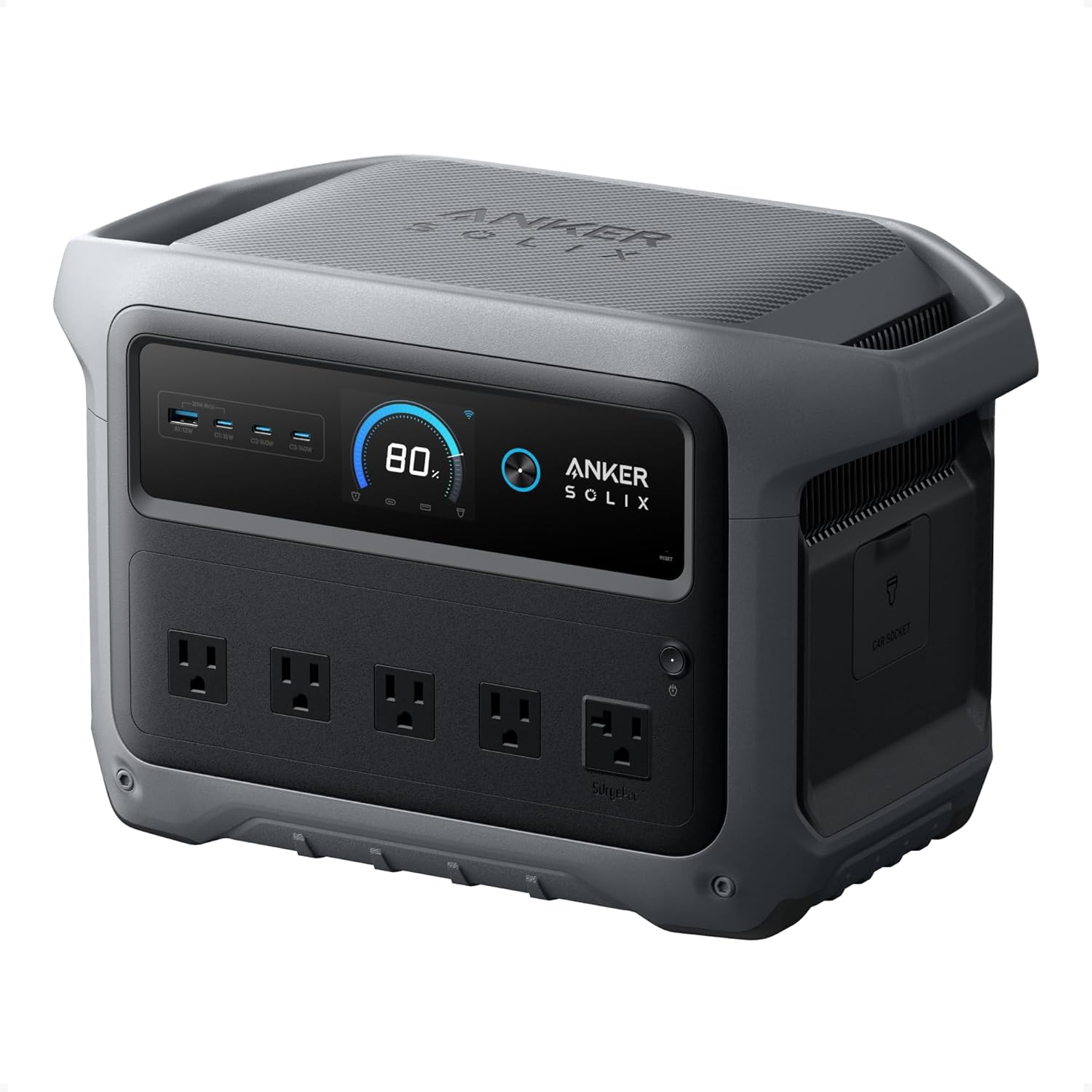
The Gen 2 improves on the original C1000 in three meaningful ways: 2,000W continuous output (up from 1,800W), 4,000-cycle battery rating (up from 3,000), and a 49-minute full charge time (down from 58 minutes). It’s 14% smaller and 11% lighter than comparable 1kWh units — the most compact packaging in its class. The battery rating translates to a genuine 10+ year usable lifespan with daily cycling.
The 2,000W continuous output opens up appliances that the original C1000 handles with less headroom — larger power tools, induction cooktops under 2,000W, and more demanding home appliances. The 10ms UPS switchover is identical to the C1000, keeping CPAP machines and computers running without interruption during power cuts. TOU (Time of Use) mode via the Anker app is a useful addition for people using it as a home battery to avoid peak electricity rates.
If the price difference between C1000 and C1000 Gen 2 is modest at time of purchase, the Gen 2 is the better long-term buy — the extra 1,000 cycles and faster AC charge will matter over years of use. For van life and full-time off-grid use particularly, the 4,000-cycle rating is the right investment. See our van solar guide for compatible panels to pair with the C1000 Gen 2.
Pros: 2,000W output, 4,000-cycle LFP battery, 49-min AC charge, 14% more compact than competitors, 10ms UPS, TOU mode
Cons: Higher price than original C1000; 1,024Wh capacity is marginally less than C1000’s 1,056Wh
Best for: Van life, frequent off-grid use, anyone who wants the longest-lasting mid-range solar generator available
Best for Home Backup: Anker SOLIX F3800
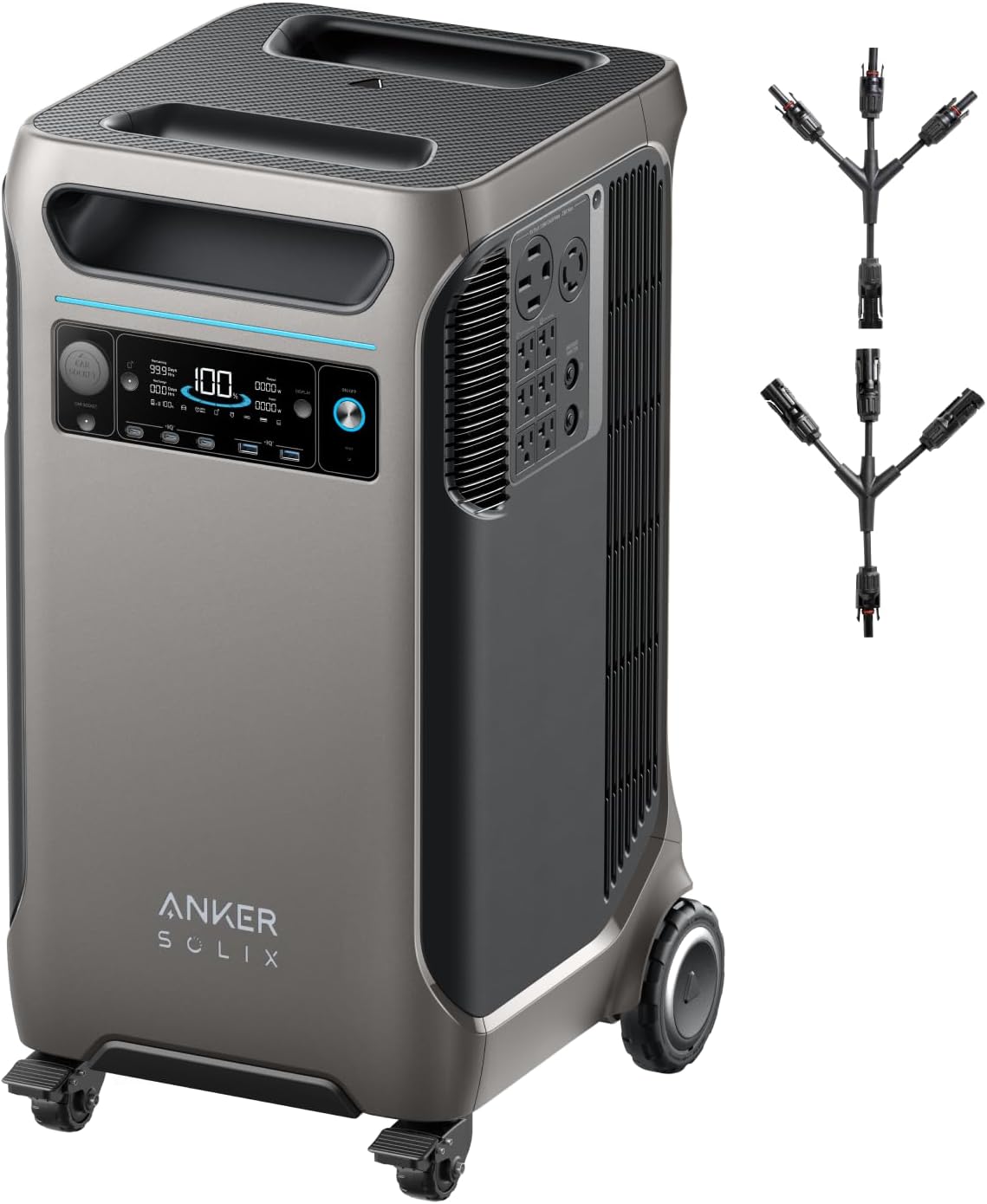
The F3800 is a fundamentally different category of product. 3,840Wh base capacity, 6,000W AC output, native 120V/240V support, and expandability up to 6 additional battery packs (23,040Wh total). This is the unit for whole-home backup — running a full-size refrigerator, window AC, sump pump, medical equipment, and lights simultaneously during extended outages. The NEMA 14-50 and L14-30 ports connect directly to an RV’s power inlet without adapters.
The 2,400W solar input (expandable to higher with optional accessories) fully recharges the base unit in approximately 1.6 hours of peak sun — fast enough to run indefinitely through a multi-day outage in reasonable sunlight. EV-class LFP batteries, Anker InfiniPower technology, and a 5-year warranty with a claimed 10-year lifespan reflect genuine engineering quality rather than marketing. This is not a camping unit — at its weight and price, it lives in the garage and comes out for emergencies. For the full breakdown of home backup sizing, see our solar generator for home backup guide.
Pros: 3,840Wh base, 6,000W output, 120V/240V, expandable to 23kWh, 2,400W solar input, NEMA 14-50 RV output, 10-year lifespan
Cons: Significantly higher price, heavy (not a carry-anywhere unit), overkill for camping or portable use
Best for: Whole-home backup power, extended outage coverage, full RV hookup replacement, serious off-grid homesteads
Anker SOLIX vs Jackery — How They Compare
The two most common alternatives at each price point are Jackery Explorer and Anker SOLIX. The honest comparison:
AC charge speed: Anker wins clearly — 49–58 minutes for the C1000 series vs 70–90+ minutes for equivalent Jackery models. If fast recharging matters, Anker is the pick.
Battery longevity: Anker C1000 Gen 2 at 4,000 cycles vs Jackery Explorer v2 series at 3,000 cycles. Both use LiFePO4. Anker has a marginal edge in rated cycle life.
Solar input: Both allow up to 600W solar input at the 1kWh class. Roughly equivalent for off-grid recharging speed.
Ecosystem and compatibility: Both brands have their own solar panels that plug in without adapters. Third-party panels work with both via MC4/XT60 adapters. Jackery has a larger and longer-established user community with more third-party accessory support.
App: Both have apps for monitoring and control. Anker’s app is generally rated slightly higher for real-time data and TOU functionality.
At similar price points, choose Anker if fast AC recharging is your priority. Choose Jackery if ecosystem breadth or a specific model’s specs better match your use case. For the full Jackery lineup comparison, see our portable power station guide.
What Solar Panel to Pair With an Anker SOLIX
Anker’s own SOLIX panels (PS60, PS100, PS200, PS400) are the plug-and-play options — XT60 connector, no adapter needed, and Anker warrants the combination. The PS200 and PS400 are rigid folding panels suited for fixed camp or home use; the PS60 and PS100 are portable and lightweight for backpacking and travel.
Third-party panels work with all SOLIX units via an MC4 to XT60 adapter (available from Anker or third-party). Important for the C300 specifically: only 11–28V panels are compatible — panels above 100W will cause a device malfunction. The C1000 and F3800 accept a wider voltage range (up to 60V for the C1000, higher for F3800). Always check the specific model’s solar input voltage ceiling before connecting any third-party panel.
For compatible third-party panels to maximise solar input, our 100W solar panel guide and 200W solar panel guide cover the options that work well with the SOLIX C Series.
Frequently Asked Questions
What is the best Anker solar generator?
For most buyers, the SOLIX C1000 Gen 2 offers the best combination of capacity, output, longevity, and portability — 1,024Wh, 2,000W output, 4,000 LFP cycles, and 49-minute AC charging. For whole-home backup, the F3800 is in a different category. For budget entry, the C300 + panel kit is the cleanest starting point.
Can the Anker SOLIX run a refrigerator?
The C1000 and C1000 Gen 2 can run a standard household refrigerator (100–400W draw) for 2–8 hours depending on the fridge’s efficiency and cycling. For keeping a fridge running through a full night’s outage, the C1000 is adequate if the fridge is reasonably efficient. The F3800’s 3,840Wh runs a full-size fridge for 24+ hours while powering other devices simultaneously.
How long does the Anker SOLIX C1000 last on one charge?
It depends on load. A laptop (60W) runs approximately 12 hours; a mini camping fridge (45W) runs 16–18 hours; LED lighting (20W) runs 40+ hours; a CPAP without humidifier (30W) lasts 2–3 nights. Use the formula: 1,056Wh × 0.85 ÷ device wattage = hours of runtime. The 0.85 accounts for inverter efficiency losses.
Does the Anker SOLIX work without solar panels?
Yes — every SOLIX unit charges via AC wall outlet, car outlet (12V), and solar. The AC charge is the fastest by far. Solar panels are optional — you don’t need them to use any SOLIX unit, but they’re what turn a portable power station into a true off-grid solar generator.
What’s the difference between the C1000 and C1000 Gen 2?
Three meaningful upgrades: the Gen 2 has 2,000W continuous output vs 1,800W, a 4,000-cycle battery rating vs 3,000 cycles, and charges fully in 49 minutes vs 58 minutes. It’s also 14% smaller and 11% lighter. At similar price points, the Gen 2 is the better long-term buy — particularly for frequent use where the extra battery cycles pay back over time.
Final Verdict
| Your Situation | Best Pick |
|---|---|
| Entry-level camping kit, complete setup | SOLIX C300 + 60W Panel (B0DBLJRRPW) |
| Best mid-range, proven model | SOLIX C1000 (B0C5C89QKZ) |
| Best upgrade, longest-lasting mid-range | SOLIX C1000 Gen 2 (B0FN7MSY4L) |
| Whole-home backup, RV hookup | SOLIX F3800 (B0C5C9HMQ2) |
For most buyers, the SOLIX C1000 Gen 2 is the right choice — 2,000W output, 4,000-cycle LFP battery, and 49-minute AC charge in a compact package. If budget is the priority, the C300 kit is the cleanest entry with panel included. For whole-home backup, the F3800 is in a different league — properly sized for running real home appliances through extended outages.
For a broader comparison across all major solar generator brands at each capacity level, see our portable power station guide. For home backup specifically, our solar generator for home backup guide covers sizing your system for real household loads.