This post contains affiliate links. If you buy through our links we may earn a small commission — at no extra cost to you. This never influences our recommendations.
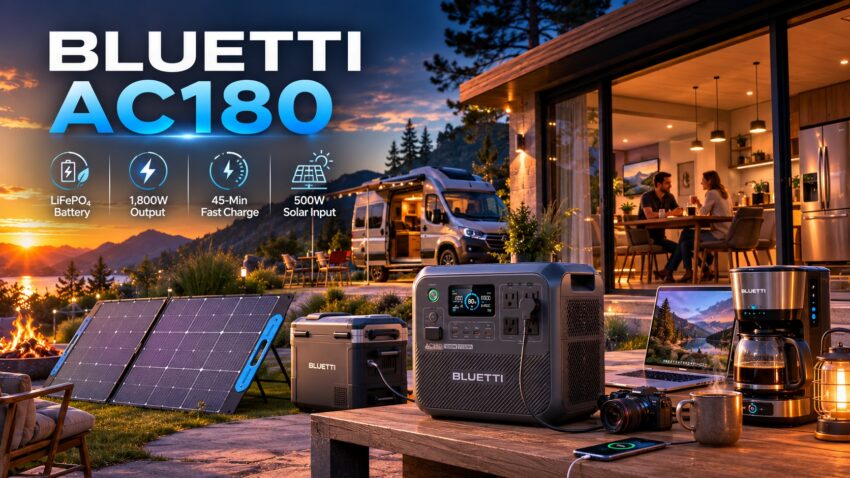
The AC180 disrupted the 1,000Wh-class market when Bluetti released it — more capacity and higher output than the Jackery and EcoFlow units that had dominated the category, often at a lower price. This review covers the full spec sheet, what independent lab testing actually measured versus the advertised numbers, and where it stacks up against the competition today.
Full Specifications
| Spec | BLUETTI AC180 |
|---|---|
| Capacity | 1,152Wh |
| Battery chemistry | LiFePO4 (LFP) |
| Cycle life | 3,500+ cycles to 80% capacity |
| AC output | 1,800W continuous |
| Surge output (Power Lifting mode) | 2,700W |
| AC charge (Turbo Charging, 0–80%) | ~45 minutes |
| Full AC charge | ~1.5–2.5 hours |
| Solar input (max) | 500W |
| Weight | 35–37 lbs |
| AC outlets | 4× NEMA 6-20P (20A/1,800W each, shared total) |
| USB ports | 4× USB-A (15W), 1× USB-C |
| Other outputs | 12V car port, wireless charging pad (15W) |
| UPS switchover | 20ms |
| Grounding port | Yes |
| App control | Yes — Bluetooth (offline) and Wi-Fi |
| Warranty | Standard Bluetti warranty (typically 2 years, extendable with registration) |
What Independent Testing Found — The Honest Efficiency Number
This is the most important finding in this review, and it’s one most spec-sheet summaries skip entirely. One independent lab ran the AC180 through a full discharge test at 80% load and measured actual delivered energy at 950Wh — roughly 18% below the advertised 1,152Wh rating, working out to about 82% real-world efficiency.
This isn’t unique to Bluetti — inverter conversion losses affect every portable power station to some degree, and 950Wh of genuinely usable capacity is still enough to run a portable stove top, recharge power tool batteries, and power lights through a full weekend of testing. But it’s worth knowing that the gap between rated and delivered capacity is larger than some competitors, and it’s a more honest number to plan around than the 1,152Wh spec-sheet figure.
Output: Power Lifting Mode Explained
The AC180’s native 1,800W continuous output would normally trip on a 2,500W space heater or similar high-draw resistive appliance. Bluetti’s “Power Lifting” mode, enabled through the app, addresses this by dropping voltage to extend usable surge capacity up to 2,700W for resistive loads — kettles, heaters, hair dryers. It’s worth understanding this is a voltage-management workaround rather than genuinely higher continuous output, and it works best specifically for resistive heating elements rather than motor-driven appliances.
In direct testing, the AC180 comfortably ran an induction stove and electric cooler simultaneously, and separately handled power tools like circular saws and table saws without issue thanks to the healthy surge headroom. Multiple testers confirmed the pure sine wave output is clean enough for sensitive electronics — laptops, medical equipment, and audio/video gear — without interference risk.
Charging Speed
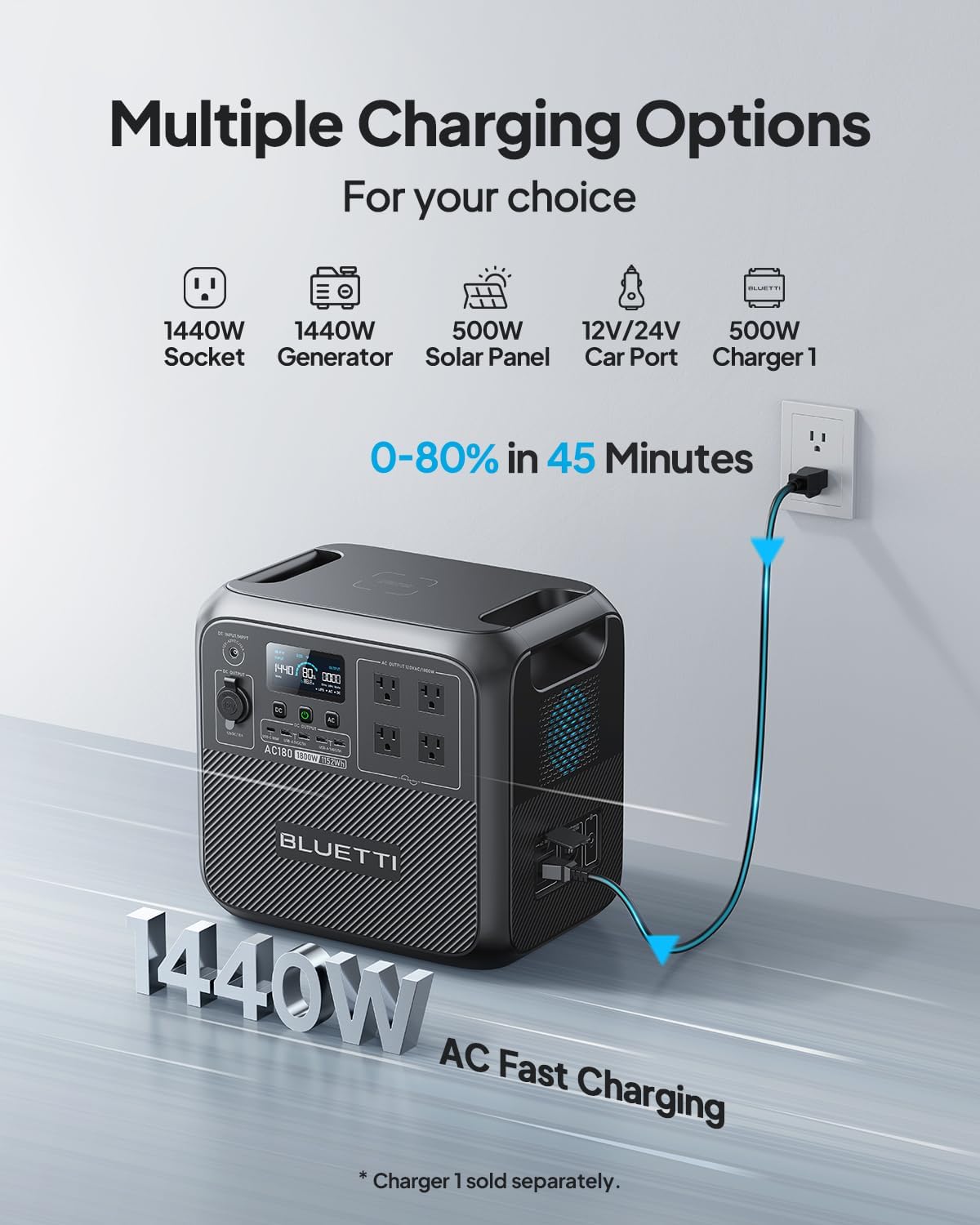
Via AC wall outlet using Turbo Charging (up to 1,440W input), the AC180 reaches 0–80% in approximately 45 minutes, with a full charge completing in roughly 1.5–2.5 hours depending on the specific testing conditions cited. This was a genuine competitive advantage when the AC180 launched, closing a charging-speed gap that used to separate Bluetti from EcoFlow.
Solar input maxes out at 500W, and with a suitably sized panel array, a full solar charge takes roughly 3–4 hours in good sun. This solar input ceiling is unusually high for this capacity tier — many competing 1,000Wh-class units cap solar input at 200–400W.
Battery Longevity
LiFePO4 chemistry rates the AC180 for 3,500+ complete cycles to 80% capacity retention — a class-leading figure at the time of release, ahead of the EcoFlow Delta 2’s 3,000-cycle rating and dramatically ahead of NMC lithium-ion units rated for only 500–800 cycles. At one full cycle per day, that translates to nearly 10 years of daily use before meaningful degradation; for typical outage-prep use (charging a few times per month), the battery should comfortably outlast a decade.
Real-World Runtime
| Device | Estimated Runtime |
|---|---|
| Full-size refrigerator | 12–18 hours |
| Laptop charging | 17+ full charges |
| Wi-Fi router | 40+ hours |
| CPAP machine | Multiple nights (varies by humidifier use) |
| Mini/portable fridge | ~20–24 hours |
These figures are consistent across multiple independent reviewers and align reasonably well with the ~950Wh real-world usable capacity measured in lab testing, once inverter efficiency is factored into the math.
Build Quality and Design
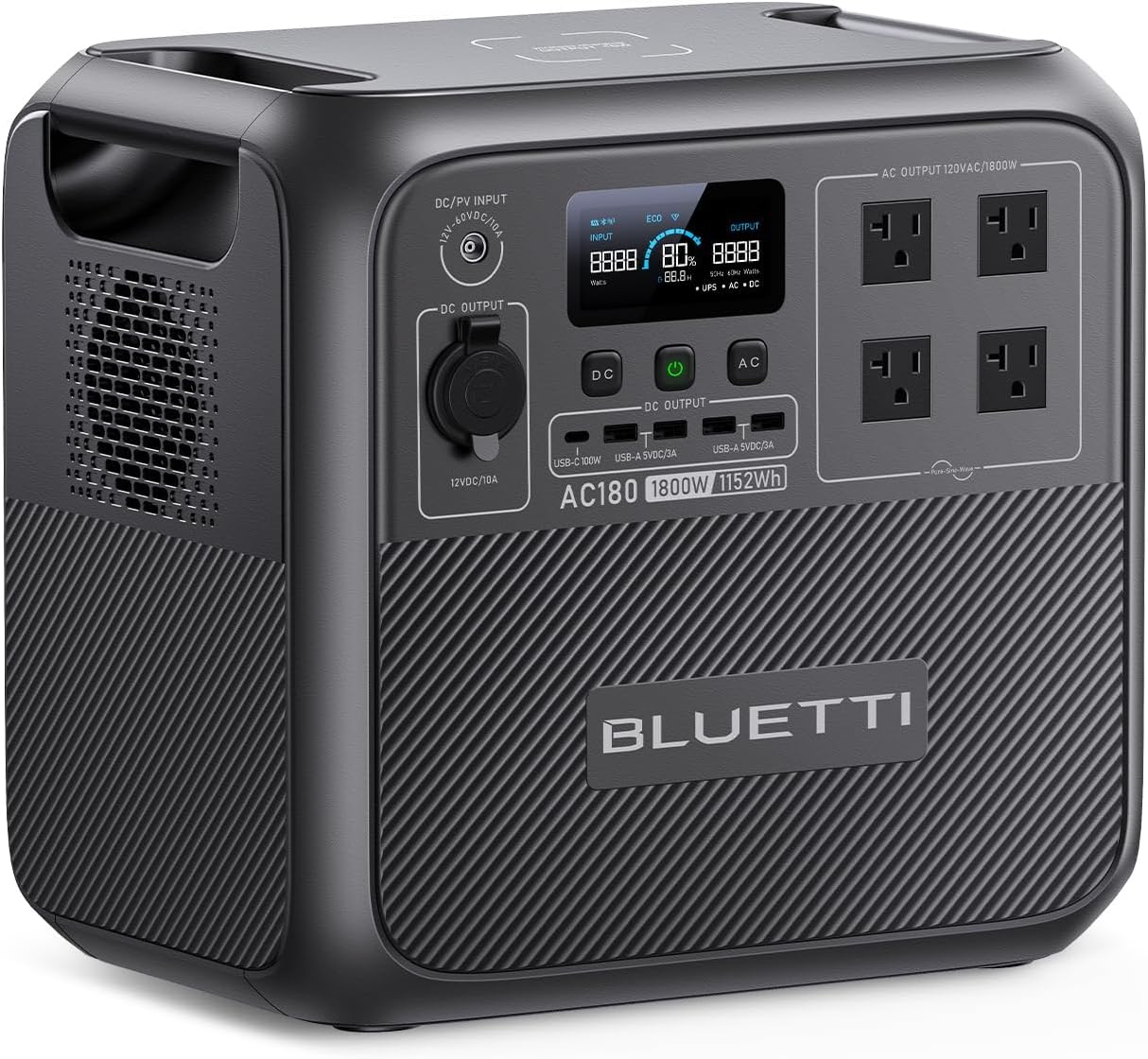
Reviewers consistently note the AC180’s textured finish resists scratches better than glossier competitors, and rubberized feet provide genuine grip — useful when running vibration-heavy tools like circular saws. The integrated handle stays comfortable for carries up to roughly 100 yards before hand fatigue sets in. The display is a notable improvement over Bluetti’s earlier touchscreen units, offering clearer, more legible information at a glance.
The 4 NEMA 6-20P outlets are well-spaced enough to accommodate large wall-wart plugs without blocking adjacent sockets — a small but frequently overlooked detail on competing units. A dedicated grounding port is a genuine safety-conscious touch that many competitors skip entirely.
Honest Drawbacks
Weight: At 35–37 lbs, the AC180 is meaningfully heavier than the EcoFlow Delta 2 (roughly 8 lbs lighter) and the original Jackery Explorer 1000 (22 lbs) — a real trade-off for anyone prioritizing portability over raw capacity and output.
Fan noise: Multiple reviewers noted the cooling fans run more aggressively than Jackery competitors, even during moderate charging — worth knowing if quiet overnight operation near sleeping areas matters to you.
Wireless charging pad: Functional at its rated 15W, but most reviewers consider it more of a nice-to-have than a genuinely useful feature, especially given the trade-off of only a single USB-C port rather than two.
No expandability: The base AC180 has fixed capacity with no battery expansion option — if your needs might grow, this is worth factoring in before buying (Bluetti’s step-up models address this).
20ms UPS switchover: Functional for general use, but some reviewers noted hesitancy in relying on this specifically for the most sensitive electronics, where a faster switchover would offer more confidence.
AC180 vs the Competition
| Comparison | Verdict |
|---|---|
| vs Jackery Explorer 1000 (original) | AC180 wins on output, charge speed, and cycle life; Jackery wins on weight (22 lbs vs 35–37 lbs) |
| vs EcoFlow Delta 2 | AC180 wins on capacity and typical price; EcoFlow wins on weight and app polish |
| vs Anker SOLIX C1000 Gen 2 | Anker charges faster and offers more granular app control; AC180 typically wins on price during sales |
For the current-generation Jackery and EcoFlow comparisons at this capacity, see our Jackery Explorer 1000 v2 review and best EcoFlow solar generator guide. For Anker’s full lineup, see our Anker solar generator guide.
Note on Newer Bluetti Models
Bluetti has continued iterating in this capacity class since the AC180’s release. The AC180P upgrades the formula with a larger 1,440Wh battery, an even higher 500W solar input ceiling as standard, and slightly faster Turbo Charging. Bluetti has also released the Elite 100 V2 as a lighter, quieter successor with faster charging, at a modestly lower capacity (1,024Wh). If weight or charging speed are dealbreakers for you specifically, it’s worth comparing current pricing on these newer models against the original AC180 before deciding.
Who Should Buy the AC180
Best for:
- Weekend campers running a mini-fridge, lights, and device charging without needing a powered campsite
- Short-duration home outage backup (3–18 hours) — router, laptop, phone, lights, and a fridge
- Part-time van lifers and RV travelers wanting a couple of days of capacity, extendable with solar
- DIY and van-build projects needing power tools on location
- Buyers who want maximum capacity and output for the price, and don’t mind the extra weight
Consider alternatives if:
- Portability is the top priority — the EcoFlow Delta 2 or Jackery Explorer 1000 v2 are both notably lighter
- You want battery expandability — look at Bluetti’s higher-tier models or a competitor with a modular battery system
- Fastest possible charging matters most — Anker’s SOLIX C1000 Gen 2 edges it out
Frequently Asked Questions
Can the Bluetti AC180 run a refrigerator?
Yes — independent testing and real-world reports consistently show the AC180 running a standard full-size refrigerator for 12–18 hours per charge, or a mini/portable fridge for 20–24 hours, depending on the fridge’s efficiency and cycling pattern.
Does the Bluetti AC180 actually deliver its full 1,152Wh capacity?
Not quite — independent lab testing measured roughly 950Wh of usable energy under an 80% load test, about 82% efficiency. This gap between rated and delivered capacity is normal for inverter-based power stations, but it’s worth planning around the ~950Wh figure rather than the full spec-sheet number for accurate runtime expectations.
How long does the Bluetti AC180 take to charge?
Via AC wall outlet with Turbo Charging enabled, it reaches 0–80% in approximately 45 minutes, with a full charge in roughly 1.5–2.5 hours. Solar charging with a 500W-capable panel setup takes about 3–4 hours in good sun.
Is the Bluetti AC180 good for CPAP use?
Yes — the pure sine wave output and 20ms UPS switchover make it suitable for CPAP use through multiple nights per charge, with exact runtime depending on whether a heated humidifier is in use. For detailed CPAP-specific sizing across multiple units, see our solar generator for CPAP guide.
What’s the difference between the AC180 and AC180P?
The AC180P is Bluetti’s upgraded variant with a larger 1,440Wh battery (versus 1,152Wh), a higher standard solar input ceiling, and modestly faster Turbo Charging. AC output remains 1,800W on both. The AC180P typically costs more but delivers meaningfully more capacity and faster charging for buyers who want the upgrade.
The Bottom Line
The AC180 earned its reputation as one of the strongest value picks in the 1,000Wh-class category — high output, fast charging, and class-leading cycle life at a competitive price. The honest caveats are real weight (35–37 lbs), louder fan noise than some competitors, and a genuine gap between advertised and delivered capacity that independent testing confirmed. For weekend camping, short-duration outages, and van life use where raw capacity and price matter more than shaving every pound, it remains a smart buy.
Check the BLUETTI AC180 on Amazon →
For a direct comparison against other units at this exact capacity, see our best 1000W solar generators for the money guide. For refrigerator and CPAP-specific sizing, our solar generator for refrigerator guide and solar generator for CPAP guide cover the exact runtime math for those use cases.