
This post contains affiliate links. If you buy through our links we may earn a small commission — at no extra cost to you. This never influences our recommendations.
Generic runtime calculators get this wrong constantly. They take a fridge’s “200W” label, divide it into a battery’s watt-hours, and spit out a number that has almost nothing to do with reality. Real refrigerators have duty cycles, startup surges, and standby drain that change the math completely — and getting the sizing wrong means either wasted money on unnecessary capacity, or a fridge that trips the inverter the moment the compressor kicks on.
This guide covers how to size a solar generator for a refrigerator correctly, the surge wattage trap that catches most first-time buyers, and the best units for different fridge types and outage lengths.
The Two Numbers That Actually Matter
Every refrigerator has two distinct power personalities, and sizing for only one of them is the most common mistake people make.
Running watts is what the compressor draws once it’s actively cooling — typically 80–150W for a modern energy-efficient fridge, 150–400W for an older unit (pre-2010) or a large side-by-side. This is the number on the energy label, and it’s the one most people size around. It’s also the less important number.
Surge watts (startup wattage) is the brief spike — usually just 1–2 seconds — when the compressor motor first kicks on. Getting a stationary motor spinning against inertia takes far more power than keeping it spinning. This surge is typically 2–3 times the running wattage, and can reach 1,200–2,000W even on a fridge that only draws 150–200W once running.
The rule that matters most: your solar generator’s continuous AC output (or surge/peak rating, depending on the unit) must exceed your fridge’s surge wattage — not just its running wattage. Size for running watts only, and the unit will trip its overload protection the instant the compressor tries to start.
How to Find Your Fridge’s Actual Power Draw
Check the energy label — usually inside the fridge, on the back near the compressor, or in the owner’s manual. It typically lists either wattage directly, or volts and amps (multiply them together for running watts). If the label doesn’t state surge wattage, use the 2–3x running watts estimate, or check the compressor’s “LRA” (Locked Rotor Amperage) rating if listed — multiply LRA by voltage for a precise surge figure.
For the most accurate number, a simple plug-in power meter (under $20) tracks actual real-time draw over 24 hours, capturing both the running average and the surge spikes as they happen. This is the most reliable method if you want to size precisely rather than estimate.
Battery Capacity — Sizing for a Full Day, Not Just “Running”
Refrigerators cycle on and off — most run the compressor for roughly 8–12 hours out of every 24, not continuously. That cycling is actually good news for sizing, but the duty cycle varies enough by fridge age, ambient temperature, and how often the door opens that a rule-of-thumb estimate needs a healthy buffer.
| Fridge Type | Daily Energy Use | Minimum Battery for 24hr |
|---|---|---|
| 12V portable/car fridge (efficient DC) | 300–600Wh | 500–700Wh |
| Modern energy-efficient full-size fridge | 1,000–1,500Wh | 1,200–1,800Wh |
| Older/standard full-size fridge | 1,500–2,400Wh | 2,000–2,800Wh |
| Full-size fridge + chest freezer | 2,500–4,000Wh | 3,000–4,500Wh |
Add a 25–30% buffer beyond your calculated daily use. This covers inverter conversion losses (batteries deliver roughly 85–90% of rated capacity as usable AC power), compressor surges, a fuller-than-expected duty cycle, and any extra devices you didn’t account for. A fridge alone might calculate to 1,200Wh — but sizing to exactly 1,200Wh leaves zero margin, and you’ll be anxious by hour 20.
Solar Panels — What You Need for Indefinite Runtime
A battery alone gets you through a defined window before it’s empty. Add solar panels sized to match your fridge’s daily consumption, and the fridge can run indefinitely — recharging during the day covers what it used overnight and through cloudy stretches.
For a standard full-size fridge using roughly 1,200–1,500Wh per day, 400W of solar panels (two 200W panels, or an equivalent array) is the practical target. In 4–5 hours of decent sun, that produces 1,600–2,000Wh — enough to replace the fridge’s daily use with margin for cloudy days and conversion losses. Scale up proportionally for larger fridges or additional loads. See our 200 watt solar panel guide for panel options that pair well with these units.
Pure Sine Wave Is Non-Negotiable
Solar generators output either pure sine wave or modified sine wave power. For a refrigerator, this isn’t optional — it must be pure sine wave. Pure sine wave power mirrors the smooth waveform of standard wall outlet electricity. Modified sine wave power delivers electricity in rough, blocky steps — AC motors (exactly what’s in a fridge compressor) run hotter, buzz audibly, and wear out faster on modified sine wave power, sometimes failing entirely within a season or two of regular use.
All four units recommended in this guide are pure sine wave. This is a baseline requirement, not a premium feature — never run a fridge on a modified sine wave inverter regardless of price.
Best Solar Generators for Refrigerators — Verified Picks
| Model | Capacity | Continuous / Surge Output | Best For |
|---|---|---|---|
| Jackery Explorer 300 | 292Wh | 300W / 600W | 12V portable/mini fridge only |
| EcoFlow DELTA 2 | 1,024Wh | 1,800W / 2,700W (X-Boost) | Standard kitchen fridge, most common outages |
| Jackery Explorer 1000 v2 | 1,070Wh | 1,500W / 3,000W | High surge tolerance, older fridges |
| Jackery Explorer 2000 Plus | 2,042Wh | 3,000W / 6,000W | Older/inefficient fridge, multi-day outages, expandable |
Best for Standard Kitchen Fridge: EcoFlow DELTA 2
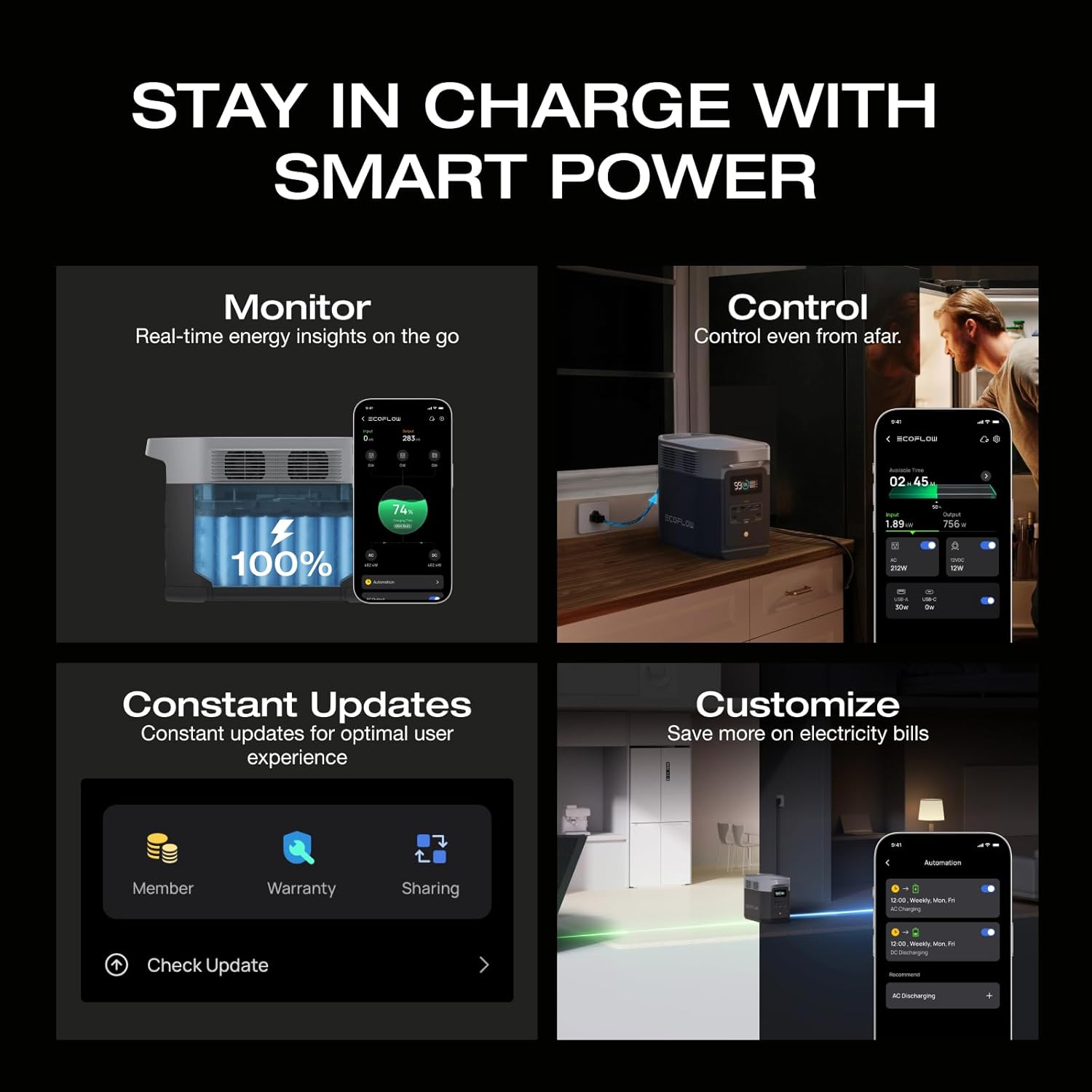
The DELTA 2 hits the sizing sweet spot for a typical modern refrigerator. Its X-Boost surge mode delivers up to 2,700W — enough headroom to handle the startup surge of nearly any modern compressor without tripping, while the 1,024Wh capacity covers a full day’s fridge cycling with buffer for lights, a router, and device charging. At 27 lbs and with 500W max solar input, it recharges efficiently during daylight to sustain fridge operation indefinitely.
The 80-minute AC charge to full means quick recovery between outage cycles if you have intermittent grid power. App control lets you monitor real-time consumption and set a discharge limit to protect the battery from complete drain — useful if you’re balancing fridge power against other essential loads during an extended outage. For most households sizing a solar generator specifically around fridge backup, this is the reference point to size against.
Pros: 2,700W X-Boost surge handles nearly any compressor startup, 500W solar input for daily recharge, app monitoring, 80-min AC charge, expandable to 3kWh
Cons: 1,024Wh alone covers roughly 12–20 hours without solar recharge for a standard fridge; needs solar or grid top-up for extended outages
Best for: Standard modern kitchen refrigerators, most common outage durations, households wanting reliable fridge backup with room for other essentials
Best for High Surge Tolerance: Jackery Explorer 1000 v2
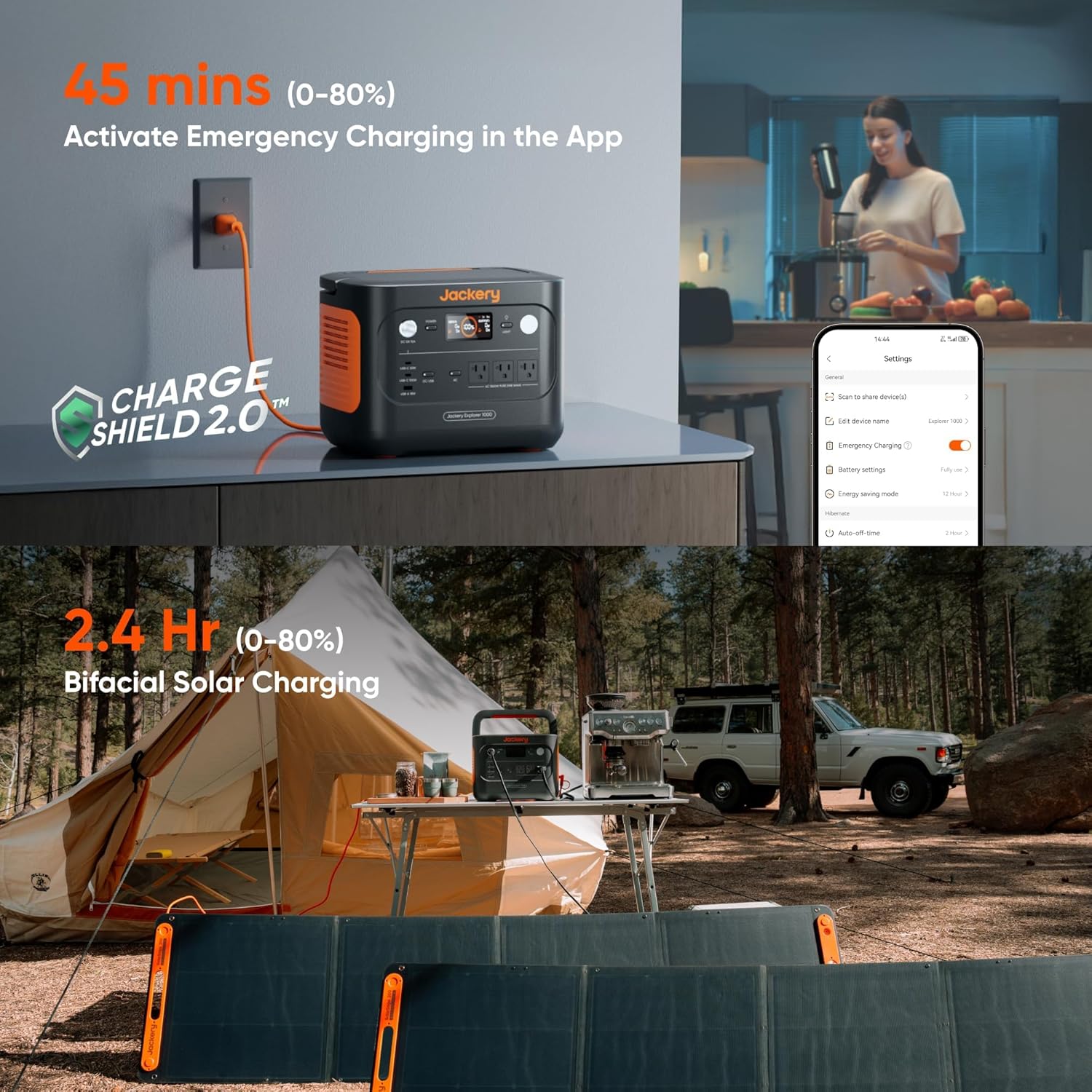
Where the Explorer 1000 v2 pulls ahead is surge capacity — 3,000W peak, the highest of any unit at this weight and capacity class. Older refrigerators, larger side-by-side units, and any fridge with a demanding compressor that surges past 2,000W on startup are exactly what this surge rating is built for. Pair that with 1,070Wh of capacity and the 4,000-cycle LFP battery (rated to 70% after 4,000 cycles), and you get a unit that outlasts its 3,000-cycle competitors in daily-use scenarios.
800W maximum solar input is the highest in this comparison — meaningful if you’re pairing with a robust panel array to sustain fridge operation through extended low-grid periods. The one caveat: solar charging requires Jackery’s own panels for plug-and-play compatibility without an adapter. For a full breakdown of this unit, see our solar generator for camping guide, where the same unit is evaluated for portable use.
Pros: 3,000W surge (highest at this capacity), 4,000 LFP cycles, 800W max solar input, 1-hour emergency AC charge
Cons: Requires Jackery panels for solar without adapter; 1,070Wh capacity similar ceiling to DELTA 2 without solar recharge
Best for: Older or larger refrigerators with demanding compressor surge, anyone prioritizing battery longevity for daily fridge duty
Best for Extended Outages: Jackery Explorer 2000 Plus
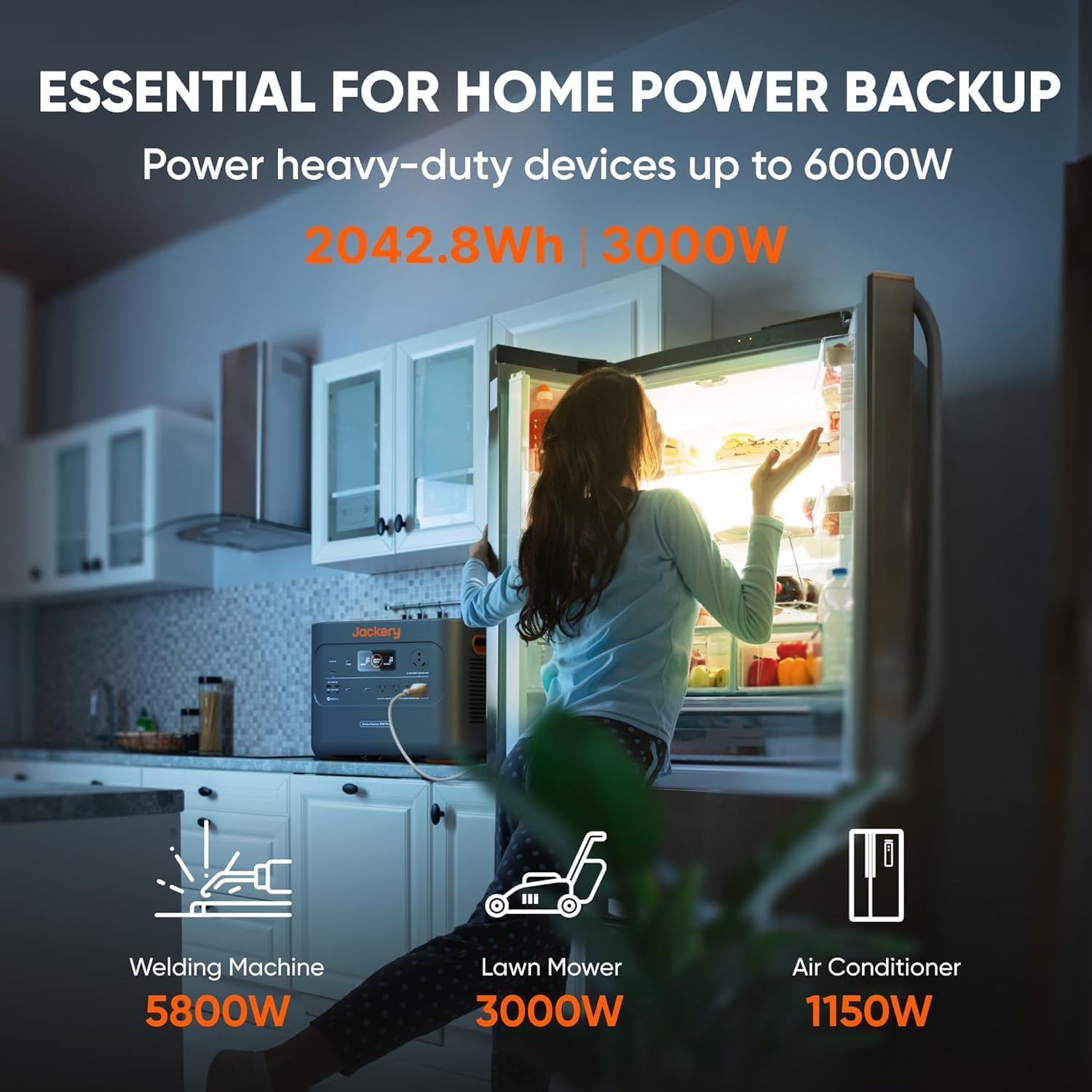
When the concern isn’t just “will it start the compressor” but “will it last through a multi-day outage,” the Explorer 2000 Plus is the right category of unit. At 2,042Wh — roughly double the capacity of the 1kWh-class units above — it covers a full-size fridge’s daily use with substantial margin, plus enough room for a chest freezer, lighting, and device charging simultaneously. The 6,000W surge and 3,000W continuous output handle even the most demanding older or commercial-style compressors without hesitation.
The real advantage for extended outages is expandability: up to 5 additional battery packs take total capacity from 2kWh to 12kWh, and two units in parallel reach 24kWh — enough to run a fridge and freezer combination for a week or more without any solar or grid recharge at all. For anyone in a region with frequent multi-day outages (hurricane zones, areas with an aging grid, rural properties with unreliable utility service), this expandability is the deciding factor over a fixed-capacity 1kWh unit. 30dB quiet operation means it can run overnight near a kitchen without disturbing sleep.
Pros: 2,042Wh base capacity, 6,000W surge, expandable to 24kWh, covers fridge + freezer simultaneously, 30dB quiet operation, 5-year warranty
Cons: Significantly higher price than 1kWh-class units; heavier and less portable at 43 lbs
Best for: Multi-day outage regions, households with both a fridge and freezer to protect, anyone who wants expansion room without buying a second full unit
Best for 12V Portable/Mini Fridge: Jackery Explorer 300
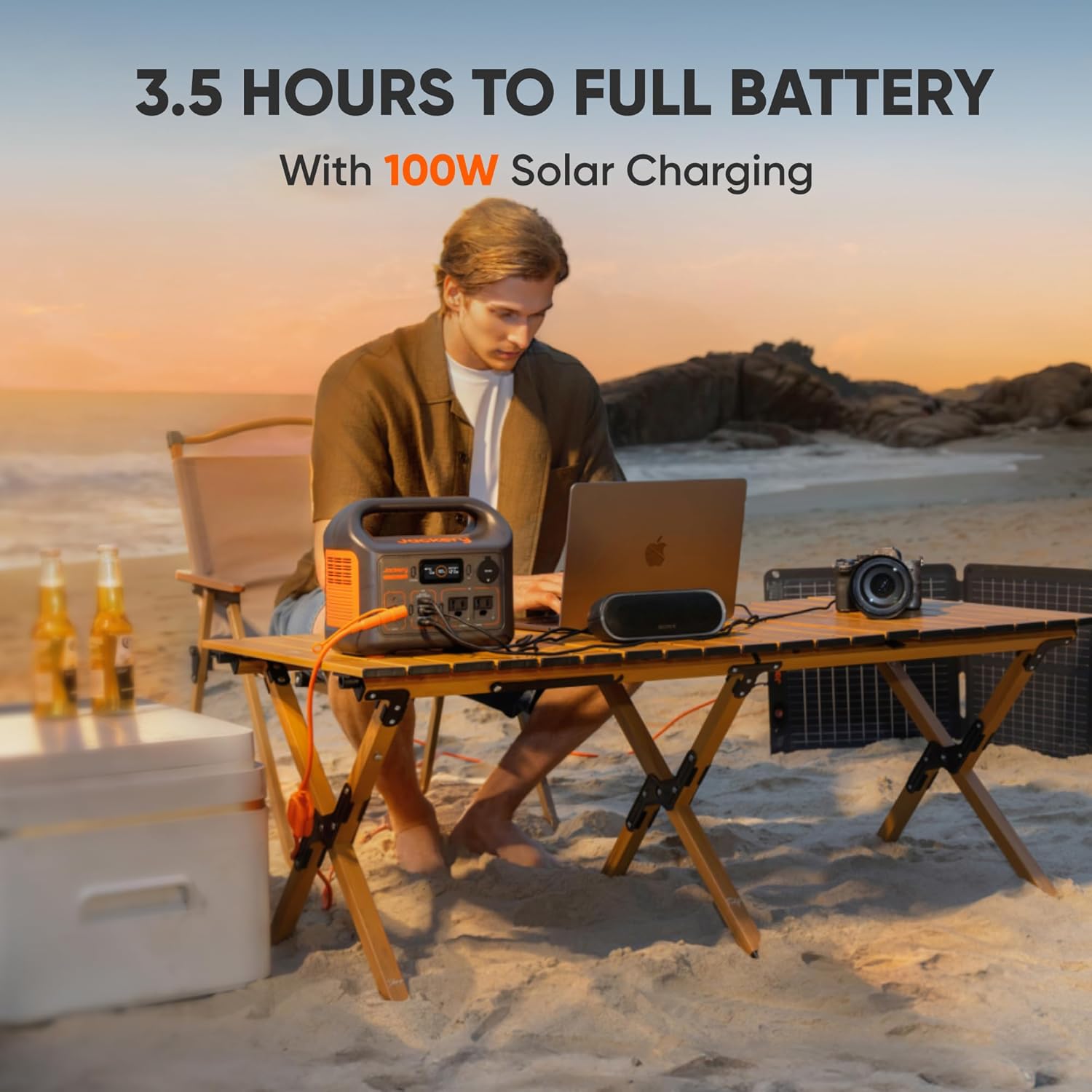
Not every refrigerator situation calls for a kitchen-scale unit. A 12V compressor fridge — the kind used in overlanding rigs, small campers, or as a dedicated medication/insulin cooler — draws a fraction of a household fridge’s power, typically 40–60W running with minimal surge since 12V DC compressors don’t have the same startup spike as AC motors. The Explorer 300’s 292Wh and 300W continuous output (600W surge) is genuinely well-matched to this use case.
At 7.1 lbs, it’s portable enough to dedicate entirely to a small fridge without a second thought — plug it in and it runs a 12V compressor fridge for a day or more on a single charge, longer with even modest solar input. This isn’t the unit for a kitchen refrigerator, but for its specific niche it’s the right-sized, right-priced tool. For the full review, see our Jackery Explorer 300 review.
Pros: Perfectly sized for 12V compressor fridges, lightest and most portable option, lowest price point, 2-hour full charge
Cons: Not suitable for a standard AC kitchen fridge — insufficient capacity and surge; 88W max solar input is slow
Best for: 12V portable/car fridges, overlanding, small campers, dedicated medication cooling
Tips to Extend Runtime — Get More From the Same Battery
Keep the fridge full. A fully stocked fridge holds cold significantly longer than an empty one between compressor cycles — thermal mass reduces how often the compressor needs to run. If your fridge is sparse, fill empty space with water bottles or jugs before an anticipated outage.
Minimize door openings. Every open door lets cold air escape and forces the compressor to work harder to recover. During an outage, consolidate what you need and limit door openings to essential access.
Clean the condenser coils. Dust and debris on the coils (usually on the back or underneath the fridge) force the compressor to work harder and draw more power to achieve the same cooling. A five-minute cleaning before storm season is genuinely worth doing.
Check the door seal. Even a small gap in the rubber gasket lets cold air escape continuously, forcing the compressor to run far more than necessary. A dollar bill test — close it in the door and see if it slides out easily — is a quick way to check seal integrity.
Consider the fridge’s temperature setting. A fridge set to 34°F cycles the compressor noticeably more than one set to 38°F. During an outage where power conservation matters more than optimal freshness, a slightly warmer setting can meaningfully reduce energy draw over a full day.
Frequently Asked Questions
What size solar generator do I need to run a refrigerator?
For a standard modern kitchen fridge, a minimum of 1,000–1,200Wh with at least 1,800W continuous output (2,000W+ surge capacity) is the practical baseline for 12–20 hours of runtime without solar recharge. For 24-hour coverage plus buffer, 1,500–2,000Wh is safer. Add solar panels sized to your fridge’s daily consumption (typically 300–400W of panels for a standard fridge) for indefinite runtime rather than a fixed window.
Will a solar generator trip when my fridge compressor starts?
Only if it’s undersized for the surge wattage — the brief 1–2 second spike when the compressor motor kicks on, typically 2–3 times the running wattage. This is the most common sizing mistake. Always check your generator’s surge/peak output rating against your fridge’s startup wattage, not just its running wattage, before buying.
How long will a 1000Wh solar generator run a refrigerator?
For a standard-size refrigerator, expect roughly 12–20 hours without solar recharge, depending on the fridge’s efficiency, ambient temperature, and how often the door opens. This is suitable for short-to-medium outages but won’t reliably cover a full 24-hour period with margin, let alone a multi-day outage — for that, step up to 2,000Wh+ or add solar panels for daily recharge.
Can I run a refrigerator and freezer on the same solar generator?
Yes, but size accordingly — the combined daily energy use of a fridge and separate freezer typically runs 2,500–4,000Wh depending on both units’ efficiency and size. A 2,000Wh+ unit like the Jackery Explorer 2000 Plus, ideally with solar panels for daily recharge or an expansion battery pack, is the right category for running both simultaneously through an extended outage.
Do I need solar panels, or can I just use the battery alone?
For short outages (under 24 hours), a properly sized battery alone is often sufficient. For anything longer — multi-day outages, off-grid living, or genuine energy independence for a fridge — solar panels are what make indefinite runtime possible. Without them, you’re limited to whatever the battery holds until you can recharge via wall outlet or car port, which requires grid power or driving to be available.
Final Verdict
| Your Situation | Best Pick |
|---|---|
| Standard modern kitchen fridge, typical outages | EcoFlow DELTA 2 (B0B9XB57XM) |
| Older fridge, high compressor surge | Jackery Explorer 1000 v2 (B0D7PPG25F) |
| Fridge + freezer, multi-day outage regions | Jackery Explorer 2000 Plus (B0C6DHK68Q) |
| 12V portable/car fridge only | Jackery Explorer 300 (B082TMBYR6) |
For most households sizing a solar generator specifically around refrigerator backup, the EcoFlow DELTA 2 covers the surge requirements of nearly any modern fridge with capacity for typical outage lengths. If your fridge is older or particularly demanding on startup, the Jackery Explorer 1000 v2’s 3,000W surge offers extra headroom. For households in outage-prone regions wanting to protect both a fridge and freezer through extended power loss, the Jackery Explorer 2000 Plus and its expansion capability is the right investment.
For complete home backup sizing beyond just the fridge, see our solar generator for home backup guide. For camping and off-grid fridge use specifically, our solar generator for camping guide covers portable and lighter-weight options.