This post contains affiliate links. If you buy through our links we may earn a small commission — at no extra cost to you. This never influences our recommendations.
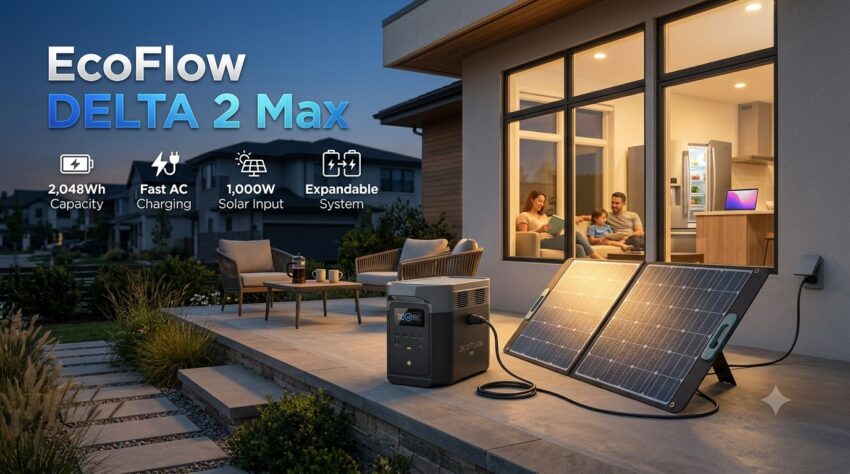
The DELTA 2 Max sits at an interesting point in EcoFlow’s lineup — bigger than the standard DELTA 2, priced below the DELTA Pro 3, and built for people who’ve outgrown a 1kWh unit but don’t need whole-home backup. This review covers the full spec sheet, what the 2,048Wh capacity actually delivers in daily use, and where it makes more sense than the units above and below it.
Full Specifications
| Spec | EcoFlow DELTA 2 Max |
|---|---|
| Capacity | 2,048Wh |
| Battery chemistry | LiFePO4 (LFP) |
| Cycle life | 3,000+ cycles to 80% capacity |
| AC output | 2,400W continuous (3,400W X-Boost) |
| Surge output | 4,800W |
| AC charge time (0–80%) | ~50 minutes |
| Full AC charge | ~80 minutes |
| Solar input (max) | 1,000W (dual MPPT, independent tracking) |
| Solar + AC combined charging | 0–80% in ~43 minutes |
| Weight | 50 lbs |
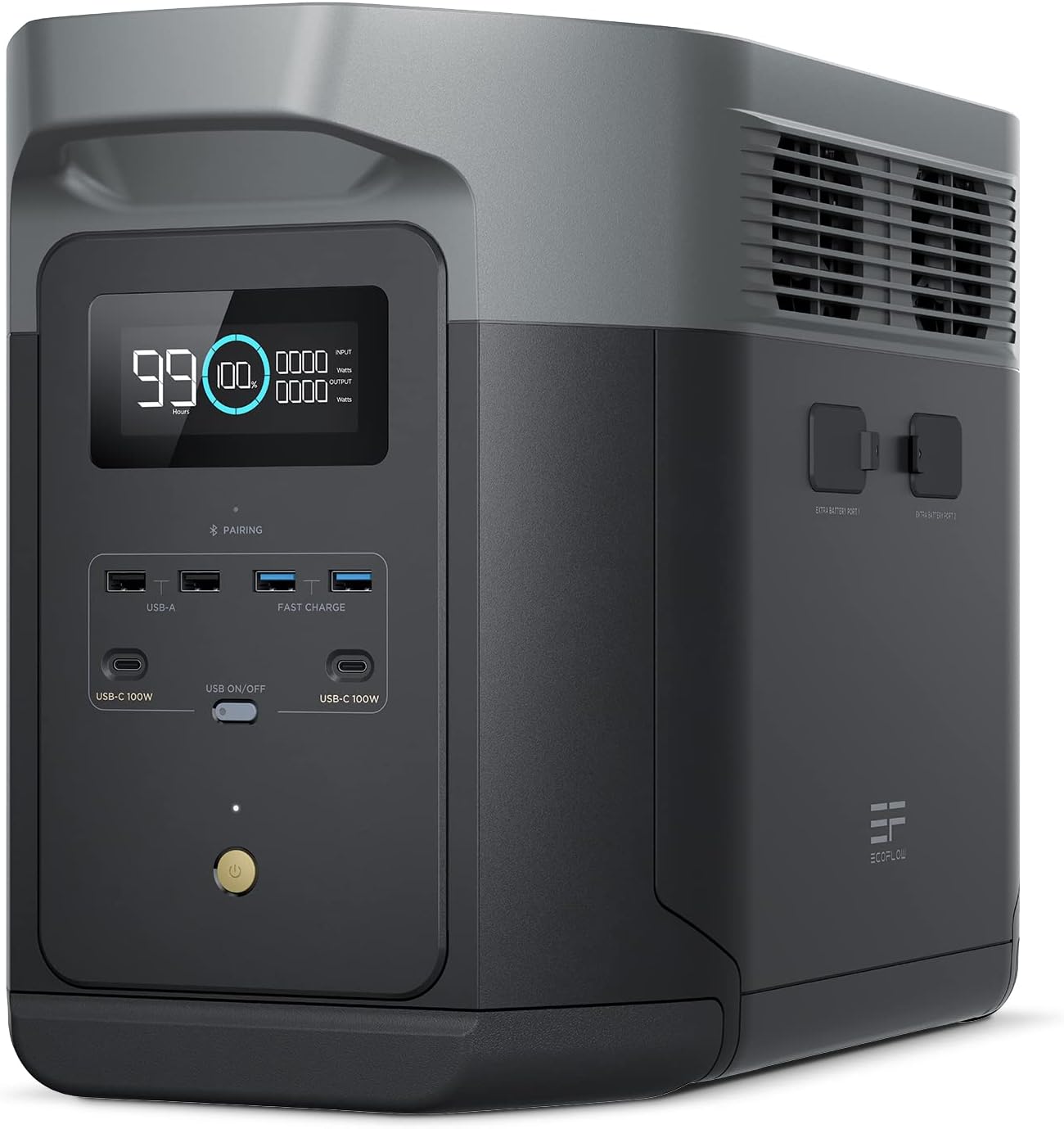
| Output ports | 6× AC, 4× USB-A, 2× USB-C (100W each), 1× 12V car socket, 2× barrel connectors |
| Expandability | Up to 6,144Wh with 2 Smart Extra Batteries |
| App control | Wi-Fi and Bluetooth |
| Noise (light load) | ~30dB |
| Warranty | 5 years |
| Operating temperature | -10°C to 45°C (charging halts below 0°C) |
What 2,048Wh Actually Means in Practice
The jump from a 1,000Wh-class unit to the DELTA 2 Max isn’t a linear upgrade — it’s categorical. At 1kWh, a power station keeps specific devices alive: a CPAP, a router, a few lights, maybe a fridge for part of a day. At 2kWh, you stop making those trade-off decisions. A 12V compressor fridge running 24/7, a CPAP overnight, a router, laptop charging, and general lighting — simultaneously, for a full day — fits comfortably within the capacity with margin to spare.
Independent lab testing measured actual discharge capacity through the inverter at roughly 1,800Wh under a 350W load — the gap between rated and delivered capacity that’s normal for any inverter-based system due to conversion losses. Budget for genuine usable capacity closer to 1,800Wh than the full 2,048Wh spec when planning your loads.
Output: What the 2,400W Inverter Can and Can’t Do
The native 2,400W continuous output covers the large majority of household appliances without needing X-Boost: window air conditioners (900–1,400W depending on BTU rating), sump pumps (surging to 1,500W on startup), microwave ovens (1,200–1,500W), and most kitchen appliances fall within this range as genuine rated power delivery, not a voltage-managed workaround.
On X-Boost specifically: EcoFlow markets X-Boost as extending output to 3,400W by reducing voltage while maintaining frequency. Independent testing has been split on how reliable this is in practice — it works well for resistive loads like heaters and hair dryers, but some reviewers have found the claimed 3,400W ceiling doesn’t hold up under sustained real-world surge testing, with limited headroom beyond the native 2,400W rating. The safer approach: budget your loads against the native 2,400W spec, and treat X-Boost as a bonus margin rather than a number to plan around.
Inverter efficiency measures around 86–90% depending on load — peak efficiency (roughly 92%) occurs in the 500–1,500W range, covering most common uses like refrigerators and power tools. Below 200W, efficiency drops to around 85% due to roughly 30W of fixed overhead the inverter electronics draw regardless of load — worth knowing if you’re running only small devices like phone chargers or LED lights for extended periods.
Charging Speed
The DELTA 2 Max’s charging speed is one of its clearest strengths. Via AC alone, it reaches 0–80% in roughly 50 minutes and a full charge in about 80 minutes, drawing up to 1,200W from a standard wall outlet — genuinely fast for a 2kWh-class unit.
The dual independent MPPT solar inputs accept up to 1,000W combined, the highest solar input in the DELTA 2 family. With two 500W panels in direct sun, expect a full charge in roughly 2.5–3 hours. Combining AC and solar simultaneously (1,800W AC + up to 600W solar) pushes charging to 0–80% in approximately 43 minutes — the fastest charging configuration EcoFlow offers at this capacity.
Expandability — The Feature That Sets It Apart
The DELTA 2 Max supports up to two Smart Extra Batteries, scaling total capacity from 2,048Wh to 4,096Wh to a maximum 6,144Wh. Each expansion battery connects via a dedicated port and is recognized instantly by the unit, with the app updating capacity automatically. This is the feature that most distinguishes the DELTA 2 Max from fixed-capacity competitors at a similar price — you can start with the base unit and scale up as your needs grow, rather than replacing the entire system.
The broader accessory ecosystem — the 800W Alternator Charger for vehicle-based charging, the Smart Home Panel for circuit-level backup integration, and the Smart Generator for hybrid setups — has been on the market long enough that compatibility issues are well understood and documented, an advantage over EcoFlow’s newer DELTA 3 series, whose ecosystem is still building out.
Battery Longevity

LiFePO4 chemistry rates the DELTA 2 Max for 3,000+ complete charge cycles to 80% capacity retention — translating to roughly 10 years of daily use before meaningful degradation. Independent accelerated testing after 200 complete charge-discharge cycles over four months measured capacity at 98.7% of original specification, consistent with EcoFlow’s longevity claims.
The battery operates efficiently across a wide temperature range (-10°C to 45°C), though charging halts below 0°C to protect the cells — standard behavior for LFP chemistry and worth knowing if you plan to charge the unit outdoors in freezing conditions.
Noise and Build Quality
At roughly 30dB under light load, the DELTA 2 Max is noticeably quieter than many competing 2kWh units, some of which run 55dB or higher. At 50 lbs, though, it’s firmly in “stationary use” territory rather than a grab-and-go camping unit — most owners keep it in a garage, utility room, or basement rather than moving it regularly. The one-piece design with reinforced ports, a rubber anti-slip base, and UL94-5VA fire-resistant casing reflect solid build quality that’s held up well across multi-year ownership reports.
DELTA 2 Max vs DELTA 2 — Is the Upgrade Worth It?
| Spec | DELTA 2 | DELTA 2 Max |
|---|---|---|
| Capacity | 1,024Wh | 2,048Wh |
| AC output | 1,800W | 2,400W |
| Solar input | 500W | 1,000W |
| Weight | 27 lbs | 50 lbs |
| Max expandable capacity | 3,072Wh | 6,144Wh |
The DELTA 2 remains the better choice for single-occupant households, apartment dwellers, and campers who prioritize portability — it comfortably runs a fridge, router, and laptop through a several-hour outage. The DELTA 2 Max earns its higher price and near-double weight when your loads genuinely require more than 1kWh: households running a fridge and CPAP simultaneously, anyone wanting a genuine multi-day outage buffer, or buyers planning to expand toward whole-home backup over time. See our full solar generator for refrigerator guide for sizing guidance specific to appliance loads.
DELTA 2 Max vs the Competition
At 2,048Wh, the DELTA 2 Max competes directly with the Bluetti AC200L and Jackery Explorer 2000 Plus. Anker’s SOLIX C1000 Gen 2, while lower capacity at 1,024Wh, deserves mention for its faster charging (49 minutes to full vs. the DELTA 2 Max’s ~80 minutes) — though it’s a different capacity class entirely. For a full breakdown of how the DELTA 2 Max stacks up within EcoFlow’s own lineup, see our best EcoFlow solar generator guide. For cross-brand comparisons, our solar generator for RV guide and portable power station guide cover competing options at this capacity.
Who Should Buy the DELTA 2 Max
Best for:
- Home backup covering a fridge, CPAP, router, and lighting simultaneously through extended outages
- Buyers who want to start with a base unit and expand capacity over time rather than replacing hardware
- RV and off-grid users who want the DELTA family’s most established accessory ecosystem
- Anyone prioritizing fast charging — both AC and solar — at this capacity level
Consider alternatives if:
- You need true portability — at 50 lbs, this is a stationary or occasional-transport unit, not a grab-and-go camping station
- 1,024Wh genuinely covers your needs — the standard DELTA 2 saves weight and money
- You want the latest EcoFlow technology at a lower price point — the newer DELTA 3 Max offers comparable specs, though with a less mature accessory ecosystem as of this writing
Frequently Asked Questions
Can the EcoFlow DELTA 2 Max run a refrigerator and air conditioner at the same time?
Yes, for smaller window AC units. A standard fridge draws 100–400W cycling, and a window AC unit draws 900–1,400W depending on BTU rating — both fall within the DELTA 2 Max’s native 2,400W continuous output when run together, assuming no other major loads are active simultaneously. Central AC systems (3,000W+) are outside what any portable unit, including this one, can handle.
How long does the EcoFlow DELTA 2 Max last on a full charge?
It depends entirely on your load. At a steady 350W draw (roughly a fridge plus router and some lighting), expect approximately 5 hours of runtime based on the ~1,800Wh of measured usable capacity. Lighter loads extend this significantly — a CPAP alone (30–60W) could run for well over 24 hours on a full charge.
Is the EcoFlow DELTA 2 Max worth it compared to the newer DELTA 3 Max?
The DELTA 2 Max’s main advantage is ecosystem maturity — accessories like the Alternator Charger and Smart Home Panel have years of real-world compatibility data behind them. The DELTA 3 Max offers comparable or improved core specs at a similar or lower price point, but its accessory ecosystem is newer and less established. For buyers who want to expand their system with confidence today, the DELTA 2 Max remains the safer infrastructure bet.
Does the DELTA 2 Max have UPS/EPS functionality?
Yes — it includes an Emergency Power Supply function with a rated 30ms switchover time, meaning it can automatically switch to battery power when grid power fails, keeping devices like a CPAP or Wi-Fi router running through the transition. This is not instant like some competitors’ sub-10ms UPS specs, but it’s fast enough that most electronics won’t register a meaningful interruption.
How many solar panels do I need to fully charge the DELTA 2 Max?
To reach the 1,000W maximum solar input, two 500W panels (or an equivalent combination) in direct sun charges the unit fully in roughly 2.5–3 hours. A single 220W EcoFlow panel works but takes considerably longer — closer to 8–10 hours for a full charge. The dual independent MPPT inputs mean you can mix panel types or angles without one underperforming panel dragging down the other’s output.
The Bottom Line
The DELTA 2 Max remains one of the strongest options in the 2kWh portable power station class — fast charging on both AC and solar, a mature and well-documented expansion ecosystem, and genuine output capable of handling real household appliances rather than approximating them through aggressive voltage tricks. At 50 lbs, it’s built for stationary home backup or occasional transport rather than frequent camping use, and the X-Boost surge claims should be treated with some skepticism rather than planned around.
For most households outgrowing a 1kWh unit and wanting a scalable, well-supported home backup system, the DELTA 2 Max remains a strong, proven choice.
Check the EcoFlow DELTA 2 Max on Amazon →
For the full EcoFlow lineup comparison, see our best EcoFlow solar generator guide. For sizing a system around specific appliances, our solar generator for refrigerator guide and solar generator for CPAP guide cover exact runtime math for common household loads.