
This post contains affiliate links. If you buy through our links we may earn a small commission — at no extra cost to you. This never influences our recommendations.
What Can a 200 Watt Solar Panel Actually Power?
Before comparing specific panels, the most useful thing is understanding what 200W of solar actually delivers — because this determines whether 200W is right for your situation.
Daily output (Wh) = Panel wattage × Peak sun hours × System efficiency
For a 200W panel in 5 peak sun hours at 80% efficiency: 200W × 5 × 0.80 = 800Wh per day.
| Appliance | Daily Consumption | Covered by 200W? |
|---|---|---|
| 12V compressor fridge (24 hrs) | ~600–800Wh | ✅ Just covered |
| LED lighting (4 hrs) | ~80Wh | ✅ Yes |
| Phone charging (×4) | ~60Wh | ✅ Yes |
| Laptop (4 hrs) | ~240Wh | ✅ Yes |
| CPAP without humidifier (8 hrs) | ~240Wh | ✅ Yes |
| Small fan (6 hrs) | ~90Wh | ✅ Yes |
| Typical light-use total | ~750Wh | ✅ Covered |
A 200W panel covers a light to moderate off-grid load — one person’s essential needs in a van or RV, a well-stocked cabin with LED lighting, or a serious shed power system. It is not sufficient for air conditioning, electric cooking, or a high-consumption household without supplementation. Most RV and van life users find 200W sufficient for solo or couple travel in sunny climates. For higher consumption or lower-sun regions, our 400 watt solar panel guide covers the next tier.
200W Solar Panel Formats — Which Type Is Right for You
Rigid monocrystalline panels (most common)
Traditional aluminium-framed glass panels — most durable, most efficient, lowest cost per watt. Best for permanent roof installations on RVs, cabins, sheds, and ground mounts. Typical 200W dimensions: approximately 53″×26″×1.4″.
Single 200W panel vs. two 100W panels
| Single 200W Panel | Two 100W Panels | |
|---|---|---|
| Installation | One mounting location — simpler | Two locations — more flexible |
| Partial shading | Whole panel affected | Only one panel affected |
| System expansion | Add another 200W | Add individual 100W panels |
| Price per watt | Usually lower | Slightly higher per watt |
Portable/foldable 200W panels
For camping and van life where the panel needs to travel with you. The Jackery SolarSaga 200W is the primary option at this wattage — higher cost per watt but genuine portability. See our foldable solar panels guide for the full portable comparison.
Key Specs Explained — What Actually Matters at 200W
N-Type vs. P-Type cells
N-Type monocrystalline cells are the current technology standard worth buying. They deliver 24–25% efficiency vs 20–22% for standard P-Type, have lower temperature coefficient (less output loss in heat), lower degradation rates (typically 0.3–0.4%/year vs 0.5%/year), and no LID (Light-Induced Degradation) — P-Type panels lose 1–3% in the first hours of operation. All Renogy N-Type panels in this article use 16BB cells.
16BB busbars
16 busbars (thin conductive ribbons per cell) reduce current travel distance, reduce resistive losses, and reduce microcrack propagation — more durable cells and slightly higher efficiency than traditional 3–5 busbar designs.
PWM vs. MPPT charge controllers at 200W
PWM controllers (often included in budget kits) waste the voltage differential between a 22V Vmp panel and a 12V battery — you effectively get ~150W into the battery rather than 200W. An MPPT controller converts the full 200W efficiently. The $40–$80 upgrade to MPPT pays back quickly in recovered energy. See our MPPT charge controller guide for the full comparison.
The Best 200 Watt Solar Panels on Amazon — Verified Picks
| Product | Cell Type | Efficiency | Format | Best For | Price |
|---|---|---|---|---|---|
| Renogy 200W N-Type 16BB | N-Type mono | 25% | Rigid single panel | Best efficiency, single panel | ~$120–$150 |
| Renogy 200W Starter Kit | Mono | 22% | 2×100W + PWM kit | Best complete beginner kit | ~$180–$220 |
| ECO-WORTHY 200W Kit | Mono | 21.5% | 2×100W + PWM kit | Best budget complete kit | ~$100–$130 |
| Jackery SolarSaga 200W | Bifacial IBC | 26.7% | Foldable portable | Best portable 200W panel | ~$220 |
Renogy 200W N-Type 16BB Solar Panel — Best Single Panel
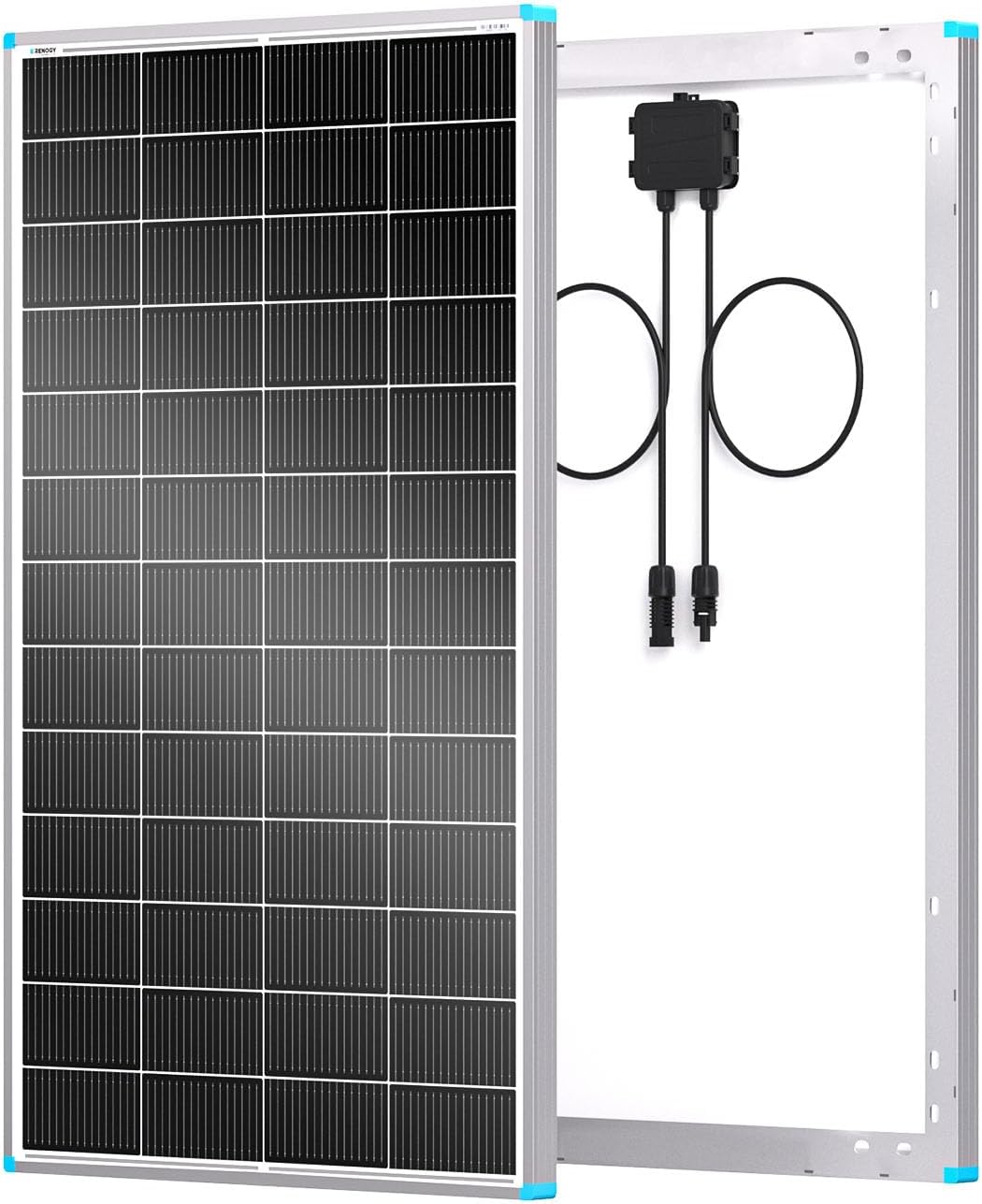
The Renogy 200W N-Type is the current benchmark for a rigid 200W single panel. Engineered with advanced 16BB N-Type cells achieving 25% efficiency — delivering approximately 20W more power output compared to standard panels of the same physical size. The lower temperature coefficient (-0.27%/°C vs -0.35%/°C for P-Type) means less output loss on hot summer days, and the absence of LID means full rated output from day one. Compatible with both 12V and 24V systems via MC4 connectors. The 25-year linear output warranty from Renogy is among the strongest in the category.
Note: this is a panel only — charge controller and wiring are purchased separately. An MPPT controller is strongly recommended to capture the full 25% efficiency advantage.
Pros: 25% N-Type efficiency (class-leading at this wattage), 16BB for durability, 12V/24V compatible, MC4 output, 25-year output warranty, Renogy reliability
Cons: Panel only — controller and wiring extra; benefits most from MPPT controller (not included); no mounting hardware
Best for: Adding to an existing system, RV/cabin roof mounting where maximum watts-per-square-foot matters, buyers who already have a charge controller
Renogy 200W Starter Kit (2×100W + Controller) — Best Complete Beginner Kit
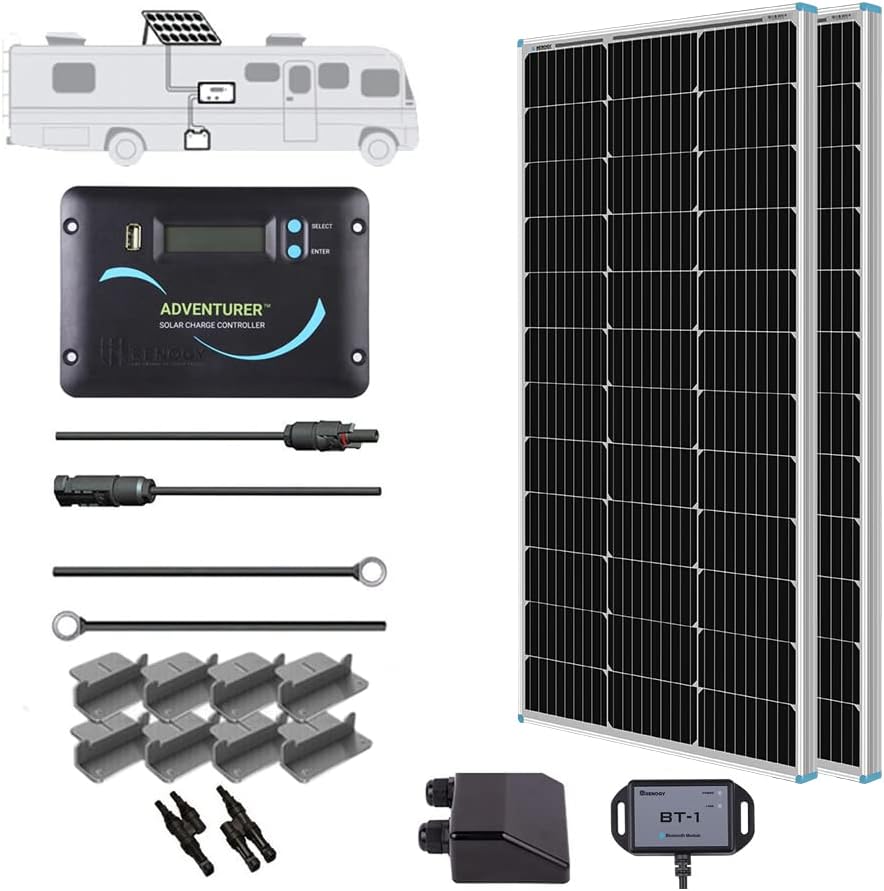
The Renogy 200W Starter Kit is the most popular entry point to solar at this wattage — two 100W monocrystalline panels, a 30A Wanderer PWM charge controller, branch connectors, cables, and Z-bracket mounts all in one box. Everything except the battery arrives together, designed to work without additional component research. The Wanderer 30A PWM controller handles the 2×100W pair with headroom for a third 100W panel if you expand later.
The honest limitation: the included PWM controller loses 10–20% efficiency vs MPPT with these panels. For maximum simplicity, the kit is excellent value. For maximum efficiency, buy the Renogy N-Type panel separately and pair it with a Renogy Rover MPPT controller.
Pros: Everything in one box, Renogy quality, 30A controller handles expansion to 300W, Z-brackets included, plug-and-play design
Cons: Included PWM controller less efficient than MPPT, 100W panels slightly less efficient than the N-Type 200W standalone
Best for: First-time solar buyers wanting a complete working system, RV and cabin installations where simplicity matters
ECO-WORTHY 200W Kit (2×100W + Controller) — Best Budget Complete Kit
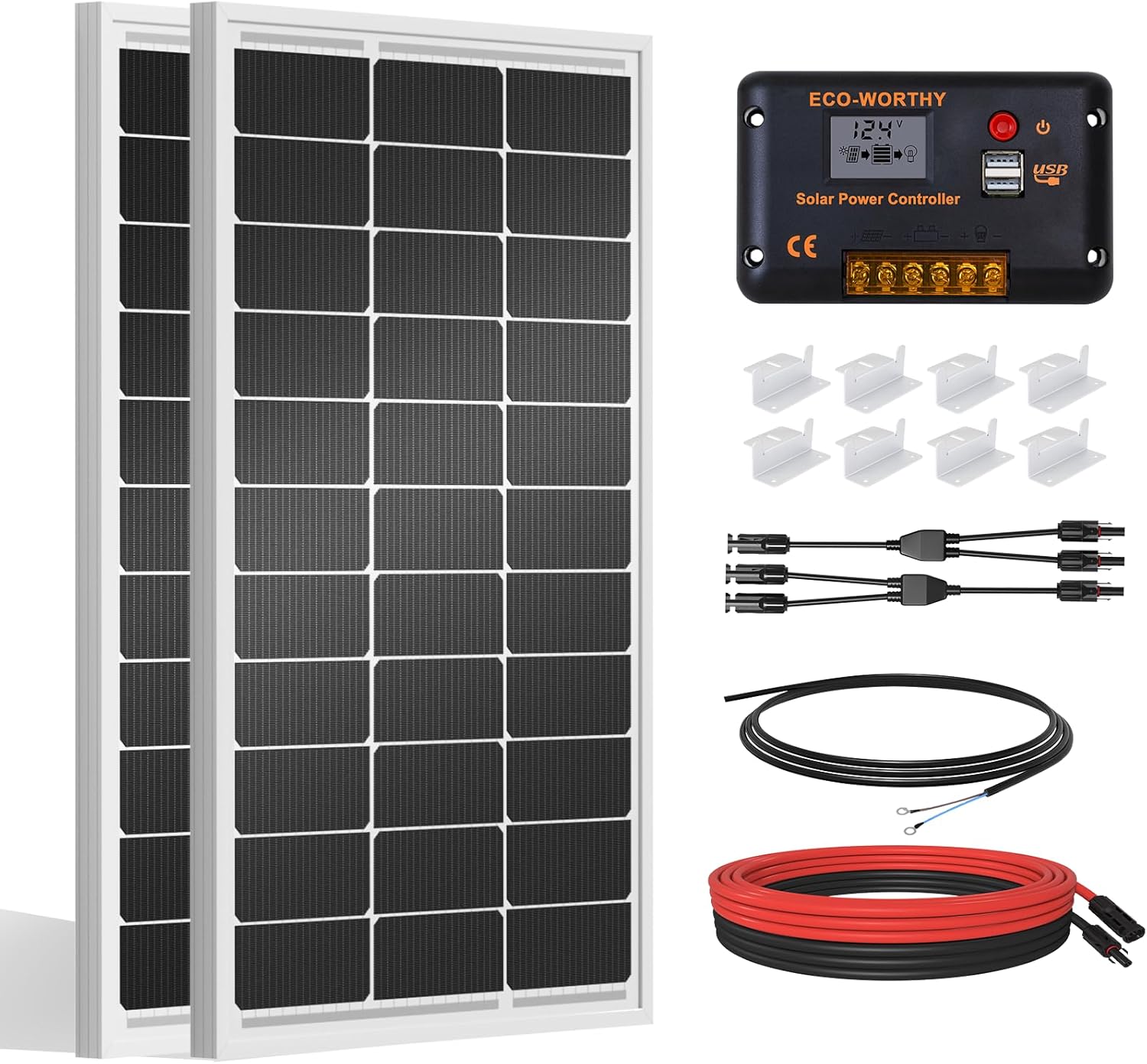
The ECO-WORTHY 200W kit delivers the same basic configuration — two 100W monocrystalline panels, a 30A PWM charge controller, Z-brackets, and cables — at a meaningfully lower price of ~$100–$130. At 21.5% efficiency the ECO-WORTHY panels are slightly behind Renogy’s current generation, but for a first system where budget is the primary constraint, the practical daily output difference (~40Wh/day) doesn’t justify the price gap. Appropriate for shed power, basic cabin lighting, and first-time solar buyers. The 1-year warranty is short — keep purchase documentation.
Pros: Lowest price for a complete 200W kit, all hardware included, plug-and-play, 12V/24V configurable
Cons: 21.5% efficiency (lower than Renogy), 1-year warranty, PWM controller, ECO-WORTHY support less established
Best for: Budget-conscious buyers, shed and outbuilding power, first-time solar buyers where upfront cost is the priority
Jackery SolarSaga 200W — Best Portable 200W Panel
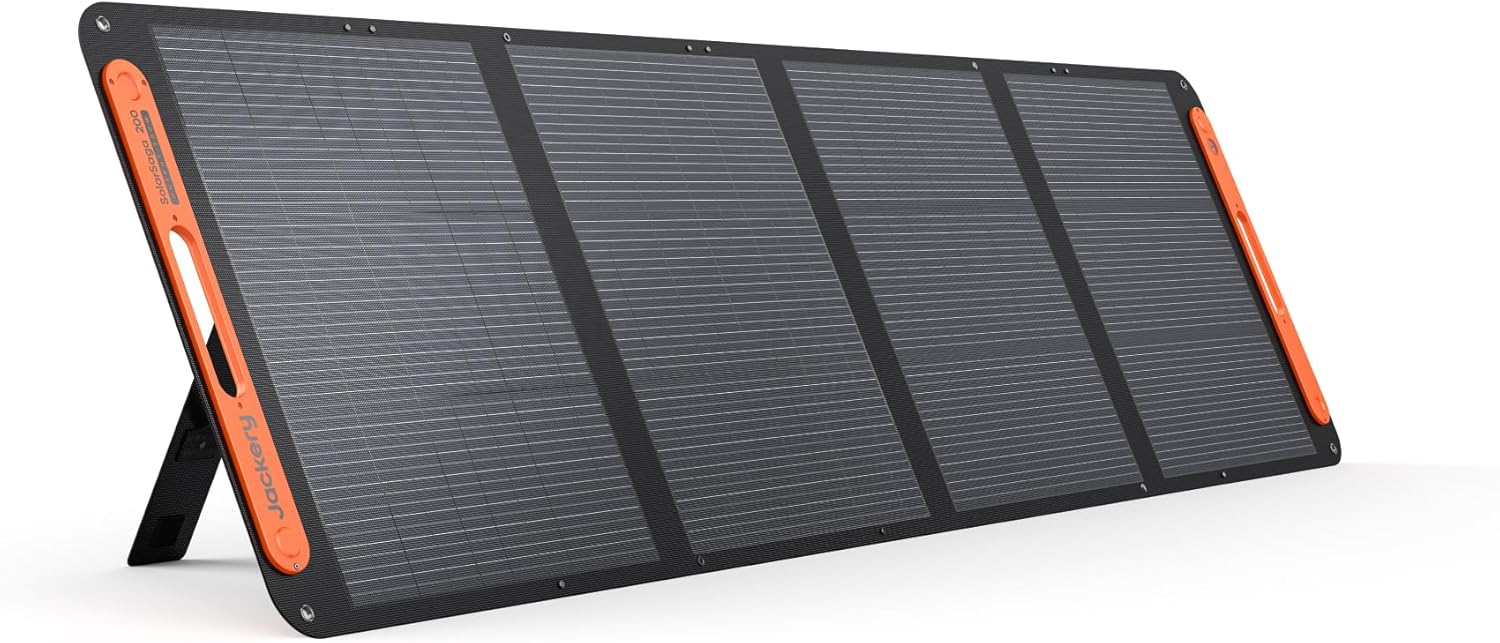
The Jackery SolarSaga 200W is the only genuinely portable option at this wattage — folding to a compact suitcase format, deploying in under a minute via integrated kickstands. At 26.7% bifacial IBC efficiency it’s the most efficient panel in our picks. IP68 waterproof, MC4 output for universal compatibility. Designed to pair with Jackery Explorer power stations but works with any power station or MPPT controller within its voltage range. Already covered in full in our Jackery solar panel guide — the recommended pairing for Explorer 1000 v2 and HomePower 3600 Plus owners.
Pros: Portable — folds flat, 26.7% bifacial IBC efficiency (highest in our picks), IP68, MC4 output, Jackery ecosystem compatibility
Cons: Higher cost per watt than rigid panels, not for permanent roof mounting
Best for: Van life and camping where the panel travels with you, Jackery Explorer power station owners
How to Size a 200W Solar System
Step 1 — Verify 200W meets your daily consumption
Calculate your total daily Wh by multiplying each appliance’s watts × daily hours. Compare to 200W × your local peak sun hours × 0.80. If your consumption exceeds this, consider 400W. Our off-grid solar system guide covers full system sizing for any load profile.
Step 2 — Size the battery bank
For 1–1.5 days of autonomy: Daily Wh × 1.5 ÷ 0.95 = minimum battery Wh needed.
For 800Wh daily: 800 × 1.5 ÷ 0.95 = ~1,263Wh → one 100Ah 12V LiFePO4 battery is the natural pairing.
See our solar battery guide for battery selection at this system size.
Step 3 — Select the right charge controller
Minimum MPPT rating: 200W ÷ 12V × 1.25 = 21A → Renogy Rover 20A is the correct match (rated to handle up to 240W at 12V). For 24V battery banks or future expansion to 400W, the Rover 40A provides appropriate headroom. See our MPPT charge controller guide for complete sizing.
Common 200W Solar System Applications
RV rooftop: The most common 200W application. One 200W panel (approximately 53″×26″) fits most Class B and C RV roofs. Powers a compressor fridge, LED lighting, phone and laptop charging, and a water pump for solo or couple travel in moderate to sunny climates. In cloudy climates or for higher consumption, 400W is a safer baseline.
Van life: A single 200W N-Type panel maximises output per square foot on a van roof — critical when roof space is limited. Combined with a 100Ah LiFePO4 and MPPT controller, it covers one person’s daily needs in good sun.
Cabin and shed power: For lighting, device charging, and occasional tool use, 200W covers a well-designed small off-grid cabin in most of the US. See our solar power for shed guide for a complete shed system walkthrough.
Frequently Asked Questions
How much power does a 200 watt solar panel produce per day?
In average US conditions (5 peak sun hours, 80% efficiency): 200W × 5 × 0.80 = 800Wh per day. This varies by location — approximately 1,040Wh/day in Phoenix, AZ and approximately 560Wh/day in Seattle, WA. Use your local peak sun hours for an accurate calculation.
Can a 200W solar panel charge a 100Ah battery?
Yes — a 200W MPPT system in 5 peak sun hours produces approximately 800Wh, partially recharging a 12V 100Ah LiFePO4 battery (1,280Wh total). Full recharge from flat takes approximately 1.5–2 sunny days. For daily cycle use, size your battery bank so daily consumption matches daily solar production.
Is 200W enough for an RV?
For light consumption in a sunny climate (one person: fridge + lights + devices ≈ 600–800Wh/day): yes. For a couple with higher consumption, air conditioning, or in cloudier climates: 400W is a safer baseline. Most experienced RV solar users recommend starting with 200W, observing actual consumption for a season, then expanding if needed.
What is the difference between a 200W N-Type and P-Type solar panel?
N-Type panels eliminate LID, achieve higher efficiency (24–25% vs 20–22%), have lower temperature coefficient (less heat loss), and degrade more slowly. At similar prices, N-Type is the better buy for any new installation. All Renogy panels in this article use N-Type cells.
Do I need a special charge controller for a 200W solar panel?
An MPPT controller is strongly recommended over PWM at 200W — it recovers 10–20% more energy from the same panel. The Renogy Rover 20A handles a single 200W panel on a 12V battery bank. For a 24V bank or future expansion, the Rover 40A provides headroom. See our MPPT charge controller guide for complete sizing.
Final Verdict
| Your Situation | Best Pick |
|---|---|
| Best efficiency, single rigid panel | Renogy 200W N-Type 16BB (~$120–$150) |
| Best complete kit for beginners | Renogy 200W Starter Kit (~$180–$220) |
| Best budget complete kit | ECO-WORTHY 200W Kit (~$100–$130) |
| Best portable 200W panel | Jackery SolarSaga 200W (~$220) |
| RV roof, maximum watts/sqft | Renogy 200W N-Type |
| Van life / portable use | Jackery SolarSaga 200W |
| Already have a charge controller | Renogy 200W N-Type (panel only) |
For most buyers starting a new 200W system, the Renogy 200W Starter Kit provides the simplest path. For buyers who already have a charge controller and want maximum efficiency, the Renogy 200W N-Type panel is the best single-panel buy. For van life and portable applications, the Jackery SolarSaga 200W is the only genuinely portable option at this wattage.
For a complete system design — battery sizing, charge controller selection, inverter matching, and wiring — see our off-grid solar system guide. For a step up in production capacity, our 400 watt solar panel guide covers the next tier.