This post contains affiliate links. If you buy through our links we may earn a small commission — at no extra cost to you. This never influences our recommendations.
What Does a 400 Watt Solar Panel Actually Produce?
The number on the label — 400W — is the panel’s rated output under Standard Test Conditions: 25°C panel temperature and 1,000W/m² of incoming solar radiation. These are laboratory conditions. Real-world output is always different.
The daily output calculation:
Daily output (Wh) = Panel wattage × Peak sun hours × System efficiency
For a 400W panel in 5 peak sun hours with 85% system efficiency:
400W × 5hrs × 0.85 = 1,700Wh (1.7kWh) per day
| Location | Peak Sun Hours | Daily Output (400W) |
|---|---|---|
| Phoenix, AZ | 6.5 hrs | ~2,200Wh |
| Dallas, TX | 5.5 hrs | ~1,870Wh |
| Los Angeles, CA | 5.5 hrs | ~1,870Wh |
| Denver, CO | 5.5 hrs | ~1,870Wh |
| New York, NY | 4.5 hrs | ~1,530Wh |
| Seattle, WA | 3.5 hrs (winter avg) | ~1,190Wh |
The gap between rated and real-world output comes from panel temperature (hot panels lose up to 15% output on summer days), wiring losses (3–5%), charge controller efficiency (MPPT captures 95–97%, PWM loses 20–30%), and partial shading. A realistic efficiency factor of 80–85% accounts for all of these.
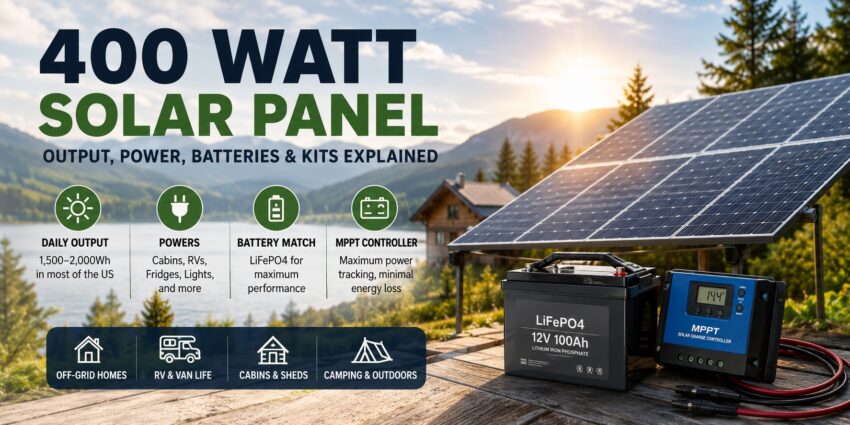
The bottom line: In most of the US, a 400W panel system produces 1,500–2,000Wh of usable energy per day — a meaningful amount that covers substantial real-world loads.
What Can a 400 Watt Solar Panel Power?
| Device | Watts | Hours/Day | Daily Wh | Powered by 400W? |
|---|---|---|---|---|
| LED lighting (10 bulbs) | 20W | 6 hrs | 120Wh | ✅ |
| Phone charging (×4) | 60W | 2 hrs | 120Wh | ✅ |
| Laptop | 60W | 6 hrs | 360Wh | ✅ |
| 12V camping fridge | 45W | 24 hrs | 1,080Wh | ✅ (tight) |
| Wi-Fi router | 10W | 24 hrs | 240Wh | ✅ |
| CPAP (no humidifier) | 30W | 8 hrs | 240Wh | ✅ |
| Window AC (5,000 BTU) | 500W | 4 hrs | 2,000Wh | ⚠️ Borderline |
| Microwave (brief use) | 1,000W | 0.25 hrs | 250Wh | ✅ |
What 400W handles comfortably: A full off-grid cabin or RV with LED lighting, device charging, a 12V fridge, Wi-Fi, and a CPAP machine — this is the sweet spot for 400W solar.
What requires more: Central air conditioning, electric water heaters, sustained electric cooking, electric heating. These require 800W+ and significant battery storage.
How Many Batteries Do You Need for a 400 Watt Solar Panel?
The battery bank lets you use power after the sun goes down. If your daily consumption is 1,500Wh and you want 2 days of autonomy with LiFePO4 (95% usable capacity):
1,500Wh × 2 days ÷ 0.95 = 3,157Wh → approximately two 100Ah 12V LiFePO4 batteries
| Battery Type | Usable Capacity | Cycle Life | Cost |
|---|---|---|---|
| LiFePO4 | 95% | 3,000–5,000 cycles | Higher |
| AGM Lead-Acid | 50% | 400–600 cycles | Lower |
For a 400W solar system designed for regular use, LiFePO4 is the right choice. The higher upfront cost is recovered through longer lifespan and greater usable capacity.
| Daily Use | Autonomy | Recommended Battery |
|---|---|---|
| 500Wh/day | 1 day | 100Ah 12V LiFePO4 |
| 1,000Wh/day | 1 day | 100Ah 24V LiFePO4 |
| 1,500Wh/day | 2 days | 2×100Ah 12V LiFePO4 |
| 2,000Wh/day | 2 days | 200Ah 24V LiFePO4 |
What Charge Controller Do You Need for a 400 Watt Solar Panel?
Always use MPPT at 400W — not PWM. A PWM controller wastes 20–30% of your panel output by clipping excess voltage. On a 400W system producing 1,700Wh per day, that’s 340–510Wh lost every single day. An MPPT controller recovers that energy by continuously tracking the panel’s maximum power point.
Sizing the MPPT controller:
- On a 12V battery bank: 400W ÷ 12V = 33.3A → 40A MPPT controller
- On a 24V battery bank: 400W ÷ 24V = 16.7A → 20A or 30A MPPT controller
A 40A MPPT on a 12V system gives headroom for expansion up to 500W without upgrading the controller. See our full guide to solar charge controllers for specific product recommendations at every amperage.
The Best 400 Watt Solar Panels and Kits on Amazon Right Now
Every product below is verified on Amazon with specs confirmed from official listings.
| Product | Type | Efficiency | Key Feature | Price |
|---|---|---|---|---|
| Renogy 400W Premium Kit | 4×100W + 40A MPPT + BT | 21% PERC | Complete kit, Bluetooth | ~$450 |
| ECO-WORTHY 400W Premium Kit | 4×100W + 40A MPPT + BT | 23% PERC | Best value complete kit | ~$220 |
| Renogy N-Type 400W (2×200W) | 2 rigid panels, no controller | 25% N-Type | Highest efficiency | ~$240 |
| Renogy 400W Portable Suitcase | Foldable, IP67 | 23% PERC | Best portable 400W | ~$300 |
Renogy 400W Premium Kit (4×100W + 40A MPPT + Bluetooth) — Best Complete Kit
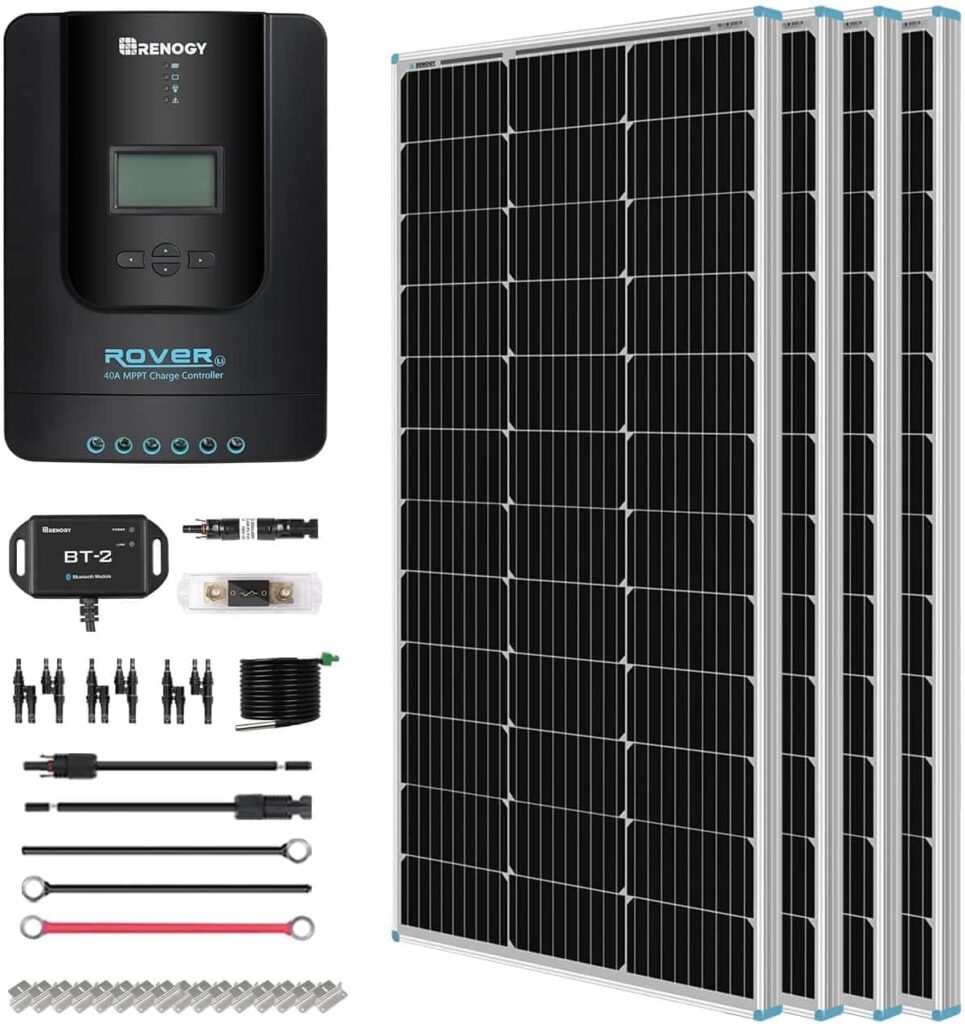
The Renogy Premium 400W Kit includes 4×100W monocrystalline panels, a 40A MPPT charge controller, Bluetooth BT-1 module, fuse, mounting Z brackets, adaptor kit, and tray cables — everything needed for a complete 400W off-grid system. The Bluetooth module pairs with the Renogy DC Home App for real-time monitoring of input wattage, battery state of charge, and historical charging data from up to 82 feet away.
The 4×100W format gives installation flexibility — four individually manageable panels rather than one large 400W unit, easier to manoeuvre on an RV roof or around obstacles. The 3.2mm low-iron glass and 35mm aluminium alloy frame handle 2400Pa wind and 5400Pa snow loads. Backed by Renogy’s 25-year power output warranty and the strongest customer support in off-grid solar.
Pros: Complete system out of the box, Bluetooth monitoring, Renogy reliability and support, 25-year warranty, flexible 4-panel format, fusing included
Cons: 21% PERC efficiency — not the highest available, more expensive than ECO-WORTHY equivalent
Best for: RV rooftops, cabins, sheds, and off-grid homes wanting the most proven complete 400W kit with the best support
ECO-WORTHY 400W Premium Kit (4×100W + 40A MPPT + Bluetooth) — Best Value Complete Kit
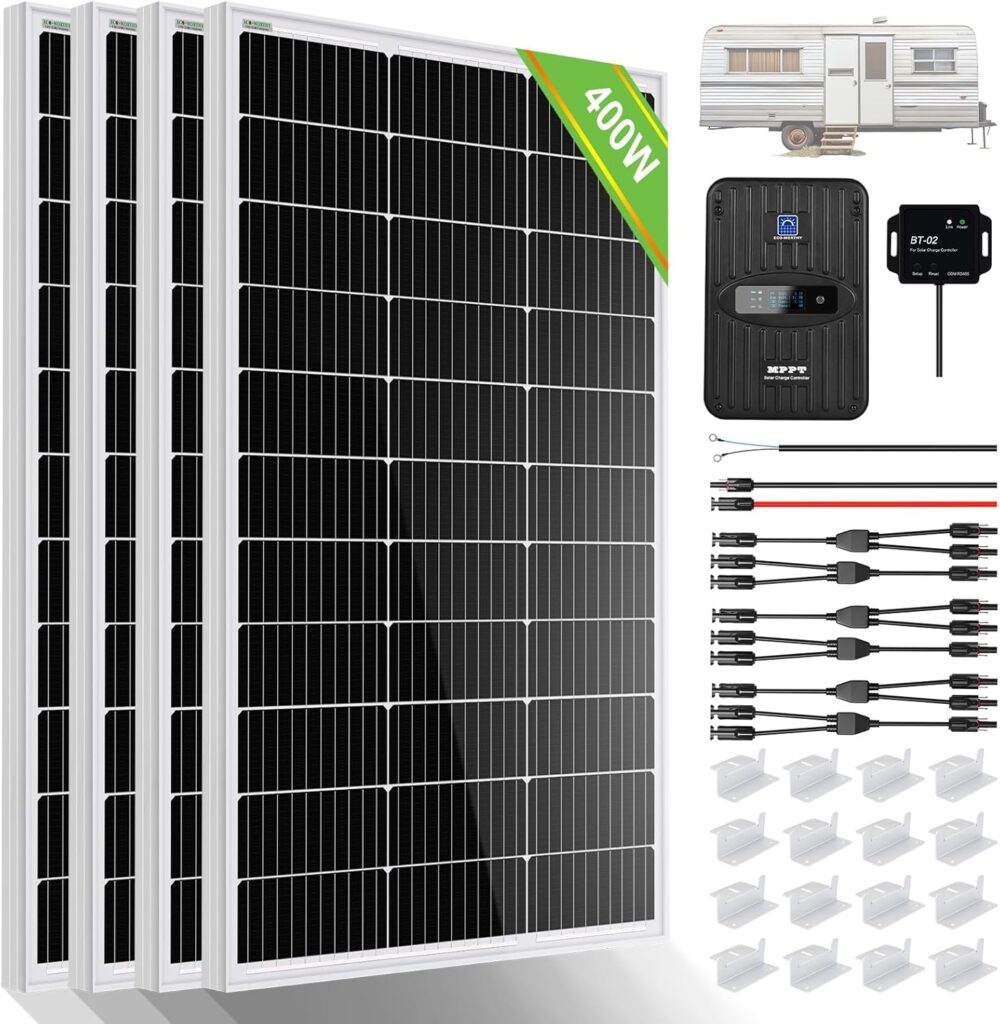
The ECO-WORTHY 400W kit delivers the same core combination as the Renogy Premium — 4×100W panels, 40A MPPT with Bluetooth, mounting hardware, MC4 cables, and Y-connectors — at roughly half the price. The 23% PERC efficiency slightly exceeds the Renogy’s 21%, and the 40A MPPT controller tracks at 99% efficiency. IP65 junction boxes and aluminium frames handle standard outdoor conditions well.
The trade-off is brand track record — Renogy’s documentation, community, and US customer support are more developed. For buyers comfortable with self-directed installation, the ECO-WORTHY kit delivers equivalent electrical performance at a significantly lower price. We covered this kit in detail in our RV solar panel kit guide.
Pros: Best price for a complete 400W MPPT + Bluetooth kit, 23% efficiency, 40A MPPT, 25-year warranty, everything included
Cons: Less established support documentation than Renogy
Best for: Budget-conscious buyers who want a complete 400W system with Bluetooth monitoring at the lowest price
Renogy N-Type 400W (2×200W Panels, 25% Efficiency) — Best High-Efficiency 400W
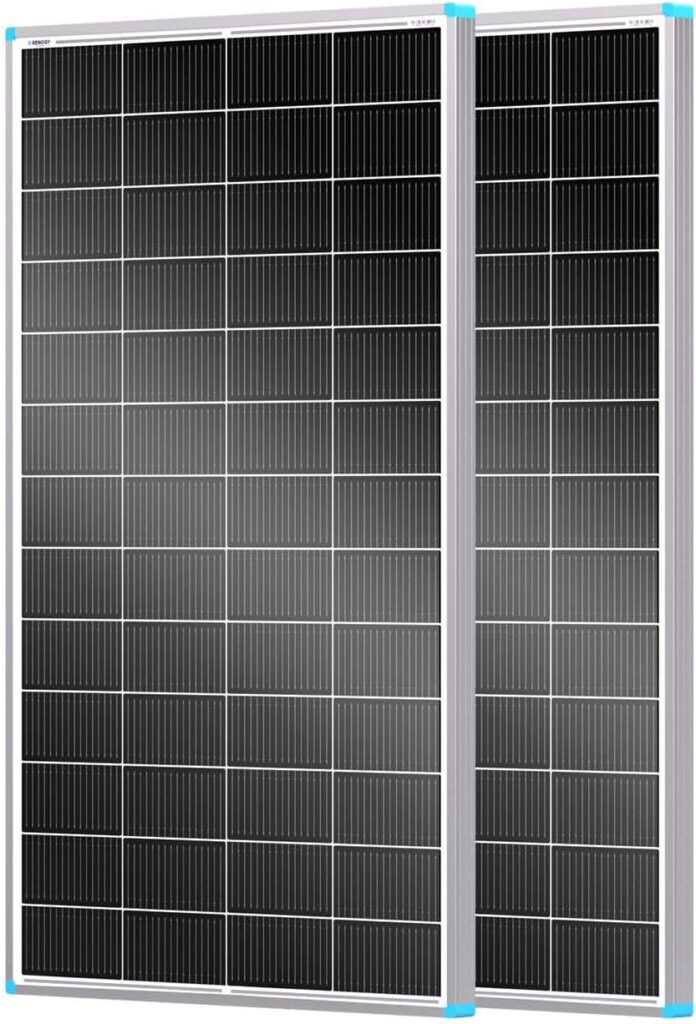
The Renogy N-Type 400W package consists of two 200W N-Type TOPCon panels delivering 25% efficiency — the highest in our picks. N-Type technology gives these panels a meaningful performance edge: 25% vs. 21% efficiency, a -0.29%/°C temperature coefficient (less heat-related output loss), and ≤0.4%/yr degradation rate. Over 25 years, these panels produce meaningfully more total energy than equivalent PERC panels of the same rated wattage.
The two-panel format is cleaner for many installations — fewer connections, simpler wiring, and larger surface per mounting point. Compatible with both 12V and 24V systems. Charge controller not included — pair with a 40A MPPT for 12V systems.
Pros: 25% N-Type efficiency, -0.29%/°C temp coefficient, 12V/24V compatible, ≤0.4%/yr degradation, Renogy quality
Cons: Controller not included, two large panels less flexible than four 100W panels for some roof layouts
Best for: Roof-mounted installations where maximum efficiency per square foot matters — RV roofs, van builds, marine
Renogy 400W Portable Solar Panel Suitcase — Best Portable 400W Option
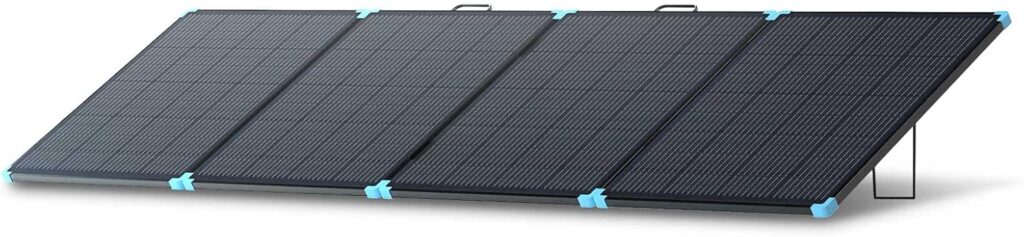
The Renogy 400W portable suitcase folds down to 33.7″×27.95″ — 4× more compact than a rigid 400W panel — and weighs just 30.2 lbs with carry case included. The ETFE-coated fiberglass construction with A+ monocrystalline cells at 23% efficiency is IP67 waterproof, with a 1-minute setup time using integrated kickstands. Connect to any power station with MC4 input and you have 400W of portable solar without any roof mounting.
Pros: Foldable and portable, 4× more compact than rigid equivalent, IP67, 23% efficiency, 1-minute setup, carry case included
Cons: 30.2 lbs — a car camping or van life tool, not for backpacking; 3-year warranty shorter than rigid panels
Best for: Car campers, overlanders, van life, and anyone wanting full 400W portable solar without permanent roof installation
How Many Amps Does a 400 Watt Solar Panel Produce?
The formula: Amps = Watts ÷ Volts
- At 12V: 400W ÷ 12V = 33.3A at peak output
- At 24V: 400W ÷ 24V = 16.7A at peak output
Higher amps require thicker wire. For a 12V system producing 33A, you need minimum 8 AWG wire for short cable runs (under 10 feet), and 6 AWG for longer runs. A 24V system halves the current, allowing thinner wire, less loss in the cables, and a better match for MPPT charge controllers. For systems over 200W, 24V is generally preferable. See our solar charge controller guide for voltage selection detail.
400 Watt Solar Panel for an RV — Is It Enough?
400W is the minimum practical solar capacity for an RV with a fridge running, and it works well when sized correctly.
| Device | Daily Wh |
|---|---|
| 12V compressor fridge | 1,000Wh |
| LED lighting | 120Wh |
| Device charging | 200Wh |
| Water pump | 50Wh |
| Fan | 120Wh |
| Total | ~1,490Wh |
A 400W system in 5 peak sun hours produces approximately 1,700Wh — covering this load with a small buffer. In 4 peak sun hours, output drops to 1,360Wh — meaning the fridge draws down the battery slightly each day.
The honest answer: 400W is enough for an RV used in reasonably sunny conditions with a single fridge and moderate device charging. For two fridges, air conditioning, or full-time living in lower-sun climates, 600–800W is more appropriate. Our RV solar panel kit guide covers sizing in detail.
400 Watt Solar Panel for Home Backup — What It Can Cover
What 400W + 200Ah LiFePO4 battery covers during an outage:
- Fridge running continuously for ~24 hours
- LED lighting throughout the house
- Phone and device charging
- Wi-Fi router continuously
- CPAP machine overnight
- Brief use of microwave or kettle
What it struggles with: Central air conditioning (2,000–3,500W), sustained electric cooking, electric water heater, well pump surge current. For serious home backup covering heavy loads, see our guide to the best solar generators for home backup.
How Long to Charge a Battery With a 400 Watt Solar Panel?
| Battery Size | Usable Capacity | Charge Time (400W panel) |
|---|---|---|
| 100Ah 12V LiFePO4 | 1,140Wh | ~3.4 hours of sun |
| 100Ah 24V LiFePO4 | 2,280Wh | ~6.7 hours of sun |
| 200Ah 12V LiFePO4 | 2,280Wh | ~6.7 hours of sun |
| 200Ah 24V LiFePO4 | 4,560Wh | ~13 hours (~2–3 sunny days) |
A 100Ah 12V LiFePO4 battery — the most common pairing for a 400W system — fully charges from empty in about 3–4 hours of good sun. This means most summer days end with a full battery going into the evening.
Frequently Asked Questions
How much power does a 400 watt solar panel produce per day?
In most US locations, 1,500–2,000Wh (1.5–2kWh) of usable energy per day, accounting for system losses and real-world conditions. In very sunny locations like Arizona, this can reach 2,200Wh. In lower-sun regions like the Pacific Northwest, expect 1,000–1,400Wh in average conditions.
Is 400 watts of solar enough to live off-grid?
For a minimalist off-grid setup — lighting, device charging, a 12V fridge, and basic appliances — 400W is workable in moderate-to-sunny climates. For comfortable full-time off-grid living with more appliances or in lower-sun climates, 600W–1,000W is more appropriate. Battery bank size matters as much as panel wattage — a 400W panel with adequate battery storage (200Ah+ LiFePO4) is significantly more capable than the same panels with an undersized battery.
How many amps does a 400 watt solar panel produce?
At 12V: approximately 33 amps at peak output. At 24V: approximately 17 amps at peak. Always size your charge controller and wiring for the peak current your configuration can produce.
What size inverter do I need for a 400 watt solar panel?
The inverter size is determined by your peak load — not the solar panel size. If you want to run a 1,000W microwave and a 200W laptop charger simultaneously, you need at least a 1,500W inverter. For typical off-grid loads alongside a 400W system, a 1,000–2,000W pure sine wave inverter covers most scenarios.
Can a 400 watt solar panel charge a 200Ah battery?
Yes — but it takes approximately 1.5–2 full days of good sun to fully charge a 200Ah 12V LiFePO4 battery from empty (~13 hours of peak output). For daily use where the battery is partially discharged and recharged rather than fully depleted each day, a 400W panel manages a 200Ah battery comfortably through daily cycling.
Final Verdict — Which 400W Solar Setup Is Right for You?
| Your Situation | Best Pick |
|---|---|
| Best complete kit, maximum support | Renogy 400W Premium Kit |
| Best value complete kit | ECO-WORTHY 400W Premium Kit |
| Best efficiency (roof/van/boat) | Renogy N-Type 400W (2×200W) |
| Best portable 400W | Renogy 400W Portable Suitcase |
A 400W solar system is the practical entry point for genuine off-grid capability — covering a fridge, lights, devices, and meaningful daily loads at an affordable, installable, and expandable price point. The key is matching the battery bank to your actual consumption and using an MPPT charge controller to capture every watt the panels generate.
For a complete system build — charge controllers, batteries, inverters, and wiring — see our off-grid solar system guide. For panels by efficiency and price, our cheap solar panels and high efficiency solar panels guides cover the full spectrum. And if you’re building a monocrystalline solar panel system from scratch, start there for the full technology breakdown before choosing your wattage.