This post contains affiliate links. If you buy through our links we may earn a small commission — at no extra cost to you. This never influences our recommendations.
Cheap Doesn’t Have to Mean Bad — But It Can
The solar panel market has changed dramatically. Prices that would have seemed impossible five years ago are now the norm — a quality 100W monocrystalline panel that costs $60 today would have cost $250 in 2018. The technology has matured, manufacturing has scaled, and competition has driven prices down across the board.
That’s the good news. The complicated news is that not every cheap panel is a good deal. The solar market has attracted a wave of unbranded, spec-inflated, poorly built panels that look identical to quality products in Amazon photos and reveal themselves only after a few months of outdoor use — cracked cells, failed junction boxes, and output that never matched the label.
This article cuts through that. We’ve verified every product against its actual Amazon listing, cross-referenced specs against manufacturer datasheets, and built a guide that tells you what the numbers mean, which brands are worth buying, and which cheap panels give you the best value for the money.
One important note on scope: This article focuses on off-grid solar panels — the 100W to 400W rigid panels used for RVs, boats, cabins, sheds, and portable power systems. Residential rooftop panels for whole-home solar are a different product category with different brands and economics.
What Makes a Solar Panel Actually Good — The Specs That Matter
Efficiency
The percentage of sunlight converted to electricity. Standard consumer panels currently range from 18% to 25%. Higher efficiency means a smaller panel for the same wattage — important when mounting space is limited.
Cell technology
Three main types in the current market:
- PERC (Passivated Emitter and Rear Contact) — the established workhorse. Most 100W panels under $80 use PERC. Efficiency typically 19–22%. Solid technology, well-proven, lower cost. The right choice for most off-grid buyers.
- N-Type TOPCon — the current premium. Higher efficiency (22–25%), lower degradation rate (~0.4%/yr vs ~0.5%/yr for PERC), better performance in high heat. Costs 10–20% more but delivers more power over 25 years.
- Bifacial — generates power from both sides of the panel. On a reflective surface (white roof, sand, snow), can add 10–25% additional output. Minimal benefit on dark surfaces.
Temperature coefficient
How much output drops as the panel heats up. Rated in %/°C — lower numbers mean less heat-related loss. A panel rated at -0.29%/°C loses less power on hot days than one rated at -0.45%/°C. In hot climates, this matters nearly as much as rated efficiency.
Degradation rate
Panels lose efficiency each year — typically 0.3–0.5%/yr for quality panels. The 25-year power output warranty guarantees a minimum — usually 80% at year 25 for most brands, with better brands now warranting 87–90%.
IP rating
IP65 is the minimum for outdoor panels — protected against dust and water jets from any direction. Check specifically for the junction box IP rating, not just the glass.
Warranty
Quality panels carry a 5-year product warranty and a 25-year power output warranty. The 25-year warranty is only meaningful if the company will still exist to honor it — stick with established brands.
Solar Panel Brands Compared — Who Actually Makes Good Panels?
Renogy is the most trusted consumer solar brand in the US off-grid market. Founded in 2010, 13+ million customers, sold in 90 countries. Consistently top-rated on Amazon with genuine warranty support. If you want reliability without paying premium, Renogy is the answer. Check out our RV solar panel kit guide for Renogy’s kit options.
ECO-WORTHY is a strong second option — significant Amazon presence, generally honest specs, decent build quality at a lower price than Renogy. A reliable budget choice particularly for buyers expanding an existing system.
DOKIO has been making solar panels for 17 years — one of the older consumer solar brands on Amazon. Good reputation in the off-grid community for honest specs and solid quality.
Brands to be cautious about: Any panel with no brand history, unusually high claimed efficiency (above 25% without N-type/HJT documentation), or a product warranty shorter than 5 years.
The Best Cheap Solar Panels Right Now — Verified Amazon Picks
Every panel below is verified on Amazon with specs confirmed from official listings.
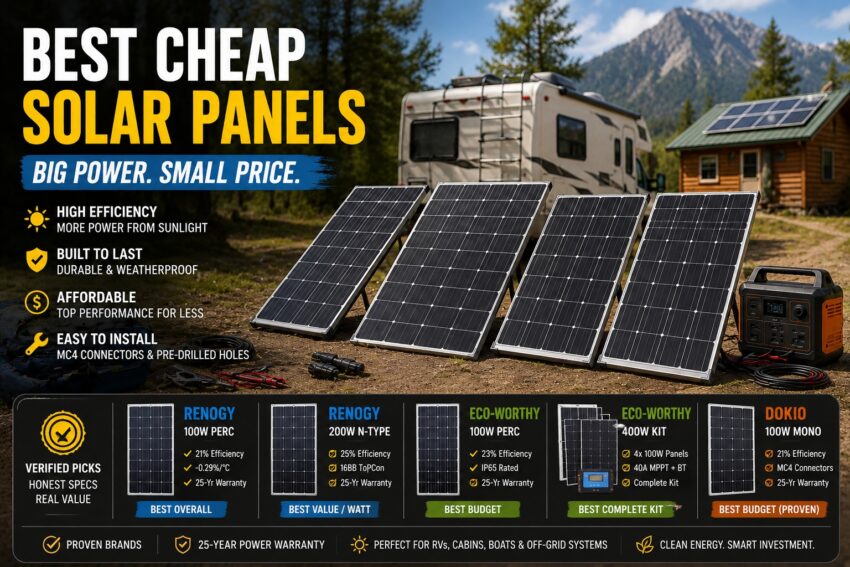
| Panel | Wattage | Cell Type | Efficiency | Temp Coeff | Warranty | Price |
|---|---|---|---|---|---|---|
| Renogy 100W (RNG-100D-SS) | 100W | PERC Mono | 21% | -0.29%/°C | 25yr power | ~$60 |
| Renogy 200W N-Type (16BB) | 200W | N-Type TOPCon | 25% | Low | 25yr power | ~$120 |
| ECO-WORTHY 100W Mono | 100W | PERC Mono | 23% | -0.35%/°C | 25yr power | ~$45 |
| ECO-WORTHY 400W Kit | 400W (4×100W) | PERC Mono | 23% | — | 25yr power | ~$220 |
| DOKIO 100W Rigid | 100W | Mono | 21% | — | 25yr power | ~$55 |
Renogy 100W 12V Monocrystalline Solar Panel — Best Overall
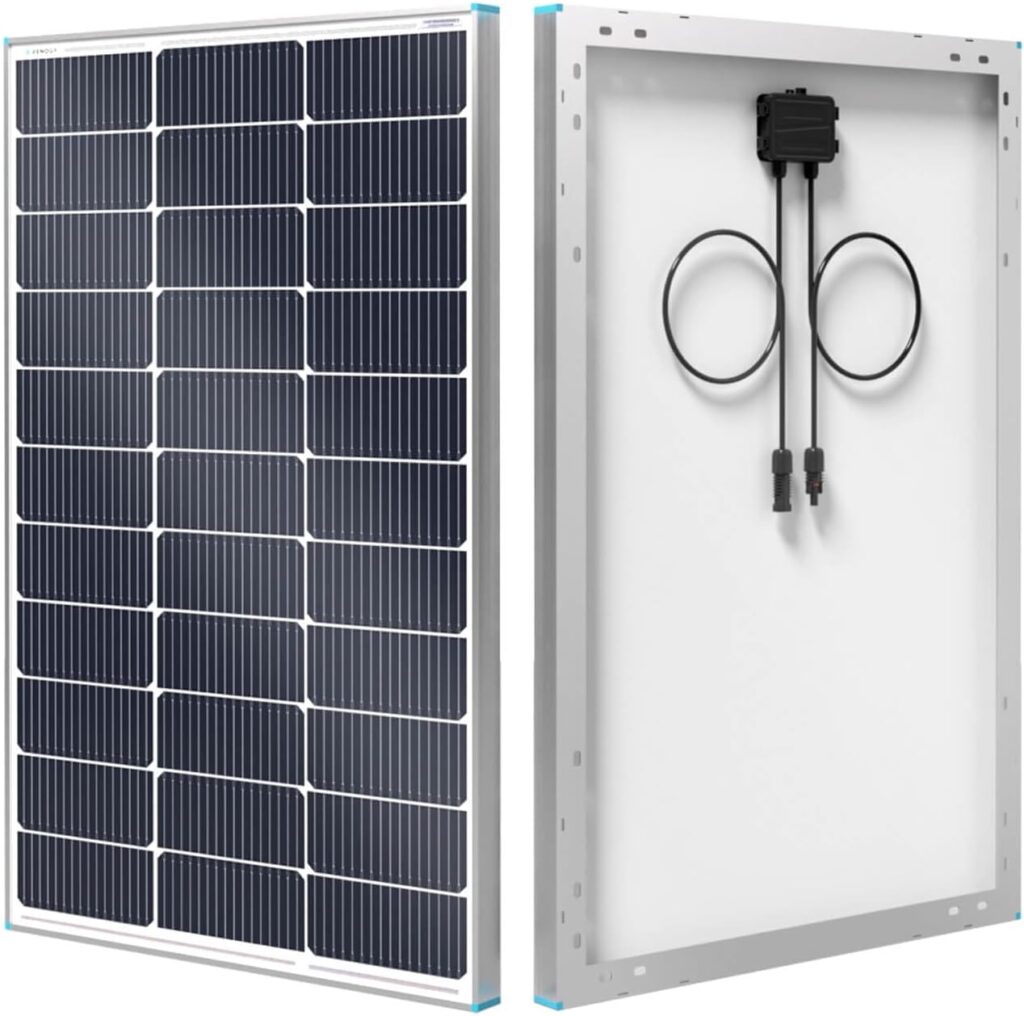
The Renogy 100W (RNG-100D-SS) is the #1 bestselling solar panel on Amazon — not because of marketing, but because it consistently delivers. It’s 11% smaller and 8% lighter than Renogy’s previous 100W model while maintaining the same output, making it ideal for tight mounting spaces on RVs, boats, and campers.
At 21% efficiency with PERC monocrystalline cells and a temperature coefficient of -0.29%/°C, it loses less output on hot days than most panels in its price range. The IP65 junction box and corrosion-resistant aluminum frame handle genuine outdoor exposure. Pre-drilled holes and MC4 connectors make installation and system expansion straightforward. Backed by Renogy’s 25-year power output warranty and 5-year materials warranty — from a company with 13+ million customers and real US customer support.
Pros: #1 Amazon bestseller, proven reliability, best-in-class -0.29%/°C temperature coefficient, IP65, 25-year power warranty, compact design, massive user community
Cons: 21% efficiency — not the highest in this list, slightly more expensive than budget alternatives
Best for: Anyone who wants a reliable workhorse panel from a brand with a genuine track record — the default choice for most off-grid buyers
Renogy 200W N-Type Solar Panel (16BB) — Best Value Per Watt
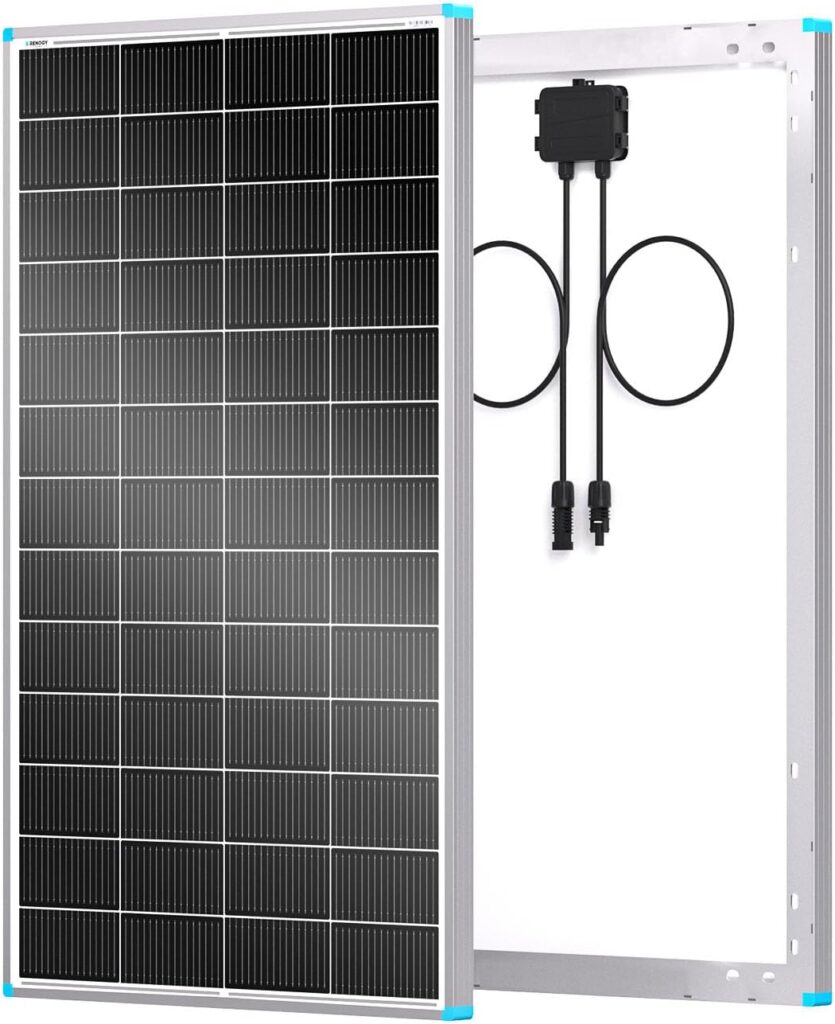
The Renogy 200W N-Type panel uses advanced 16-busbar N-type TOPCon cells to achieve 25% efficiency — delivering 20W more than a comparable standard 200W panel of the same physical size. At around $120, the value per watt is exceptional.
N-type silicon resists light-induced degradation better than P-type PERC, meaning it maintains output more consistently over its 25-year life. The 16BB design reduces internal resistance, minimizes hotspot risk, and improves performance in partial shade. For RV and boat installations where mounting space is at a premium, a single 200W panel at 25% efficiency beats two 100W panels at 21% — more power from less space with fewer connections.
Pros: 25% N-type efficiency, 16BB anti-hotspot technology, 20W more than standard 200W panels, excellent value per watt, 25-year warranty
Cons: Larger single panel may not suit all mounting configurations
Best for: RV roofs, boat decks, and off-grid installations where maximizing watts per square foot matters
ECO-WORTHY 100W 12V Monocrystalline — Best Budget Rigid Panel
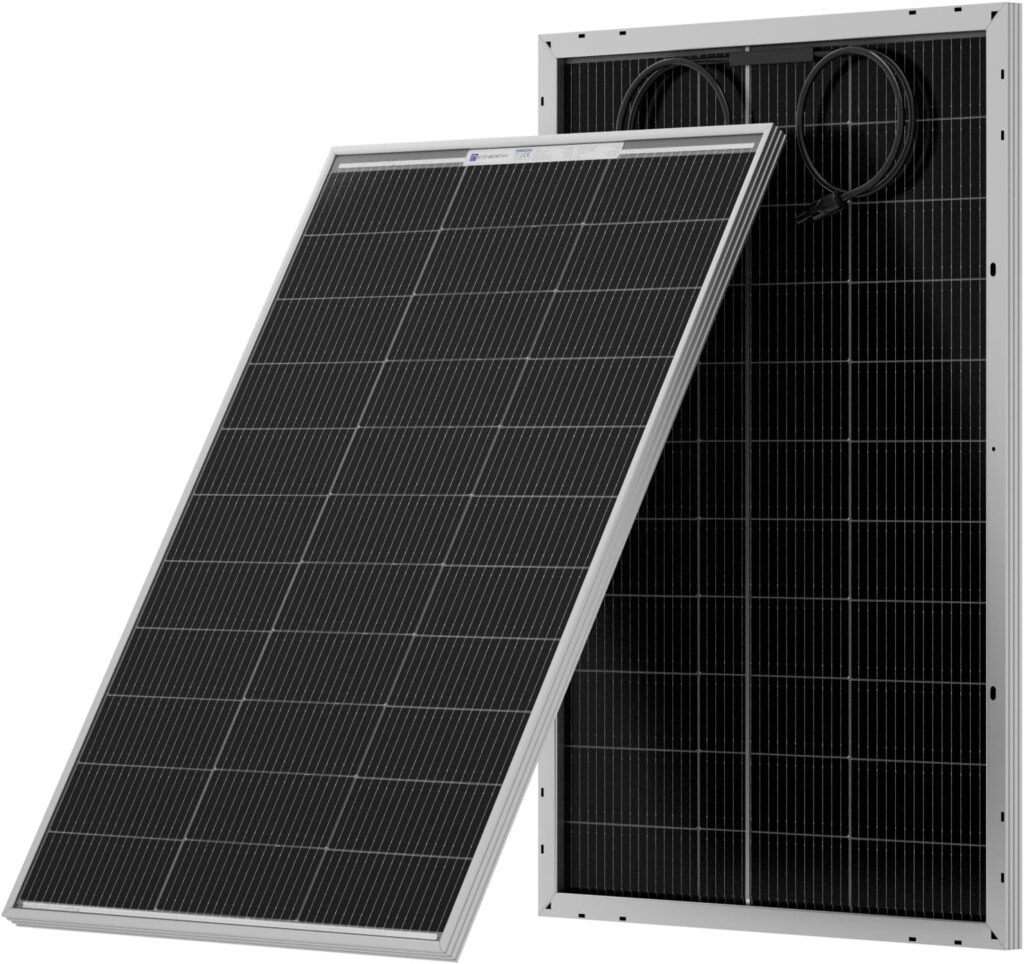
The ECO-WORTHY 100W is the most popular budget rigid solar panel on Amazon and consistently delivers on its claimed specs. At around $45 — roughly 25% less than the Renogy equivalent — it’s the right choice for buyers expanding a system, building a budget setup, or adding supplemental charging capacity.
The PERC technology claims 23% efficiency through a passivation film that enhances sunlight reflection inside the silicon substrate. The IP65 junction box is weather-rated, the aluminum frame handles 2400Pa wind and 5400Pa snow loads, and the 25-year power output warranty is genuine. The temperature coefficient of -0.35%/°C is slightly worse than Renogy’s -0.29%/°C — in moderate climates, the difference is negligible.
Pros: Best price in this roundup (~$45), 23% PERC efficiency, IP65, 25-year warranty, pre-attached cables
Cons: Temperature coefficient (-0.35%/°C) slightly worse than Renogy, shorter brand track record
Best for: Budget buyers, system expansion, cabins, sheds, and anyone adding panels to an existing setup
ECO-WORTHY 400W Premium Solar Panel Kit — Best Budget Complete Kit
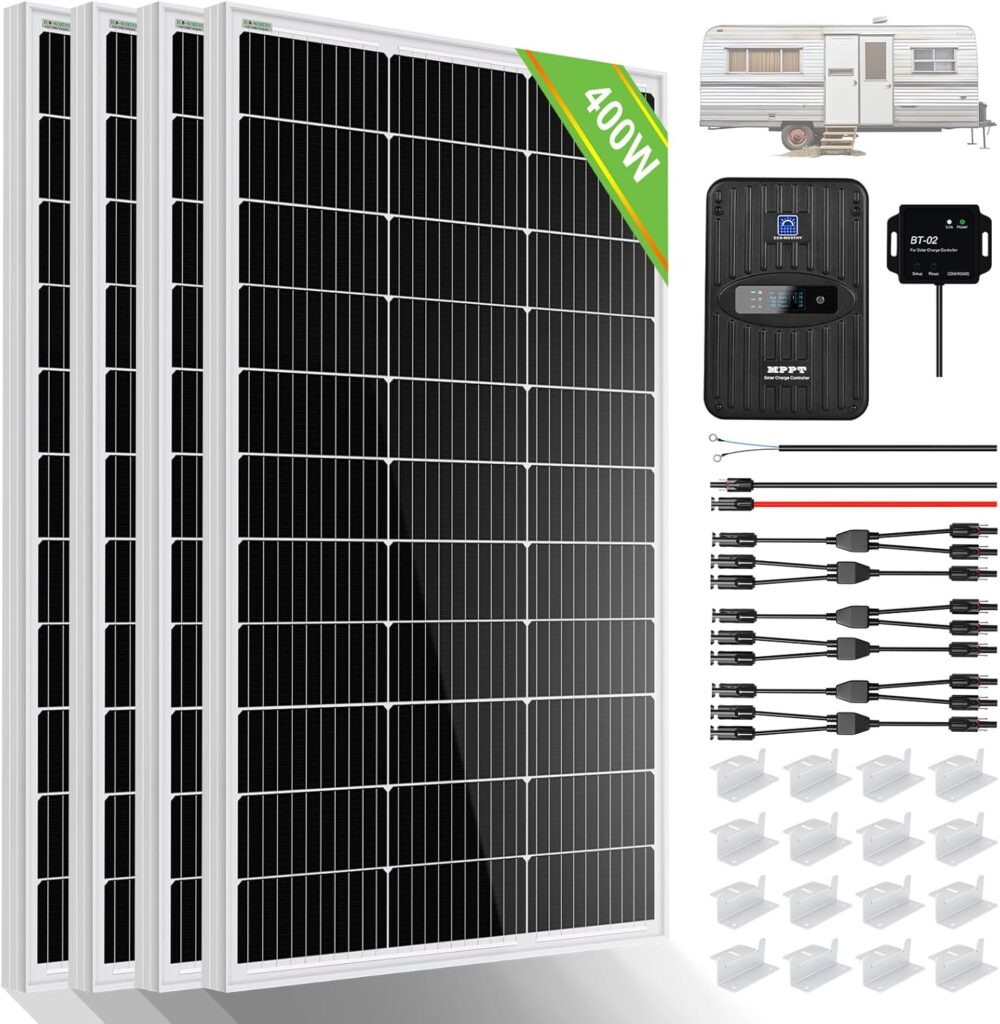
The ECO-WORTHY 400W kit includes four 100W PERC monocrystalline panels, a 40A MPPT charge controller with Bluetooth monitoring, mounting Z-brackets, MC4 cables, and Y-connectors — everything needed for a complete 400W off-grid system at a competitive price.
The 40A MPPT controller extracts maximum power in real-world conditions — partial shade, morning and evening sun, temperature variations — delivering 20–30% more energy than PWM alternatives. Bluetooth connectivity lets you monitor input wattage, battery state of charge, and charge history from your phone. We covered this kit in detail in our RV solar panel kit guide — it’s consistently the best value 400W kit on Amazon.
Pros: Complete kit — panels, 40A MPPT controller, Bluetooth, mounts, and cables all included, 25-year panel warranty, competitive price for 400W
Cons: Less comprehensive documentation than Renogy kits, app less polished than Renogy’s
Best for: RVs, boats, cabins, and anyone building a complete 400W off-grid system who wants everything in one purchase
DOKIO 100W 18V Monocrystalline Rigid Solar Panel — Best Budget With Proven History
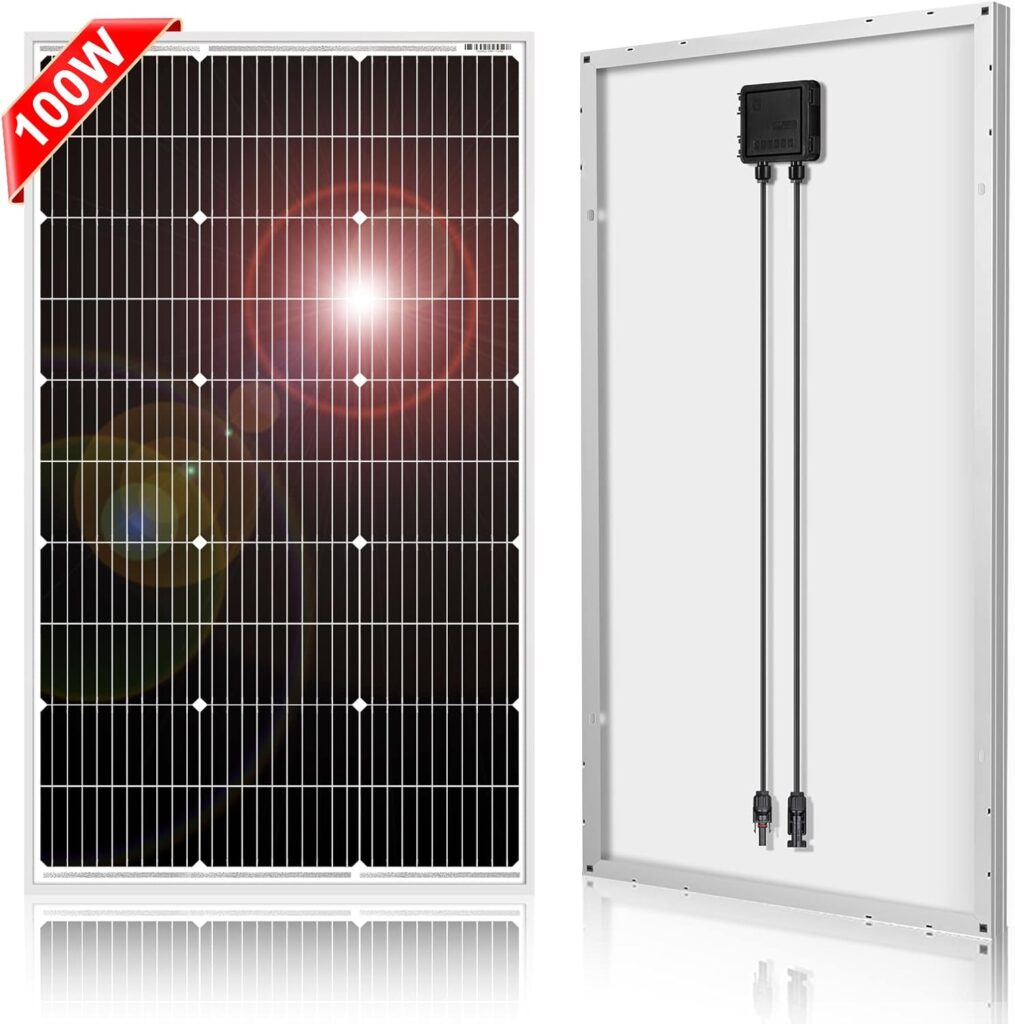
DOKIO has been making solar panels for 17 years — longer than most brands on Amazon. Their 100W rigid glass panel is a consistently honest product: glass-and-aluminum frame construction, MC4 connectors, pre-drilled mounting holes, 21% monocrystalline efficiency, and genuine outdoor durability. At around $55 it sits between ECO-WORTHY’s budget pricing and Renogy’s premium.
DOKIO’s 17-year market track record means their warranty claims have actual history behind them. They were building panels before most no-name brands currently on Amazon even existed — which counts for a lot when you’re buying something with a 25-year warranty.
Pros: 17 years brand history, honest specs, glass/aluminum frame, MC4 connectors, pre-drilled mounting holes, solid low-light performance
Cons: 21% efficiency matches but doesn’t exceed Renogy at only slightly lower price
Best for: Budget buyers who want a rigid panel from a brand with genuine market history rather than a no-name alternative
How to Read Solar Panel Specs Without Getting Fooled
The efficiency claim problem. A panel rated at 23% efficiency has a specific physical relationship between its dimensions and its wattage. Check: Power (W) ÷ Area (m²) ÷ 1,000 = efficiency%. A genuine 23% efficient 100W panel will be roughly 0.43m². If the dimensions don’t match the claimed efficiency, the claim is inflated.
The wattage tolerance issue. Quality panels ship with 0–3% positive power tolerance — they produce at or slightly above rated wattage. Cheap panels with negative tolerance can deliver 3–5% below rated output from day one. Look for “positive power tolerance” in the spec sheet.
The warranty paper problem. A 25-year warranty is only worth something if the company will exist to honor it. A brand that appeared on Amazon in 2023 with no manufacturing history has no meaningful track record. Renogy, ECO-WORTHY, and DOKIO all have verifiable history.
The temperature coefficient trap. Two panels with identical wattage ratings can perform very differently on hot days. A panel with -0.29%/°C loses 2.9% output per 10°C of temperature rise. A panel with -0.45%/°C loses 4.5% — a 55% larger heat penalty. In hot climates, check this number.
Proprietary connectors. The industry standard is MC4. If a panel uses a proprietary connector, it locks you into that brand’s ecosystem. Always verify MC4 compatibility.
Cheap Solar Panels by Use Case
For a basic RV starter kit (100–200W): Renogy 100W (RNG-100D-SS) paired with a Renogy starter kit. The most proven, best-documented entry point to RV solar with the strongest community support.
For a complete RV or boat system (400W): ECO-WORTHY 400W Kit. Everything included, MPPT controlled, Bluetooth monitored, and significantly cheaper than assembling the same system from individual components.
For maximizing output in limited space: Renogy 200W N-Type (16BB). At 25% efficiency, the most power per square foot of mounting area in our picks.
For a cabin or shed on a tight budget: ECO-WORTHY 100W. At ~$45, the most cost-effective way to add 100W of reliable solar capacity.
For portable and camping use: Rigid panels aren’t the right tool. See our guide to flexible solar panels for portable and curve-mounted options.
For battery maintenance and trickle charging: See our guide to the best solar battery chargers — small dedicated units designed for that specific purpose.
Budget Solar Red Flags — What to Avoid
Efficiency above 25% from unknown brands. The physics of mainstream silicon cells puts a practical ceiling at around 25–26% for consumer panels. Claims above this without N-type or HJT cell documentation are almost certainly inflated.
No-name brands with no Amazon history. A brand that appeared in 2023 with 47 reviews and no manufacturing track record is a risk. Buy from brands that will still exist when you need warranty support in 2035.
Junction boxes without IP65 rating. The junction box is where panel wiring connects to the outside world. A junction box that lets water in corrodes the connections and fails the panel. Always check IP rating specifically for the junction box.
No positive power tolerance. Quality panels are guaranteed to produce at rated output or above. If a panel doesn’t specify positive tolerance, it may be producing less than its rating from day one.
Frequently Asked Questions
What is the best cheap solar panel for an RV?
The Renogy 100W (RNG-100D-SS) at ~$60 is the most reliable 100W option at a genuinely affordable price. For a complete system, the ECO-WORTHY 400W kit at ~$220 gives you four panels, a 40A MPPT controller, and all wiring — the best complete-system value on Amazon. See our full RV solar panel kit guide for detailed sizing guidance.
Are cheap solar panels worth it?
Budget panels from established brands like ECO-WORTHY and DOKIO genuinely deliver what they claim and are absolutely worth buying. No-name panels with inflated specs from unverified manufacturers are not. The price premium for Renogy over budget brands is typically 20–30% — often worth it for the warranty support and quality consistency.
What is the most efficient solar panel on Amazon?
Renogy’s N-Type 16BB panels currently claim 25% efficiency — the highest of any established brand in the consumer Amazon market. Anything claiming substantially above 25% without N-type or HJT cell documentation should be treated with scepticism.
How long do cheap solar panels last?
Quality panels from established brands carry 25-year power output warranties and typically maintain 80–87% of original output at year 25. The weak link in cheap panels is usually the junction box and connectors — these fail before the cells do. IP65-rated junction boxes and quality MC4 connectors dramatically extend real-world lifespan.
Can I mix different solar panel brands in one system?
Yes — solar panels are standardized on MC4 connectors and voltage compatibility. Panels from different brands can work together as long as you match voltage and wiring configuration to your charge controller’s input requirements. Panels wired in series should have the same wattage and ideally the same model to avoid output imbalance.
Who makes the best solar panels for off-grid use?
For consumer off-grid applications (RV, boat, cabin, shed): Renogy for best overall reliability, ECO-WORTHY for best budget value, DOKIO for proven budget-to-mid-range quality. For off-grid power systems, also see our guide to the best solar charge controllers to pair with your panels.
The Bottom Line
Cheap solar panels in 2026 are genuinely good value — if you buy from the right brands. Renogy, ECO-WORTHY, and DOKIO all deliver real-world performance that matches their specifications at prices that would have seemed impossible five years ago.
The mistake most buyers make isn’t buying cheap — it’s buying from brands with no history, inflated specs, and no meaningful warranty. Stick with verified brands, check the temperature coefficient alongside the efficiency rating, make sure the junction box is IP65 rated, and verify MC4 connectors. Do those four things and a “cheap” solar panel becomes a genuinely smart investment.
For most off-grid buyers, the Renogy 100W (RNG-100D-SS) at ~$60 is the answer. For complete systems, the ECO-WORTHY 400W kit at ~$220 is the best value. For maximum watts per square foot, the Renogy 200W N-Type at ~$120 is hard to beat. And if you need to power an entire off-grid setup, see our guide to the best solar generator for home backup to pair your panels with the right storage solution.