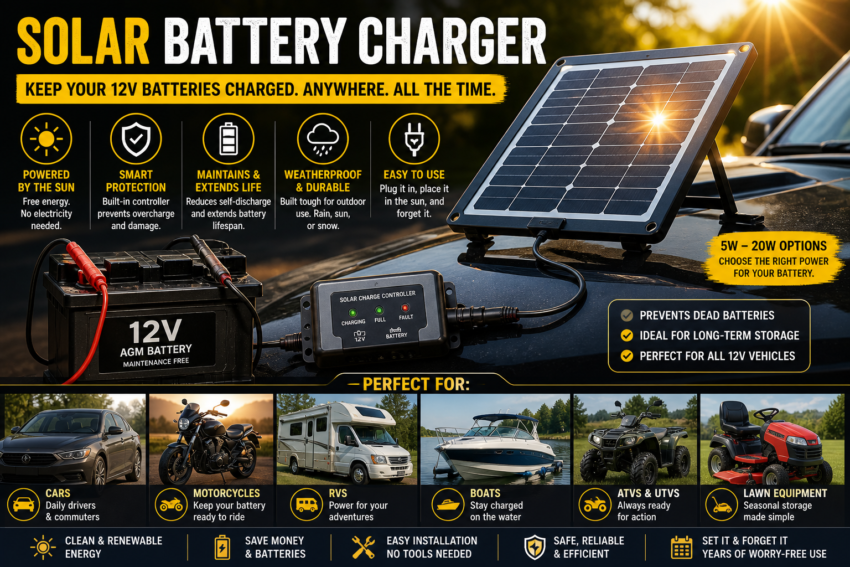
What Is a Solar Battery Charger?
A solar battery charger is a solar panel — usually small and portable — designed specifically to charge or maintain a 12V battery using sunlight. Unlike the large solar panels used for home power systems, solar battery chargers are compact, plug-and-play units designed for cars, motorcycles, RVs, boats, ATVs, and any other vehicle or equipment with a 12V lead-acid or AGM battery.
There are three main types to know before you buy:
- Solar battery chargers — deliver enough current to actively charge a depleted or partially depleted battery over several hours of sun exposure.
- Solar trickle chargers — deliver a small, continuous trickle of current that offsets self-discharge in a stored battery, keeping it topped up without actively charging from low.
- Solar battery maintainers — smart chargers that monitor battery voltage and switch between charging and maintenance modes automatically. The most sophisticated option for long-term storage.
Solar Battery Charger vs. Solar Trickle Charger vs. Solar Maintainer — What’s the Difference?
This is the most common source of confusion when shopping in this category. Here’s the clear breakdown:
| Type | Output | Best For | Overcharge Risk |
|---|---|---|---|
| Solar battery charger | 5–20W (0.3–1.5A) | Actively charging a low battery | Yes — needs protection circuit |
| Solar trickle charger | 1–5W (0.08–0.3A) | Maintaining a stored battery | Low — output too small to overcharge |
| Solar maintainer | 5–20W + smart circuit | Long-term storage, any vehicle | None — auto-regulates |
Use a solar battery charger when: Your battery is depleted or low and you need to actively restore charge over a day of sunlight.
Use a solar trickle charger when: Your vehicle sits unused for weeks or months and you just want to offset self-discharge — classic use case for seasonal vehicles like boats, classic cars, motorcycles, and lawnmowers.
Use a solar maintainer when: You want a set-and-forget solution that handles both charging and long-term maintenance automatically, with zero risk of overcharge regardless of how long it’s connected.
For most people buying a “solar trickle charger for a car battery” — what they actually want is a solar maintainer. It does everything a trickle charger does, but smarter.
What to Look for When Buying a Solar Battery Charger
Wattage and output current
Wattage determines how fast the panel charges. For trickle/maintenance use, 5–10W is sufficient. For actively charging a car battery from low, 10–20W gives you a practical charge time. A 10W panel on a 12V system delivers roughly 0.8A — enough for maintenance, not enough to recover a dead battery quickly.
Voltage compatibility
Virtually all automotive solar chargers are 12V. Some support 24V (useful for trucks and RVs with 24V systems). Always verify before buying.
Overcharge protection
This is non-negotiable for anything above 5W. A built-in charge controller or overcharge protection circuit prevents the panel from pushing excessive voltage into a full battery. Look for units that explicitly state “overcharge protection” or include a built-in charge controller.
Battery type compatibility
Most solar chargers support standard flooded lead-acid and AGM batteries. If you have a gel or lithium battery, verify compatibility before buying — lithium batteries need a specific charge profile not all solar chargers support.
Connector types
Standard connectors include: SAE connector (most common for automotive), alligator clips (direct battery connection), and cigarette lighter/OBD port adapters. Most solar chargers include multiple connector options.
Portability vs. fixed mount
Dashboard-mount panels use a suction cup inside the windshield — convenient but less efficient (glass filters up to 30–50% of solar radiation). Hood or roof-mounted panels in full sun charge much faster. For long-term garage storage, a panel with a long cable that reaches through a cracked window or door gap works best.
Weather resistance
For outdoor use, look for an IP65 rating at minimum. For marine or exposed environments, IP67 or better.
Best Solar Battery Chargers in 2026 — Top Amazon Picks
| Model | Wattage | Controller | Overcharge Protection | IP Rating | Price | Best For |
|---|---|---|---|---|---|---|
| Battery Tender 5W Solar | 5W | Float mode | ✅ Built-in | IP67 | ~$35 | Best overall trickle |
| OYMSAE 12W Solar Car Charger | 12W | Smart controller | ✅ Built-in | IP65 | ~$25 | Best for cars |
| SUNER POWER 12W Waterproof | 12W | MPPT | ✅ Built-in | IP65 | ~$30 | Best waterproof |
| SUNER POWER 20W PRO | 20W | MPPT | ✅ Built-in | IP65 | ~$45 | Best for RV/boat |
| ALLPOWERS 18W Solar Charger | 18W | Basic blocking diode | ✅ Basic | Splash resistant | ~$25 | Best budget |
Battery Tender 5W Solar Charger — Best Overall Trickle Charger
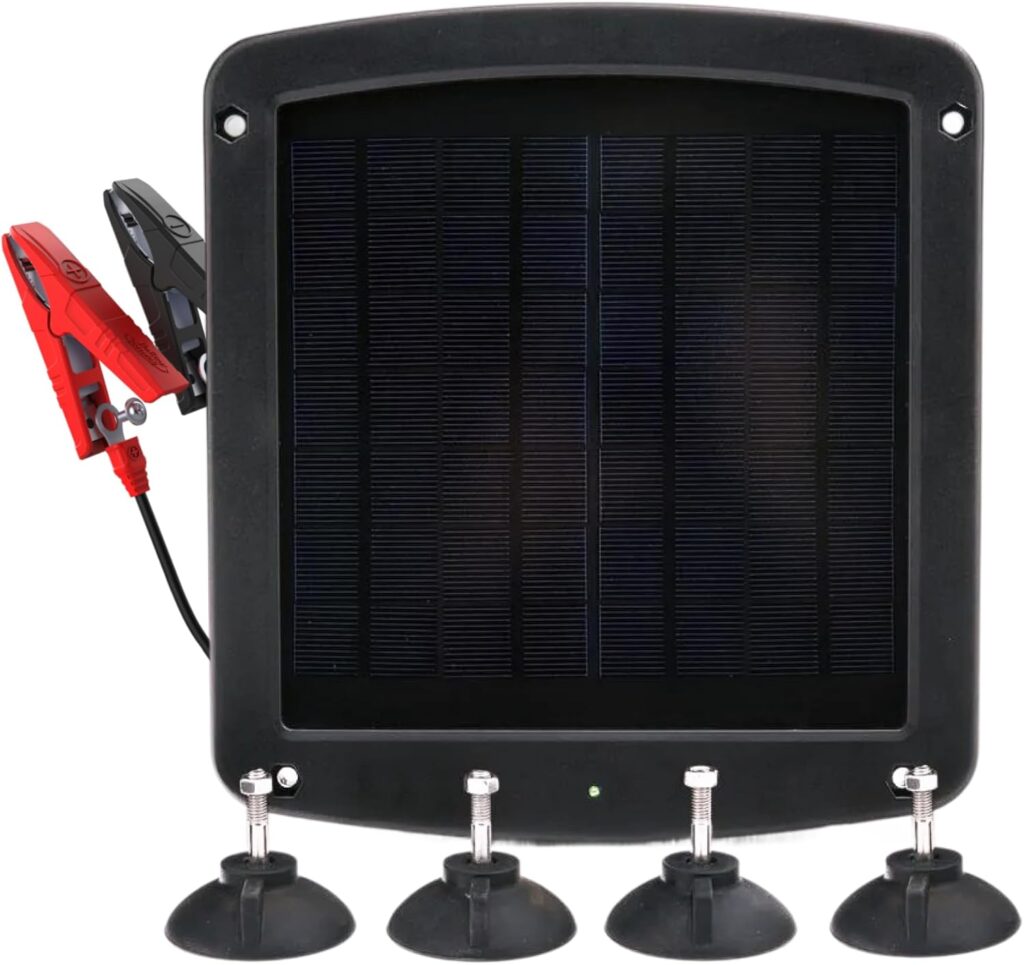
Battery Tender is the most trusted name in battery maintenance products — their 5W solar charger is consistently ranked the #1 bestseller in solar battery chargers on Amazon. The 5W output is perfectly sized for trickle maintenance on any standard 12V vehicle battery without any risk of overcharge.
The built-in controller with float mode makes it a true set-and-forget solution. Connect it in spring, leave it all season, and your battery stays healthy without any intervention. It comes with both an SAE connector (for permanent ring terminal mount) and alligator clips, covering all mounting scenarios. IP67 rated and backed by a 5-year warranty.
Pros: #1 bestseller on Amazon, float mode, IP67, 5-year warranty, dual connectors, proven reliability
Cons: 5W is too small to actively charge a depleted battery — purely for maintenance use
Best for: Seasonal vehicles, classic cars, motorcycles, boats, and any vehicle stored for weeks or months
OYMSAE 12W Solar Car Battery Charger — Best for Cars
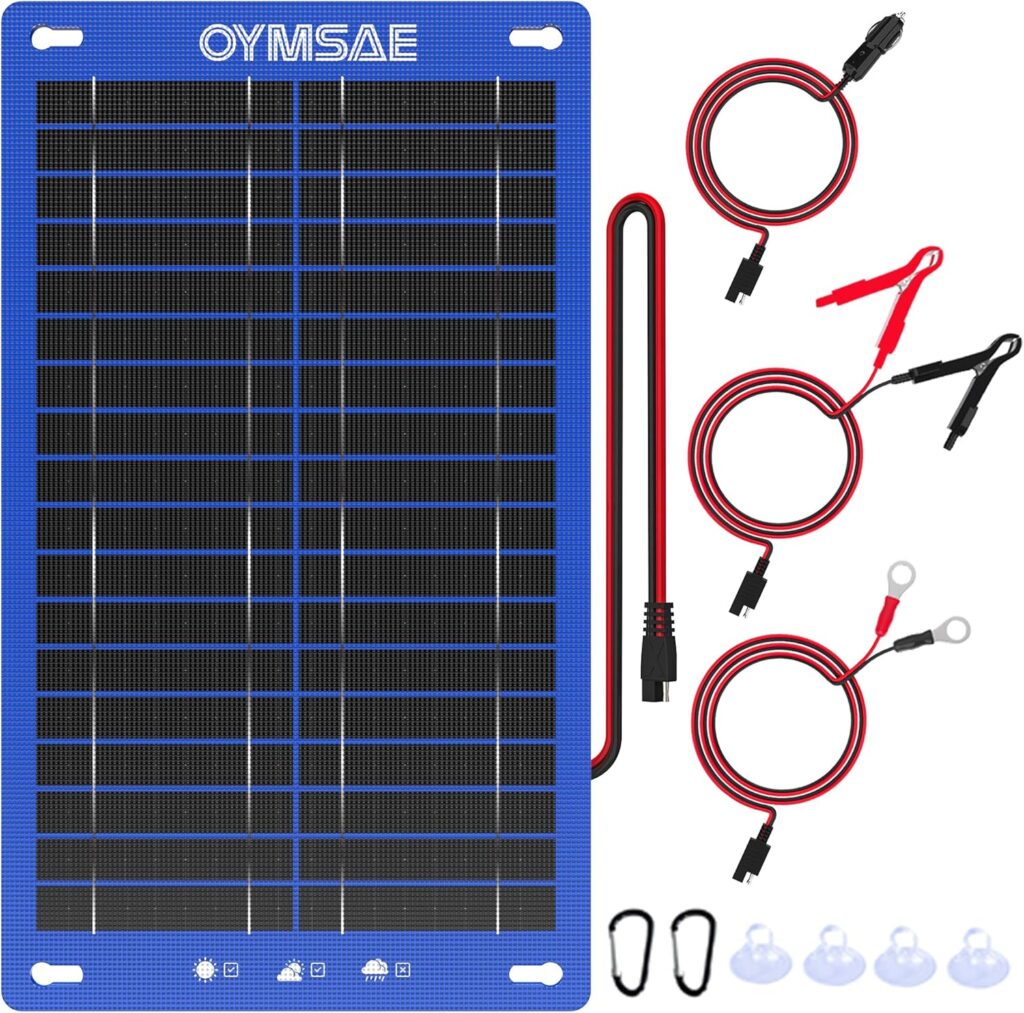
The OYMSAE 12W is a well-rated 12W solar car battery charger on Amazon with a built-in smart controller that includes overcharge protection, over-voltage protection, and reverse current blocking. At 12W it delivers enough current to maintain and slowly charge a car battery throughout the day.
The ETFE coating makes it more durable under UV exposure than PET-coated budget alternatives. It comes with a full SAE cable kit for plug-and-play connection, and the suction cup and carabiner mounts make it easy to position on a windshield or attach to a bag for camping use. A zero-night-drain controller cuts charging at sunset.
Pros: Smart controller with full protection suite, ETFE coating, zero night drain, SAE plug-and-play, great value
Cons: IP65 rather than IP67 — suitable for rain but not submersion
Best for: Cars, RVs, motorcycles, and anyone who wants a smart 12W charger at an accessible price
SUNER POWER 12W Waterproof Solar Trickle Charger — Best Waterproof Option
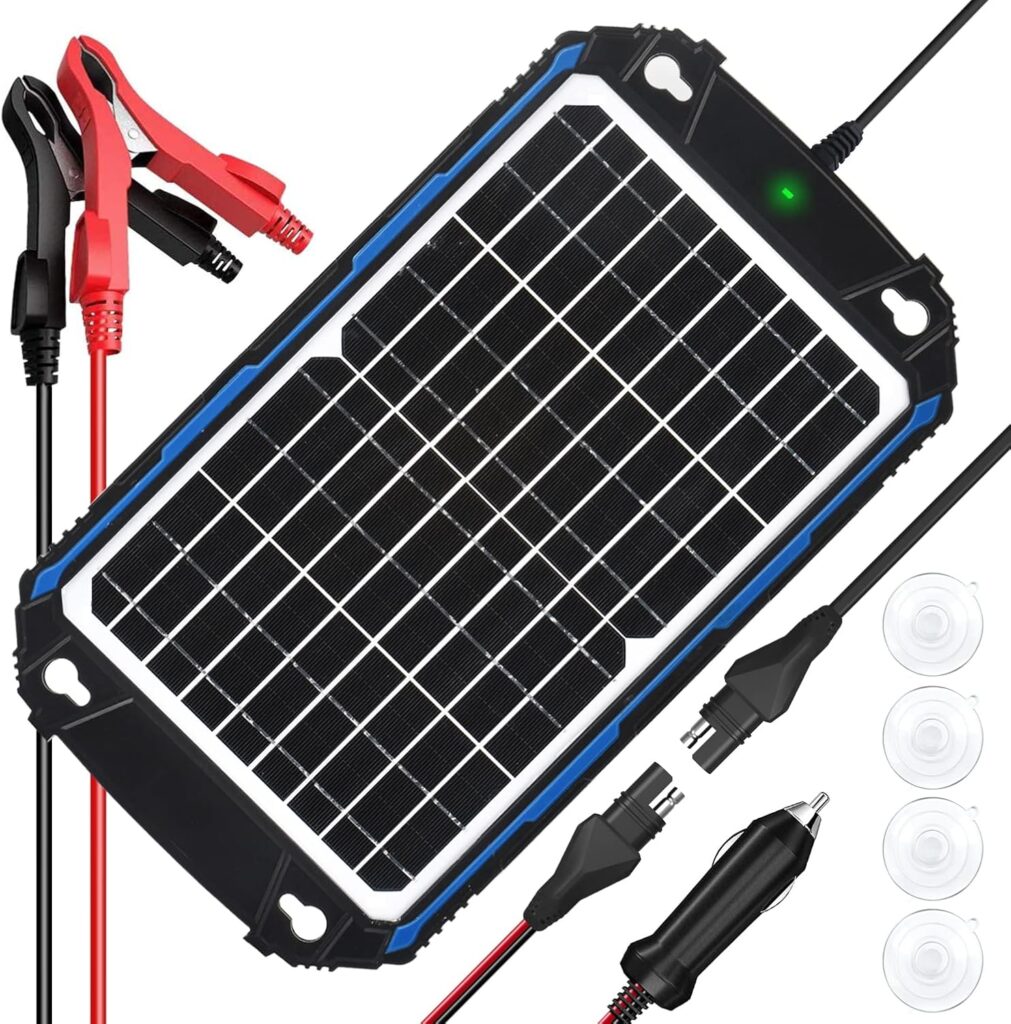
If your vehicle lives outdoors — a boat on a dock, an RV in a campsite, a motorcycle uncovered in a driveway — the SUNER POWER 12W is the top waterproof solar charger in this category on Amazon. Voted “Best Battery Maintainer” by CNET, it features a built-in UltraSmart MPPT charge controller that delivers 20–30% more power than traditional PWM controllers.
The 3-stage charging algorithm (bulk, absorption, float) ensures the battery is safely charged and maintained automatically. Full protection suite includes overcharge, over-discharge, over-voltage, reverse polarity, and temperature protection. The tempered glass surface and durable frame handle UV, hail, and extreme temperatures.
Pros: MPPT controller (best-in-class efficiency), CNET award winner, 3-stage automatic charging, full protection suite, proven track record
Cons: IP65 — waterproof but check if IP67 is needed for fully submerged marine use
Best for: Boats, outdoor motorcycles, RVs, and any vehicle stored outdoors year-round
SUNER POWER 20W PRO Solar Battery Charger — Best for RVs and Boats
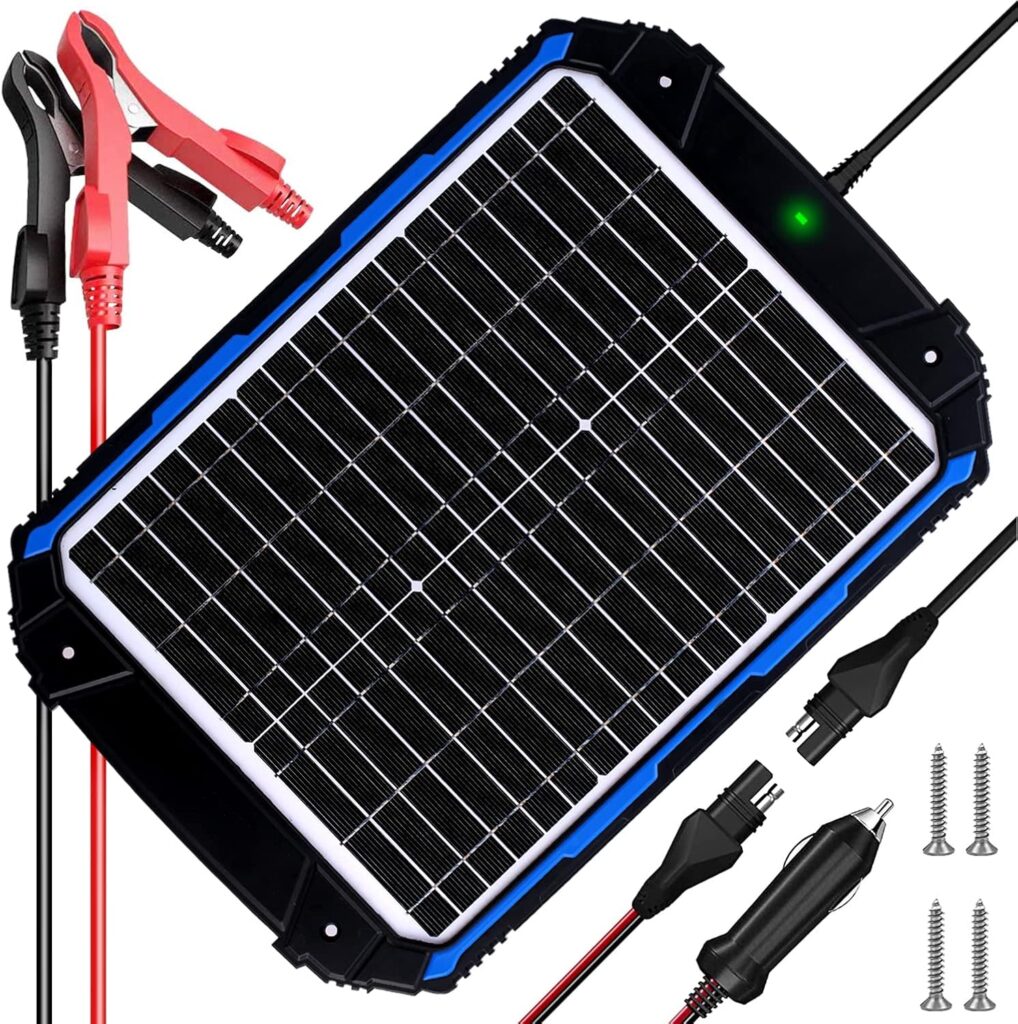
For larger 12V battery banks — RV house batteries, boat batteries, dual-battery systems in trucks — the SUNER POWER 20W PRO delivers the highest output in our picks. At 20W with a built-in intelligent MPPT controller, it actively charges a depleted battery much faster than the 5W or 12W alternatives while still maintaining safely in float mode once full.
The 3-stage MPPT charging algorithm generates up to 30% more power than competing PWM units, the LED indicator clearly shows charging status, and the tempered glass surface with IP65 weatherproofing handles year-round outdoor installation. Multiple mounting options (Z-brackets included) make it adaptable to most installations.
Pros: MPPT controller for maximum output, 20W handles larger battery banks, LED status indicator, IP65, Z-brackets included
Cons: Larger physical size than compact trickle chargers — requires more mounting space
Best for: RV house batteries, boat batteries, dual-battery truck setups, and larger 12V systems that need active charging
ALLPOWERS 18W Solar Car Charger — Best Budget Pick
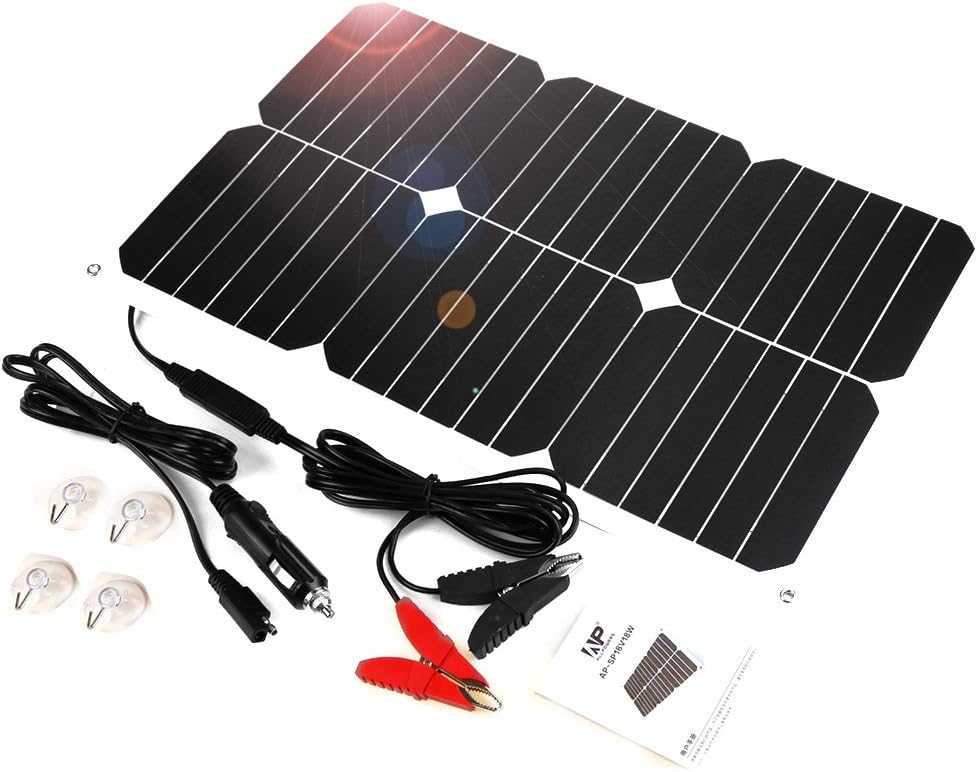
ALLPOWERS has a long-established presence on Amazon for solar battery charging. Their 18W car charger uses monocrystalline solar cells and includes a built-in blocking diode that prevents reverse discharge at night. It comes with both a cigarette lighter plug and alligator clips and is easy to mount on a dashboard or windshield.
One important note: unlike the SUNER POWER or OYMSAE models, the ALLPOWERS 18W uses a basic blocking diode rather than a smart multi-stage charge controller. This means it’s suitable for batteries 20Ah or larger where the panel’s output won’t overcharge, but it’s not the best choice for smaller batteries or fully automated long-term use. For a basic, affordable 18W charger for everyday use, it gets the job done.
Pros: Affordable, well-established Amazon brand, 18W output, monocrystalline cells, dual connection options
Cons: Basic blocking diode only — not a smart multi-stage controller; not ideal for batteries under 20Ah
Best for: Budget buyers with standard-sized car batteries (40Ah+) who want basic solar charging without the premium price
Solar Trickle Chargers for Cars — Everything You Need to Know
A solar trickle charger for a car battery serves one primary purpose: keeping a healthy battery healthy during periods of inactivity.
Car batteries self-discharge at a rate of roughly 1–3% per week at room temperature. A typical 5W solar trickle charger outputs around 0.3A, which is enough to offset that self-discharge and keep the battery at full charge indefinitely as long as it receives a few hours of sun per day.
When a solar trickle charger makes sense:
- Car stored for winter or extended periods
- Classic or collector car used occasionally
- Boat sitting in a marina between trips
- Motorcycle stored off-season
- Lawnmower or ATV used only seasonally
- Second vehicle used infrequently
When it won’t help: A solar trickle charger can’t recover a dead battery. If your battery is below 50% charge, you need either a higher-wattage solar charger (10–20W) or a traditional plug-in charger to recover it first.
Connecting a solar trickle charger to a car battery:
- Attach the ring terminal connectors permanently to the battery terminals (positive first)
- Route the cable out through a door or window gap
- Position the panel in full sun — on the dashboard, hood, or roof
- The charger handles everything else automatically
Dashboard vs. hood mount: Dashboard placement through the windshield is convenient but less efficient — glass can reduce solar transmission by 30–50% depending on tint and coating. Hood or roof placement in direct sun charges 2–3x faster but requires a longer cable and weatherproof construction.
12V Solar Battery Chargers — Use Cases and Sizing Guide
| Battery Size | Vehicle Type | Recommended Solar Wattage |
|---|---|---|
| 20–40Ah | Motorcycle, ATV, small boat | 5–10W |
| 40–70Ah | Standard car, small van | 10–15W |
| 70–100Ah | Large car, SUV, truck | 15–20W |
| 100–200Ah | RV house battery, large boat | 20–30W |
| 200Ah+ | Dual battery, large RV | 30W+ (consider full charge controller) |
The overcharge protection question: At low wattages (5W or under) on a large battery (60Ah+), the risk of overcharge is minimal — the math simply doesn’t allow it. A 5W panel on a 60Ah battery can deliver at most 0.33A, well within safe continuous charge limits for lead-acid chemistry. At higher wattages (15W+), or with smaller batteries, overcharge protection becomes important. All five of our Amazon picks include it.
Solar Battery Charger for Cars — How to Use One Correctly
Step 1 — Check your battery first
A solar charger can’t recover a severely depleted battery (below 11.5V). If your battery is dead, charge it with a traditional plug-in charger first, then switch to solar for ongoing maintenance.
Step 2 — Connect correctly
Always connect positive (red) first, then negative (black). For ring terminal connections, secure tightly to the battery post. For alligator clips, ensure clean metal contact — no corrosion between the clip and terminal.
Step 3 — Position the panel
Place the panel where it gets maximum unobstructed sun. For dashboard placement, angle toward the windshield. For external placement, aim at the angle that faces the sun most directly during peak hours (10am–3pm).
Step 4 — Leave it connected
With overcharge protection or float mode, leaving the charger connected indefinitely is safe and recommended. The panel maintains the battery automatically.
Common mistakes to avoid:
- Using a solar charger as the sole recovery method for a dead battery — it’s too slow
- Placing the panel under a heavily tinted windshield without accounting for efficiency loss
- Buying a charger without overcharge protection for wattages above 5W
- Connecting negative before positive — reverse the order when disconnecting (negative first when removing)
Automatic Solar Battery Chargers and Maintainers
The terms “automatic” and “maintainer” refer to solar chargers with smart charge controllers that regulate output based on battery voltage rather than delivering continuous current regardless of battery state.
Here’s what happens in an automatic solar maintainer:
- Bulk phase: Battery is below 80% charge — controller sends maximum available current to charge as fast as possible.
- Absorption phase: Battery reaches 80% — controller holds voltage steady and gradually reduces current.
- Float phase: Battery is full — controller drops to a maintenance trickle (typically 13.2–13.4V) that keeps the battery topped without overcharging.
- Equalization phase (lead-acid only): Periodically the controller runs a slightly elevated charge to prevent sulfation buildup.
The result is a charger that can be connected permanently to any 12V battery without any risk of damage — regardless of how much sun the panel receives or how long it’s been connected. The Battery Tender 5W, OYMSAE 12W, and both SUNER POWER models in our picks all operate this way.
Frequently Asked Questions
Will a solar battery charger work through a car windshield?
Yes, but with reduced efficiency. Windshield glass — especially tinted or UV-coated glass — filters solar radiation and can reduce panel output by 30–50% depending on the specific glass. For maximum charging efficiency, external panel placement is always better. For convenience, dashboard placement works fine for trickle and maintenance use.
How long does it take a solar charger to charge a 12V battery?
It depends on the panel wattage and battery size. A 10W panel delivers roughly 0.7A on a 12V system. A 60Ah car battery at half charge (30Ah depleted) would take approximately 43 hours of full sun to recover — around 7–9 full sunny days. Solar chargers are not designed to recover deeply depleted batteries quickly. Use a plug-in charger for recovery, solar for ongoing maintenance.
Can I leave a solar trickle charger connected all the time?
Yes — with overcharge protection or float mode. All five products in our picks include this protection. Without it, a panel outputting continuously into a full battery causes overcharging, heating, and premature battery failure. Never leave a solar charger connected long-term without confirmed overcharge protection.
What size solar charger do I need for my car battery?
For standard car battery maintenance (keeping a healthy battery healthy): 5–10W is sufficient. For active slow charging of a partially depleted battery: 10–20W. Use the sizing table above for more specific guidance based on your battery’s Ah rating.
Do solar battery chargers work in cloudy weather?
Yes, at reduced output. Overcast conditions typically deliver 10–25% of full sun output. A 10W panel on a cloudy day might produce 1–2.5W — still enough for trickle maintenance, but not enough for meaningful active charging. Several cloudy days in a row will gradually allow a battery to self-discharge faster than the panel can compensate.
Can a solar charger overcharge my battery?
Without overcharge protection, yes — particularly at higher wattages or with smaller batteries. With built-in overcharge protection or a float-mode controller (all five of our picks), no. The controller stops pushing current once the battery reaches full charge and drops to a safe maintenance level. Always verify overcharge protection is included before buying.
Final Verdict — Which Solar Battery Charger Should You Buy?
| Use Case | Best Pick |
|---|---|
| Best overall trickle charger | Battery Tender 5W Solar Charger |
| Best for cars (smart controller) | OYMSAE 12W Solar Car Battery Charger |
| Best waterproof / outdoor use | SUNER POWER 12W Waterproof Solar Trickle Charger |
| Best for RV / boat / large battery | SUNER POWER 20W PRO Solar Battery Charger |
| Best budget pick | ALLPOWERS 18W Solar Car Charger |
| Best for motorcycle / ATV storage | Battery Tender 5W Solar Charger |
| Best for marine use | SUNER POWER 12W Waterproof |
| Best automatic maintainer | Battery Tender 5W or SUNER POWER 12W |
Our top pick for most people: Battery Tender 5W Solar Charger
For the most common use case — keeping a car, motorcycle, boat, or seasonal vehicle battery healthy during storage — the Battery Tender 5W is the answer. It’s the #1 bestselling solar battery charger on Amazon, from the most trusted brand in battery maintenance, with a 5-year warranty and IP67 weatherproofing.
If you need more than maintenance — active charging of a partially depleted battery on an RV, boat, or truck — step up to the SUNER POWER 20W PRO. The MPPT controller and higher wattage make it the right tool for larger battery banks.
And if your vehicle lives outside in all weather, the SUNER POWER 12W is the one to buy. The CNET-awarded MPPT controller and weatherproof build make it the most capable outdoor solar charger at its price point.
A solar battery charger is one of the smartest, lowest-effort investments you can make for any vehicle you don’t drive daily. Set it up once and your battery stays healthy indefinitely — no dead starts, no surprise replacements, no hassle.