This post contains affiliate links. If you buy through our links we may earn a small commission — at no extra cost to you. This never influences our recommendations.
Why Solar Flood Lights Have Gotten So Much Better
A few years ago, solar security lights had a reputation problem. They were dim, they died by midnight, and after a few months of outdoor use, they stopped working reliably. That reputation was earned — cheap solar cells, weak batteries, and LED arrays that couldn’t deliver the brightness they claimed.
That’s genuinely changed. The solar cells in today’s better outdoor flood lights are monocrystalline with conversion rates pushing 25–35%. Lithium-ion batteries have replaced cheaper NiMH cells. And LED efficiency has improved to the point where a properly charged solar flood light can deliver 2,500–4,200 lumens — enough to flood a full driveway or backyard with useful light — and stay bright from dusk to midnight or beyond.
No wiring. No electrician. No electricity bill. Screw them to the wall, point the panel at the sun for a few days, and they’re running.
How Solar Flood Lights Work
The system is simple — but understanding it helps you buy the right product and position it correctly.
The solar panel charges a built-in lithium-ion battery throughout the day. Most quality solar flood lights use monocrystalline panels with conversion rates of 20–35%. In 6 hours of direct sun, a well-sized panel fully charges the battery.
The PIR motion sensor detects movement — typically people, vehicles, or animals — within a set range (usually 16–40 feet) and within a detection angle (typically 120°–180°). When triggered, the light activates.
The LED array delivers the actual illumination. Modern high-efficiency LEDs can produce 2,500–4,500+ lumens from a compact head while drawing minimal power.
The light modes determine how the battery gets used. Most quality solar flood lights offer three modes:
- Mode 1 (Security/Motion): Light stays off, activates at 100% brightness when motion is detected, then turns off 15–25 seconds after motion stops. Saves the most battery.
- Mode 2 (Dim + Motion): Light stays on at 10–20% brightness all night, bursts to 100% when motion detected. Good balance of ambient light and security.
- Mode 3 (Always On): Light stays at full brightness all night. Uses the most battery — may not last through the night in winter without sufficient sun.
What to Look for Before You Buy
Lumens — not LED count
LED count is a marketing number. Lumens tell you how bright the light actually is. For a driveway or backyard: 2,000–2,500 lumens is adequate. For large areas or dark environments: 3,000–4,500 lumens. Anything claiming 10,000+ lumens from a small solar panel is inflated — the physics don’t work.
Battery capacity (mAh)
The battery determines how long the light can run through the night. 2,000mAh is the minimum for reliable all-night dim mode. 2,500–3,000mAh is better for climates with shorter winter days or extended overcast periods.
Detection angle and range
Most flood lights have a PIR detection angle of 120°–180° and a detection range of 16–40 feet. The wider the angle and longer the range, the less likely someone passes through undetected. The 270° illumination angle (how light spreads) is different from the detection angle — check both specs.
IP rating
IP65: protected from water jets — suitable for most outdoor use. IP66: protected from powerful water jets — better for fully exposed locations in heavy rain. For general outdoor installation, IP65 is the minimum; IP66 is better if the light is completely exposed to the elements.
Solar panel quality
Monocrystalline panels (25–35% conversion rate) significantly outperform the polycrystalline panels in cheaper lights. Some lights have a fixed panel on the body — fine for south-facing walls. Others have a separate panel on a cable — useful when the light location isn’t ideal for solar charging.
Number of adjustable heads
3-head and 4-head designs let you aim different heads at different areas simultaneously — a driveway, a garden, a pathway — from one mounting point. More heads = more coverage flexibility without multiple installations.
Remote control
Not essential, but genuinely useful. Being able to switch modes from inside the house without a ladder is a practical convenience — particularly when the light is mounted 8+ feet high.
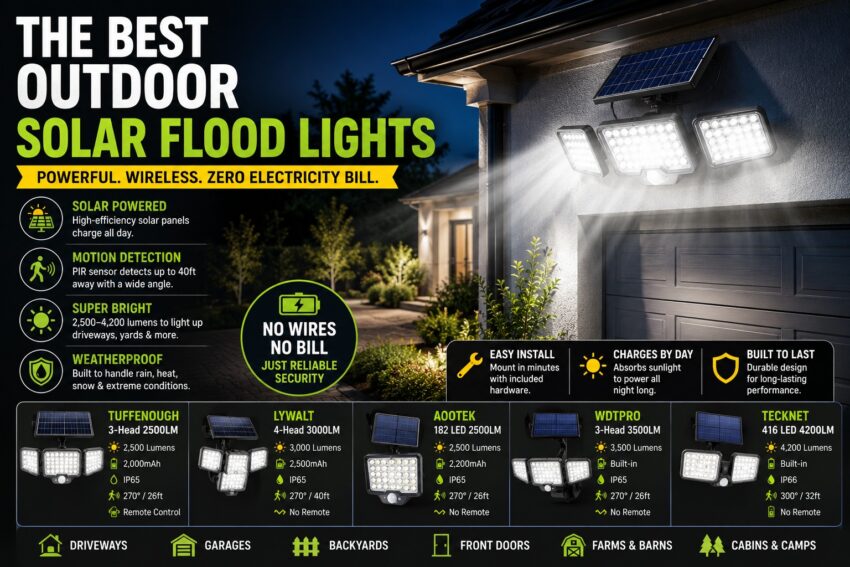
The Best Outdoor Solar Flood Lights Right Now — Verified Amazon Picks
Every product below is verified on Amazon with specs confirmed from official listings.
| Product | Lumens | Heads | Battery | IP Rating | Detection | Remote | Price |
|---|---|---|---|---|---|---|---|
| Tuffenough 3-Head 2500LM | 2,500 | 3 | 2,000mAh | IP65 | 270°/26ft | ✅ | ~$30 |
| LYWALT 4-Head 3000LM | 3,000 | 4 | 2,500mAh | IP65 | 270°/40ft | ❌ | ~$32 |
| Aootek 182 LED 2500LM | 2,500 | 1 | 2,200mAh | IP65 | 180°/26ft | ❌ | ~$25 |
| WdtPro 3-Head 3500LM | 3,500 | 3 | Built-in | IP65 | 270°/26ft | ❌ | ~$35 |
| TECKNET 416 LED 4200LM | 4,200 | 3 | Built-in | IP66 | 300°/32ft | ❌ | ~$40 |
Tuffenough 2500LM 3-Head Solar Flood Light — Best Overall
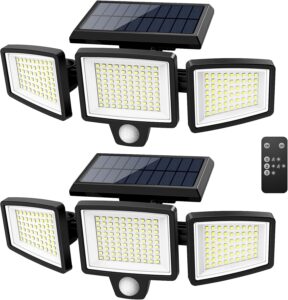
The Tuffenough 2500LM is the most practical all-rounder in this roundup — and the only one that includes a remote control at this price point. The 210-LED array produces 2,500 lumens at 6500K daylight white, spread across three independently adjustable heads covering a 270° illumination angle. Three modes cover every use case: motion-only, dim-plus-motion, and always-on. The remote lets you switch between modes without touching the light — genuinely useful once it’s mounted 8 feet up a wall.
The 2,000mAh battery handles summer conditions easily. In winter or low-sun climates, Mode 1 (motion-only) gives the most reliable all-night performance.
Pros: Remote control included, 3 adjustable heads, 270° illumination, 2,500LM, 3 modes, IP65, great value for a 2-pack
Cons: 2,000mAh battery is the smallest in our picks — winter performance in low-sun climates may be limited
Best for: Driveways, garages, backyards, and anyone who wants remote mode switching without a ladder
LYWALT 3000LM 4-Head Solar Flood Light — Best Coverage
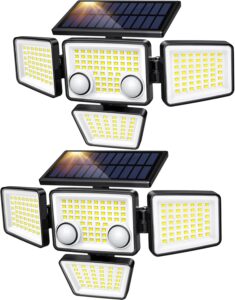
The LYWALT stands out with a 4-head design and the longest detection range in our picks at 40 feet. Each of the four heads is independently adjustable, giving you the ability to aim light in four different directions from a single mounting point — covering a corner of a property, a driveway plus a garden, or a wide perimeter without multiple installations.
The extra-large tempered glass solar panel boasts a 35% conversion rate — higher than most competitors — which is why LYWALT performs better on cloudy and rainy days. The 2,500mAh battery is a step up from the Tuffenough, giving more reliable all-night runtime. The 40-foot detection distance is the standout practical advantage — triggers before someone reaches your door.
Pros: 4-head design covers the widest area, 40ft detection range (longest in roundup), 35% panel conversion rate, 3,000LM, 2,500mAh battery, easy tool-free installation
Cons: No remote control, panel integrated into light body (no separate cable)
Best for: Large properties, corner installations needing coverage in multiple directions, anyone who wants maximum detection range
Aootek 182 LED 2500LM Solar Motion Sensor Light — Best Budget / Most Proven
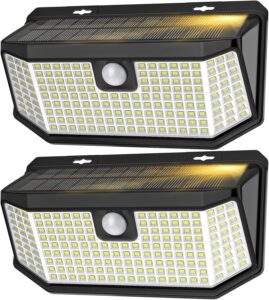
The Aootek has over 50,000 customer reviews on Amazon — the largest verified review base in our picks by a significant margin. That track record matters in a market full of no-name alternatives. It delivers 2,500 lumens from 182 LED beads across a 270° wide angle, with a 2,200mAh battery and three operating modes. The monocrystalline solar panel has a 20.5% conversion rate. At around $25 for a 2-pack, it’s the most affordable verified option without sacrificing core functionality.
Pros: 50,000+ Amazon reviews — most proven track record in our picks, 2,200mAh battery, 2,500LM, 270° wide angle, 3 modes, IP65, ~$25 for a 2-pack
Cons: Single-head design limits directional flexibility vs. 3 or 4-head alternatives
Best for: Budget-conscious buyers who want proven reliability backed by a massive real-world review base
WdtPro 3500LM 3-Head Solar Flood Light — Best for Harsh Conditions
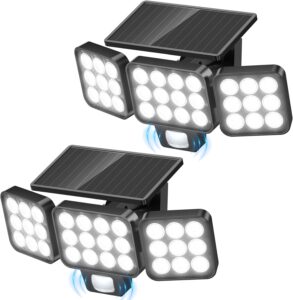
The WdtPro earns its place with two standout specs: 3,500 lumens (second highest in our picks) and a verified 800+ daily cycles rating — laboratory verified, 60% more cycles than standard solar security lights. This matters for high-traffic areas where constant motion triggering would degrade cheaper batteries quickly. The -40°F to 158°F temperature rating is the most extreme cold-weather spec in our roundup, and the condensation evacuation technology expels 99.7% of moisture within 30 seconds after storms.
Pros: 3,500LM, 800+ daily cycle rating (best longevity for high-traffic), -40°F rated, condensation resistant, 3 adjustable heads, 270°
Cons: No remote control, newer brand with smaller review base than Aootek or Tuffenough
Best for: High-traffic areas with frequent motion triggering, cold climates, and anyone who prioritises longevity and durability
TECKNET 4200LM 416 LED Solar Flood Light — Brightest Pick
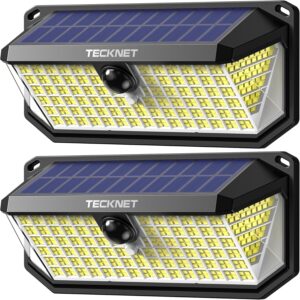
The TECKNET delivers the most lumens in our picks at 4,200LM from 416 LEDs — visibly brighter than any other option here. The 300° illumination angle is the widest in the roundup. And the IP66 waterproof rating exceeds the IP65 standard on all other picks — protected against powerful water jets rather than just spray, which matters for fully exposed installations in high-rainfall areas. Three adjustable heads, three modes, and a 32-foot detection range complete the package.
Pros: 4,200LM — brightest in roundup, 300° illumination angle — widest in roundup, IP66 best waterproof rating, 416 LEDs, 32ft detection, 3 heads, 3 modes
Cons: Highest price in roundup (~$40), no remote control
Best for: Large driveways, commercial properties, fully exposed locations in high-rainfall areas, anyone who wants the most powerful solar flood light
Best Use Cases for Solar Outdoor Flood Lights
Driveway: 2,500–3,500 lumens, motion-activated, mounted at 8–10 feet at the entrance. A 3 or 4-head design covers both the approach and the sides simultaneously. The Tuffenough or LYWALT are ideal here.
Backyard and garden: 2,500–3,000 lumens in dim-plus-motion mode gives a pleasant ambient glow with security burst capability. The Aootek in Mode 2 handles this well.
Garage and outbuildings: 3,000+ lumens provides good visibility for parking and working. The WdtPro or TECKNET handle high-traffic areas better — their cycle ratings and brightness suit frequently-triggered locations.
Pathways and steps: 1,000–1,500 lumens is sufficient for a lit walkway. The Aootek in Mode 2 (dim all night, bright on motion) is the practical choice.
Perimeter security: Multiple lights in Mode 1 (motion-only) maximize battery life across a larger perimeter. The LYWALT’s 40-foot detection range means fewer units needed to cover a large yard.
If you’re also looking to add decorative lighting to your outdoor space, see our guide to the best solar deck lights — they pair well with flood lights for a complete outdoor solar lighting setup.
Getting the Most Out of Solar Flood Lights
Position the solar panel for maximum sun. The most common installation mistake is mounting lights on north-facing walls or in shaded positions. The panel needs unobstructed direct sunlight for 6–8 hours per day. If your intended position is shaded, look for lights with a separate panel on a cable.
Charge before first use. Leave the light in a sunny position for 2–3 days before switching on, building up a full initial charge.
Choose Mode 1 in winter. Shorter days mean less charging time. Motion-only mode (Mode 1) is the most battery-efficient choice through winter months.
Mount at 8–10 feet. Too low and the PIR sensor triggers constantly from pets. Too high and the illumination angle doesn’t cover the ground effectively. 8–10 feet is the practical sweet spot.
Clean the panel seasonally. Dust, pollen, and bird mess reduce charging efficiency by 10–20%. A damp cloth wipe at the start of each season keeps output at maximum.
For more on maximising solar performance in outdoor applications, see our guide to solar power for a shed — many of the same principles apply to flood light positioning and panel care.
Solar Flood Lights vs. Wired Flood Lights
| Factor | Solar Flood Lights | Wired Flood Lights |
|---|---|---|
| Installation | No wiring, drill and screw | Requires electrician or wiring knowledge |
| Running cost | $0 | Small ongoing electricity cost |
| Placement flexibility | Anywhere with sun | Tied to existing wiring |
| Winter reliability | Reduced in low-sun climates | Full regardless of weather |
| Brightness ceiling | 2,500–4,500LM (consumer) | Much higher possible |
| Power outage | ✅ Continues working | ❌ Fails with power outage |
Solar wins on installation convenience and placement flexibility. Wired wins on maximum brightness and all-weather reliability. For most residential applications — driveways, backyards, gardens, garages — solar flood lights deliver more than enough brightness with zero installation complexity.
Frequently Asked Questions
How bright should outdoor solar flood lights be?
For a standard driveway or backyard: 2,000–2,500 lumens is adequate. For large areas, dark environments, or security-focused applications: 3,000–4,500 lumens. As a reference: a standard 100W incandescent bulb produces about 1,600 lumens. A 2,500LM solar flood light is significantly brighter than a standard bulb.
How long do solar flood lights stay on?
In motion-only mode, each triggered activation lasts 15–25 seconds — the battery lasts through multiple nights easily. In dim-plus-motion mode, the ambient setting runs all night (8–12 hours) from a full charge. In always-on mode, runtime is typically 6–10 hours from a full charge — which may not cover a full winter night without sufficient daytime sun.
Do solar flood lights work in winter?
Yes, but with reduced performance. Shorter days mean less charging time. In motion-only mode (Mode 1), most quality lights handle winter without issue. Lights with larger batteries (2,500mAh+) and higher-efficiency panels handle winter better. Switch to Mode 1 through the shortest winter months for most reliable performance.
Can solar flood lights replace wired security lights?
For most residential applications — yes. Modern solar flood lights deliver 2,500–4,200 lumens, detect motion at 26–40 feet, and run reliably through summer and mild-climate winters. The key advantage over wired lights is installation flexibility — no outdoor socket, no electrician, no wiring. They can go anywhere there’s sun.
How far away should a solar flood light be from what it’s illuminating?
Mount 8–10 feet high, 10–20 feet back from the area you want illuminated. The 270°–300° illumination angle spreads light across a wide area from a single mounting point. Multiple lights covering different angles give better overall coverage than one very bright single light.
So Which Solar Flood Light Should You Buy?
| Your Situation | Best Pick |
|---|---|
| Best overall | Tuffenough 2500LM 3-Head (with remote) |
| Best coverage (largest area) | LYWALT 3000LM 4-Head |
| Best budget / most proven | Aootek 182 LED 2500LM |
| Best for harsh conditions / high traffic | WdtPro 3500LM 3-Head |
| Brightest / best IP rating | TECKNET 4200LM IP66 |
| Best for large driveway | LYWALT (40ft detection) or TECKNET (4200LM) |
| Best for garden or pathway | Aootek (Mode 2, gentle ambient) |
For most homeowners, the Tuffenough 2500LM is the answer. 2,500 lumens covers the vast majority of residential applications, the remote control is genuinely convenient, and the 2-pack at ~$30 gives everything needed for a complete driveway or backyard setup.
If coverage area is the priority — a large property, a corner installation, or anywhere you need one light to do the work of two — the LYWALT 4-Head delivers the widest physical coverage and the longest detection range in this roundup.
And if you simply want the brightest, most waterproof option available: the TECKNET 4200LM IP66 is the one.
Solar flood lighting has reached the point where there’s no meaningful argument for running wiring when wiring isn’t already there. The performance is real, the installation is trivially easy, and the running cost is exactly zero.