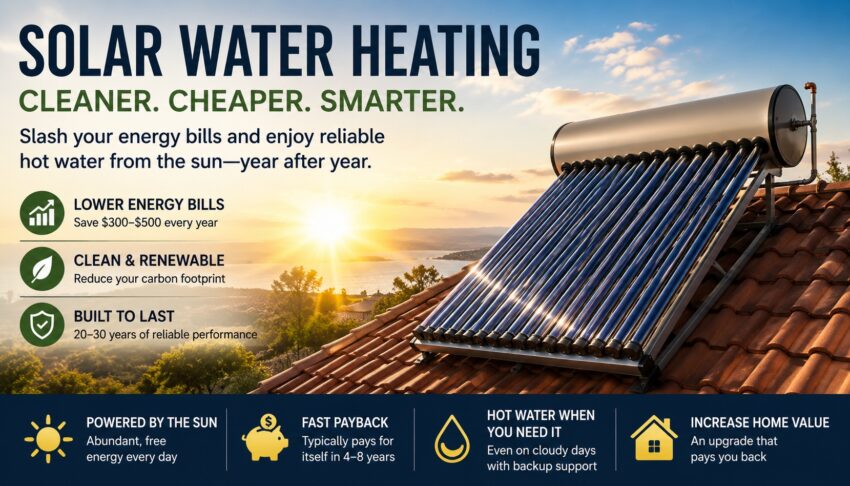
Looking for something simpler for a camping trip rather than a full home installation? See our portable solar shower guide instead — this article covers full residential and off-grid tank systems.
Why Solar Water Heating Makes More Sense Than Most People Realize
Here’s something most homeowners don’t know: heating water is responsible for 14–18% of a typical home’s energy bill. It’s the second biggest energy cost after space heating and cooling — and unlike running the HVAC, it happens every single day, year-round.
That makes it a uniquely good target for solar. A solar water heater doesn’t need to power your whole home — it just needs to heat water. The system is simpler, cheaper, and pays back faster than a full solar PV installation.
The average American household spends $400–$600 per year on water heating. A properly sized solar water heater covers 50–80% of that load depending on your climate. With the current 30% federal tax credit (Residential Clean Energy Credit), the economics are genuinely compelling — and getting better as energy prices rise.
How a Solar Water Heater System Works
The concept is simple. A collector on your roof or in your yard absorbs heat from the sun and transfers it to water. That hot water is stored in an insulated tank until you need it. A backup heating element handles the gap when solar input isn’t enough.
The core components are:
Solar collector — the panel or tube array that absorbs solar radiation and converts it to heat. This is where the technology varies most between system types.
Storage tank — an insulated water tank, usually 40–120 gallons for residential use. In indirect systems, this includes a heat exchanger coil that transfers heat from the collector fluid to the domestic water.
Heat transfer fluid — in indirect systems, a propylene glycol solution circulates between the collector and the tank, transferring heat without risk of freezing. In direct systems, domestic water circulates through the collector itself.
Circulation pump and controller (active systems only) — a small electric pump moves fluid between the collector and tank. A differential solar charge controller monitors temperature differences and runs the pump when the collector is hotter than the tank.
Backup heating element — electric or gas, integrated into the tank or in a separate backup heater. Provides hot water when solar input falls short.
Types of Solar Water Heater Systems
Flat Plate Collectors
The original solar water heating technology and still the most widely installed worldwide. A flat plate collector is an insulated metal box with a dark absorber plate under a tempered glass cover. Sunlight passes through the glass, heats the absorber, and the heat transfers to fluid flowing through pipes attached to the plate.
Best for: Mild to moderate climates where temperatures rarely drop below freezing. Less effective than evacuated tubes in cold or frequently overcast conditions.
Pros: Lower cost than evacuated tubes, durable and well-proven, easier to repair, performs well in moderate climates.
Cons: Less efficient in cold or overcast conditions, more heat loss than evacuated tubes, heavier.
Evacuated Tube Collectors
The technology that’s transformed solar water heating in colder climates. Each tube is a glass cylinder within a glass cylinder with a vacuum between them — the same principle as a thermos flask. The vacuum eliminates convective heat loss, allowing the collector to retain heat even in freezing temperatures and overcast conditions.
Best for: Cold climates, northern latitudes, year-round performance in any US climate zone.
Pros: Excellent cold-weather and low-light performance, high efficiency, handles freezing temperatures better than flat plate.
Cons: Higher cost, glass tubes can break (though individually replaceable), can overheat in very hot climates if not managed.
Integral Collector Storage (ICS / Batch) Systems
The simplest type — a black tank or tubes inside an insulated, glazed box. Cold water enters, heats up sitting in the collector, and hot water is drawn off when needed. No pump, no controller, no moving parts. Only suitable for mild, sunny climates (California, Arizona, Florida, Gulf Coast) — not suitable for freeze-risk climates.
Pros: Zero moving parts, lowest cost, easiest to install.
Cons: Warm climates only, hot water cools overnight.
Thermosyphon Systems
A passive system where the storage tank sits above the collector. Hot water rises naturally into the tank through convection — no pump required. Common in warm climates worldwide and increasingly available in the US. Heavy tank on the roof requires structural verification.
Best for: Warm climates, rooftop installations where the tank can be mounted above the collector.
Active vs Passive Solar Water Heaters
| Feature | Active System | Passive System |
|---|---|---|
| Moving parts | Pump + controller | None |
| Freeze protection | Glycol solution (indirect) | Limited — warm climates only |
| Efficiency | Higher — optimized by controller | Good in right climate |
| Reliability | Good — pump can fail | Excellent — nothing to fail |
| Installation complexity | Higher | Lower |
| Best climate | Any — freeze protected | Warm climates |
Passive systems are elegantly simple and last for decades with minimal maintenance. Active systems are more versatile — they work in any climate and can be optimized for maximum performance. The controller logic in active solar water heaters is similar to how a solar charge controller manages energy flow in a battery-based solar system — always optimizing based on conditions. For cold climates, an active indirect system is usually the right choice. For warm, sunny climates, a quality passive system is hard to beat.
Solar Water Heater Cost — What You Should Expect to Pay
System cost (equipment only):
- Basic passive systems (ICS/batch): $500–$1,500
- Thermosyphon and evacuated tube passive systems: $1,500–$2,500
- Active indirect split systems (evacuated tube): $2,000–$4,000
- Premium active systems with full installation kit: $3,000–$6,000
Installation cost:
- DIY-friendly passive systems: $200–$500 in materials and fittings
- Professional installation (active systems): $1,500–$3,500
- Total installed cost range: $2,000 (DIY passive) to $8,000+ (professionally installed active)
The 30% Federal Tax Credit: Solar water heaters that are SRCC (Solar Rating and Certification Corporation) certified qualify for the 30% Residential Clean Energy Credit. That means $3,000 spent on a solar water heater yields $900 back on your federal taxes. Always verify SRCC certification before buying.
| System Cost (after 30% credit) | Annual Savings | Payback Period |
|---|---|---|
| $1,400 (DIY passive) | $350/yr | 4 years |
| $2,100 (mid-range) | $400/yr | 5–6 years |
| $3,500 (installed active) | $500/yr | 7 years |
After payback, every year of operation is essentially free hot water. Systems last 20–30 years with proper maintenance — which means 15–25 years of free or near-free water heating after the investment is recovered.
The Best Solar Water Heater Systems Right Now
Solar water heaters are specialist products. The best systems are sold through brand websites, specialty solar distributors, and plumbing supply houses — not exclusively through Amazon. Every product below is verified and the correct purchase link is listed for each.
| System | Type | Capacity | SRCC | Climate | Price |
|---|---|---|---|---|---|
| Sunbank 40 Gallon | Passive evacuated tube | 40 gal | ✅ | Warm–mild | ~$1,500 |
| Sunbank 80 Gallon | Passive evacuated tube | 80 gal | ✅ | Warm–mild | ~$2,200 |
| Duda Solar 200L Active Split | Active indirect evacuated tube | 53 gal | ✅ | Any climate | ~$2,500 |
Sunbank 40 Gallon Solar Water Heater — Best for Small Households
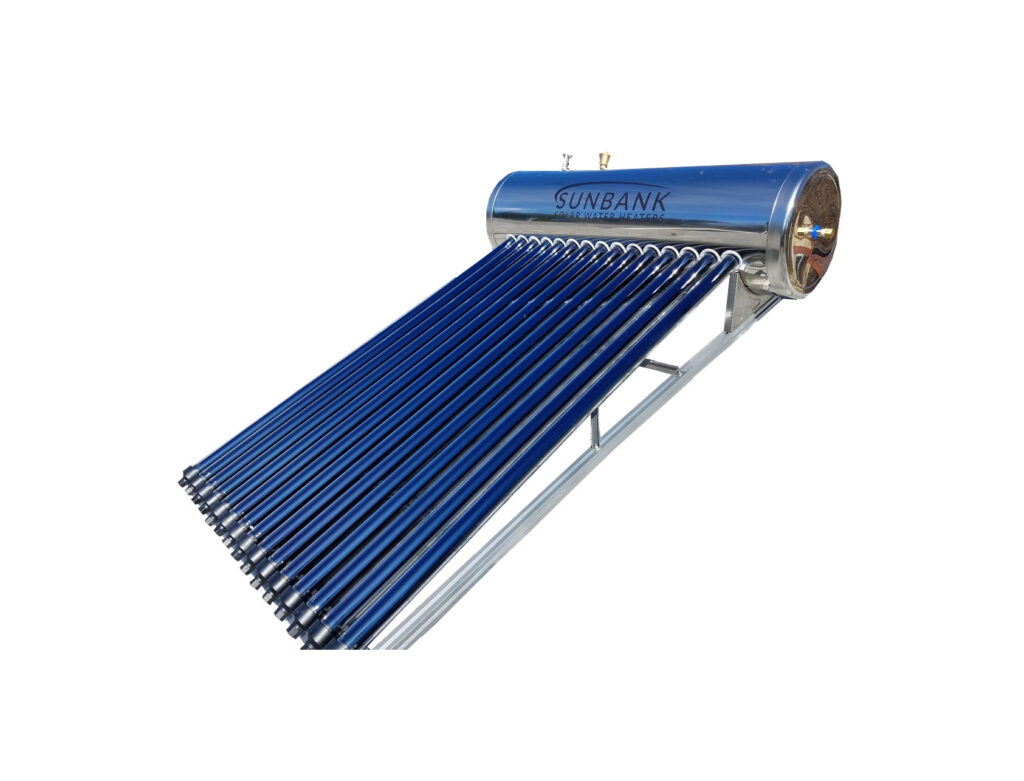
The Sunbank is the most consistently well-reviewed solar water heater in the US residential market — and the easiest to understand. It’s a passive direct system: evacuated tubes absorb solar heat, and the domestic water circulates through them into the insulated stainless steel tank above. No pump, no controller, no glycol, no electricity required.
The 316L stainless steel tank is significantly more corrosion-resistant than the 304 stainless used by most competitors — a real long-term durability advantage. SRCC certified for the 30% federal tax credit. Real-world customer reports are impressive: water temperatures regularly reaching 140–160°F in sunny climates, losing only 5°F overnight, and functioning year-round without supplemental heat in Florida, Southern California, and Arizona.
The optional 1,500W electric backup element handles cloudy days. Customer support from the founder (James) is unusually personal — multiple reviews specifically call out his direct involvement even long after purchase.
Pros: No moving parts, 316L stainless steel tank, SRCC certified (30% tax credit), DIY-friendly, excellent customer support, 20–30 year lifespan
Cons: Not suitable for freeze climates, 40 gallons limits to small households, mineral buildup possible in hard water areas
Best for: 1–3 person households in warm climates (Sun Belt states), DIY installers, off-grid homes
Sunbank 80 Gallon Solar Water Heater — Best for Families
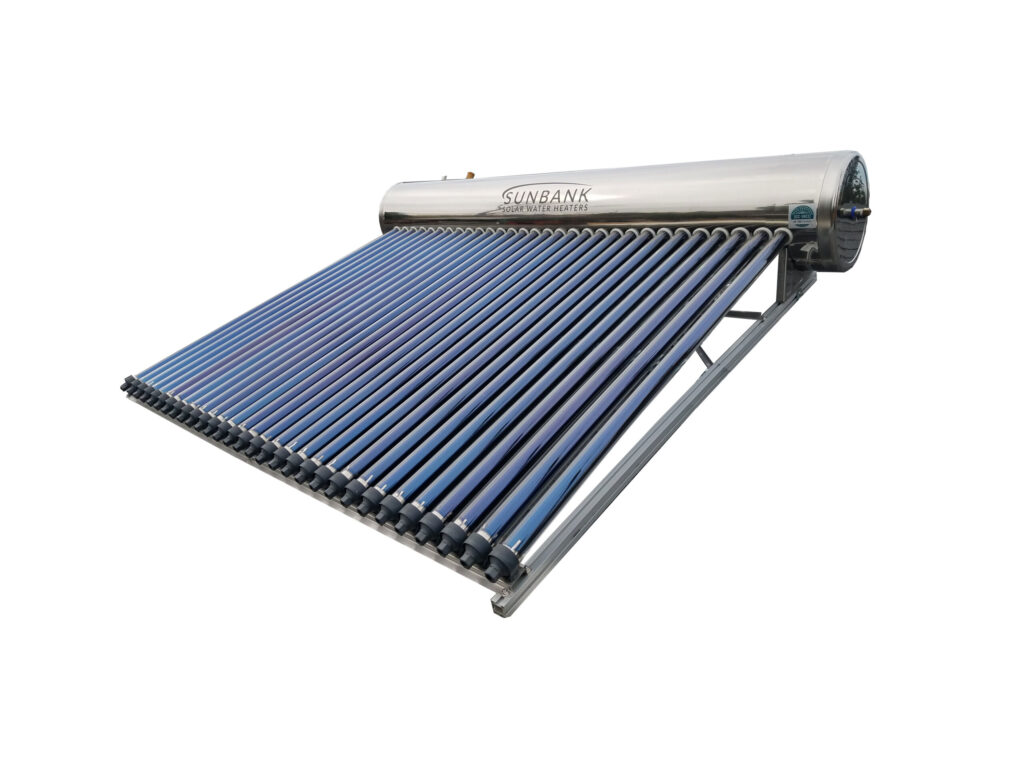
Everything that makes the 40-gallon Sunbank excellent applies here — the passive direct design, the 316L stainless steel tank, the SRCC certification, the DIY-friendly installation — scaled up for a 3–5 person household. The 80-gallon version is the most popular Sunbank product for families, with a long track record of real-world performance.
After the 30% federal tax credit, the net cost drops to approximately $1,540 — making it one of the best value solar water heaters available in the US market for warm-climate households. The system is scalable too — customers who find they need more capacity simply add a second unit.
Pros: 80 gallons covers most family needs, same proven 316L tank and SRCC certification, strong real-world track record, DIY-installable
Cons: Warm climates only, heavy roof load (verify roof structure beforehand)
Best for: 3–5 person households in warm-to-mild climates wanting a complete DIY solar water heating system
Duda Solar 200L Active Split System — Best for Cold Climates
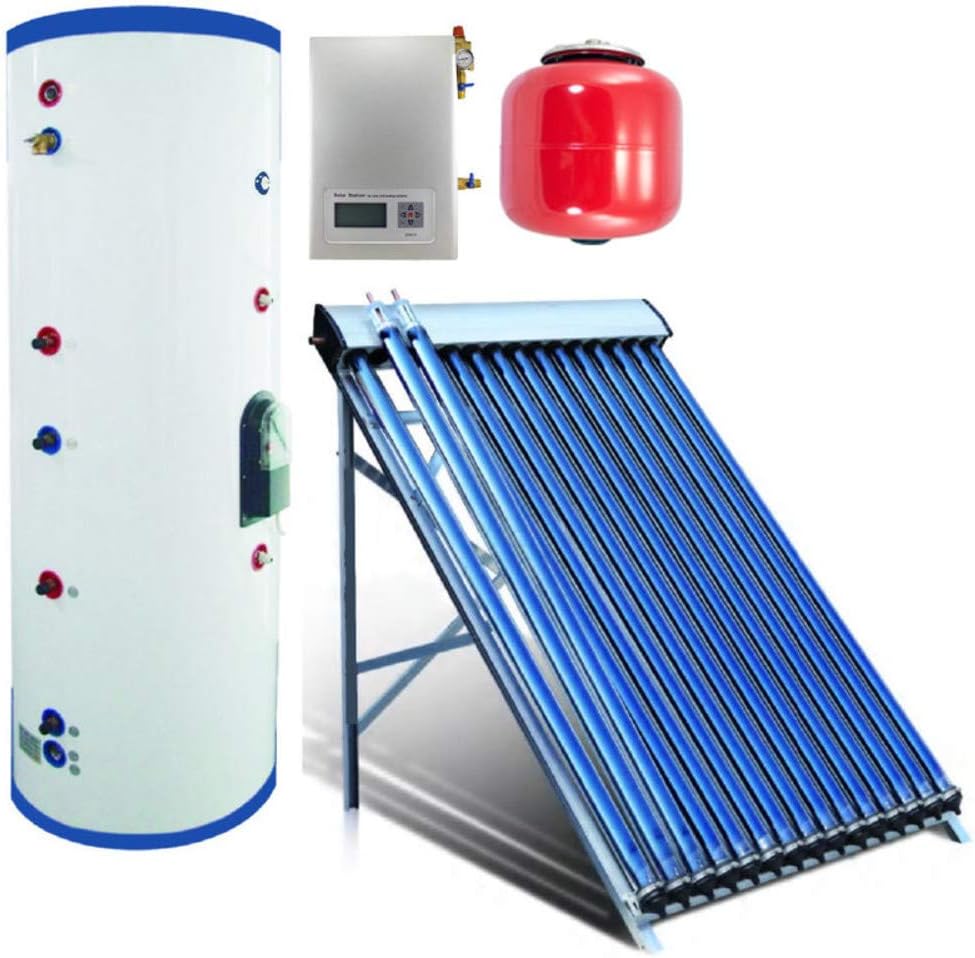
For homeowners in cold climates — the Northeast, Pacific Northwest, Mountain West, Midwest — the Duda Solar Active Split System is the right choice. It’s an active indirect system: propylene glycol circulates between the evacuated tube collector and a stainless steel tank with a dual coil heat exchanger, providing freeze protection down to well below 0°F.
The system includes 20 evacuated vacuum tubes in a 45° mounting frame, a stainless steel storage tank, a working station with controller and pump, an automatic air vent, a submersible water pump, a thermostatic mixing valve, and 2 gallons of food-grade propylene glycol. SRCC certified. The dual coil tank allows simultaneous connection to both solar and a conventional water heater backup — your existing hot water system remains fully functional on cloudy days and in winter.
Pros: Works in any climate including severe freeze (-40°F), complete kit with pump and controller included, SRCC certified, dual coil tank for easy backup integration
Cons: More complex installation — professional recommended, glycol requires replacement every 3–5 years, pump adds electricity consumption
Best for: Cold-climate homeowners in the Northeast, Midwest, Mountain West, and Pacific Northwest
Solar Water Heater Installation — DIY or Professional?
The Sunbank passive systems are genuinely DIY-installable. The installation requires basic plumbing knowledge — connecting water lines, running pipes, mounting the bracket. No electrical work needed for the basic system. Multiple customers report successful self-installation, and the Sunbank website provides detailed manuals and video guidance. Budget $200–$500 for pipes, fittings, insulation, and mounting hardware.
Active split systems (like the Duda Solar) are more involved. You’re connecting a glycol loop, installing the pump station and controller, running sensor wires, and integrating with your existing water heater. Most homeowners hire a plumber or solar installer for at least part of the work. Budget $1,500–$3,000 for professional installation on top of equipment cost.
Permits: Most jurisdictions require a permit for solar water heater installation. Check with your local building department before starting. Keep all documentation for the federal tax credit.
Freeze protection: For any climate where temperatures drop below 32°F, use either an active indirect (glycol) system or a drainback system. Never install a direct passive system in a freeze-risk climate.
Solar Water Heater vs Electric vs Heat Pump Water Heater
| Factor | Solar Water Heater | Standard Electric | Heat Pump Water Heater |
|---|---|---|---|
| Annual operating cost | ~$50–$100 (backup only) | $400–$600 | $150–$200 |
| Upfront cost | $1,500–$6,000 | $400–$800 | $1,000–$1,500 |
| Federal incentive | 30% tax credit | None | 30% tax credit |
| Lifespan | 20–30 years | 10–15 years | 10–15 years |
| Works without grid power | ✅ (passive systems) | ❌ | ❌ |
| Carbon footprint | Near zero | High (grid dependent) | Low–medium |
When solar wins: Sunny climate, suitable south-facing roof or yard space, plan to stay in the home 7+ years, lowest possible long-term operating cost is the priority.
The heat pump water heater alternative: A heat pump water heater (HPWH) at $1,000–$1,500 with the 30% tax credit gets you to $700–$1,050 net cost — significantly cheaper upfront. It cuts water heating bills by 60–70%. For homeowners who want efficiency without solar water heating complexity, an HPWH is the smart alternative. And if whole-home backup power is also on your radar, see our guide to the best solar generator for home backup.
Does a Solar Water Heater Work in Winter or Cold Climates?
Yes — with the right system. The key is choosing an evacuated tube collector. The vacuum in evacuated tubes eliminates convective heat loss, allowing meaningful heat absorption even when air temperatures are well below freezing.
Freeze protection options:
- Active indirect (glycol): Most common and reliable. Propylene glycol circulates through the collector and never freezes. Works down to -40°F. Requires glycol replacement every 3–5 years.
- Drainback systems: Water drains out of the collector automatically when the pump stops, preventing freeze damage. Requires careful installation to ensure complete drainage.
- Never: Install a direct passive system in a climate with regular freezing temperatures.
Real-world winter performance: A properly installed active indirect evacuated tube system in Boston or Chicago typically provides 30–40% of annual hot water needs in winter and 80–100% in summer — for a yearly average of 50–70% solar coverage. Even in cold climates, the economics usually work.
How Much Hot Water Can a Solar Water Heater Produce?
| Household Size | Daily Hot Water Use | Collector Area Needed | Tank Size |
|---|---|---|---|
| 1–2 people | 40–50 gallons | 20–30 sq ft | 40–60 gal |
| 3–4 people | 60–80 gallons | 40–60 sq ft | 60–80 gal |
| 5–6 people | 80–100 gallons | 60–80 sq ft | 80–120 gal |
Solar fraction by climate: Sunny climates (Arizona, California, Texas, Florida) — 80–100% of annual hot water. Moderate climates (Pacific Northwest, Midwest) — 50–70%. Northern climates (New England, Great Lakes) — 40–60%. The remaining fraction is covered by the backup heating element.
Maintenance and Lifespan
Annual maintenance checklist:
- Check collector for damage, soiling, or shading from new growth
- Clean collector surface if dirty — a damp cloth is usually sufficient
- Inspect pipe connections and insulation for wear
- Check glycol concentration (active indirect systems) — replace every 3–5 years
- Test backup heating element
- Verify pump and controller function (active systems)
Glycol replacement: In active indirect systems, propylene glycol should be tested annually and replaced every 3–5 years. Degraded glycol becomes acidic and can damage the heat exchanger.
Lifespan: Quality evacuated tube collectors last 20–30 years. The Sunbank 316L stainless tank is designed for exceptional longevity. Active system pumps and controllers typically last 10–15 years and can be replaced independently. Individual evacuated tubes can be replaced if cracked without replacing the whole collector.
Frequently Asked Questions
How much does a solar water heater save per year?
Typically $300–$500 per year for households using electric water heating, or $200–$350 for gas water heating (gas is cheaper to start with). In sunny climates with high electricity rates — California, Hawaii, the Southwest — annual savings at the high end are common.
Do solar water heaters work on cloudy days?
Yes, at reduced output. Evacuated tube collectors are particularly effective in diffuse light conditions — on a fully overcast day, a good system might produce 30–50% of its full-sun output. Extended cloudy periods are handled by the backup heating element, which kicks in automatically when tank temperature drops below a set point.
How long does a solar water heater take to pay for itself?
4–8 years is the typical range after the 30% tax credit. In high-electricity-cost areas like California and Hawaii, payback can be as fast as 3–4 years. Systems last 20–30 years, so even a 10-year payback leaves 10–20 years of free hot water.
Can I add solar water heating to my existing system?
Yes — most solar water heaters are designed to work as a preheater to your existing water heater. The solar system heats water to whatever temperature the sun allows, and the existing heater tops it up if needed. You never run out of hot water — solar does the heavy lifting and the backup handles the rest.
Is a solar water heater worth it?
For most homeowners in moderate to sunny climates who plan to stay in their home for 7+ years — yes, clearly. The math works, the technology is proven, the 30% federal tax credit reduces upfront cost significantly, and systems last 20–30 years. The question isn’t really “is it worth it” but “which system is right for my climate.”
So Which Solar Water Heater System Should You Buy?
| Your Situation | Best Pick |
|---|---|
| Warm climate, 1–3 person household | Sunbank 40 Gallon |
| Warm climate, family of 3–5 | Sunbank 80 Gallon |
| Cold or freeze-risk climate | Duda Solar 200L Active Split |
| DIY installation | Sunbank (40 or 80 gallon) |
| Professional installation, any climate | Duda Solar 200L Active Split |
| Off-grid home | Sunbank (no electricity needed) |
For most US homeowners in warm to mild climates, the Sunbank 40 or 80 gallon is the right starting point. The passive direct design means nothing to fail, the 316L stainless steel tank is built to last 30 years, the SRCC certification qualifies you for the 30% tax credit, and the real-world customer reviews are consistently excellent.
For cold-climate homeowners, the Duda Solar Active Split System is the verified Amazon option that handles serious freeze conditions. The active indirect design with glycol protection works down to -40°F, and the dual coil tank integrates cleanly with your existing water heater.
Hot water heating is one of the highest-ROI investments a homeowner can make in solar energy. It’s simpler than solar PV, cheaper upfront, and pays back faster. If you’re considering solar for your home and haven’t looked at solar water heating first — start here. And if you’re also thinking about powering other structures on your property, our guide to solar power for a shed is worth a read too.