What Are Flexible Solar Panels?
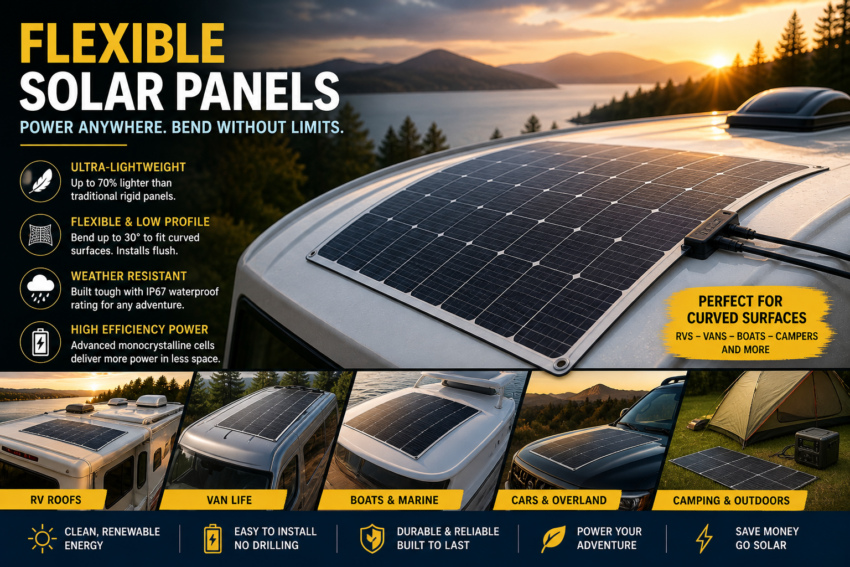
Flexible solar panels are exactly what they sound like — solar panels that bend. Unlike the rigid glass-and-aluminum panels most people picture when they think of solar, flexible panels are built on a thin, lightweight substrate that can conform to curved and irregular surfaces. They can be bent, rolled, and in some cases even folded without losing their ability to generate electricity.
That flexibility opens up a huge range of applications that rigid panels simply can’t reach. RV roofs, van rooftops, boat hulls, curved camper shells, car bonnets, backpacks, tents — anywhere a flat rigid panel won’t sit, a flexible panel often can.
They’re built for people who need portable, low-profile, or curve-friendly solar power. If you’re building a van life setup, fitting solar to a fiberglass boat, or want lightweight panels that won’t add dangerous weight to a motorhome roof — flexible panels are the category to explore.
How Flexible Solar Panels Work — The Technology Explained
Standard rigid solar panels use thick crystalline silicon wafers mounted in an aluminum frame under a tempered glass cover. Flexible panels work differently — they use thin-film semiconductor technology deposited onto a flexible backing material. Here’s how the main types compare:
Thin-Film Technology
Thin-film is the umbrella term for solar cells made by depositing photovoltaic material in extremely thin layers onto a flexible substrate. The layer is typically just a few micrometers thick — thousands of times thinner than a human hair. This thinness is what allows the panel to flex without the semiconductor layer cracking.
CIGS (Copper Indium Gallium Selenide)
CIGS is the highest-performing thin-film technology currently available. It achieves efficiency ratings of 15–20% — competitive with budget rigid monocrystalline panels. CIGS panels handle partial shade better than most solar technologies, making them well-suited to the irregular lighting conditions common in RV and marine environments. They’re more expensive to produce, so CIGS flexible panels tend to sit at the premium end of the market.
Amorphous Silicon
Amorphous silicon panels are cheaper to manufacture and perform better than CIGS in diffuse light conditions (overcast days, indirect light) but top out at around 6–10% efficiency — significantly lower than CIGS or monocrystalline panels. They’re common in very thin, ultra-lightweight flexible panels and are a reasonable choice when weight is the absolute top priority over power output.
Thin-Film Monocrystalline
Some newer flexible panels use actual monocrystalline silicon cells on a flexible backing rather than true thin-film technology. These achieve higher efficiency (18–24%) but have a tighter minimum bend radius than CIGS — they flex but can’t curve as dramatically. Most consumer flexible panels sold on Amazon fall into this category.
Flexible Solar Panels vs. Rigid Solar Panels
Understanding the trade-offs is essential before you buy. Flexible panels solve real problems — but they come with real limitations too.
| Feature | Flexible Solar Panels | Rigid Solar Panels |
|---|---|---|
| Weight | Very light (1–3 lbs per 100W) | Heavy (15–20 lbs per 100W) |
| Efficiency | 15–23% | 20–23% |
| Lifespan | 5–15 years | 25–30 years |
| Durability | Moderate — substrate degrades over time | High — tempered glass, aluminum frame |
| Bend radius | 30° max (most panels) | None — rigid only |
| Installation | Adhesive or lightweight mount | Requires mounting brackets |
| Profile | Ultra-low, flush to surface | Raised, needs gap for airflow |
| Cost per watt | Higher | Lower |
| Best for | Curved surfaces, weight-sensitive builds | Fixed rooftop installs, ground mounts |
When to choose flexible: You have a curved surface. Weight is critical (boat, van, RV). You need a flush low-profile installation. You’re mounting on a surface that can’t support bracket hardware.
When to stick with rigid: You have a flat surface and budget matters. You want maximum longevity (25+ years). You need the highest efficiency per dollar. You’re doing a permanent ground or roof mount.
The honest efficiency trade-off: most consumer flexible panels are 18–22% efficient compared to 20–23% for premium rigid panels. The gap has narrowed significantly but rigid panels still win on efficiency and lifespan. For most RV and van applications the weight and installation advantages of flexible panels more than compensate.
Types of Flexible Solar Panels
Stick-On Solar Panels
Stick-on panels use a pre-applied or separately purchased adhesive to mount directly onto a surface — no screws, no brackets, no drilling. They’re ideal for surfaces where you can’t or don’t want to make holes: fiberglass boat hulls, painted van roofs, and camper shells where drilling would compromise the structure. The limitation is that adhesive-mounted panels can be harder to remove and don’t allow airflow underneath — which can slightly reduce output in hot conditions.
Bendable Solar Panels
These are flexible panels specifically designed to conform to curved surfaces — RV rooftops, dome-shaped camper shells, boat cabins. Most have a maximum bend radius of around 30°. Going beyond the manufacturer’s specified curve risks microcracks in the cells that reduce output over time.
Thin Flexible Solar Panels
Ultra-thin and ultra-lightweight — some as thin as 2–3mm and weighing under 2 lbs per 100W. These sacrifice some efficiency and durability for maximum portability and the lowest possible profile. Best for applications where weight is the absolute priority: lightweight overlanding rigs, kayak camping, bicycle touring.
Flexible Solar Panel Kits
Kits bundle flexible panels with a charge controller, wiring, and sometimes mounting accessories. They remove the guesswork for buyers who don’t want to source components individually. Good kit options are available in 100W, 200W, and 400W configurations.
Narrow and Lightweight Solar Panels
Narrow panels are rigid or semi-flexible panels designed to fit in tight spaces — between roof features on an RV, along the gunwale of a boat, or on a vehicle where width is constrained. They’re worth knowing about as a category because several flexible solar searches are really looking for narrow or low-profile solutions rather than true bend-capable panels.
Best Use Cases for Flexible Solar Panels
Flexible Solar Panels for RV Roofs
RV roofs are the most common application for flexible solar panels. Most RV roofs have a slight curve, making rigid panels an awkward fit. Flexible panels conform to the roofline, keep a lower profile (less wind resistance at highway speeds), and are dramatically lighter — important when you’re watching your roof weight limit. Best approach: adhesive mount with silicone sealant around the edges for weather sealing. Wire through an existing vent or a new waterproof cable entry gland.
Flexible Solar Panels for Van Roofs
Van conversions are the other major sweet spot. Flexible panels sit flush on a metal van roof — no roof rack, no drilling (with adhesive mount), no noise at speed, and a clean stealth look. Most van roof solar setups use 1–3 flexible panels wired to an MPPT charge controller under the floor or in a cabinet.
Flexible Solar Panels for Boats
Marine applications are where flexible panels really shine. Fiberglass hulls and cabin tops can’t always support bracket-mounted rigid panels, and the curved surfaces are a perfect match for flexible technology. The key requirement for marine use is an IP67 or higher waterproof rating — spray, salt water, and high humidity are all guaranteed.
Flexible Solar Panels for Cars
Mounting flexible panels temporarily on a car bonnet or roof for camping or overlanding is a practical option for weekend adventurers who don’t want a permanent install. Use suction cup mounts or magnetic mounts for easy on/off without marking the paint.
Flexible Solar Panels for Camping and Backpacking
Ultra-thin flexible panels can be sewn into backpack fabric, rolled and strapped to a pack, or laid flat at a campsite. They’re not as efficient as foldable rigid-panel camping units but offer more versatility for unconventional setups.
What to Look for When Buying Flexible Solar Panels
Wattage and efficiency
Match wattage to your actual power needs — don’t buy more than your charge controller and battery can handle. Efficiency matters more per square foot on a space-constrained surface like a van roof: higher efficiency means more watts from less space.
Cell type
Monocrystalline thin-film cells offer the best efficiency (18–23%) for consumer flexible panels. CIGS is premium-tier with excellent shade tolerance. Amorphous silicon is cheapest but lowest efficiency (6–10%) — only consider it if weight is more important than output.
Bend radius
Check the manufacturer’s minimum bend radius specification. Most panels handle up to 30° of curvature. Exceeding this creates microcracks. If your surface curves more than 30°, look specifically for panels rated for tighter curves.
Weight per watt
For weight-sensitive builds (boats, lightweight vans, backpacking), this is as important as efficiency. Look for panels under 2 lbs per 100W for truly lightweight builds.
IP rating
For outdoor use: IP65 minimum. For marine or exposed wet environments: IP67 or IP68. Don’t compromise here — water ingress ruins flexible panels faster than any other failure mode.
Connector type
Most flexible panels use MC4 connectors — standard and compatible with most charge controllers. Some budget panels use proprietary connectors that limit compatibility. Always check before buying.
Warranty
Quality flexible panels come with a 1–5 year product warranty and a 10–25 year power output guarantee. Shorter warranties often signal lower-quality cell construction.
Best Flexible Solar Panels in 2026 — Top Amazon Picks
| Model | Wattage | Efficiency | Weight | IP Rating | Price | Best For |
|---|---|---|---|---|---|---|
| Renogy 100W Flexible | 100W | 23% | 4.2 lbs | IP67 | ~$120 | Best overall |
| BougeRV 200W Flexible | 200W | 23% | 5.9 lbs | IP67 | ~$200 | Best RV/Van |
| DOKIO 100W Flexible | 100W | 18% | 2.6 lbs | IP65 | ~$70 | Best budget |
| Newpowa 100W Flexible | 100W | 21% | 3.5 lbs | IP65 | ~$95 | Best value |
| Eco-Worthy 120W Flexible | 120W | 20% | 3.9 lbs | IP65 | ~$100 | Best for boats |
Renogy 100W Flexible Solar Panel — Best Overall
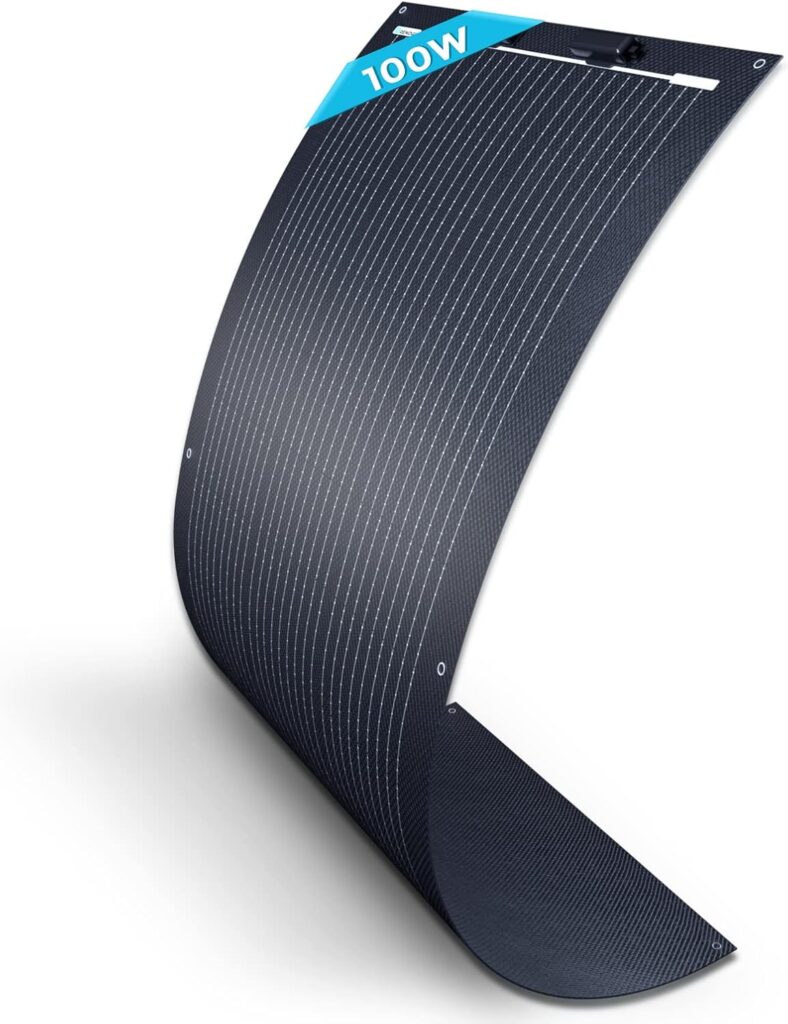
Renogy is the most trusted name in consumer solar and their 100W flexible panel is consistently one of the top-rated flexible panels on Amazon. At 23% efficiency using monocrystalline cells, it’s among the most efficient flexible panels available at this price point. IP67 rated and ETFE surface coated — significantly more durable than cheaper PET-coated alternatives.
At 4.2 lbs it’s not the lightest option, but the build quality justifies the weight. It comes with pre-drilled grommets for mechanical mounting and works with adhesive for stick-on installs. Renogy’s 5-year material warranty and 25-year power output warranty are industry-leading for flexible panels.
Pros: 23% efficiency, IP67, ETFE coating, 5-year warranty, trusted brand, MC4 connectors
Cons: Slightly heavier than ultra-budget options, premium price
Best for: RV roofs, van roofs, boats — anywhere you want the best balance of performance and durability
BougeRV 200W Flexible Solar Panel — Best for RV and Van
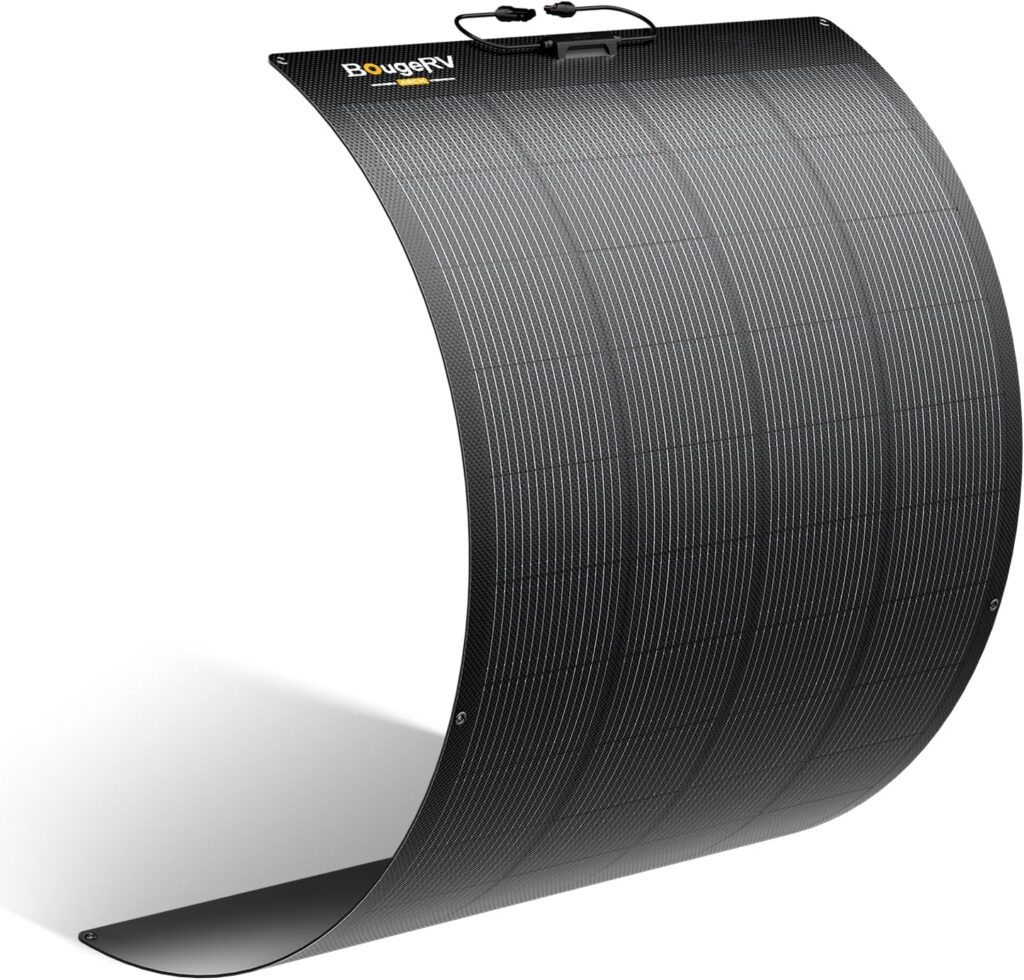
BougeRV has quickly become one of the most respected flexible solar brands on Amazon, particularly among the RV and van life community. Their 200W flexible panel delivers serious output at just 5.9 lbs — an exceptional power-to-weight ratio. At 23% efficiency with ETFE coating and IP67 rating, it matches Renogy’s spec sheet at a lower price per watt.
The 200W output on a single lightweight panel is ideal for RV and van builds where roof space is limited and you want to maximize watts without multiple panel installations. It handles up to 30° of curvature comfortably.
Pros: 200W in one lightweight panel, 23% efficiency, ETFE coating, IP67, excellent value per watt
Cons: Larger footprint than 100W panels — measure your roof space carefully before ordering
Best for: RV roofs, van roofs, and anyone who wants maximum output from a single flexible panel
DOKIO 100W Flexible Solar Panel — Best Budget Pick
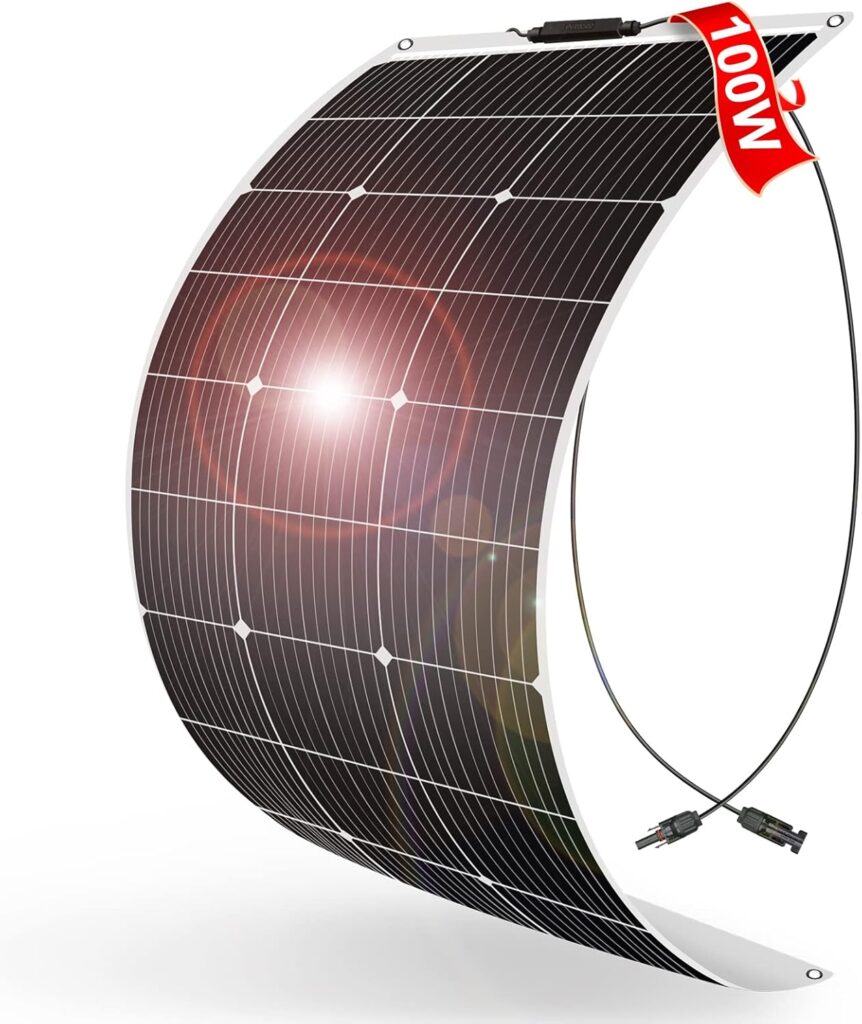
For buyers who need basic flexible solar capability at the lowest possible price, the DOKIO 100W is the go-to on Amazon. At around $70 it’s roughly half the price of the Renogy and weighs just 2.6 lbs — the lightest option on this list.
The trade-offs are real: 18% efficiency, IP65 rather than IP67, and PET coating instead of ETFE — meaning it will degrade faster under UV exposure. For occasional use, temporary installations, or buyers testing flexible solar before committing to a premium setup, DOKIO is a reasonable entry point.
Pros: Very affordable, lightest on this list at 2.6 lbs, decent for occasional use
Cons: Lower efficiency, PET coating degrades faster, IP65 not suitable for submersion
Best for: Budget buyers, temporary installs, testing flexible solar before upgrading
Newpowa 100W Flexible Monocrystalline — Best Value
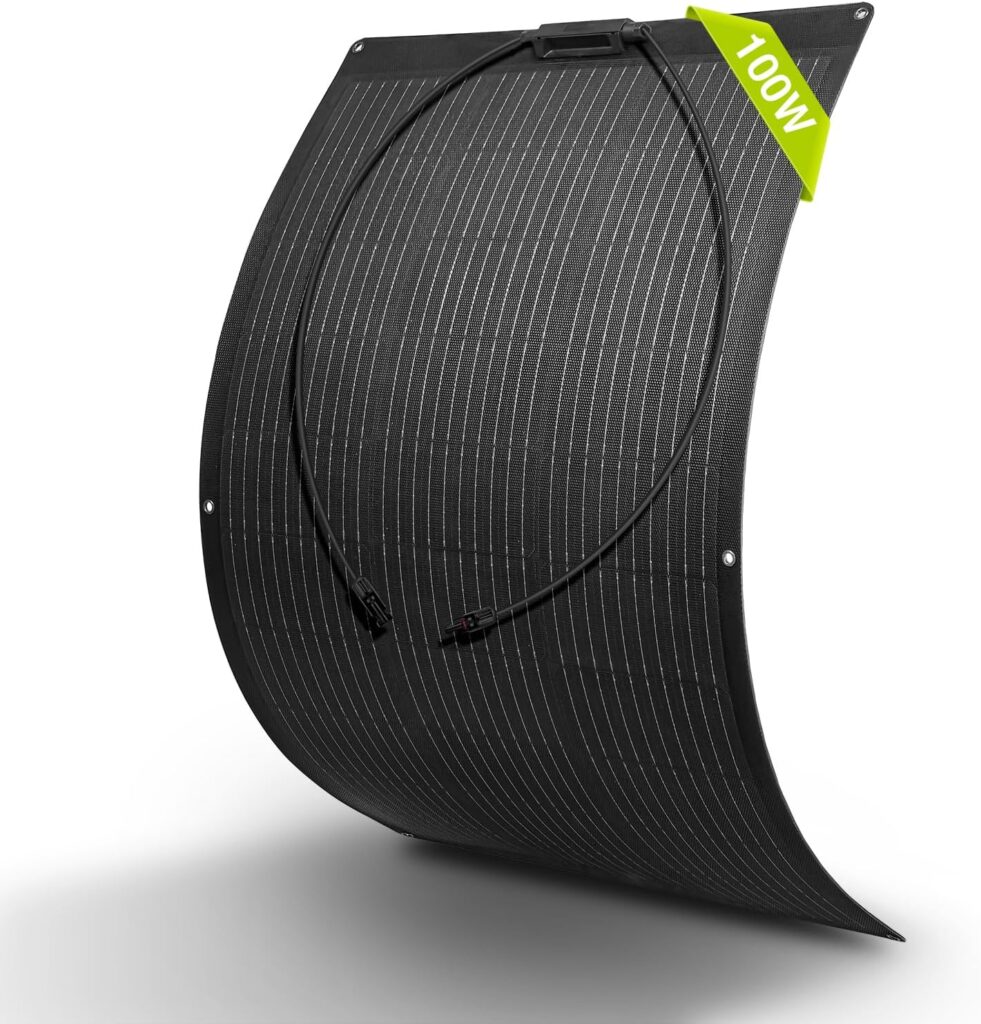
Newpowa sits in the sweet spot between DOKIO’s budget pricing and Renogy’s premium. At around $95 it’s 21% efficient with ETFE coating for longer-term durability. IP65 rated rather than IP67, so not ideal for truly marine environments, but solid for RV and van use.
Newpowa has built a strong reputation in the solar DIY community for consistent build quality and reliable output figures. Their flexible panels come with pre-attached MC4 connectors and grommets for easy installation.
Pros: Good efficiency for the price, ETFE coating, reliable brand, pre-attached MC4 connectors
Cons: IP65 rather than IP67, slightly less efficient than Renogy
Best for: Value-conscious RV and van builders who want ETFE durability without paying the Renogy premium
Eco-Worthy 120W Flexible Solar Panel — Best for Boats
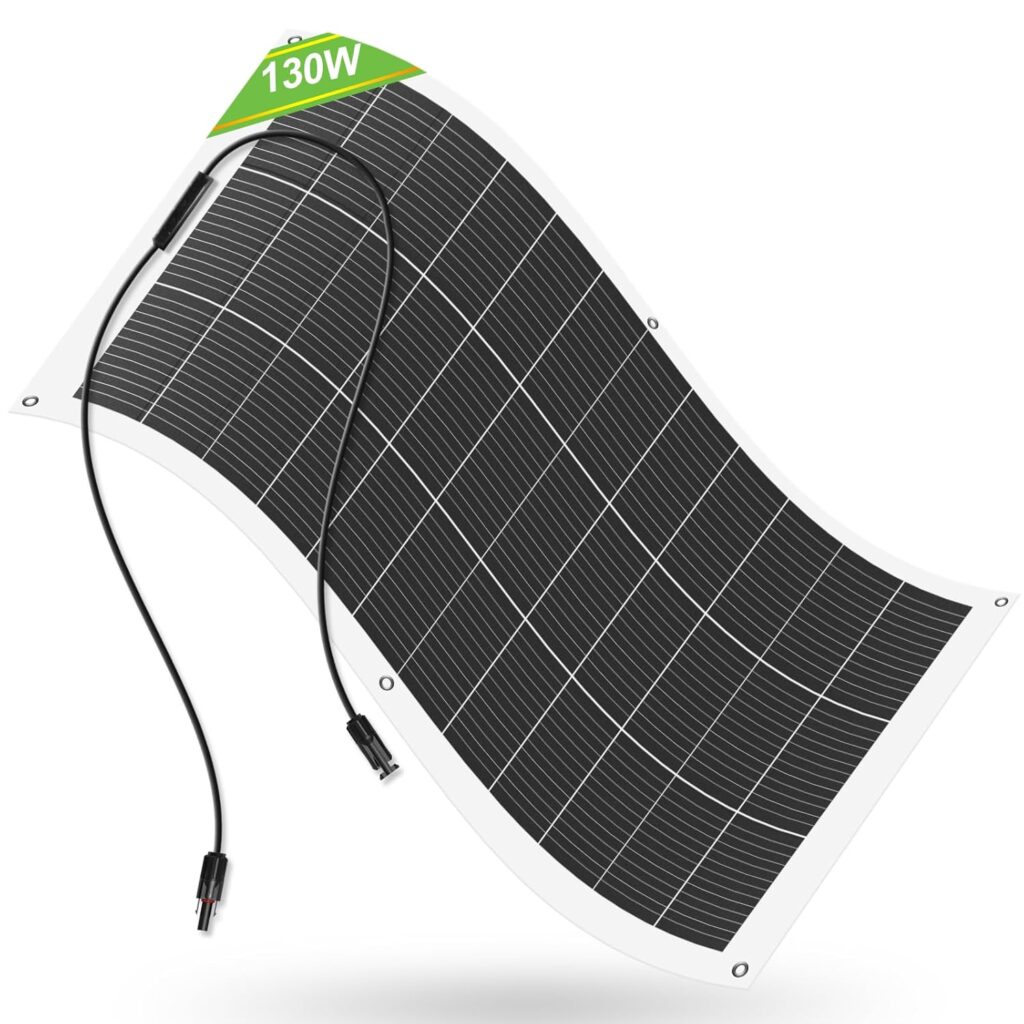
Eco-Worthy’s 120W flexible panel is a practical choice for boat cabins and fiberglass surfaces. The combination of ETFE coating, IP65 rating, and 120W output makes it a solid marine option. It handles the 30° curve of most boat decks without issue and the lightweight build (3.9 lbs) keeps it manageable on a rolling deck.
Pros: 120W output at a competitive price, ETFE coating, good weight for marine use, flexible enough for boat curves
Cons: IP65 rather than IP67 — keep away from direct wave splash if possible
Best for: Boat cabins, curved marine surfaces, and anyone needing a mid-range wattage flexible option
Flexible Solar Panel Kits — Are They Worth It?
Kits take the guesswork out of component compatibility by bundling panel, charge controller, wiring, and often mounting hardware together.
Best flexible solar panel kit options on Amazon:
- Renogy 100W Flexible Kit (~$180): Flexible panel + 20A MPPT controller + wiring. The easiest plug-and-play option for RV and van first-timers.
- BougeRV 200W Flexible Kit (~$280): 200W panel + 30A MPPT + cables. Best for larger builds.
- Eco-Worthy 120W Flexible Kit (~$160): Good marine-focused kit with charge controller included.
Kit vs. buying separately:
Kits save time and eliminate compatibility worries — worth the slight premium for beginners. If you already have a charge controller or want to choose specific components, buying the panel separately makes more sense. For most first-time flexible panel buyers, a kit is the right call.
How to Install Flexible Solar Panels
Step 1 — Prepare the surface
Clean the mounting surface thoroughly with isopropyl alcohol. Remove all dust, grease, and oxidation. Any contamination under an adhesive-mounted panel will cause premature peeling.
Step 2 — Choose your mounting method
Adhesive mounting (VHB tape or marine-grade sealant) gives a flush, permanent install with no holes. Mechanical mounting using the pre-drilled grommets allows removal and provides a slight air gap that keeps the panel cooler — improving performance in hot climates.
Step 3 — Leave a ventilation gap if possible
Flexible panels mounted flush to a surface with no airflow run hotter than rigid panels on raised mounts. Heat reduces output by roughly 0.3–0.5% per degree above 25°C. Even a 2–3mm gap makes a measurable difference.
Step 4 — Wire to your charge controller
Run MC4 cables through a waterproof cable entry gland. Connect to an MPPT charge controller sized for your panel wattage. Always connect battery to controller before connecting panels.
Step 5 — Seal all penetrations
Use self-amalgamating tape or marine-grade sealant around any cable entry points. Water ingress is the primary cause of failure in flexible panel installations.
Common mistakes to avoid:
- Exceeding the panel’s rated bend radius — causes microcracks and permanent output loss
- Using cheap double-sided tape instead of VHB or proper adhesive — panels peel off at speed
- Not sealing cable entry points — water gets in and causes shorts
- Covering the panels with equipment or cargo — partial shading dramatically reduces output
How Much Power Do Flexible Solar Panels Produce?
Daily output (Wh) = Panel wattage × Peak sun hours × 0.85
| Panel Size | 4 Peak Sun Hours | 5 Peak Sun Hours | 6 Peak Sun Hours |
|---|---|---|---|
| 100W | 340Wh | 425Wh | 510Wh |
| 200W | 680Wh | 850Wh | 1,020Wh |
| 400W | 1,360Wh | 1,700Wh | 2,040Wh |
Flexible panels may produce 5–10% less than equivalent rigid panels in identical conditions due to slightly lower efficiency and heat buildup from flush mounting. Factor this into your calculations when sizing a system.
Pairing with power stations: A 200W flexible panel pairs well with a 500–1,000Wh portable power station. A 400W setup (two 200W panels) can realistically charge a 2,000Wh station in a full sunny day.
Frequently Asked Questions
Are flexible solar panels as efficient as rigid ones?
Close, but not quite. The best flexible panels reach 23% efficiency — matching budget rigid panels. Premium rigid panels achieve 22–23%. The gap has narrowed significantly but rigid panels still have a slight efficiency edge. For most RV and van applications, the weight and installation advantages of flexible panels more than compensate.
How long do flexible solar panels last?
Quality flexible panels from brands like Renogy and BougeRV are rated for 10–25 years of output. In practice, expect 10–15 years of good performance with normal outdoor use. ETFE-coated panels last significantly longer than PET-coated alternatives under UV exposure. The flexible substrate degrades faster than rigid glass — lifespan is the main trade-off vs. rigid panels.
Can flexible solar panels be walked on?
Most cannot — and shouldn’t be. Walking on flexible panels cracks the cells even if the surface feels resilient. A few specialist marine panels are rated for foot traffic but they’re expensive and rare. Check the manufacturer’s specification before stepping on any panel.
Do flexible solar panels work in cloudy weather?
Yes, at reduced output. CIGS flexible panels handle diffuse light particularly well and can outperform monocrystalline panels in overcast conditions. Amorphous silicon panels also perform well in low light. Expect 15–30% of rated output on a fully overcast day.
Can I use flexible solar panels on a curved surface?
Yes — that’s their primary advantage. Most flexible panels handle up to 30° of curvature. Check your specific panel’s bend radius specification before installing — exceeding it causes microcracks. For tighter curves, look for panels specifically rated for the bend radius you need.
What is the best flexible solar panel for an RV?
The BougeRV 200W Flexible Solar Panel is the top pick for RV use — 200W of output from a single 5.9 lb panel with 23% efficiency and IP67 waterproofing. For a budget option, the Newpowa 100W offers solid performance at a lower price point.
Are stick-on solar panels permanent?
They can be removed, but not easily — especially those installed with VHB tape or marine sealant. Removal typically requires a heat gun to soften the adhesive and a plastic scraper to avoid surface damage. If you want easy removal, use mechanical mounting through the grommets instead of adhesive.
Final Verdict — Which Flexible Solar Panel Should You Buy?
| Use Case | Best Pick |
|---|---|
| Best overall | Renogy 100W Flexible Solar Panel |
| Best for RV roof | BougeRV 200W Flexible Solar Panel |
| Best for van roof | BougeRV 200W Flexible Solar Panel |
| Best for boats | Eco-Worthy 120W Flexible Solar Panel |
| Best budget option | DOKIO 100W Flexible Solar Panel |
| Best value mid-range | Newpowa 100W Flexible Solar Panel |
| Best complete kit | Renogy 100W Flexible Solar Kit |
Our top pick for most people: BougeRV 200W Flexible Solar Panel
It delivers the best combination of output, weight, efficiency, and price of anything in this category. At 5.9 lbs and 200W with ETFE coating and IP67 rating, it covers the needs of the vast majority of RV, van, and marine builds in a single panel. Add a Renogy Rover 20A MPPT controller and a 100Ah LiFePO4 battery and you have a complete, capable mobile solar system.
If 200W is more than you need or your budget is tighter, the Newpowa 100W is the smart step down — better quality than DOKIO at a price point well below Renogy.
Flexible solar has come a long way. The panels available today are reliable, efficient, and genuinely suited to the demanding environments they’re designed for. Choose the right panel for your surface and use case — and enjoy solar power without the weight, the brackets, or the drilling.