This post contains affiliate links. If you buy through our links we may earn a small commission — at no extra cost to you. This never influences our recommendations.
What “Foldable Solar Panel” Actually Means
The term covers two distinct product types that look similar but serve very different purposes.
Lightweight folding panels (40–120W) use a fabric or flexible backing that folds like a book or wallet. They weigh 3–12 lbs, fit in a backpack or daypack, and connect directly to a portable power station or small battery via USB or Anderson connector. These are the panels people take camping, backpacking, and on road trips.
Suitcase-style folding panels (200–400W) use rigid monocrystalline cells mounted on a hinged aluminium frame that folds in half like a briefcase. They weigh 15–35 lbs, come with a carry handle, and connect via MC4 to power stations or charge controllers. These are the panels overlanders, van lifers, and RV owners use when they need serious charging capacity without permanent roof installation.
Both fold for transport and deploy in under a minute. The right choice depends entirely on what you’re trying to power and how you’re travelling.
What to Look for in a Foldable Solar Panel
Wattage — matched to your power station. Check your power station’s maximum solar input before buying. A Jackery Explorer 500 accepts up to 100W. A Jackery Explorer 1000 v2 accepts up to 400W. A mismatch between panel output and power station input is one of the most common buying mistakes in this category — excess wattage simply gets clipped.
Efficiency. Monocrystalline cells in the 22–25% range are standard for quality foldable panels. ETFE-coated panels are more efficient and more durable than PET-coated alternatives — worth the small premium.
IP waterproof rating. IP65 handles rain splashes and light rain. IP67 handles brief submersion — meaningfully more durable for coastal use, heavy rain, or accidental drops. IP68 handles extended submersion. The difference matters: an IP65 panel left out in a downpour can be damaged; an IP67 or IP68 panel cannot.
Connector type — the compatibility question. Three common types: MC4 (universal standard, works with MPPT charge controllers and most power stations via adapter), Anderson connector (common on Jackery panels, direct plug-in to Jackery power stations), and DC barrel connectors (various sizes). MC4 is the most universally compatible — if you have a mix of brands, an MC4 panel works with everything.
Weight and packed size. For hiking, every gram matters. For car camping and overlanding, it matters less. Know which category you’re shopping in before comparing weights.
Kickstands. Quality foldable panels include adjustable kickstands that prop the panel at the correct angle without requiring improvisation. Verify the panel includes a usable stand before buying.
The Best Foldable Solar Panels on Amazon Right Now — Verified Picks
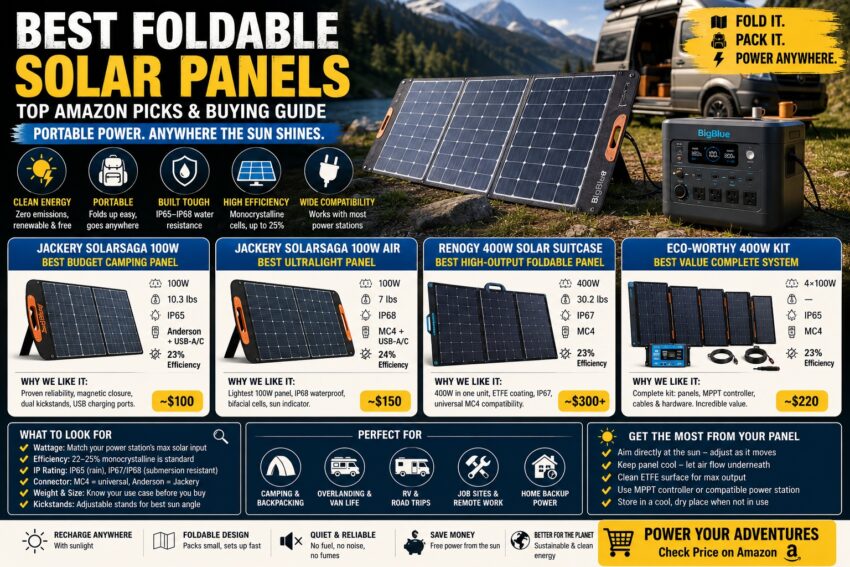
| Product | Watts | Weight | IP Rating | Connector | Best For | Price |
|---|---|---|---|---|---|---|
| Jackery SolarSaga 100W | 100W | 10.3 lbs | IP65 | Anderson + USB | Budget camping/car camping | ~$100 |
| Jackery SolarSaga 100W Air | 100W | 7 lbs | IP68 | MC4 + USB | Ultralight camping | ~$150 |
| Renogy 400W Solar Suitcase | 400W | 30.2 lbs | IP67 | MC4 | Overlanding, van life, RV | ~$300+ |
| ECO-WORTHY 400W Kit | 4×100W | — | IP65 | MC4 | Complete off-grid kit, best value | ~$220 |
Jackery SolarSaga 100W — Best Budget Camping Panel
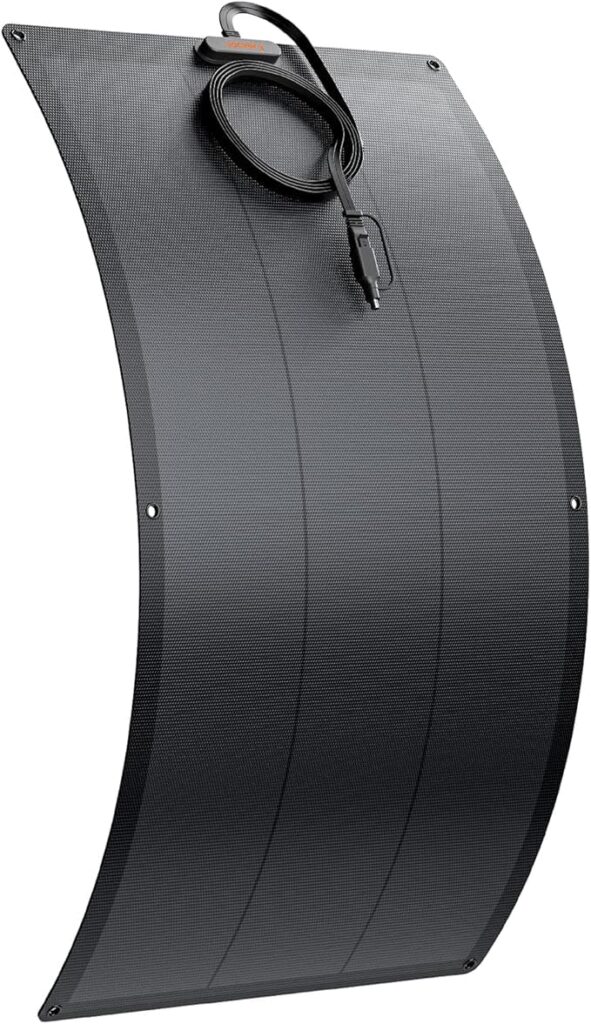
The original SolarSaga 100W is the panel that established Jackery’s reputation in portable solar and remains one of the most reviewed foldable panels on Amazon. It folds to a compact 24″×21″ footprint and opens to 48″×21″ for use. The SolarSaga 100W has been Jackery’s flagship portable panel since 2019, earning its place through sheer reliability and a refined design — the magnetic closure snaps shut when you pack up camp, and the dual adjustable kickstands hold their angle firmly on uneven terrain.
The two built-in USB ports (USB-A 5V/2.4A and USB-C 5V/3A) let you charge phones, cameras, and small devices directly from the panel without a power station. In independent testing, it hit 50.7W peak in direct sun and still pushed 13.3W under overcast conditions — outperforming most competitors at both ends of the light spectrum.
Pros: Most proven portable solar panel on Amazon, magnetic closure, dual kickstands, USB-A + USB-C direct charging, 23% efficiency, Jackery warranty and support
Cons: IP65 (not IP67/IP68 — bring inside in heavy rain), 10.3 lbs, Anderson connector limits non-Jackery compatibility
Best for: Car campers within the Jackery ecosystem, first-time portable solar buyers, anyone who wants a proven panel with strong Amazon reviews
Jackery SolarSaga 100W Air — Best Ultralight Foldable Panel

The SolarSaga 100W Air is Jackery’s most recent generation — a meaningful improvement over the original in every dimension that matters for weight-conscious campers. At 7 lbs, it’s 27% lighter than the previous SolarSaga. The W-fold design collapses smaller than A2 paper and fits in a daypack. The bifacial PERC cells capture reflected light from the ground surface in addition to direct sun, improving output in diffuse or low-angle light conditions common in early morning and late afternoon camping.
IP68 is a genuine upgrade over the original’s IP65 — it handles being caught in rain without risk of damage. The built-in sun indicator shows in real time whether the panel is aimed optimally, removing the guesswork from placement. At ~$150 versus ~$100 for the original, it’s worth the premium for anyone for whom weight and weather resistance are priorities.
Important compatibility note: The SolarSaga 100W Air is not compatible with the older Jackery Explorer 300 and Explorer 300 v2 due to voltage mismatch. Verify compatibility with your specific power station before ordering.
Pros: Lightest 100W foldable at 7 lbs, bifacial cells for better low-light output, IP68 fully waterproof, W-fold ultra-compact, sun indicator for optimal aiming, 60-second setup
Cons: ~$50 more than original SolarSaga 100W, not compatible with Explorer 300/300 v2
Best for: Backpackers and ultralight campers, anyone who prioritises minimum weight and maximum weather resistance in a 100W panel
Renogy 400W Portable Solar Suitcase — Best High-Output Foldable Panel
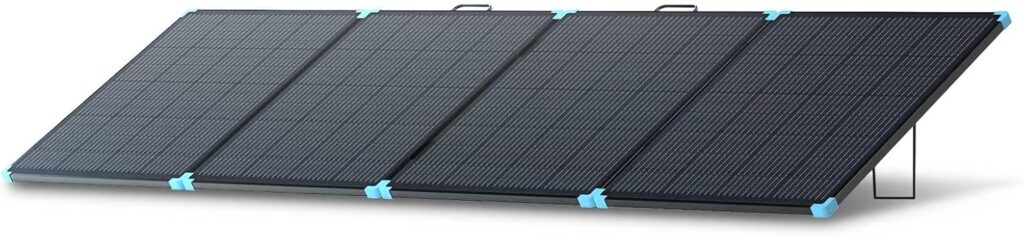
The Renogy 400W suitcase is the answer for overlanders, van lifers, and RV owners who want 400W of portable solar without permanent roof mounting. It folds to 33.7″×28″ — 4× more compact than four separate rigid 100W panels — and the integrated carry case and handle make it genuinely transportable as a single unit. The 23% ETFE-coated cells deliver IP67 waterproofing and deploy in approximately one minute with integrated sturdy kickstands.
The MC4 output is universal — connects to any MPPT charge controller or power station with MC4 input, including Jackery Explorer 1000 v2, EcoFlow DELTA, Bluetti, Anker SOLIX, or any standalone charge controller. At 30.2 lbs, it’s a two-hands-or-one-steady-carry — appropriate for loading in and out of a truck bed, van, or RV storage bay, not for hiking. See our full 400 watt solar panel guide for detailed specs and comparisons.
Real-world note: In actual outdoor conditions, output typically lands at 320–360W rather than the full 400W rating — standard across all solar panels where Standard Test Conditions rarely match outdoor reality. Still the highest-output single foldable unit available at this price point.
Pros: 400W from a single foldable unit, ETFE 23% efficiency, IP67 waterproof, MC4 universal connector, carry case included, works with any power station or charge controller, Renogy reliability
Cons: 30.2 lbs — vehicle-based use only, real-world output 320–360W, requires power station or MPPT controller (no built-in battery)
Best for: Overlanders, van builds, RV owners, anyone who wants maximum foldable solar output without roof mounting
ECO-WORTHY 400W Premium Kit — Best Value Complete Foldable System
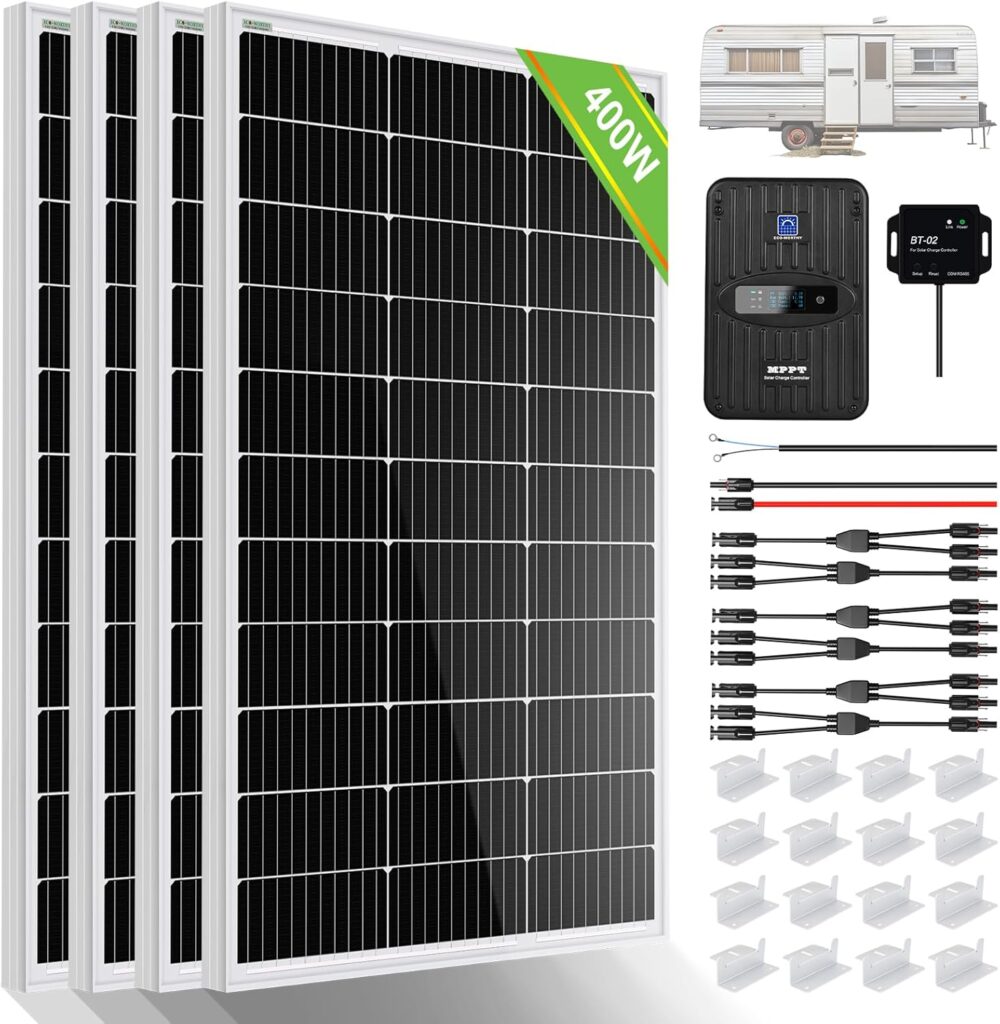
The ECO-WORTHY 400W Premium Kit takes a different approach: four 100W rigid panels, a 40A MPPT charge controller with Bluetooth monitoring, MC4 cables, Y-connectors, and mounting hardware — a complete 400W system with everything included for ~$220. This is the best value complete solar charging system on Amazon.
The four individual 100W panels are more installation-flexible than a single 400W suitcase — they can be arranged in different configurations, wired in series or parallel depending on your battery voltage, and stored more easily in tight spaces. The included Bluetooth MPPT controller eliminates a separate purchase. The trade-off: transport requires more organisation than a pre-folded suitcase unit. Better suited as a semi-permanent camping setup than a grab-and-go portable solution. Covered fully in our RV solar panel kit guide.
Pros: Most complete system at the price — panels, MPPT controller, Bluetooth, cables, everything included, 23% efficiency, Bluetooth monitoring, ~$220 total
Cons: Individual panels require more organisation for transport, less grab-and-go than the Renogy suitcase
Best for: Budget-conscious buyers wanting a complete 400W system, base camp setups, RV owners who want panels + controller in one purchase
Foldable vs. Rigid Solar Panels — When Foldable Is Right
| Factor | Foldable | Rigid Framed |
|---|---|---|
| Portability | ✅ Designed to move | Limited — best fixed in place |
| Setup time | ✅ Under 60 seconds | Requires mounting hardware |
| Durability | Good (ETFE coated) | ✅ Tempered glass — longer lifespan |
| Cost per watt | Higher | Lower |
| Lifespan | 5–10 years typical | 25–35 years typical |
| Best for | Camping, overlanding, portable use | Rooftop, ground mount, permanent |
If the panel stays in one place permanently, rigid framed panels deliver more watt-hours per dollar. If the panel moves with you, foldable panels justify the premium. For permanent installations, see our guides to monocrystalline solar panels and ground mounted solar panels.
Matching a Foldable Panel to Your Power Station
The most common buying mistake: choosing a panel without checking the power station’s maximum solar input limit.
| Power Station | Max Solar Input | Best Panel Match |
|---|---|---|
| Jackery Explorer 300 | 100W | SolarSaga 100W (not Air — voltage mismatch) |
| Jackery Explorer 500 v2 | 100W | SolarSaga 100W or 100W Air |
| Jackery Explorer 1000 v2 | 400W | Renogy 400W Suitcase or 4×100W |
| EcoFlow DELTA 2 | 500W | Renogy 400W Suitcase (with MC4 adapter) |
| Any MPPT charge controller | Up to controller rating | Renogy 400W or ECO-WORTHY 400W Kit |
For a complete guide to pairing panels with power stations, see our solar power for camping guide — it walks through the full sizing calculation for any combination.
Getting the Most Output From a Foldable Solar Panel
Aim directly at the sun. The difference between a panel aimed 20° off the sun and one aimed directly can be 15–25% of output. The SolarSaga 100W Air’s sun indicator removes the guesswork; for other panels, aim for the sharpest, smallest shadow from any object on the panel surface.
Adjust angle as the sun moves. A single midday adjustment recovers 10–15% of daily output versus a panel left in a fixed morning position. If you’re leaving camp, position for peak sun hours (10am–2pm).
Keep the panel cool. Panels lose efficiency as they heat up. The kickstands on quality foldable panels allow air circulation underneath — use them rather than laying the panel flat on a hot surface.
Clean the ETFE surface before use. Dust and fingerprints reduce output by 5–15%. Wipe with a damp cloth before extended use, particularly after vehicle transport.
Frequently Asked Questions
Can foldable solar panels charge a 12V battery directly?
Not without a charge controller between them. Connecting a foldable panel directly to a 12V battery risks overcharging and battery damage. Always use an MPPT charge controller for direct battery charging. Power stations (Jackery, EcoFlow, Bluetti) have a built-in MPPT controller — that’s why they’re the safest and easiest target for foldable panel output. Our MPPT charge controller guide covers controller selection for battery-direct setups.
Are foldable solar panels waterproof?
Quality panels are rated IP65 (rain resistant), IP67 (brief submersion), or IP68 (extended submersion). The original SolarSaga 100W is IP65 — handle rain with care. The SolarSaga 100W Air and Renogy 400W Suitcase are IP67/IP68 — genuinely weather-resistant. Always check the specific IP rating before leaving a panel out in uncertain weather.
Do foldable solar panels work on cloudy days?
Yes, at reduced output. A fully overcast day typically produces 20–30% of full rated output; partly cloudy conditions produce 50–70%. Battery-backed power stations handle cloudy days by drawing from stored charge — see our solar power for camping guide for how to size battery storage to cover overcast periods.
How long do foldable solar panels last?
Quality ETFE-coated monocrystalline panels typically last 5–10 years of regular use — shorter than rigid tempered glass panels (25+ years) because the flexible backing and fabric materials degrade faster under UV exposure and repeated folding. Proper storage extends lifespan significantly. For a full breakdown of solar panel longevity by type, see our how long do solar panels last guide.
What size foldable solar panel do I need for camping?
For phones, camera, headlamp, and a small speaker: 60–100W is adequate. For adding a laptop: 100W minimum. For running a 12V camping fridge: 200–400W with a battery. Simple rule: daily Wh consumption ÷ peak sun hours (typically 5 in summer) = minimum panel wattage. Add 25% buffer for real-world losses.
What is the lightest foldable solar panel available?
In the 100W class, the Jackery SolarSaga 100W Air at 7 lbs (3.2 kg) is currently the lightest quality 100W foldable panel available. Below 100W, lighter options exist but sacrifice meaningful charging capability. For backpacking applications where every ounce counts, 40–60W panels in the 2–4 lb range are available, though charging times increase proportionally.
Final Verdict
| Your Situation | Best Pick |
|---|---|
| Best overall / proven reliability | Jackery SolarSaga 100W |
| Best ultralight for backpacking | Jackery SolarSaga 100W Air |
| Best high-output, grab-and-go | Renogy 400W Solar Suitcase |
| Best value complete 400W system | ECO-WORTHY 400W Kit |
| Best for Jackery power stations | Jackery SolarSaga 100W or 100W Air |
| Best universal compatibility (MC4) | Renogy 400W Suitcase |
| Best for overlanding and RV | Renogy 400W Suitcase |
For most first-time buyers camping with a Jackery or similar power station, the Jackery SolarSaga 100W is the safest starting point — proven technology, strong support, and a price that won’t sting if your camping habits change. Step up to the SolarSaga 100W Air if minimum weight and IP68 weather resistance matter more than budget.
For overlanders and van lifers who need serious portable power, the Renogy 400W Solar Suitcase is the pick — four times the output of a 100W panel in a single foldable unit with universal MC4 compatibility.
For a complete off-grid system built around foldable panels — charge controller sizing, battery bank selection, and wiring — start with our off-grid solar system guide. For camping-specific power station pairings and full camping solar setups, our solar power for camping guide covers the complete picture from panel to power station to appliance.