This post contains affiliate links. If you buy through our links we may earn a small commission — at no extra cost to you. This never influences our recommendations.
A portable power station with a solar panel is the simplest way to get power that doesn’t depend on an outlet. The station stores the energy, the panel refills it from the sun, and you don’t need to wire anything.
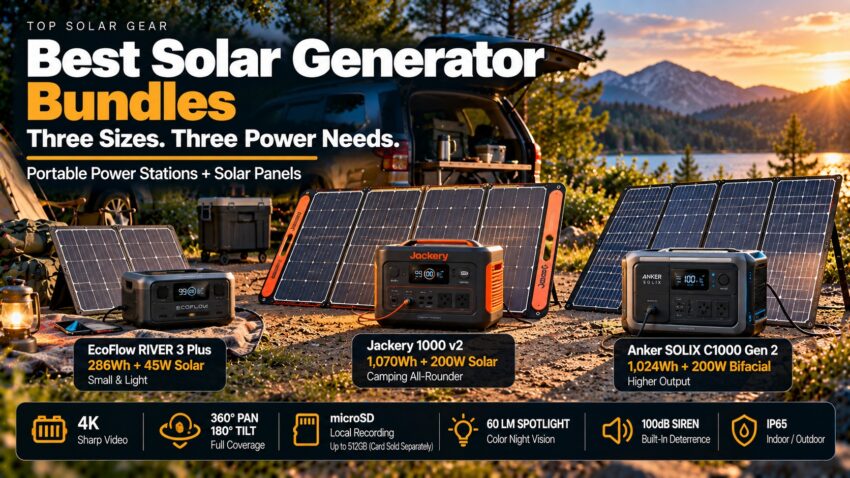
The catch is choosing the right size. A small station and panel is great for a weekend. It won’t run much more than a laptop, lights, and phones. Here are three bundles at different sizes, and how to pick between them.
| Bundle | Battery | AC Output | Panel |
|---|---|---|---|
| EcoFlow RIVER 3 Plus + Solar Panel | 286Wh | 600W+ (X-Boost up to 1,200W) | 45W |
| Jackery Solar Generator 1000 v2 | 1,070Wh | 1,500W (3,000W surge) | 200W |
| Anker SOLIX C1000 Gen 2 + Bifacial Panel | 1,024Wh | 2,000W (3,000W peak) | 200W |
Bundle or Buy Separately?
For most people, a bundle is the easier route. The station and panel are made to work together, the cable is usually included, and you skip the guesswork about plugs and voltage.
Buying separately only makes sense if you already own a panel, or want a bigger one than the bundle offers. If so, check the station’s maximum solar input before you buy. Our sizing guide walks through that math.
How Much Panel Do You Actually Need?
A quick rule: a panel’s rated watts times about 5 hours of good sun, then take off roughly 20 to 35% for real-world losses. That gives you a fair estimate of what you’ll get in a day.
A 45W panel makes roughly 150 to 180Wh on a good day, so refilling the 286Wh RIVER 3 Plus takes a day or two of sun. A 200W panel makes closer to 650 to 800Wh, which takes the 1,000Wh stations most of a day to fully refill.
Those are our estimates, not brand claims. Cloud, shade, and a flat angle can cut them a lot.
Our Picks
EcoFlow RIVER 3 Plus + 45W Solar Panel
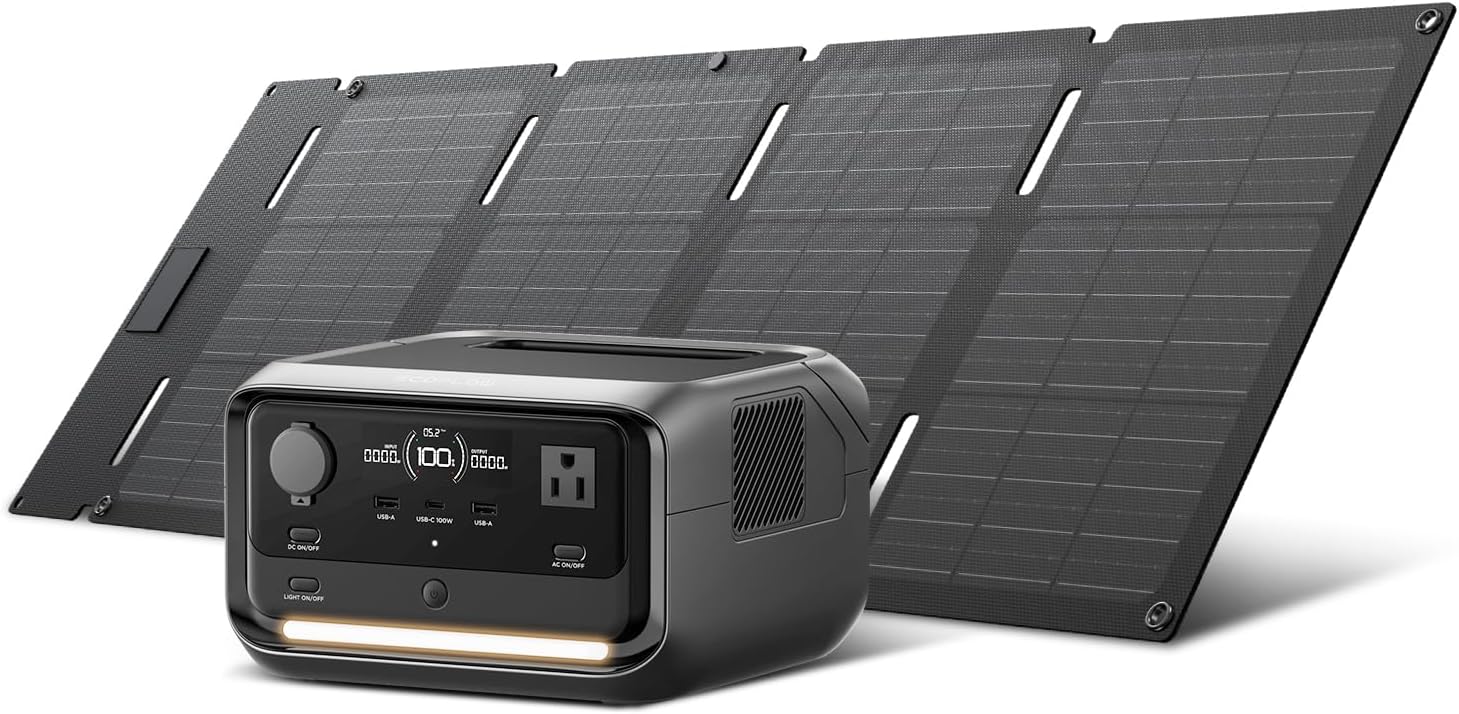
This is the small, easy choice. It weighs about 10 pounds, holds 286Wh, and can run a laptop, lights, a fan, and phone charging for a weekend trip. It also switches over to battery power in under 10 milliseconds, so it works as a backup for a router or small electronics too.
The bundled 45W panel is small, so think of it as a trickle charger. Solar input tops out at 220W, so you can add a bigger panel later. The battery can also grow: EcoFlow sells extra batteries that take it up to 858Wh.
| Pros | Cons |
|---|---|
| Light and compact at about 10 lb | 286Wh won’t run a fridge or heater for long |
| Fast wall charging: 0 to 100% in about an hour | The 45W panel refills it slowly, so a bigger panel is a good add-on |
| Expandable with extra batteries up to 858Wh | Extra batteries are sold separately |
Best for: Weekend campers, road trips, and small backup needs like phones, a laptop, and a router.
Full details and current price: EcoFlow RIVER 3 Plus + 45W Solar Panel on Amazon
Want the full breakdown? Read our EcoFlow RIVER 3 review.
Jackery Solar Generator 1000 v2 + 200W Panel
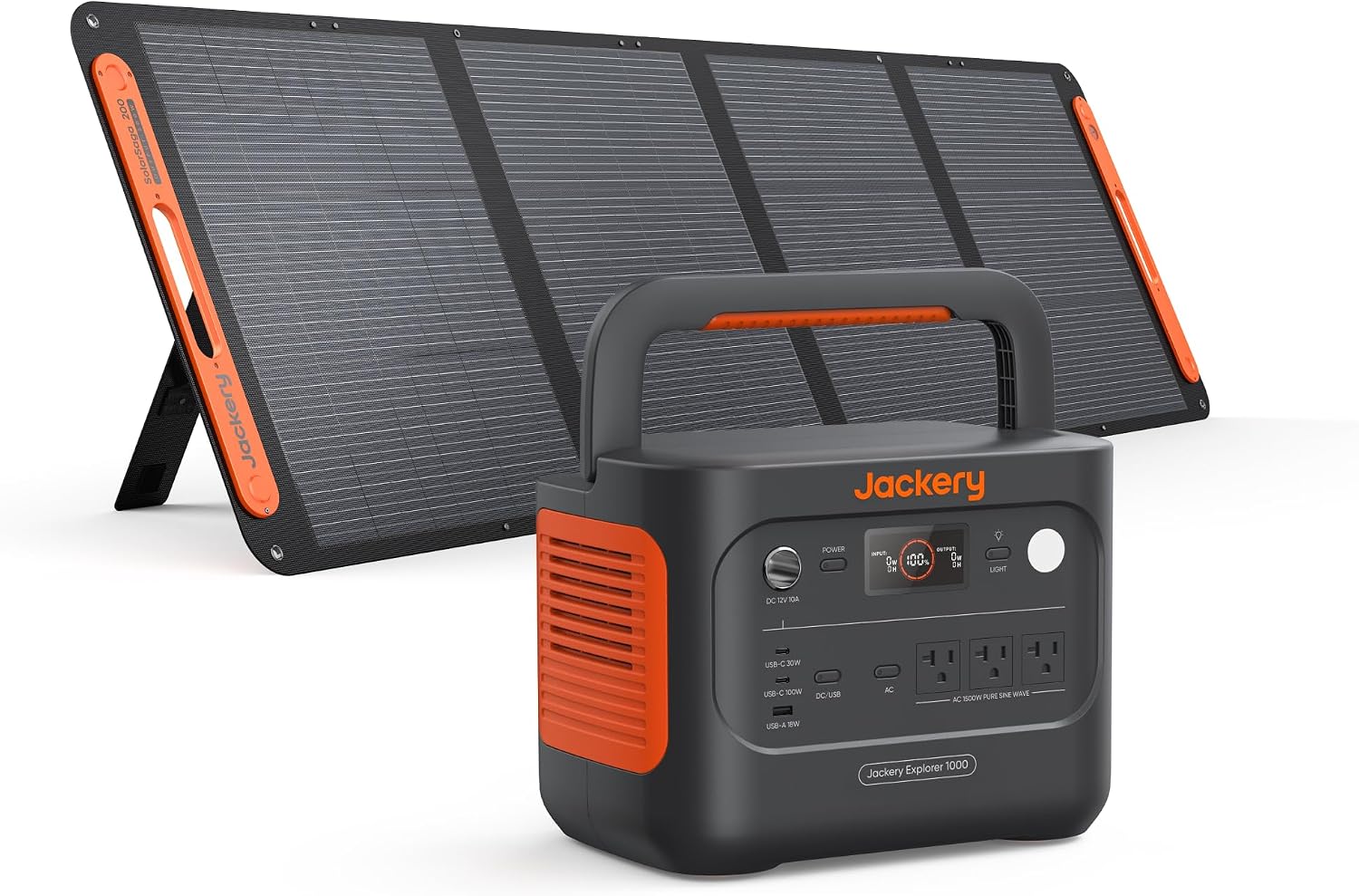
This is the big-enough-for-most-things option that still carries easily. At about 23.8 pounds, it’s easy to carry for a 1,000Wh station. It can run a mini fridge, a TV, a CPAP, and lights without trouble.
The included 200W SolarSaga folds to about 24 x 22 inches and weighs roughly 14 pounds. The station can accept up to 400W of solar, so adding a second panel later is an option. Jackery backs it with a 5-year warranty.
| Pros | Cons |
|---|---|
| Easy to carry at about 23.8 lb for 1,070Wh | 1,500W output is lower than the Anker’s 2,000W |
| 200W panel folds small and weighs about 14 lb | Bundle prices change often, so check the current deal |
| Accepts up to 400W of solar for future expansion | A 200W panel needs most of a sunny day for a full refill |
Best for: Campers, van lifers, and anyone who wants a grab-and-go station with a sensible panel.
Full details and current price: Jackery Solar Generator 1000 v2 + 200W Solar Panel on Amazon
Read our Jackery Explorer 1000 v2 review for the full station breakdown.
Anker SOLIX C1000 Gen 2 + 200W Bifacial Panel
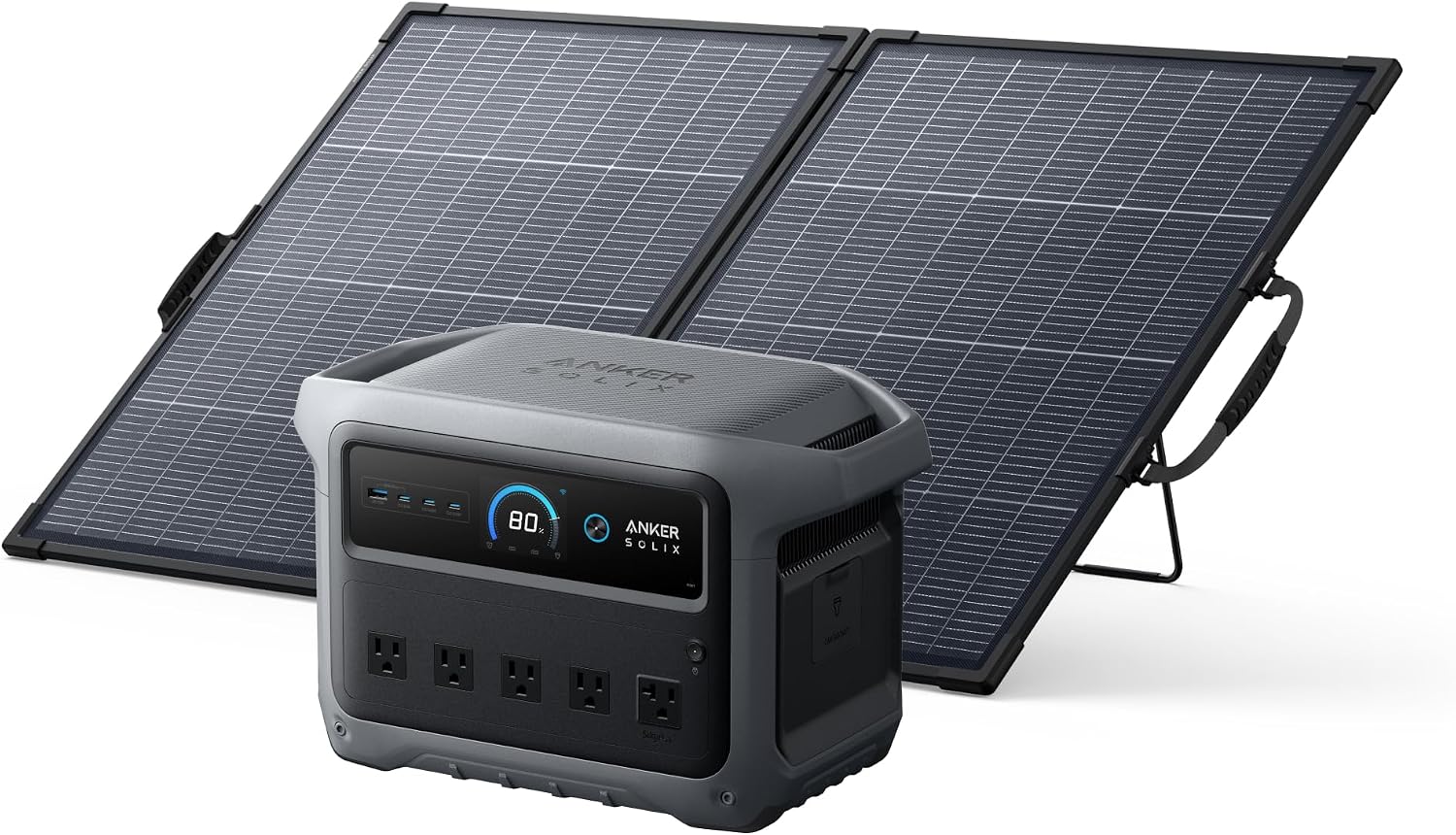
This is the one for higher-power gear. It puts out 2,000W with a 3,000W peak, so it handles things the Jackery may struggle with, like a bigger microwave or a small space heater for short bursts.
It also takes up to 600W of solar input, which is the most of the three. That means you can add more panels later and recharge much faster. The bifacial panel collects light on both sides, which helps a little when it’s set up over bright ground like sand or snow.
| Pros | Cons |
|---|---|
| 2,000W output with a 3,000W peak | Bigger and heavier than the RIVER 3 Plus |
| Up to 600W of solar input for faster expansion | Fastest wall charging needs a setting turned on in the Anker app |
| Fast wall charging: about 49 minutes in UltraFast mode | A 200W panel still takes most of a day to refill it |
Best for: Home backup, higher-wattage appliances, and anyone planning to add more panels later.
Full details and current price: Anker SOLIX C1000 Gen 2 + 200W Bifacial Panel on Amazon
See our Anker SOLIX C1000 Gen 2 review for a deeper look.
Frequently Asked Questions
Can I use any solar panel with a portable power station?
Not always. Check the station’s maximum solar input and its voltage range first, and make sure the connector fits. A bundle avoids that problem.
How long does it take to charge a power station with solar?
It depends on the panel and the sun. A 200W panel needs roughly 7 to 8 hours of good sun to refill a 1,000Wh station. A 45W panel needs a day or two to refill a 286Wh station, and a 110W panel about 3 to 4 hours.
Can I charge it from the wall too?
Yes. All three charge from a standard outlet, and wall charging is much faster than solar. Solar is best for off-grid trips and long outages.
Do I need a charge controller?
No. Each station has one built in, so you plug the panel straight in.
What size power station should I buy?
Add up the watts of what you want to run and how long you’ll run it. For phones, lights, and a laptop, 300Wh is plenty. For a fridge, CPAP, or TV, aim for 1,000Wh or more.
Final Verdict
| Bundle | Best For |
|---|---|
| EcoFlow RIVER 3 Plus + 45W Panel | Weekend trips, phones and laptops, and small backup needs |
| Jackery Solar Generator 1000 v2 + 200W | Camping, vans, and an easy-to-carry all-rounder |
| Anker SOLIX C1000 Gen 2 + 200W Bifacial | Higher-wattage appliances and room to add more panels |
If you only need to keep small electronics running, start with the RIVER 3 Plus. For fridges, CPAPs, and bigger loads, step up to a 1,000Wh bundle and pick the Jackery for weight or the Anker for power and expansion room.