This post contains affiliate links. If you buy through our links we may earn a small commission — at no extra cost to you. This never influences our recommendations.
Jackery HomePower 3600 Plus: At a Glance
There’s a moment during an extended power outage — usually around hour six, when the fridge starts to warm and you realise the sump pump isn’t running — when “emergency power” stops being a nice-to-have and becomes the only thing you can think about.
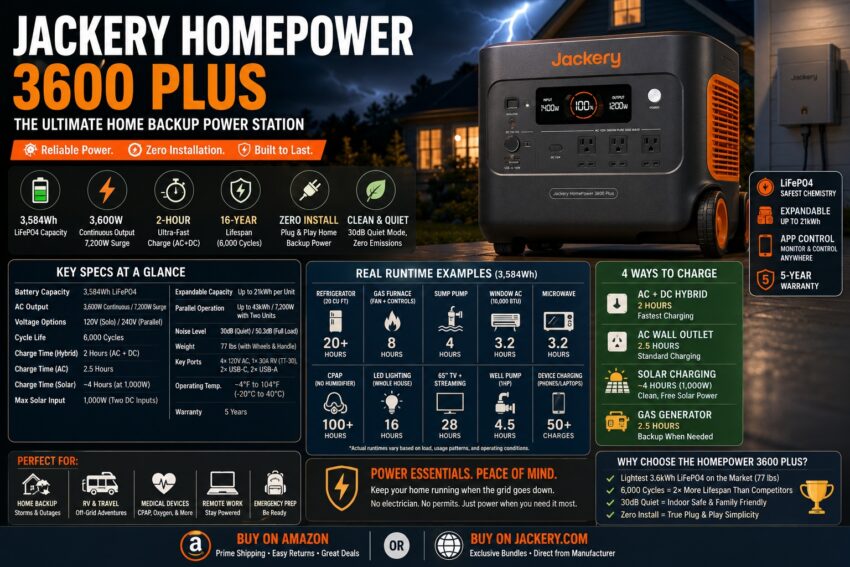
The Jackery HomePower 3600 Plus was designed for exactly that moment. It’s Jackery’s flagship home backup unit: 3,584Wh of LiFePO4 capacity, 3,600W of continuous AC output, expandable to 21kWh, rechargeable in two hours, and — crucially — operational without an electrician, a gas line, or a permit.
| Spec | Detail |
|---|---|
| Battery Capacity | 3,584Wh LiFePO4 |
| AC Output | 3,600W continuous / 7,200W surge |
| Voltage Options | 120V solo / 240V in parallel |
| Battery Chemistry | Lithium Iron Phosphate (LFP) |
| Cycle Life | 6,000 cycles |
| Estimated Lifespan | 16 years (at 1 cycle/day) |
| Charge Time (hybrid) | 2 hours (AC + DC combined) |
| Charge Time (AC only) | 2.5 hours |
| Charge Time (solar only) | ~4 hours (at 1,000W) |
| Max Solar Input | 1,000W |
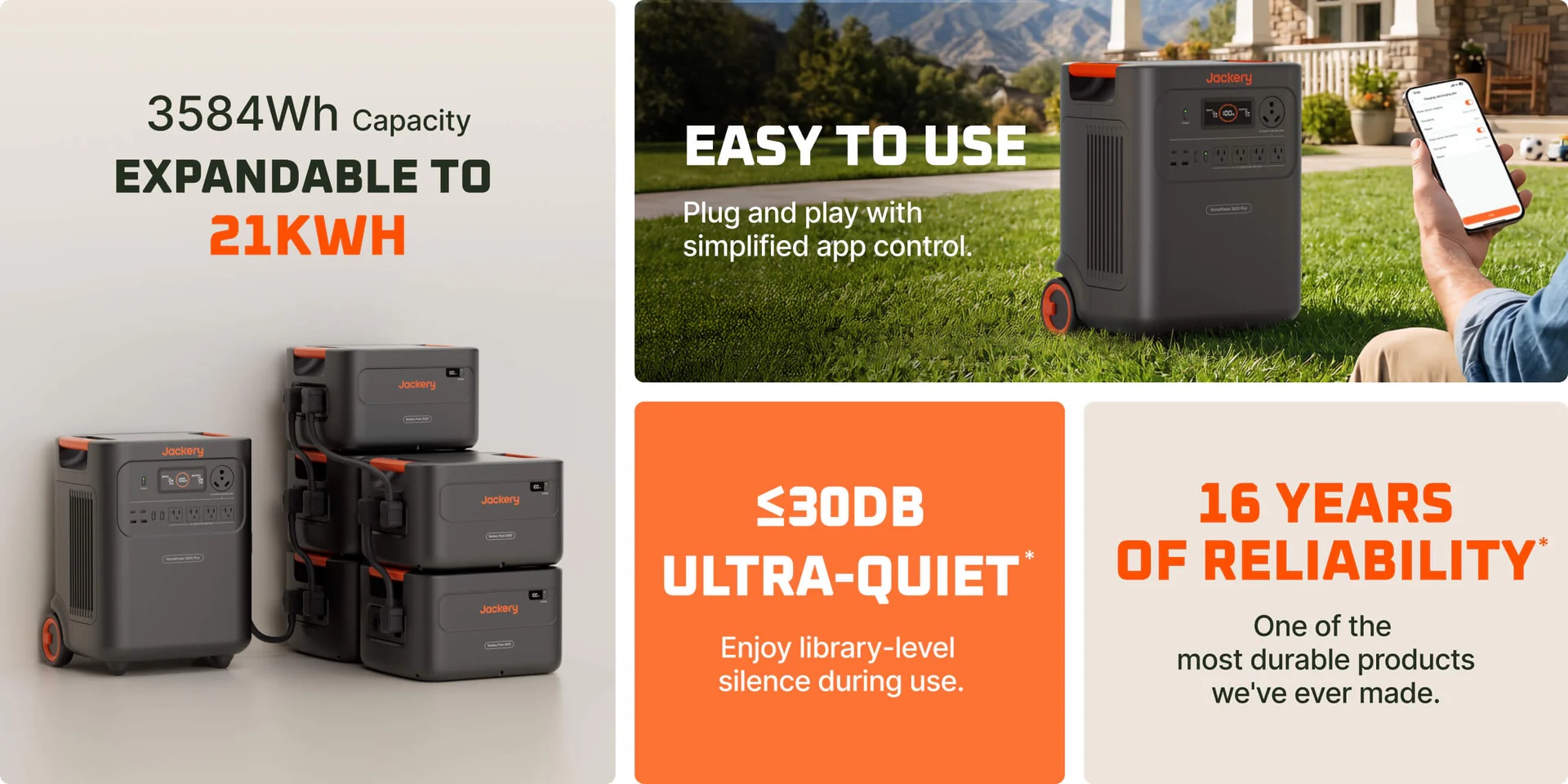
| Expandable Capacity | Up to 21kWh per unit |
| Parallel Operation | Up to 43kWh / 7,200W with two units |
| Noise Level | 30dB (quiet mode) / 50.3dB (full load) |
| Weight | 77 lbs (with wheels + handle) |
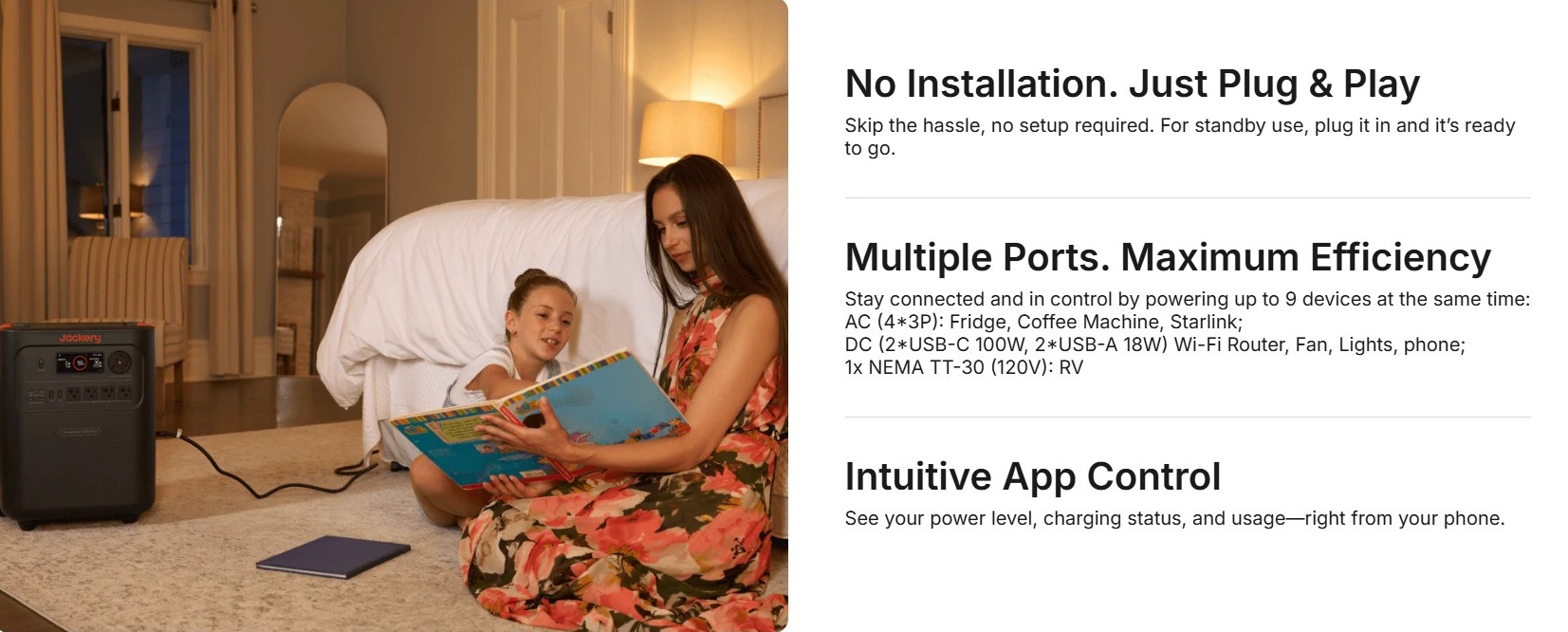
| Key Ports | 4× 120V AC, 1× 30A RV (TT-30), 2× USB-C, 2× USB-A |
| Operating Temperature | -4°F to 104°F (-20°C to 40°C) |
| Warranty | 5 years |
→ Buy on Amazon (Prime shipping, easy returns)
→ Buy on Jackery.com (direct from manufacturer, exclusive bundles)
Build Quality and Design
At 77 lbs the HomePower 3600 Plus is the lightest 3.6kWh LFP power station on the market — but it’s still not liftable for most people. Built-in rubber wheels and a telescopic handle make it genuinely rollable around a house or garage, which is the practical design intent: position it near whatever needs power rather than running extension cords across the house.
The LCD display is large and clear, showing battery percentage, input wattage, output wattage, and estimated runtime simultaneously. The Jackery app mirrors all of this on your phone and allows remote monitoring and mode adjustment — useful for checking status from another room during an outage.
The LFP chemistry with high-temp resistant ceramic membrane battery cells tested to 302°F prevents thermal runaway from heat or overcharge — a meaningful safety advantage over NMC lithium-ion alternatives. LFP is inherently more thermally stable, and the ceramic membrane cells add an additional layer of protection against the failure modes responsible for fires in cheaper power stations.
Real-World Performance
Independent testing confirms performance that meets or exceeds Jackery’s published specs across multiple real-world scenarios.
During a staged 48-hour blackout test, one independent reviewer’s unit powered a 21 cu ft refrigerator (8 hours on / 15 minutes off cycle) with a total runtime of 42 hours before reaching 20% charge — exceeding Jackery’s own 38-hour projection. In a separate 45-day Northern Michigan winter evaluation, including a 19-hour power outage at 5°F ambient temperature, the unit kept a refrigerator, furnace, and critical electronics running without issue.
Cold-weather performance is where many power stations fail: battery capacity drops significantly at low temperatures. The HomePower 3600 Plus handled genuine winter conditions without the capacity loss that plagues NMC alternatives.
The 3,600W continuous output held true in load testing — a reviewer pulled 3,582W without shutdowns. The pure sine wave output remained under 3% Total Harmonic Distortion even with sensitive equipment drawing simultaneously. Medical equipment, variable speed motors, and modern electronics all require clean power — the HomePower 3600 Plus delivers it.
The Four Charging Options
The HomePower 3600 Plus can be fully recharged from 0–100% in just 2 hours via hybrid AC+DC, 2.5 hours via AC alone, approximately 4 hours via solar (at maximum 1,000W input), or 2.5 hours via a gas generator. This charging flexibility is one of the unit’s strongest real-world advantages.
Hybrid AC + DC (2 hours): The fastest option — wall power combined with DC input simultaneously. In practice this means you can pre-charge in two hours before a forecasted storm, or restore a full charge within two hours of power returning.
AC only (2.5 hours): Standard wall outlet charging, still very fast for a 3.6kWh battery. Most comparable units take 4–6 hours from a standard outlet.
Solar (4 hours at 1,000W input): Solar input supports up to 1,000W combined via two DC inputs (16–60V, 12A max each; 24A / 1,000W combined maximum). This is adequate for most users — though it’s worth noting that competing units like the EcoFlow Delta Pro 2 support 1,600W of solar input, which matters if you’re building a serious off-grid solar setup with a large panel array.
Gas generator (2.5 hours): A practical backup for extended outages when cloud cover persists. Connect any portable gas generator for rapid recharging without relying on solar or grid.
Expandability — The Real Differentiator
This is where the HomePower 3600 Plus pulls ahead of most portable power stations in its class. You can grow a single unit to 21kWh by adding Jackery Battery Pack 3600 units via the DC expansion port — each pack adds significant capacity without requiring a new inverter or control system.
Two HomePower 3600 Plus units connected in parallel deliver 240V, 7,200W continuous, and 14,400W surge — enough for whole-home scenarios including large HVAC systems and EV chargers. Two-unit parallel operation brings total combined expandable capacity to 43kWh.
The MTS (Mobile Transfer Switch) is the hardware that completes the plug-and-play home backup story: during an outage, plug MTS into HomePower, press “Power-On,” and turn on the necessary circuits. No electrician required. No permanent installation. No permit needed in most jurisdictions.
What It Can Power — Real Load Examples
| Appliance | Draw | Runtime (3,584Wh) |
|---|---|---|
| Refrigerator (20 cu ft) | 150W avg | 20+ hours |
| Gas furnace (fan + controls) | 400W | 8 hours |
| Window AC (10,000 BTU) | 1,000W | 3.2 hours |
| Sump pump | 800W running | 4 hours |
| Well pump (1HP) | 750W running | 4.5 hours |
| Microwave | 1,000W | 3.2 hours |
| CPAP (no humidifier) | 30W | 100+ hours |
| LED lighting (whole house) | 200W | 16 hours |
| 65″ TV + streaming | 120W | 28 hours |
A realistic essential-load outage scenario (fridge + furnace fan + lights + device charging) draws 700–900W average, giving approximately 4–5 hours at full combined load — or much longer across a typical cycle where not everything runs simultaneously.
The Honest Limitations
The 1,000W solar input ceiling. Adequate for most users, but if you’ve invested in a 2,000W+ solar array and want to maximise off-grid charging speed, competitors like the EcoFlow Delta Pro 2 (1,600W) or Anker SOLIX F3800 (2,400W) have a genuine advantage here.
Weight. 77 lbs on wheels is manageable around the house. It is not a camping power station. If loading into vehicles and portability between locations is a priority, look at the Jackery Explorer series in the 20–30 lb range instead.
MTS sold separately. The plug-and-play home circuit backup story requires the MTS, which is an additional cost. Factor this in if powering specific home circuits (rather than direct appliance use) is part of your plan.
Price. At full retail this is a significant investment. However, promotional pricing has brought the HomePower 3600 Plus to $1,999 (45% off) during sales periods. Checking both Amazon and Jackery direct before purchasing is worth doing — pricing shifts frequently.
HomePower 3600 Plus vs. Key Competitors
| HomePower 3600 Plus | EcoFlow Delta Pro 2 | Anker SOLIX F3800 | |
|---|---|---|---|
| Capacity | 3,584Wh | 4,096Wh | 3,840Wh |
| AC Output | 3,600W | 3,600W | 3,840W |
| Solar Input | 1,000W | 1,600W | 2,400W |
| Cycle Life | 6,000 | 3,000 | 3,000 |
| Max Expandable | 21kWh | 25kWh | 26.9kWh |
| Weight | 77 lbs | 97.7 lbs | 88.2 lbs |
| Fastest Charge | 2 hrs | 1.8 hrs | 1.5 hrs |
| Quiet Mode | 30dB | Not rated | 30dB |
| Warranty | 5 years | 5 years | 5 years |
The HomePower 3600 Plus wins on weight (lightest in its class), cycle life (2× competitors at 6,000 cycles), and noise. Competitors win on solar input speed and initial capacity. For buyers prioritising long-term durability and plug-and-play simplicity over fastest solar charging, the Jackery is the stronger choice.
Who Should Buy the Jackery HomePower 3600 Plus
Homeowners in outage-prone areas. The primary use case. If you experience regular outages from storms, grid instability, or rural utility response times, the HomePower 3600 Plus covers the essential loads — fridge, furnace fan, lights, devices — for a meaningful duration with zero setup complexity.
People who want home backup without permanent installation. A standby generator requires a transfer switch, gas line, concrete pad, and licensed electrician — typically $3,000–$10,000 in installation before the generator itself. The HomePower 3600 Plus requires none of this. Plug it in, press a button.
RV owners and van lifers. The TT-30 (30A) outlet powers an RV directly. The rolling design stores and moves easily. The expandable capacity scales for extended off-grid trips. The 30dB quiet mode doesn’t disturb campsite neighbours.
Medical equipment users. CPAP, oxygen concentrators, and nebulisers require clean pure sine wave power. The HomePower 3600 Plus delivers under 3% THD — medical-grade stability. For households where power interruption affects health, this matters.
Long-term energy resilience planners. The 6,000-cycle LFP battery and 16-year rated lifespan make this a long-term infrastructure purchase. Starting with one unit and adding expansion batteries or a second unit over time is a genuine scalable strategy.
Who Should Look Elsewhere
Off-grid solar builders with large panel arrays. At 1,000W max solar input, users with 2kW+ of panels won’t be able to use their full array. The EcoFlow Delta Pro 2 (1,600W) or Anker SOLIX F3800 (2,400W) recharge faster from solar alone.
True portable camping users. 77 lbs doesn’t belong in a pack or a small vehicle. Look at the Jackery Explorer 1000 v2 or similar 20–25 lb alternatives for backcountry and vehicle-based camping.
Whole-home whole-load users. Central AC, electric dryer, and electric water heater running simultaneously requires a dual-unit parallel setup (7,200W, 240V) or a dedicated standby generator. A single HomePower 3600 Plus covers essentials, not the full home simultaneously at peak load.
Frequently Asked Questions
Does the Jackery HomePower 3600 Plus work in cold weather?
Yes — rated to -4°F and tested in real Northern Michigan winter conditions including a 19-hour outage at 5°F with no performance issues. The LFP chemistry and ceramic membrane cells maintain better cold-weather performance than NMC lithium-ion alternatives.
Can it run a well pump or sump pump?
Yes — the 7,200W surge capacity handles the high startup current of most residential well pumps (1HP ≈ 2,000W surge) and sump pumps. If an appliance has a very high startup surge (5-ton AC compressors, for example), unplug other loads to give the appliance the full surge capacity.
Is the MTS (Mobile Transfer Switch) required?
Not for direct appliance use — plug appliances into the unit’s outlets and use it immediately. The MTS is needed to power specific home circuits during an outage cleanly, without manually running extension cords to every appliance.
How many solar panels do I need to fully charge it in a day?
Four 250W panels (1,000W total) will fully charge it in approximately 4 hours of good direct sun. In less-than-ideal conditions, budget 6–8 hours. Our guides to high efficiency solar panels and 400 watt solar panels cover compatible panel options for building a solar charging setup around this unit.
Can two units run in parallel for 240V?
Yes — two HomePower 3600 Plus units connected in parallel deliver 240V, 7,200W continuous, and 14,400W surge. Enough for large central AC compressors, electric dryers, and other 240V appliances. The expansion path from one unit to two is straightforward.
What is the warranty?
5 years from Jackery — covering defects in materials, workmanship, and performance. In line with EcoFlow and Anker warranty terms for comparable products.
Where to Buy — Amazon vs. Jackery Direct
This is a purchase worth comparing across both channels before committing.
Amazon typically offers Prime shipping (fast and often free), easy returns, and multiple bundle configurations (power station only, with panels, with expansion battery) visible in one place. Amazon pricing fluctuates — the HomePower 3600 Plus has been listed as low as $1,999 during promotional periods.
Jackery direct sometimes unlocks exclusive bundle pricing, promotional discounts not available elsewhere, and direct manufacturer warranty service. Jackery’s website shows the full accessory ecosystem — expansion batteries, MTS, compatible solar panels — making it easier to plan a complete system purchase.
Check both before purchasing — the better deal depends on current promotions and inventory.
🛒 → Buy the Jackery HomePower 3600 Plus on Amazon
(Prime shipping · Easy returns · Price history visibility · Bundle options)
🏪 → Buy the Jackery HomePower 3600 Plus on Jackery.com
(Manufacturer direct · Exclusive bundles · Full accessory ecosystem)
Final Verdict
The Jackery HomePower 3600 Plus is the right answer for a specific and very large buyer category: the homeowner who wants serious backup power — enough for a fridge, furnace, sump pump, and the rest of the essentials — without the cost, complexity, and permanent infrastructure of a standby generator.
Its strengths are real: 6,000-cycle LFP battery (2× most competitors), 2-hour hybrid charge time, 30dB quiet indoor operation, expandability from 3.6kWh to 21kWh, and zero-installation plug-and-play operation. The limitations are also real: 1,000W solar input is adequate but not class-leading, and 77 lbs means it’s a home device, not a camping device.
For most households shopping in this category — prioritising longevity, noise level, and ease of use — the HomePower 3600 Plus is the strongest available option. The 6,000-cycle battery alone makes the long-term cost-per-cycle economics significantly better than comparable units with 3,000-cycle ratings.
For more on building a complete solar backup system around this unit, see our guides to best solar generators for home backup, off-grid solar system design, and high efficiency solar panels.