This post contains affiliate links. If you buy through our links we may earn a small commission — at no extra cost to you. This never influences our recommendations.
Solar Battery Charger for 12V Battery — Trickle Charger vs. Full Charger: Know the Difference
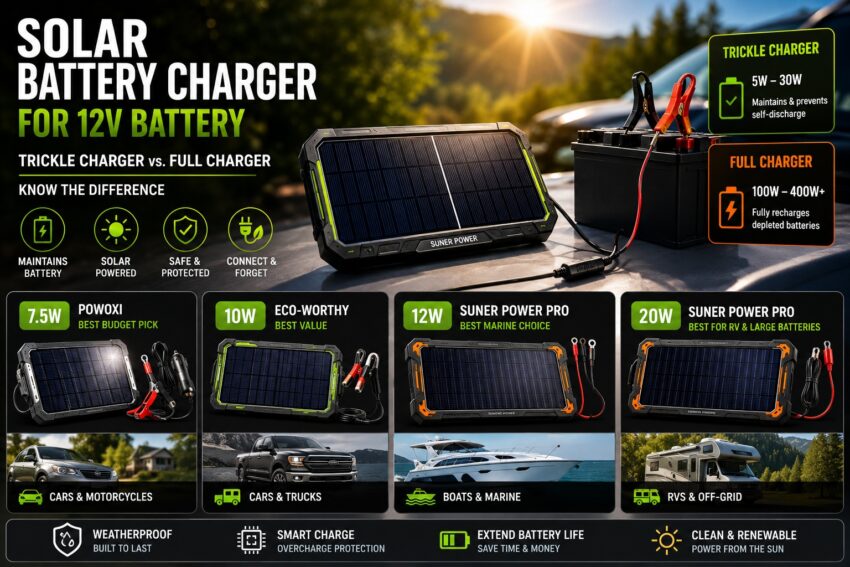
Before buying, the most important clarification in this product category: a solar battery charger for a 12V battery is almost always a trickle charger and maintainer — not a full-speed charger that can revive a completely dead battery quickly. This is the distinction that causes the most confusion and returns in this category.
Solar trickle charger / maintainer (this article): Outputs 5W–30W. Keeps a healthy battery topped up and prevents self-discharge. Cannot rapidly recharge a deeply discharged battery. Designed for long-term maintenance — seasonal storage, infrequently used vehicles, marine applications. Connect and forget.
Solar charging system (for serious off-grid use): Outputs 100W–400W+. Connected to an MPPT charge controller and battery bank. Can fully recharge a depleted deep-cycle battery in hours. Requires proper system design and wiring. Covered in our MPPT charge controller guide and solar battery guide.
Who Actually Needs a Solar 12V Battery Charger
The solar trickle charger solves one specific problem extremely well: battery self-discharge during periods of inactivity.
Every 12V lead-acid battery slowly self-discharges when not in use — a typical car battery loses 1–25% of its charge per month through self-discharge alone. Add parasitic draws (alarm systems, clock, ECU memory) and a parked vehicle can have a dead battery in 4–8 weeks without any use.
A solar trickle charger connected to the battery and placed in the sun produces enough current to offset this self-discharge and parasitic draw — keeping the battery at full charge indefinitely without grid power, without a plug, and without attention.
Classic use cases:
- Classic and seasonal cars stored over winter
- Boats stored at a marina or on a trailer between outings
- Motorcycles, ATVs, jet skis, and snowmobiles in off-season storage
- RVs and camper vans parked between trips
- Lawn mowers and garden tractors stored over winter
- Emergency vehicles and backup generators that sit unused for months
What to Look for in a Solar 12V Battery Charger
Wattage — the key sizing decision. For pure maintenance with no parasitic draw: 5W–10W is sufficient. For vehicles with moderate parasitic draws (alarm, dashcam, GPS): 10W–15W. For larger batteries (RV coach, marine deep-cycle) or higher parasitic draws: 20W–30W. The rule of thumb: size the panel to produce approximately 10–20% of your battery’s Ah capacity per day in peak sun hours.
Built-in charge controller — essential. Any solar charger worth buying includes a built-in charge controller — either PWM or MPPT. The controller prevents overcharging, which can permanently damage a lead-acid battery. Without a controller, a solar panel connected directly to a battery will overcharge it once full. MPPT controllers are 20–30% more efficient than PWM and worth the small premium when available.
Reverse current protection. At night or in shade, a panel without reverse current protection will drain the battery — the panel becomes a load rather than a source. Quality trickle chargers include a blocking diode or the charge controller handles this automatically.
Weatherproofing. A solar battery charger left on a vehicle must handle rain, sun, and temperature swings. IP65 minimum — rated for water jets from any direction. Verify the IP rating rather than relying on “waterproof” marketing language.
Connection types. Most include two methods: cigarette lighter plug (easiest, but only works if the socket is always-on with ignition off — check your vehicle), and alligator clips (direct to battery terminals, works regardless of ignition — most reliable for maintenance). SAE connector is the cleanest permanent installation option.
The Best Solar Battery Chargers for 12V Batteries — Verified Picks
| Product | Wattage | Controller | Best For | Price |
|---|---|---|---|---|
| POWOXI 7.5W Trickle Charger | 7.5W | Built-in | Cars, motorcycles, budget pick | ~$20–$25 |
| ECO-WORTHY 10W Trickle Charger | 10W | Built-in PWM | Cars, trucks, light RV | ~$25–$30 |
| SUNER POWER 12W Pro | 12W | Built-in MPPT | Boats, marine, permanent install | ~$25–$35 |
| SUNER POWER 20W Pro | 20W | Built-in MPPT | RV, large batteries, high parasitic draw | ~$35–$45 |
POWOXI 7.5W Solar Battery Trickle Charger — Best Budget Pick
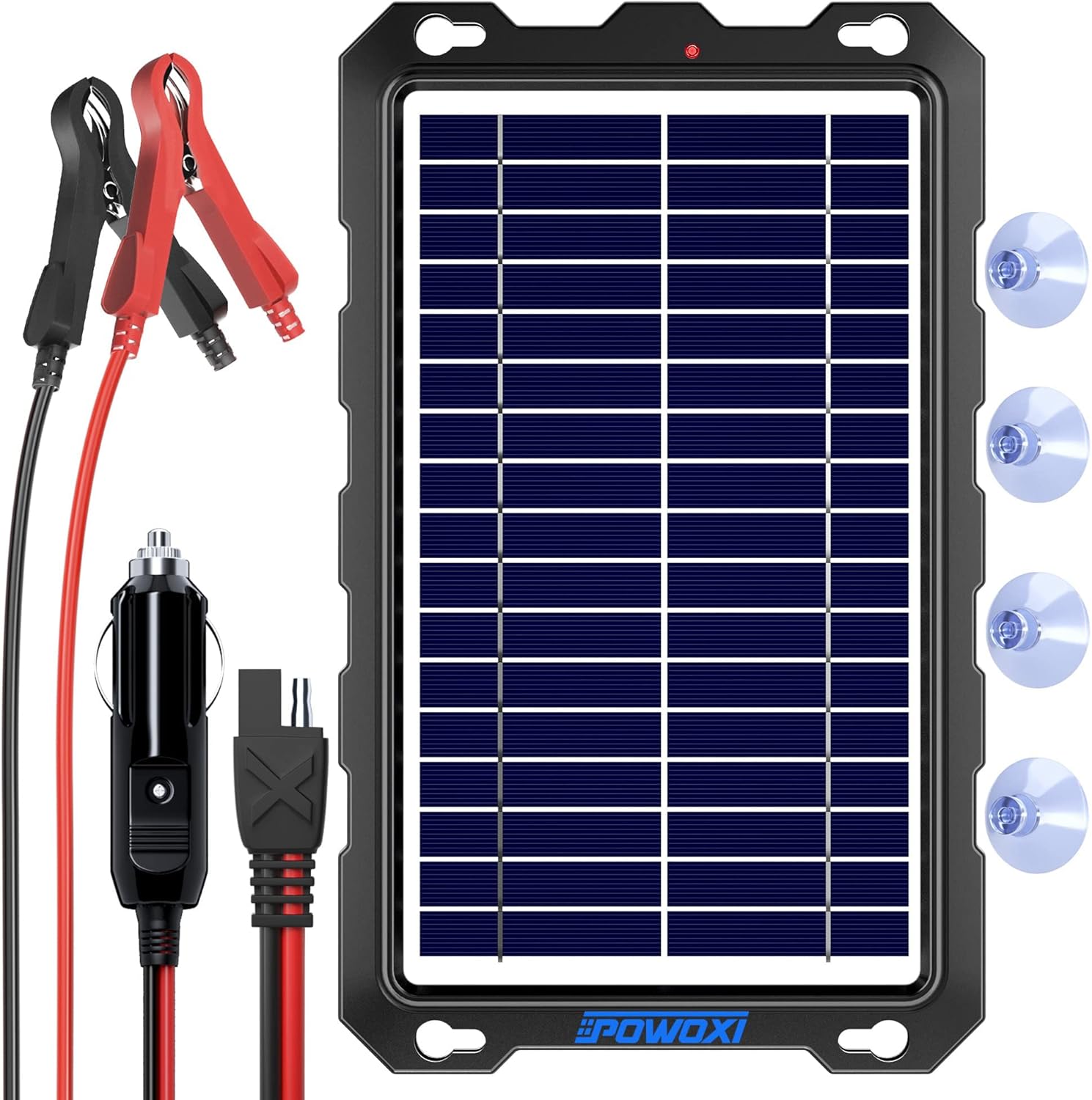
The POWOXI 7.5W is the consistent Amazon bestseller in the solar trickle charger category — CE and ROHS certified, portable and waterproof, at ~$20–$25 the most affordable genuinely functional solar trickle charger available. The two-colour LED indicator (red = receiving sunlight, green = charging battery) provides clear visual confirmation of operating status. Includes both cigarette lighter plug and alligator clips for connection flexibility.
The 7.5W output is appropriate for maintenance charging of a standard car, motorcycle, ATV, or any 12V battery with minimal parasitic draw. It will not meaningfully recharge a deeply discharged battery — it’s a maintainer, not a fast charger. For a completely dead battery, use a conventional mains charger first, then hand off to the POWOXI for ongoing maintenance.
Pros: Amazon bestseller, CE/ROHS certified, waterproof, dual connection options, LED indicator, 12-month warranty, ~$20–$25
Cons: 7.5W marginal for vehicles with higher parasitic draws, no MPPT, cigarette lighter socket may not be always-on
Best for: Standard cars, motorcycles, ATVs, snowmobiles, and seasonal vehicles in storage
ECO-WORTHY 10W Solar Car Battery Charger Maintainer — Best Value Step-Up
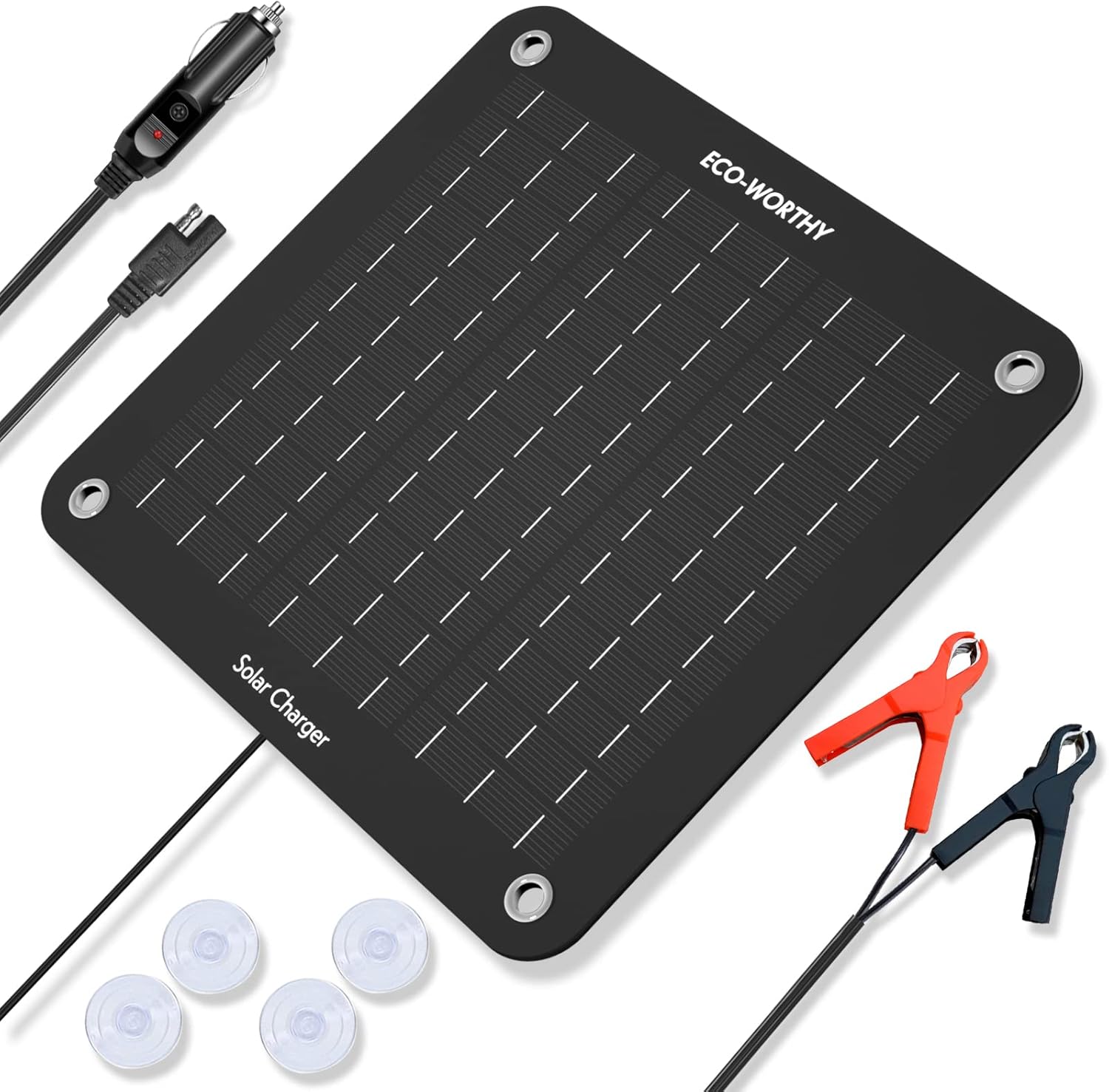
ECO-WORTHY’s 10W trickle charger adds useful wattage headroom for vehicles with a standard alarm system or GPS tracker as a parasitic draw. The waterproof monocrystalline panel includes SAE cable for permanent battery lead installation and alligator clips. Reverse and overcharge protections are included via built-in PCB controller. At ~$25–$30, it hits the sweet spot of adequate wattage, robust construction, and brand reliability from a recognised solar equipment manufacturer.
Pros: 10W adequate for light parasitic draws, SAE + alligator clip connections, reverse and overcharge protection, waterproof, ECO-WORTHY reliability, indicator light
Cons: PWM controller (less efficient than MPPT), no adjustable mount bracket
Best for: Cars, trucks, and light RV battery maintenance — particularly where a permanent SAE lead installation is planned
SUNER POWER 12W 12V Solar Battery Charger Pro — Best Mid-Range
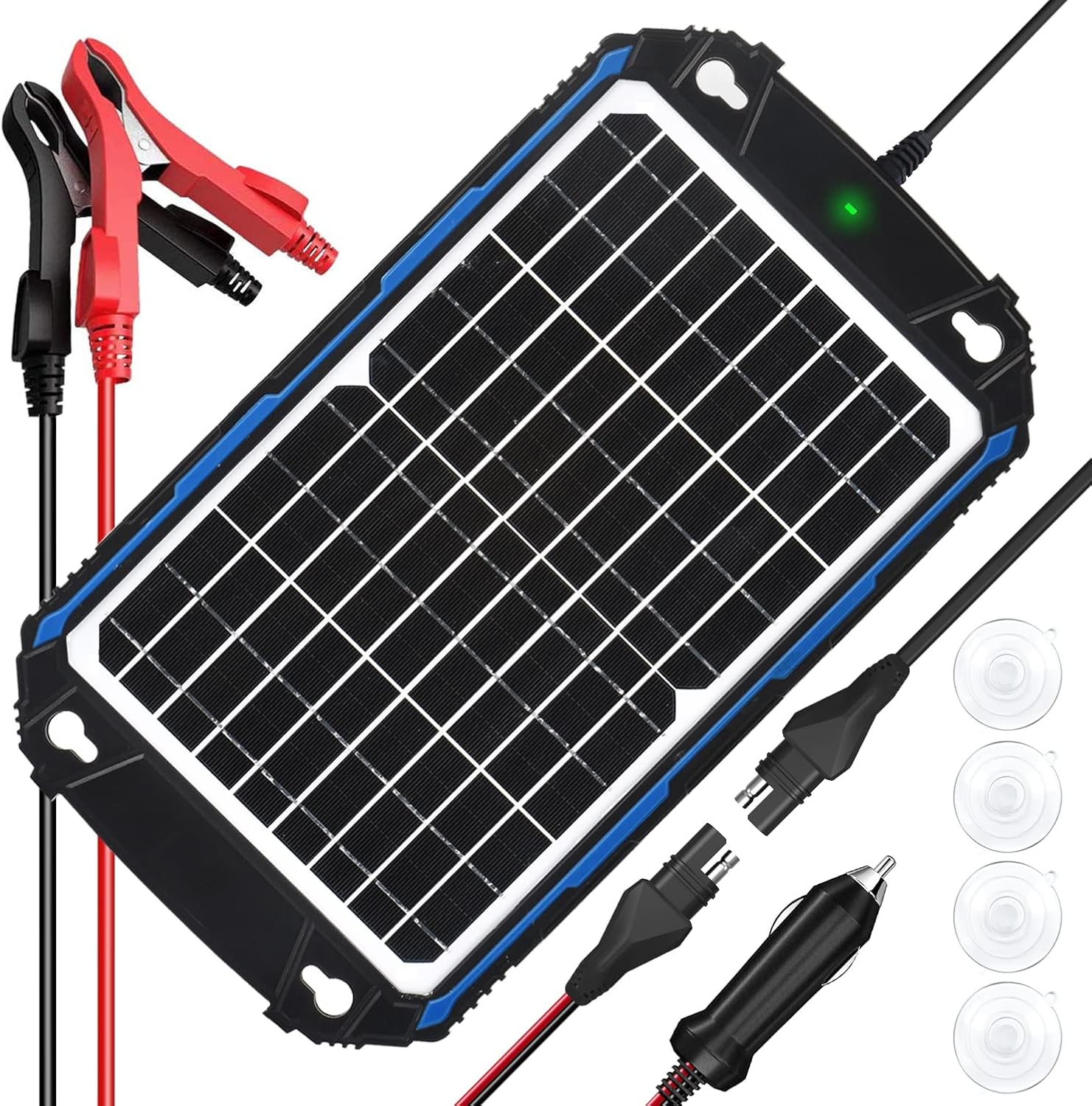
The SUNER POWER 12W Pro steps up meaningfully with a built-in UltraSmart MPPT charge controller — extracting 20–30% more energy from the panel than PWM-only competitors. SUNER POWER was founded by a team of technicians with 10+ years of solar industry experience, and the build quality reflects that background. In real-world conditions of partial shade, early morning sun, or cloud cover, MPPT tracking maintains peak power extraction throughout the day where PWM cannot. The adjustable joint bracket allows optimising panel angle for maximum sun exposure — particularly useful for fixed installations on boat decks or RV roofs. Explicitly compatible with AGM, gel, SLA, flooded, and LiFePO4 batteries.
Pros: Built-in MPPT (20–30% more efficient than PWM), waterproof, adjustable bracket, LED indicator, LiFePO4 compatible, SUNER POWER solar expertise
Cons: ~$25–$35 (modest premium over budget picks), 12W limits usefulness for very large batteries with high parasitic draws
Best for: Cars, motorcycles, boats, marine applications, and any installation where MPPT efficiency and build quality justify the premium
SUNER POWER 20W 12V Solar Battery Charger Pro — Best for RV and Marine
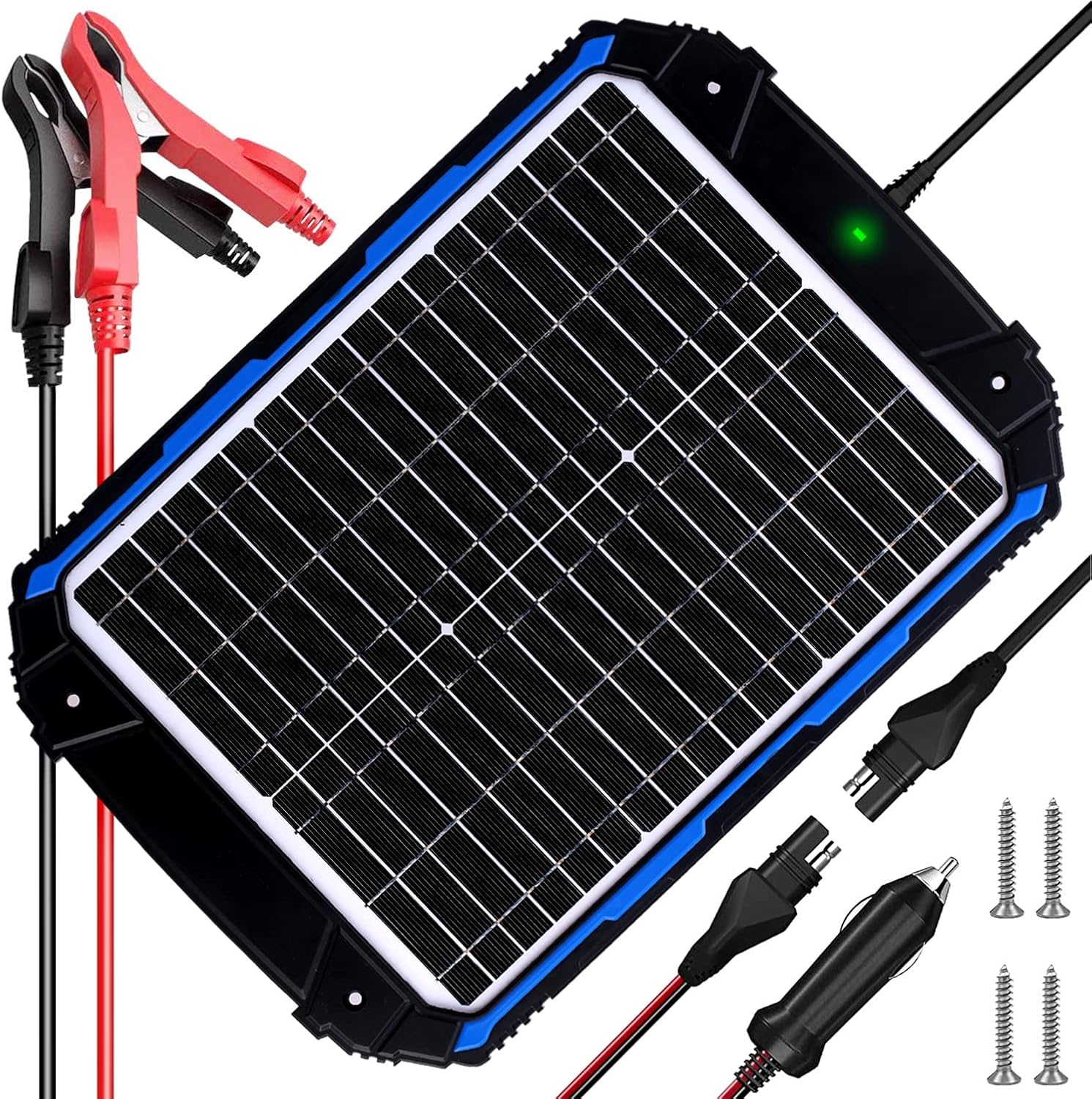
The SUNER POWER 20W Pro is the right pick when the battery is larger, the parasitic draw is higher, or the installation demands more reliable recharge headroom — RV coach batteries, marine deep-cycle batteries, and any application where the 12W unit’s output margin is too tight. At 20W with built-in MPPT, this unit delivers enough current to not only maintain a large battery against parasitic draw but to slowly replenish partial discharge events — the difference between a maintainer that barely keeps up and one that actively recovers the battery to full charge between cloudy stretches.
Pros: 20W appropriate for RV and marine applications, MPPT controller, waterproof, adjustable bracket, handles larger batteries and higher parasitic draws, AGM/LiFePO4 compatible
Cons: Higher price (~$35–$45), overkill for simple car/motorcycle maintenance, larger panel requires more mounting space
Best for: RV coach batteries, marine deep-cycle batteries, large AGM batteries, vehicles with higher parasitic draws
How to Install a Solar Battery Charger — Step by Step
Step 1 — Choose your connection method. For temporary use: cigarette lighter plug (verify always-on with ignition off). For permanent installation: alligator clips direct to battery terminals or a permanent SAE lead. Alligator clips are the most reliable for true battery maintenance.
Step 2 — Connect to the battery. Red clip to positive terminal (+), black clip to negative (–). Connect battery clips before exposing the panel to sunlight to prevent arcing. The LED indicator should confirm connection.
Step 3 — Position the panel in direct sun. South-facing at the approximate latitude angle delivers optimal year-round performance. A panel behind a car windscreen loses 20–40% of output through the glass — outdoor placement is significantly better for serious maintenance.
Step 4 — Verify charging status. The LED indicator confirms the unit is operating. Check on the first day before leaving it unattended long-term.
Step 5 — Leave it. The built-in charge controller prevents overcharging — no need to disconnect when the battery reaches full charge. The panel reduces output automatically as the battery approaches full and maintains float level indefinitely.
Solar Battery Charger vs. Traditional Charger — When to Use Each
| Situation | Best Tool |
|---|---|
| Battery completely dead | Traditional mains charger first, then solar maintainer |
| Vehicle in storage for weeks or months | Solar trickle charger — set and forget |
| Boat at marina between trips | Solar trickle charger on deck |
| RV parked between camping trips | Solar trickle charger on roof or dash |
| Daily driver with regular use | Not needed — alternator maintains charge |
| Off-grid system requiring full recharge | MPPT controller + 100W+ panel array |
| Motorcycle off-season storage | Solar trickle charger — ideal application |
Frequently Asked Questions
Will a solar trickle charger charge a dead battery?
Very slowly — and not reliably. A 10W solar panel in 5 peak sun hours produces 50Wh per day. A completely discharged 50Ah car battery needs approximately 600Wh to recharge — that’s 12 days of ideal sun, which is impractical. Use a conventional mains charger to bring a dead battery to full first, then hand off to the solar trickle charger for ongoing maintenance.
Can I leave a solar battery charger connected all the time?
Yes — that’s exactly what they’re designed for. The built-in charge controller prevents overcharging by reducing output as the battery approaches full charge and switching to float maintenance mode. A quality solar trickle charger with a proper controller can stay connected indefinitely without damaging the battery.
Will a solar charger work through a windscreen or window?
Yes, but with significantly reduced output. Automotive glass filters approximately 20–40% of sunlight — so a 10W panel behind a windscreen effectively produces 6–8W. For best results, route the cable through a window or door seal and position the panel outside.
What size solar panel do I need for my 12V battery?
Standard car or motorcycle with no parasitic draw: 5W–7.5W sufficient. Vehicles with alarms, GPS trackers, or dashcams: 10W–15W. RV coach batteries or large marine batteries: 20W–30W. For sizing a complete off-grid solar system for deep-cycle batteries, see our solar battery guide and MPPT charge controller guide.
Do solar battery chargers work in winter?
Yes — reduced efficiency but still functional. Solar panels produce output from available light, not heat — they actually perform slightly better in cold temperatures. The reduction in winter comes from shorter days, lower sun angles, and potential snow coverage. A 10W panel in winter might effectively deliver 4–6W average per day — still enough for basic maintenance in most climates.
Are solar battery chargers compatible with LiFePO4 batteries?
The SUNER POWER Pro series explicitly lists LiFePO4 compatibility alongside AGM, gel, and SLA. Budget PWM-only chargers may not be appropriate for LiFePO4 without verifying the charge voltage profile. If you have a LiFePO4 battery, choose a charger that explicitly lists LiFePO4 compatibility with an MPPT controller. See our solar battery guide for LiFePO4 specifics.
Final Verdict
| Your Situation | Best Pick |
|---|---|
| Budget car / motorcycle maintenance | POWOXI 7.5W (~$20–$25) |
| Car / truck with light parasitic draw | ECO-WORTHY 10W (~$25–$30) |
| Boat, marine, or permanent installation | SUNER POWER 12W Pro (~$25–$35) |
| RV, large battery, higher parasitic draw | SUNER POWER 20W Pro (~$35–$45) |
For most buyers maintaining a single car, motorcycle, or seasonal vehicle, the POWOXI 7.5W covers the job at the lowest price in the category. Step up to the SUNER POWER 12W Pro for marine or permanent installations where MPPT efficiency justifies the modest premium. For RV coach batteries and larger marine applications, the SUNER POWER 20W Pro provides the output headroom to maintain larger batteries reliably.
For complete solar battery storage systems — LiFePO4 banks, off-grid cabins, RV solar charging beyond trickle maintenance — see our solar battery guide, MPPT charge controller guide, and off-grid solar system guide.