Two Ways to Go Solar — Understanding the Fundamental Choice
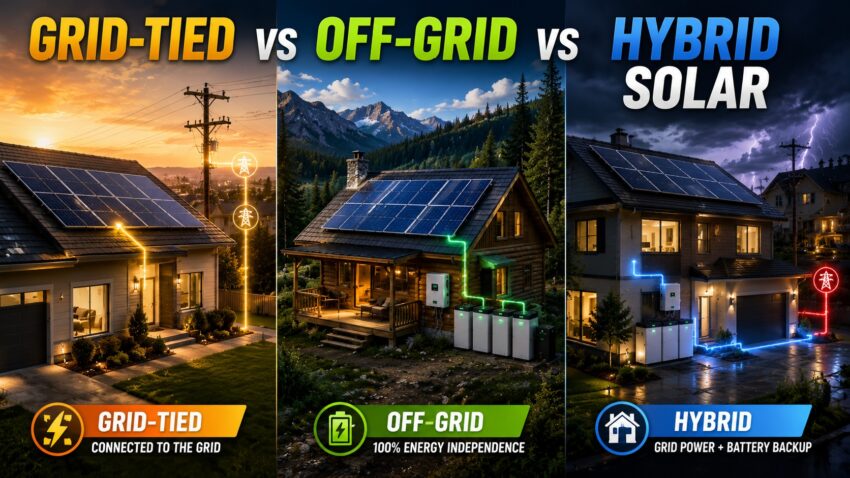
Every solar installation in the world falls into one of two categories: connected to the utility grid, or not. This single decision shapes everything else — the system components you need, the costs involved, how you use electricity day to day, and what happens when the sun isn’t shining.
Most people encounter solar as a home improvement decision — panels on the roof, potentially lower electricity bills. That’s grid-tied solar. But a growing number of people are asking a different question: what if I didn’t need the grid at all? That’s off-grid solar. And a third category — hybrid solar — sits between them, connected to the grid but with battery backup for resilience.
Understanding the real differences between these systems before making any purchasing decision is the most valuable thing this article can give you.
Grid-Tied Solar Systems — How They Work
A grid-tied solar system connects your solar panels directly to the utility electricity grid through a grid-tied inverter. When your panels produce more electricity than your home uses, the surplus flows back into the grid. When your panels produce less than you need — at night, on cloudy days, or during high-demand periods — you draw from the grid as normal.
The core components:
- Solar panels (monocrystalline, typically 300W–400W per panel for residential)
- Grid-tied inverter (converts DC from panels to AC for home use and grid export)
- Utility meter (bidirectional — measures both consumption and export)
- Disconnect switch (safety requirement for utility connection)
No batteries. No charge controllers. The grid itself acts as your storage — you export when you produce surplus, you import when you need more than you produce.
Net metering — how you get paid for your surplus: Most US states have net metering policies that credit your electricity bill for every kWh you export. If you export 500kWh in a month and import 400kWh, you may pay nothing and carry forward a credit. Net metering rates and policies vary significantly by state and utility — understanding your utility’s specific policy before sizing a grid-tied system is essential.
Why grid-tied is the most common residential choice:
- Lowest upfront cost — no batteries required
- Simplest system — fewer components, less maintenance
- Never run out of power — the grid is always there as backup
- Net metering can dramatically reduce electricity bills
- Fastest payback period of any solar configuration
The critical limitation: A standard grid-tied system goes offline during a grid outage — even if your panels are producing full power. This is a safety requirement: inverters must shut down when the grid fails to prevent backfeeding energised power onto lines that utility workers are repairing. If power outage protection is important to you, a standard grid-tied system without batteries doesn’t provide it.
Off-Grid Solar Systems — How They Work
An off-grid solar system has no connection to the utility grid. It produces all the electricity the building uses, stores surplus in a battery bank, and manages the whole system through a charge controller and inverter — with no grid as backup.
The core components:
- Solar panels (sized to meet 100% of daily consumption plus battery charging)
- MPPT charge controller (regulates charging from panels to batteries)
- Battery bank (stores energy for nights, cloudy days, and peak loads)
- Off-grid inverter (converts battery DC to AC for household use)
- Generator backup (optional but strongly recommended)
Who actually uses off-grid solar: Off-grid solar is not primarily a cost-saving decision in 2026 — the battery bank cost alone typically makes it more expensive per kWh than grid electricity for most users. It’s the right choice when grid connection is genuinely unavailable or prohibitively expensive:
- Remote properties where grid connection would cost $15,000–$50,000+ per mile
- Cabins, hunting lodges, and seasonal retreats far from utility infrastructure
- Homesteaders and self-sufficiency-oriented households who value independence
- Van life and mobile living where there is no fixed grid connection
- Emergency and disaster-resilient installations in high-risk areas
The honest economics: The average cost to extend grid power to a rural property is approximately $15,000–$50,000 per mile of line extension depending on terrain and utility requirements. At those costs, off-grid solar becomes economically competitive — or superior — for properties more than 1–2 miles from existing infrastructure. For urban and suburban properties with grid access, off-grid solar is almost never the economically rational choice.
Sizing an off-grid system: Off-grid systems must be sized conservatively. The design load is not average daily consumption — it’s the worst-case scenario: maximum daily consumption during the least productive solar month in your location.
- Daily consumption (Wh) × days of autonomy (typically 3–5 days) = minimum battery capacity
- Daily consumption ÷ peak sun hours ÷ system efficiency = minimum panel wattage
- Add 25–30% to both figures as a safety margin
For a complete off-grid system design walkthrough, see our off-grid solar system guide.
Hybrid Solar Systems — The Best of Both Worlds
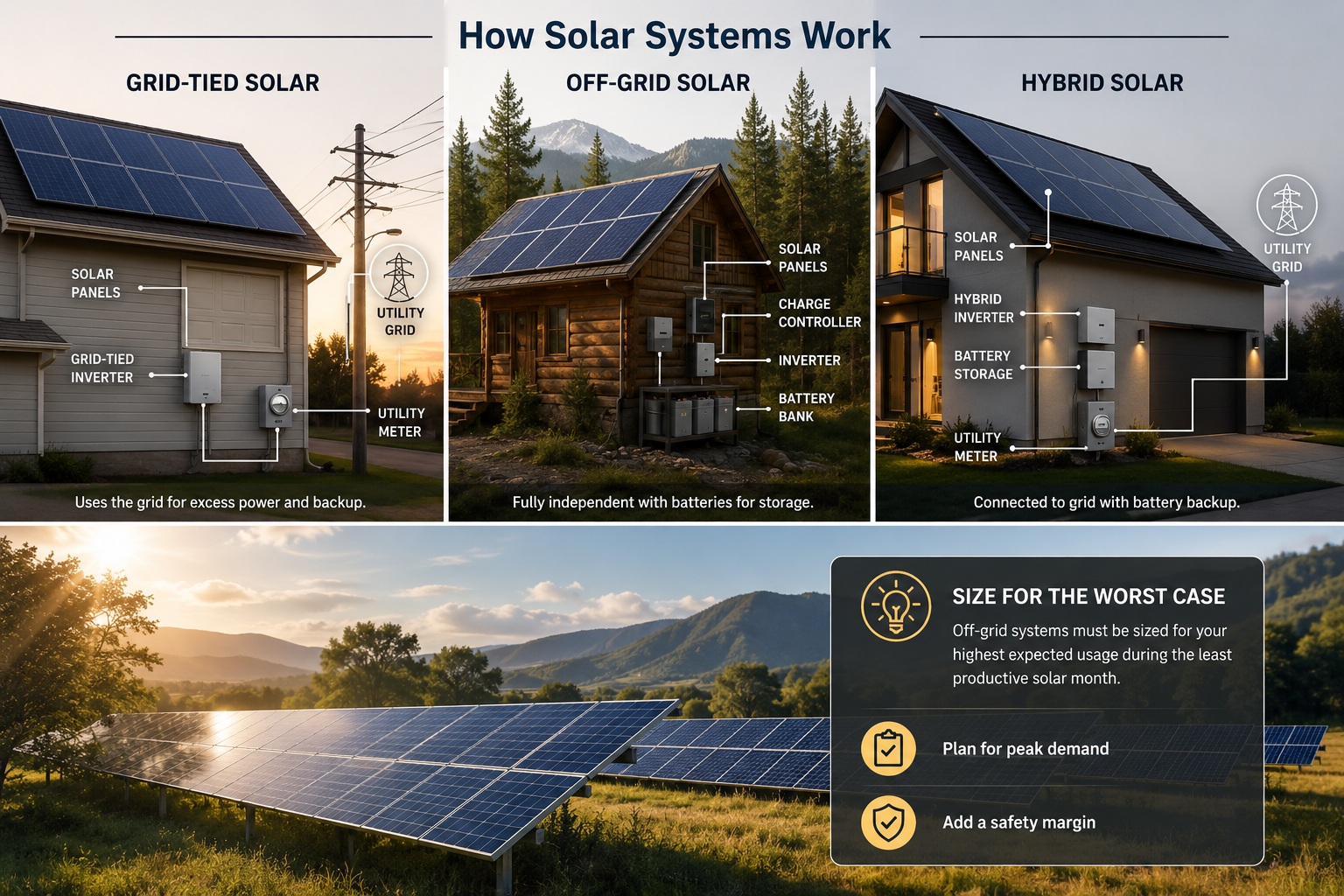
Hybrid solar combines grid connection with battery backup — the fastest-growing solar configuration in the residential market. The system operates grid-tied under normal conditions (lowest cost, net metering benefits) but switches to battery backup automatically during grid outages.
The core components:
- Solar panels
- Hybrid inverter (handles both grid-tied and battery backup operation)
- Battery bank (sized for backup duration rather than full independence)
- Bidirectional utility meter
The key difference from pure off-grid: the battery bank in a hybrid system is sized for backup resilience (8–24 hours of essential loads) rather than full independence (3–5 days of all loads). This dramatically reduces the battery cost while still providing meaningful outage protection.
Why hybrid is increasingly the default choice:
- Grid connection maintained — net metering benefits preserved
- Battery backup for outages — addresses the main limitation of pure grid-tied
- Batteries sized for resilience rather than independence — lower cost than full off-grid
- Self-consumption optimisation — use battery-stored solar instead of grid power during peak rate periods
- Future-proof — battery can be expanded over time as costs fall
For serious home backup system design, see our best solar battery backup system for home guide.
Grid-Tied vs Off-Grid vs Hybrid — The Full Comparison
| Factor | Grid-Tied | Off-Grid | Hybrid |
|---|---|---|---|
| Upfront cost | Lowest | Highest | Medium |
| Battery required | No | Yes (large) | Yes (smaller) |
| Grid connection | Required | None | Required |
| Power during outage | ❌ No | ✅ Yes | ✅ Yes |
| Net metering eligible | ✅ Yes | ❌ No | ✅ Yes |
| Payback period | Fastest | Slowest | Medium |
| Best location | Urban/suburban | Remote/rural | Any with grid access |
| System complexity | Simple | Complex | Medium |
| Suitable for van/RV | No | Yes | No |
| 2026 typical cost (10kW) | $18,000–$25,000 | $35,000–$60,000+ | $25,000–$40,000 |
The Components That Differ — A Technical Comparison
Inverters — the most significant technical difference between system types. Grid-tied inverters synchronise with the grid frequency and shut down when the grid fails. Off-grid inverters must create their own stable AC frequency and manage battery charge state simultaneously. Hybrid inverters do both — the most sophisticated and expensive category. String inverters are common in grid-tied systems; microinverters (Enphase) and power optimisers (SolarEdge) are increasingly popular for shade handling and panel-level monitoring.
Charge controllers — grid-tied systems don’t use them (the grid-tied inverter handles all power conversion directly). Off-grid and hybrid systems require MPPT charge controllers to regulate panel output for battery charging. See our MPPT charge controller guide for sizing and selection.
Batteries — grid-tied: none required. Off-grid: the largest cost component and most critical design element. Hybrid: smaller bank sized for backup hours rather than full independence. LiFePO4 is the standard chemistry in 2026 — 4,000–6,000 cycles, no maintenance, safe for indoor installation. See our solar battery guide and lithium solar batteries guide.
Solar panels — the panels themselves are identical across all three configurations. The difference is in how many you need. Grid-tied systems are sized to offset annual consumption. Off-grid systems are sized to cover peak daily load plus battery charging. Hybrid systems are typically sized similarly to grid-tied. See our panel guides: 100W, 200W, and 400W.
How to Choose — The Decision Framework
Start with grid access:
- No grid access (or grid extension costs prohibitive) → Off-grid is the only practical option
- Grid access available → Grid-tied or hybrid
Then assess outage sensitivity:
- Outages rare and tolerable → Grid-tied (lowest cost, fastest payback)
- Outages common, medically necessary equipment, or work-from-home → Hybrid
- Full energy independence is the goal → Hybrid (maximise battery) or off-grid
Then assess economics:
- Maximise financial return → Grid-tied with net metering
- Balance resilience and economics → Hybrid with modest battery bank
- Economics secondary to independence → Off-grid
The increasingly common answer in 2026: Hybrid. Falling battery costs have made hybrid systems more accessible than ever — combining net metering economics, outage protection, and self-consumption optimisation in the most balanced residential configuration available.
Real-World System Examples
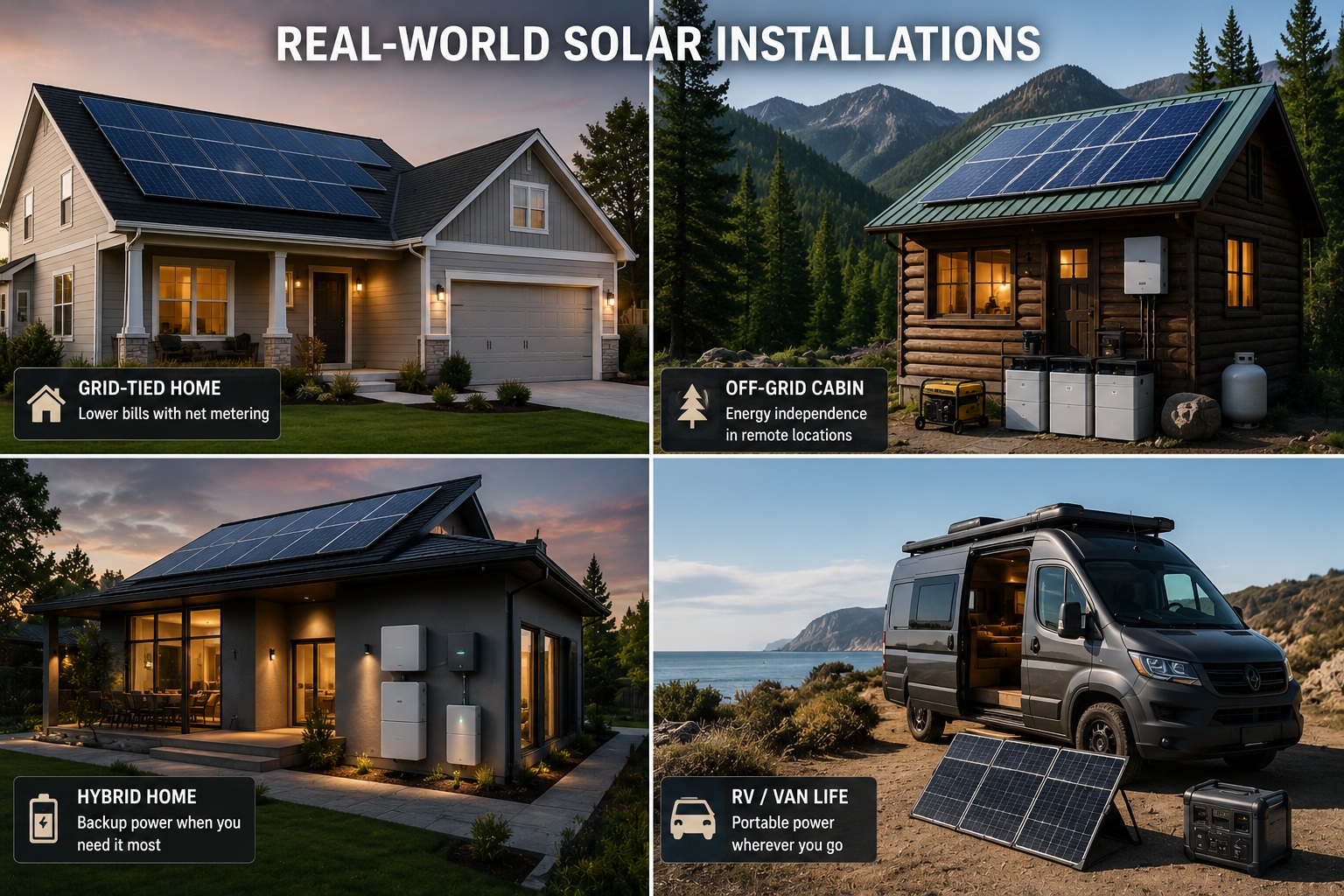
Suburban home, grid-tied: 4kW array (10× 400W panels), string inverter, bidirectional meter. Daily production: ~16kWh. Monthly bill offset: 80–90% in a sunny climate. Payback period: 6–9 years. No outage protection.
Remote cabin, off-grid: 3kW array (10× 300W panels), MPPT charge controller, 400Ah LiFePO4 battery bank (24V, ~9.6kWh), 3kW off-grid inverter, propane generator backup. Powers lighting, fridge, laptop, and water pump with 3 days of autonomy. See our solar power for shed guide for smaller-scale off-grid examples.
Suburban home, hybrid: 6kW array, hybrid inverter, 10kWh LiFePO4 battery bank. Covers essential loads (fridge + lights + devices + CPAP) for 16–20 hours during outages. Net metering applies to grid exports. Self-consumption prioritises battery charging before exporting surplus to grid.
Van life or RV: 400W portable array (2× 200W panels), MPPT charge controller, 200Ah LiFePO4 battery, 2,000W inverter. Powers devices, lighting, a 12V fridge, and phone/laptop charging — a mobile off-grid system with no grid connection by design. See our solar power for camping guide for portable solar specifics.
Frequently Asked Questions
Can I switch from grid-tied to off-grid later?
Technically yes, but it’s rarely straightforward. A grid-tied system is sized and configured differently from an off-grid system — the inverter, wiring, and panel sizing may all need to change. Adding batteries to an existing grid-tied system (creating a hybrid) is more practical — some grid-tied inverters are battery-ready, while others require replacement. Planning for future battery addition at the design stage is far cheaper than retrofitting later.
Is off-grid solar cheaper than paying the grid?
Rarely, for properties with existing grid access. Off-grid systems typically cost 40–100% more than grid-tied equivalents due to battery bank costs. The economics improve significantly for remote properties where grid connection would be expensive — and for people who value energy independence beyond pure financial calculation.
What happens to excess solar power in each system type?
Grid-tied: excess exports to the grid, credited via net metering. Off-grid: excess charges the battery bank; if the bank is full, the charge controller redirects or dumps the surplus. Hybrid: excess charges the battery first, then exports to grid if the battery is full.
Can I go completely off-grid in a city?
Legally possible in most jurisdictions but rarely practical or economical. Urban off-grid requires significant battery storage (days of autonomy without sun), a large enough roof array, and the willingness to manage consumption carefully. Most urban solar users are better served by a hybrid system that provides resilience without the cost and complexity of full independence.
What size solar system do I need to go off-grid?
This depends entirely on your daily electricity consumption. A typical US home consuming 30kWh/day would need approximately 8–10kW of panels and 60–90kWh of battery storage for true off-grid operation — a substantial installation. The calculation: daily consumption (Wh) ÷ peak sun hours ÷ 0.80 = minimum panel wattage; daily consumption × days of autonomy ÷ 0.95 = minimum battery Wh. See our off-grid solar system guide for the complete sizing walkthrough.
Do I need planning permission for a solar system?
For rooftop solar on residential properties, most US jurisdictions consider panels permitted development — no planning permission required, though building permits and utility interconnection agreements are typically needed for grid-tied systems. Off-grid systems on remote properties often have fewer regulatory requirements. Check with your local authority and utility before installation.
Final Thoughts
The choice between grid-tied, off-grid, and hybrid solar is not a technical decision — it’s a priorities decision. Cost optimisation points toward grid-tied. Energy independence points toward off-grid. Resilience with economics points toward hybrid.
What’s changed in 2026 is the hybrid calculus. Battery costs have fallen far enough that adding meaningful backup capacity to a grid-tied system no longer requires a dramatic budget premium. The combination of net metering economics, outage protection, and self-consumption optimisation makes hybrid solar the most balanced residential choice for the majority of homeowners with grid access — and the fastest-growing solar configuration in the US as a result.
For remote properties, off-grid remains the only practical option — and with LiFePO4 battery technology now delivering 10–15 years of reliable service, the long-term economics of genuine energy independence have never been better.
For complete system design guidance at every scale, see our off-grid solar system guide, our home backup system guide, and our solar panel maintenance guide for keeping any system running at peak performance for decades.