This post contains affiliate links. If you buy through our links we may earn a small commission — at no extra cost to you. This never influences our recommendations.
Jackery Explorer 2000 Plus Review — The Short Version
There’s a moment in any serious power station purchase where you stop asking “how much does it cost?” and start asking “what will I need in five years?” The Jackery Explorer 2000 Plus is built for people who’ve reached that moment.
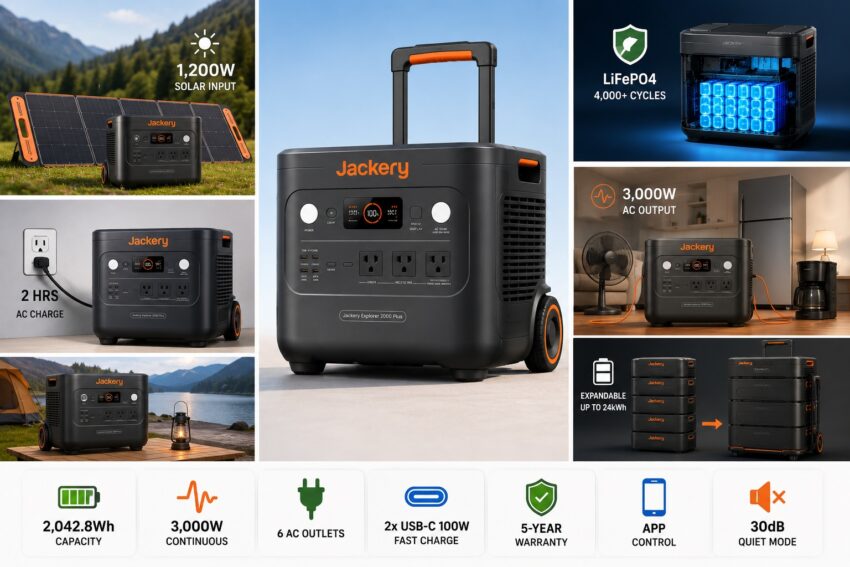
At its current price of ~$899 — down significantly from a $1,399 launch price — the Explorer 2000 Plus delivers 2,042.8Wh of LiFePO4 capacity, 3,000W of continuous AC output, and an expansion system that scales to 24kWh. That combination doesn’t exist elsewhere in this price bracket. This is not a fixed-capacity portable power station. It’s a modular power platform.
🛒 Buy on Amazon (Prime shipping, easy returns)
🏪 Buy on Jackery.com (direct, exclusive bundles)
Jackery Explorer 2000 Plus: Specs at a Glance
| Spec | Detail |
|---|---|
| Battery Capacity | 2,042.8Wh LiFePO4 |
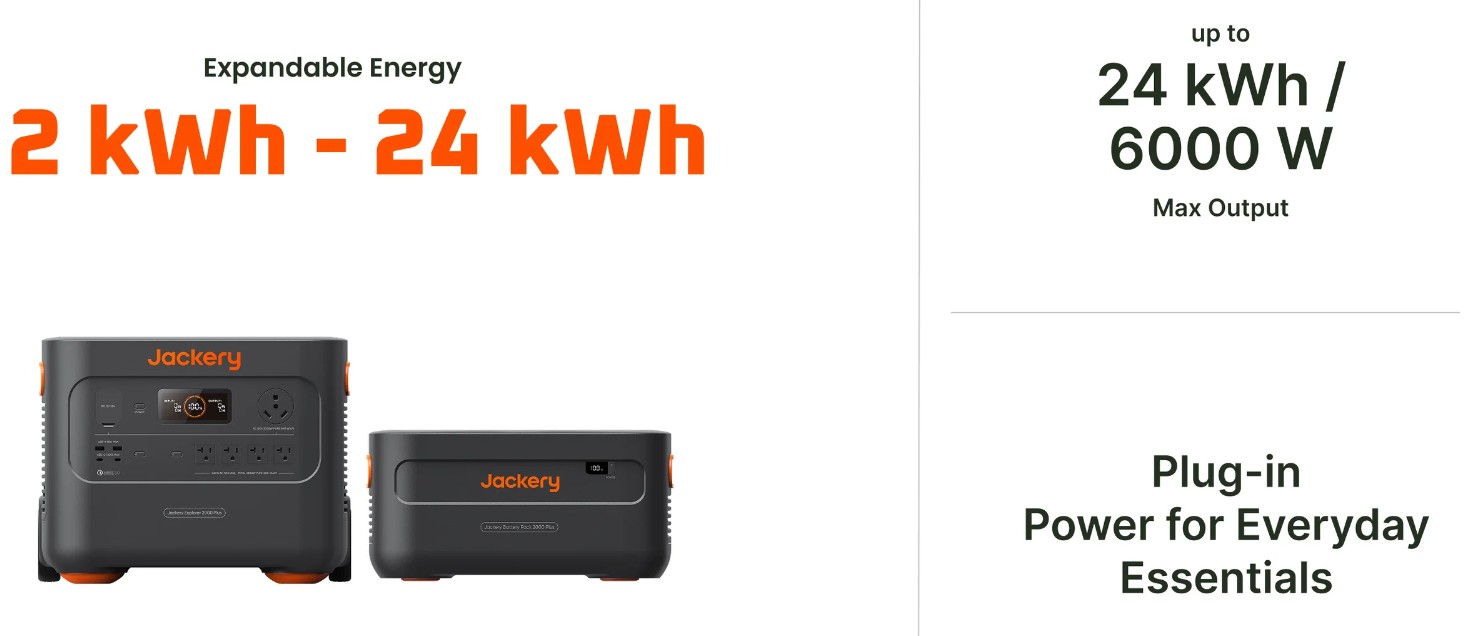
| Expandable to | 24kWh (Battery Pack 2000 Plus add-ons) |
| AC Output (standalone) | 3,000W continuous / 6,000W surge |
| AC Output (parallel) | 6,000W continuous / 12,000W surge |
| Battery Chemistry | LiFePO4 (LFP) |
| Cycle Life | 4,000+ cycles to 70% capacity |
| Estimated Lifespan | 10+ years (at 1 cycle/day) |
| Solar Input | 1,200W max (IBC) |
| AC Charge Time | 2 hours (0–100%) |
| Solar Charge Time | ~2 hours (6× SolarSaga 200W) |
| Noise Level | 30dB (quiet mode) |
| Weight | 61.5 lbs |
| AC Outlets | 6× |
| USB-C Output | 2× 100W PD |
| USB-A Output | 2× |
| Other Ports | 12V car port, DC barrel |
| App | Jackery app (WiFi + Bluetooth) |
| Warranty | 5 years |
| Price | ~$899 (down from $1,399) |
The Feature That Changes Everything: Expandability to 24kWh
At $899, you’re getting 2,042.8Wh of LFP capacity, 3,000W standalone output, 6,000W in parallel, IBC solar charging, and an expansion system that scales to 24kWh — a combination that doesn’t exist elsewhere in this price bracket.
Most 2kWh-class power stations are fixed-capacity units — you buy what you get. The Explorer 2000 Plus is a platform. You can daisy-chain up to five additional Battery Pack 2000 Plus units for a total of approximately 12kWh per standalone unit, or connect two complete units via the Battery Pack Hub to reach 24,000Wh.
The practical implication: start at 2kWh today — covering a weekend camping trip, a day or two of essential home backup, or a full off-grid van build — and expand incrementally as budget allows or needs grow. Each Battery Pack 2000 Plus adds another 2,042.8Wh for approximately $899. This is a smarter investment than buying a fixed-capacity unit and replacing it when needs grow.
Important caveat: Battery Pack 2000 Plus units are exclusively compatible with the 2000 Plus platform — they don’t work with any other Jackery model. If you’re building toward a large system, the 2000 Plus is the right foundation, but it’s a platform commitment.
Real-World Performance — What Independent Testing Shows
Although the Explorer 2000 Plus claims 2,048Wh, getting 83% of the advertised capacity for AC output is very respectable in independent testing. In practice, if the power goes out at home, you could run the average 600W refrigerator for 8.5 hours, or recharge a typical 100Wh laptop battery approximately 17 times. The 3,000W output handles essentially every common AC device, from space heaters to portable electric stove tops.
| Appliance | Draw | Runtime |
|---|---|---|
| Refrigerator (600W avg) | 150W avg | ~8.5 hours |
| Laptop (100Wh battery) | 60W | ~17 charges |
| CPAP (no humidifier) | 30W | ~40 hours |
| Microwave (1,100W) | 1,100W | ~1.5 hours |
| Space heater (1,500W) | 1,500W | ~1 hour |
| LED lighting (whole house) | 200W | ~7 hours |
| Power drill (750W) | 750W | ~2 hours |
| Phone charging | 15W | 100+ charges |
The 3,000W continuous output and 6,000W surge handle the startup spikes from motor-driven equipment — well pumps, sump pumps, compressor fridges — that trip up lower-output competitors.
Solar Charging — The 1,200W IBC Advantage
The 2000 Plus charges significantly faster from solar than most competitors thanks to its 1,200W IBC solar input — versus the Explorer 2000 v2’s 800W limit. With six SolarSaga 200W panels connected, the Explorer 2000 Plus reaches full charge in approximately 2 hours of good sun. Three 200W panels (600W total) charges it in approximately 4 hours.
IBC (Interdigitated Back Contact) solar charging is the premium technology here — the same cell design used in the SolarSaga 200W’s 26.7% efficiency panels. For buyers with an existing or planned solar array who want maximum off-grid recharge speed, the 1,200W input is a significant practical advantage. The Jackery SolarSaga 200W is the optimal pairing — covered in our Jackery solar panel guide.
Build Quality and Design
The “suitcase” design — rectangular form factor, integrated wheels, telescoping aluminium handle — makes the 61.5 lb weight manageable for rolling across flat surfaces. Lifting it into a truck bed or carrying it up stairs requires two people. This is a semi-permanent deployment device, not a carry-anywhere unit.
The six AC outlets are a meaningful practical upgrade over most competitors — providing simultaneous multi-appliance backup without extension strips. The display provides real-time battery percentage, input wattage, output wattage, and estimated runtime. The Jackery app (WiFi + Bluetooth) adds remote monitoring, charging schedules, and output customisation for unattended operation.
The Honest Limitations
61.5 lbs is genuinely heavy. At 61.5 lbs, this is not practical for camping trips where you need to move it from car to campsite repeatedly. The Explorer 2000 v2 at 39 lbs is meaningfully more portable for the same base capacity.
No native 240V from a single unit. Two 2000 Plus units in parallel deliver 120/240V capability — but that requires a second $899 unit. For 240V appliances (central HVAC, electric dryer, EV charger), the Jackery HomePower 3600 Plus provides 240V from a single unit.
Expansion batteries are platform-exclusive. Battery Pack 2000 Plus units are not compatible with any other Jackery model. This is a platform commitment, not a universally modular accessory.
4,000 cycles to 70% capacity. The cycle rating specifies degradation to 70% — not the 80% benchmark some competitors use. After 4,000 daily cycles, you’d retain approximately 1,430Wh of usable capacity — still substantial, but worth knowing when comparing specifications directly.
Explorer 2000 Plus vs. Explorer 2000 v2 — The Decision That Matters
For many buyers, this is the actual purchasing decision. Both carry approximately 2,042Wh of LiFePO4 capacity at a $100 price difference. The differences beneath that surface are significant.
| Explorer 2000 Plus | Explorer 2000 v2 | |
|---|---|---|
| Capacity | 2,042.8Wh | 2,042Wh |
| AC Output | 3,000W | 2,200W |
| Solar Input | 1,200W IBC | 800W |
| Expandable | ✅ Up to 24kWh | ❌ Fixed |
| 240V (parallel) | ✅ Two units | ❌ No |
| Weight | 61.5 lbs | 39 lbs |
| Noise | 30dB | <30dB |
| AC Outlets | 6 | 3 |
| Price | ~$899 | ~$799 |
Choose the 2000 Plus if: Future capacity expansion is a realistic possibility, you want faster solar charging (1,200W vs 800W), you need 6 AC outlets simultaneously, or you want the option of 240V via parallel operation.
Choose the 2000 v2 if: Portability is the priority (39 lbs vs 61.5 lbs), you’re confident 2kWh fixed is sufficient permanently, or indoor near-silent operation is critical.
The direct verdict from independent reviewers: if you can afford the Explorer 2000 Plus, buy the Plus. The $100 premium buys higher output, faster solar charging, expandability, and more outlets — meaningful capability upgrades for a minor price difference.
Who Should Buy the Explorer 2000 Plus
RV owners and serious overlanders. The 3,000W continuous output handles rooftop AC compressors, electric cooking, and all RV 120V loads. The 1,200W solar input means a full day’s camping produces a full battery. The telescoping handle and wheels make repositioning within a campsite practical.
Homeowners building a scalable backup system. The smartest thing about the 2000 Plus is that it’s not a dead end. Buy the unit today for basic essential-load backup, and add Battery Pack 2000 Plus units as budget allows — scaling from 2kWh to 4kWh, 6kWh, or beyond without replacing the core unit.
Off-grid cabin and van life users. 2,042Wh handles a full day’s off-grid electrical needs for one or two people. The 1,200W solar input paired with SolarSaga 200W panels makes daily self-sufficiency achievable in good weather.
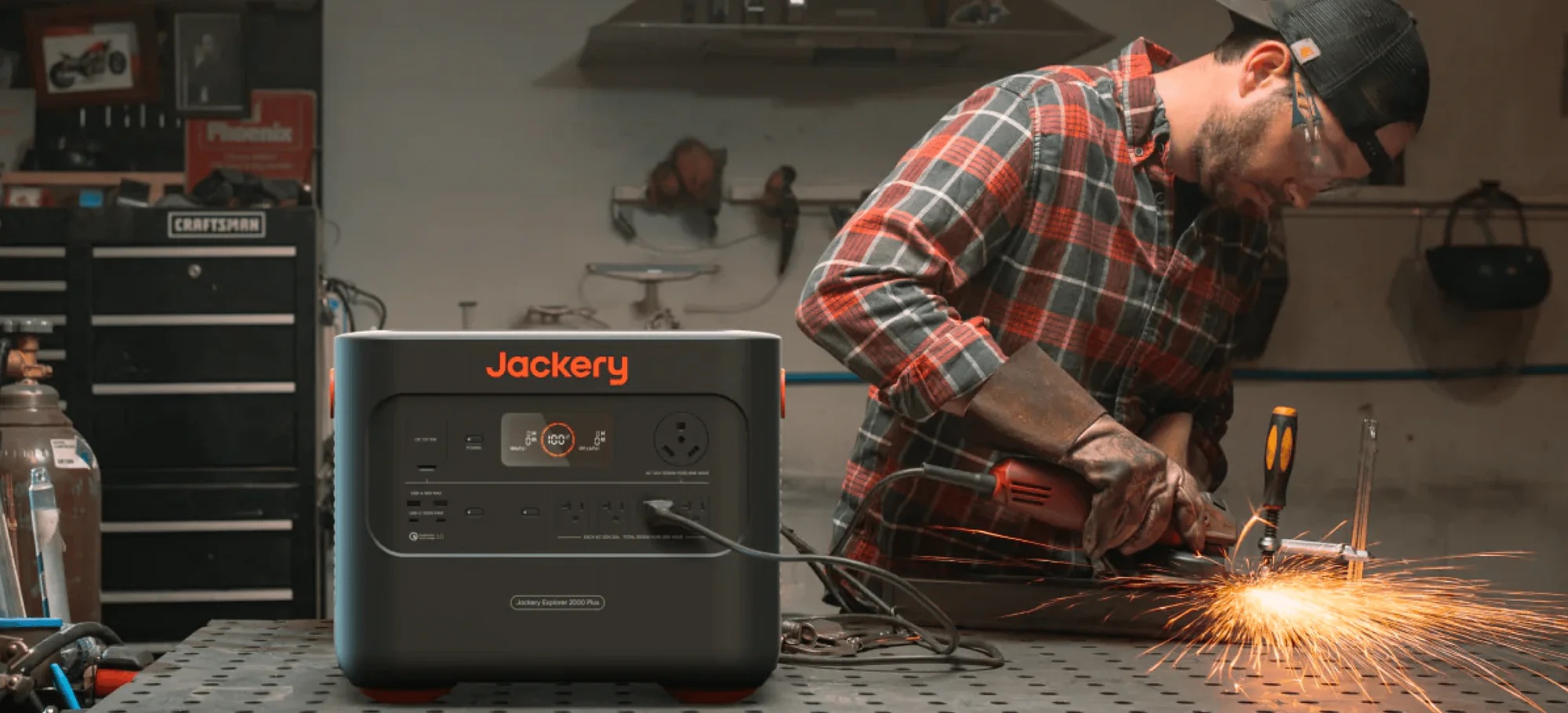
Power tool users and job site backup. 3,000W continuous runs most professional power tools without the fumes, noise, and fuel logistics of a gas generator. Six AC outlets serve an entire crew simultaneously.
Who Should Look Elsewhere
Buyers who need frequent portability. At 61.5 lbs, this is a roll-and-place unit. The Explorer 2000 v2 (39 lbs) or Explorer 1000 v2 are more appropriate for frequent lifting and carrying.
Buyers who need 240V without two units. The Jackery HomePower 3600 Plus provides 240V from a single unit with a simpler installation path for whole-home backup.
Light users with occasional needs. If your needs are weekend camping with phones, a laptop, and LED lighting, the Explorer 1000 v2 covers this at roughly $599 and half the weight.
Frequently Asked Questions
Can the Explorer 2000 Plus run a central air conditioner?
Most central HVAC systems draw 3,500–7,000W at startup — beyond the single unit’s 3,000W continuous rating for most 3-ton+ systems. Window and portable AC units (700–1,200W) run comfortably for 1.5–3 hours. Two units in parallel (6,000W continuous) cover most 2-ton central AC compressors.
How many solar panels do I need to charge it in a day?
The Explorer 2000 Plus accepts up to 1,200W of solar input. Six SolarSaga 200W panels charge it in approximately 2 hours of ideal sun; three 200W panels (600W) charge it in approximately 4 hours. See our Jackery solar panel guide for full SolarSaga lineup compatibility and charging time calculations.
Does it work as a UPS for computers?
The EPS (Emergency Power Supply) function switches to battery quickly when grid power fails. It is not specified as a sub-10ms UPS. For sensitive medical equipment or computers requiring guaranteed sub-10ms transfer, the Explorer 5000 Plus with 0ms transfer is the more appropriate option.
What’s the difference between the 2000 Plus and the 2000 v2?
The Explorer 2000 v2 is lighter (39 lbs), quieter (<30dB), and $100 cheaper — but fixed at 2kWh with no expansion path and only 800W solar input. The 2000 Plus is heavier but expandable to 24kWh, accepts 1,200W solar, has 6 AC outlets vs 3, and outputs 3,000W vs 2,200W. For anyone who might want more capacity later, the 2000 Plus is worth the $100 premium and extra weight.
What is the warranty?
5 years from Jackery, covering defects in materials, workmanship, and performance. Register your product on Jackery.com immediately after purchase to establish warranty coverage.
Where to Buy — Amazon vs. Jackery Direct
Amazon typically offers Prime shipping, easy returns, price history visibility, and multiple bundle configurations in one place. The Explorer 2000 Plus has been available at $899 — significantly below the $1,399 MSRP. Bundle kits (4kWh with one expansion battery, 6kWh with two) can deliver better per-kWh value than buying components separately.
Jackery direct can unlock exclusive bundle pricing and direct manufacturer warranty service. Jackery’s site also shows the full accessory ecosystem — Battery Pack 2000 Plus expansion units, SolarSaga 200W panels, and the Battery Pack Hub for multi-unit configurations — making it easier to price a complete system before purchasing.
🛒 → Buy the Jackery Explorer 2000 Plus on Amazon
(Prime shipping · Easy returns · Price history · Bundle options)
🏪 → Buy the Jackery Explorer 2000 Plus on Jackery.com
(Manufacturer direct · Exclusive bundles · Full accessory ecosystem)
Final Verdict
At $899, the Explorer 2000 Plus delivers 2,042.8Wh of LFP capacity, 3,000W standalone output, 6,000W in parallel, 1,200W IBC solar charging, and an expansion system that scales to 24kWh. That combination doesn’t exist elsewhere in this price bracket.
The three features that genuinely differentiate it from fixed-capacity competitors — expandability to 24kWh, 1,200W IBC solar input, and 6,000W parallel output — address the most common regrets buyers have with less capable units. The limitations are equally clear: 61.5 lbs requires semi-permanent placement, no native 240V from a single unit, and expansion batteries are platform-exclusive.
For the buyer who wants a 2kWh system that grows with their needs — and who values fast solar charging and maximum output flexibility — the Explorer 2000 Plus at $899 is the most capable and cost-effective answer available at this price point.
🛒 → Buy on Amazon
🏪 → Buy on Jackery.com
For how the 2000 Plus compares to larger systems, see our reviews of the Jackery HomePower 3600 Plus and Jackery Explorer 5000 Plus. For the solar panels that keep it charged, see our Jackery solar panel guide. For home backup system comparisons across all brands, see our best solar battery backup system for home guide.