This post contains affiliate links. If you buy through our links we may earn a small commission — at no extra cost to you. This never influences our recommendations.
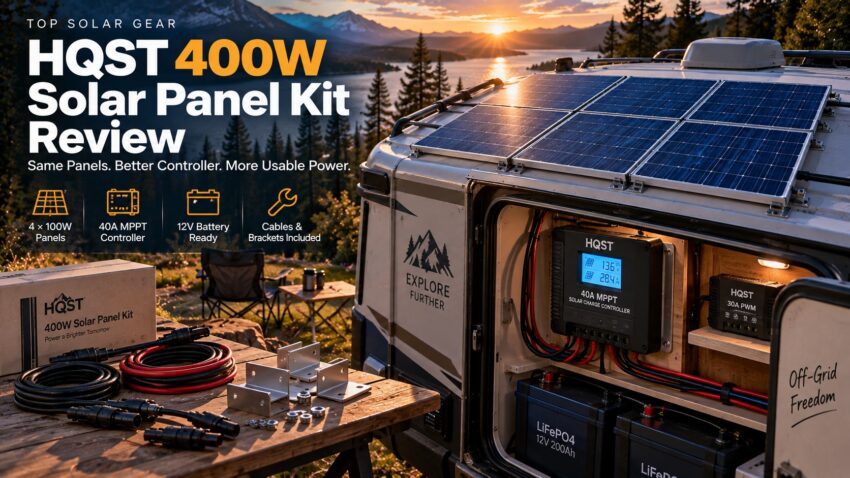
HQST has built its name on budget-friendly off-grid panels, and the 400W polycrystalline kit is one of their most popular sizes — four 100W panels bundled with a charge controller, cables, and mounting brackets in one order.
One thing worth knowing before you buy: HQST sells this same 400W polycrystalline setup with two different controllers. Get the right one and it changes how much of that 400W you actually capture.
| Spec | HQST 400W Polycrystalline Kit (40A MPPT) |
|---|---|
| Panels | 4x 100W polycrystalline |
| Controller | 40A MPPT, LCD display |
| Cables | 20ft 10AWG panel/controller cable, 8ft tray cable |
| Mounting | 4 sets Z-brackets included |
| Weatherproofing | IP65 junction box, corrosion-resistant aluminum frame |
| Battery compatibility | Sealed, gel, flooded, and lithium |
Polycrystalline vs. Monocrystalline: Does It Matter Here?
Polycrystalline cells run a few percentage points less efficient than monocrystalline — HQST’s mono panels claim up to 23-25%, while poly typically lands a bit lower.
In practice, that gap rarely changes the buying decision for a fixed RV or off-grid battery setup. Polycrystalline costs less per watt, and unless roof space is genuinely tight, four slightly larger poly panels do the same job as pricier mono ones.
PWM vs. MPPT: Worth Paying More For?
HQST sells this exact 400W polycrystalline panel set with either a 30A PWM controller or a 40A MPPT controller — same panels, different brains.
MPPT tracks the panel’s optimal voltage in real time and typically pulls 20-30% more usable power out of the same panels compared to PWM, especially on cooler days or when the panels aren’t perfectly angled at the sun.
The MPPT version costs more up front, but for a 400W array, that efficiency gap is large enough to matter — it’s the version we’d point you toward unless budget is the only factor.
Real-World Output and Setup
Expect somewhere around 500 watt-hours a day under good sun — roughly 400W across 5 peak hours — with the usual caveats for cloud cover, panel angle, and morning or evening light.
Setup is straightforward: the included Z-brackets handle flat mounting, cables come pre-terminated, and the controller’s LCD display shows charging status without needing a separate app or monitor.
Sizing This to Your Battery Bank
400W is a solid match for a 200-400Ah battery bank at 12V — enough to fully recharge a moderately drained bank in a single good sunny day.
Smaller battery banks will simply top off faster and spend more of the day at full charge, which isn’t wasted — it just means you have headroom if you add more electrical loads later.
Need more down the road? These panels wire in parallel, so adding a second 400W kit on the same MPPT controller (rated well above its stock 400W load) is a realistic upgrade path rather than a full system replacement.
| Pros | Cons |
|---|---|
| Complete kit — panels, controller, cables, and brackets all included | Polycrystalline is a step below monocrystalline on raw efficiency |
| MPPT controller option captures meaningfully more usable power | Four separate 100W panels to mount instead of one larger unit |
| IP65 weatherproofing and a corrosion-resistant frame | PWM version is a real downgrade if bought by mistake |
Best for: Off-grid RV, marine, or cabin setups on a budget that still want MPPT-level charging efficiency.
HQST 400W 12V Polycrystalline Solar Panel Kit (40A MPPT)
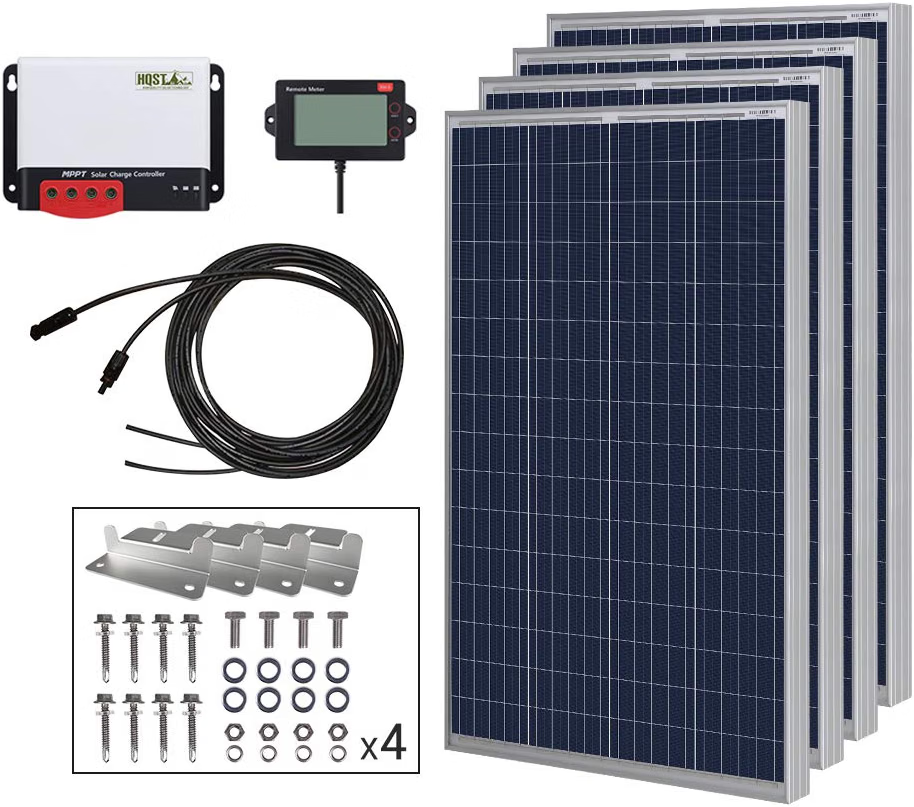
This is the version worth buying — same four polycrystalline panels as the cheaper kit, but the 40A MPPT controller means you’re not leaving power on the table every sunny day.
It’s a genuinely complete off-grid starter kit: nothing else to source before your battery bank is charging.
Full details and current price: HQST 400W 12V Polycrystalline Solar Panel Kit (40A MPPT) on Amazon
Frequently Asked Questions
What’s the difference between the PWM and MPPT versions of this kit?
Same panels, different controller — MPPT captures roughly 20-30% more usable power from the same panels, especially in cooler or less-than-ideal sun conditions.
How much power will this 400W kit actually produce per day?
Around 500 watt-hours on a good day with 5 hours of usable sun — less on cloudy days or with a poor panel angle.
Is polycrystalline worse than monocrystalline?
Slightly less efficient per square foot, but cheaper — for a fixed off-grid setup with enough mounting space, the difference rarely matters in practice.
Can this kit charge a lithium battery?
Yes, the included controller supports sealed, gel, flooded, and lithium battery types.
Does it come with everything needed for installation?
Yes — panels, controller, mounting Z-brackets, and cables are all included in the kit.
Final Verdict
Skip the PWM version and spend the extra on the 40A MPPT kit — for a 400W array, that efficiency difference pays for itself in actual charging performance, not just spec-sheet bragging rights.