This post contains affiliate links. If you buy through our links we may earn a small commission — at no extra cost to you. This never influences our recommendations.
The wire between your solar panel and your charge controller or power station isn’t glamorous, but get it wrong and you’re quietly losing power you already paid for.
Most people searching this just want a straight answer: what gauge, what connector, and which cable actually holds up outside. Here it is.
| Wire Gauge | Max Current (MC4) | Best For |
|---|---|---|
| 12 AWG | 20A | Short runs, under 20-30 ft |
| 10 AWG | 30A | Most home and RV setups |
| 8 AWG | Higher, check connector rating | Long runs (50+ ft) or high-current arrays |
Picking the Right Gauge
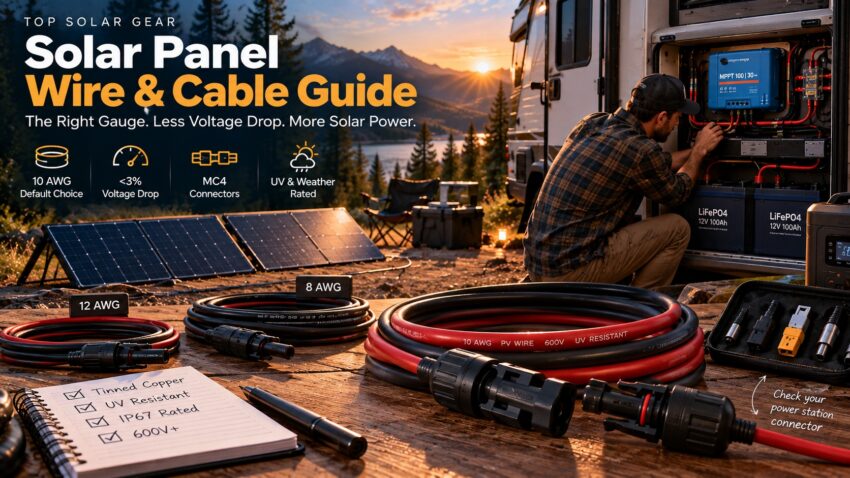
10 AWG is the default answer for most people, and for good reason — it balances cost against power loss better than 12 AWG, and you won’t outgrow it if you add another panel later.
12 AWG is fine for short runs under 20-30 feet, where the extra resistance of a thinner wire barely registers.
Running 50 feet or more, or feeding a higher-current array? Step up to 8 AWG — thicker wire cuts resistance by roughly 30-40% per gauge step, and that compounds over a long run.
Voltage Drop: Why the Gauge Actually Matters
Every foot of wire adds resistance, and resistance turns some of your solar panel’s output into heat instead of usable power — that’s voltage drop.
Keep it under 2-3% and you won’t notice the loss. Go much higher and you’re leaving real charging speed on the table.
A real example: one 24V setup running 4mm² wire (roughly 12 AWG) over 20 meters saw a 1.5V drop — close to 6% loss. Switching to 6mm² wire (roughly 10 AWG) cut that to 0.6V.
Rule of thumb: under 20-30 feet, don’t overthink it. Past that, upgrade the gauge before you upgrade anything else in the system.
MC4 Connectors and Brand Compatibility
MC4 is the near-universal solar connector — male and female ends that lock together and can’t be joined incorrectly, which is exactly why almost every panel and cable uses it.
Here’s the catch: “universal” for panel-to-panel connections doesn’t mean universal for panel-to-power-station connections. Some brands lock you into their own plug instead.
We ran into this directly with the Goal Zero Nomad’s proprietary 8mm connector — MC4 wire won’t plug straight into a Goal Zero Yeti without an adapter cable in between.
Before you buy wire, confirm which connector your power station or charge controller actually takes — MC4, XT60, 8mm, or DC5521 all show up depending on the brand.
What to Actually Look For
Tinned copper conductors resist corrosion better than plain copper, which matters a lot for anything living outside long-term.
UV-resistant, IP67-rated insulation is non-negotiable if the cable runs anywhere the sun and rain can reach it — cheap PVC cracks and degrades within a season or two of real sun exposure.
Check the voltage and temperature rating too: look for 600V or higher, and an operating range that covers real outdoor extremes (roughly -40°F to 194°F is standard for quality PV wire).
Pros: 10 AWG covers almost every home and RV setup without overspending; tinned copper and IP67 sealing hold up to years of outdoor exposure; MC4 connectors are foolproof to plug in correctly.
Cons: Longer runs still need a gauge upgrade no cable spec sheet will remind you about; MC4 won’t plug into every power station brand without an adapter.
Best for: Anyone extending a solar panel to a charge controller, portable power station, or combiner box and wants a cable that won’t be the weak link in the system.
GEARit 10 AWG MC4-to-MC4 Solar Extension Cable
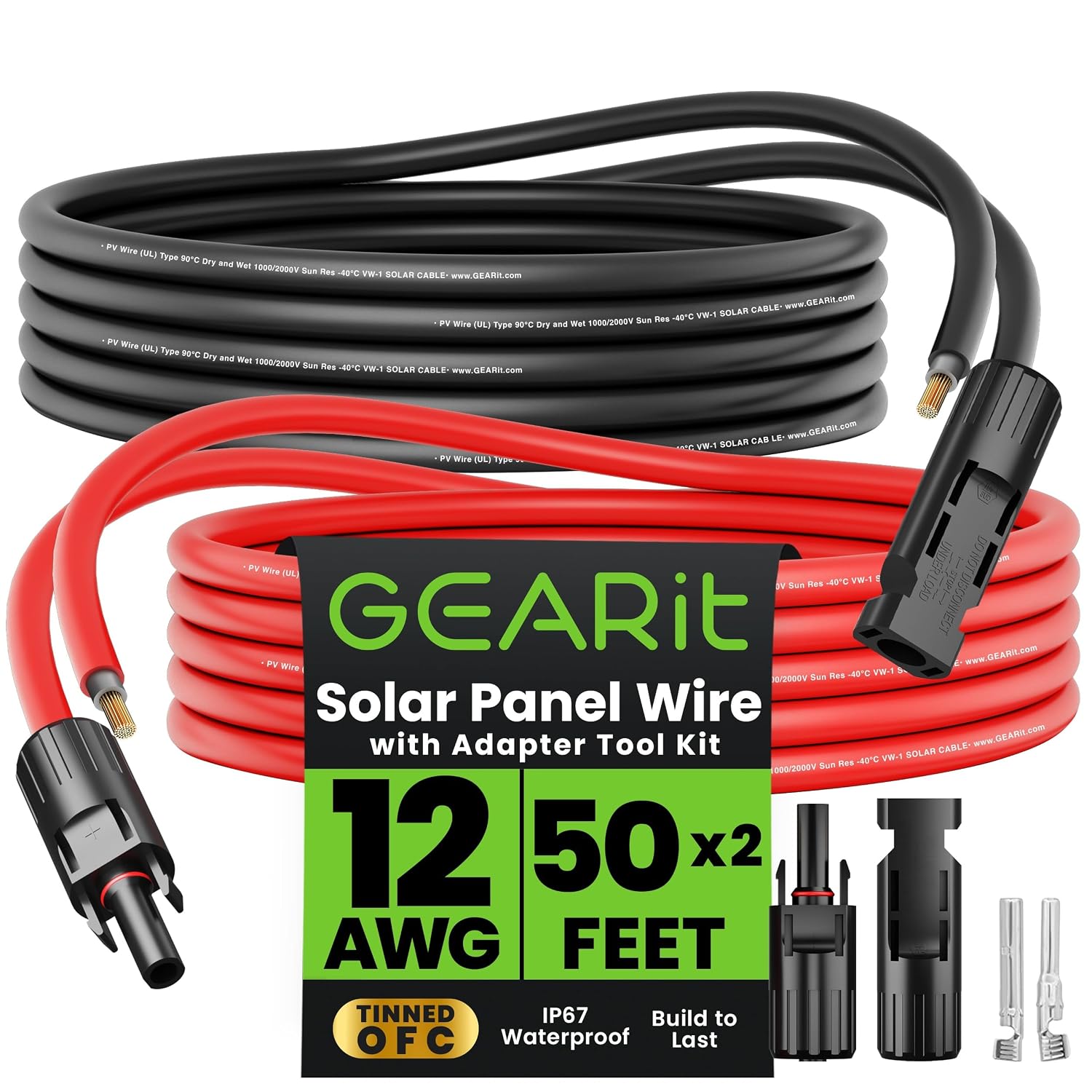
Full details and current price: GEARit 10 AWG MC4-to-MC4 Solar Extension Cable on Amazon
Frequently Asked Questions
What gauge wire do I need for solar panels?
10 AWG covers most home and RV setups. Use 12 AWG only for short runs under 20-30 feet, and step up to 8 AWG for runs over 50 feet or higher-current arrays.
Will MC4 wire work with any solar power station?
Not always — some brands use their own proprietary connector instead of MC4, so check what your specific power station or charge controller actually accepts before buying wire.
How much voltage drop is acceptable?
Keep it under 2-3%. Beyond that, you’re measurably losing charging speed, and it’s worth upgrading to a thicker gauge.
Does the wire need to be UV-resistant?
Yes, if any part of the run is exposed outdoors — standard PVC insulation cracks and degrades under real sun exposure within a season or two.
Can I use regular wire instead of PV-rated wire?
Not for the outdoor portion of the run — PV wire is rated for the voltage, UV exposure, and temperature swings a solar setup actually sees, which standard wire isn’t built for.
Final Verdict
Unless you’re running a genuinely long cable or a high-current array, 10 AWG with real MC4 connectors and UV-resistant insulation is the right call — cheap enough to not think twice about, thick enough to not cost you power.