This post contains affiliate links. If you buy through our links we may earn a small commission — at no extra cost to you. This never influences our recommendations.
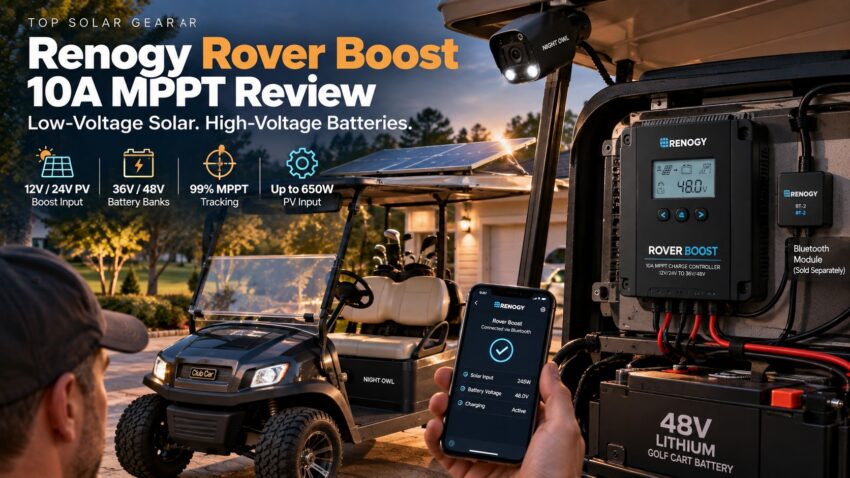
Most MPPT controllers step voltage down. This one does the opposite — it boosts a 12V or 24V solar panel’s output high enough to charge a 36V or 48V battery bank, which is exactly what a golf cart or electric vehicle needs.
| Spec | Renogy Rover Boost 10A |
|---|---|
| Function | Boosts 12V/24V panel voltage to charge 36V/48V batteries |
| PV input power | 500W max (36V systems), 650W max (48V systems) |
| Charging power | 450W (36V), 600W (48V) |
| MPPT efficiency | 99% tracking, 90% conversion |
| Battery presets | AGM/Sealed, Gel, Flooded, Lithium, User custom |
Why “Boost” Matters Here
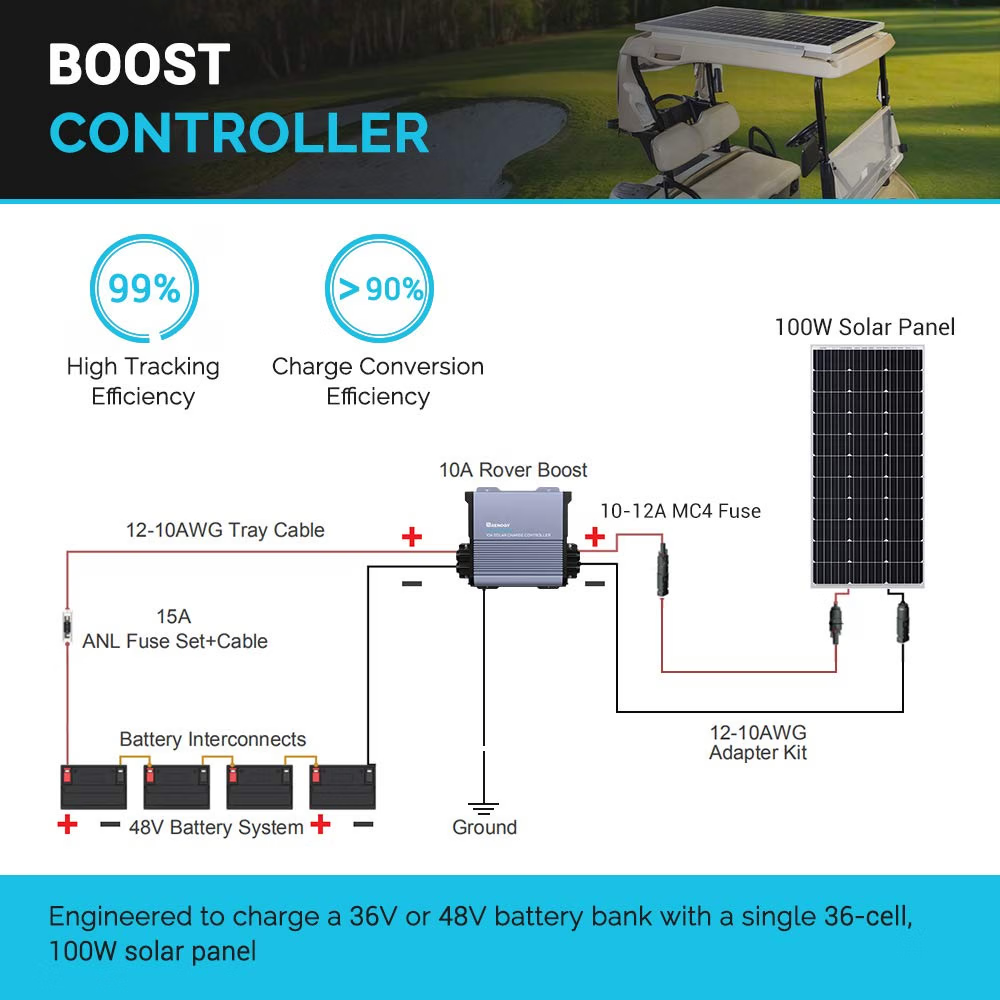
A standard 36V or 48V battery bank normally needs a solar panel array already wired above that voltage to charge properly with a typical MPPT or PWM controller.
That’s rarely practical in a golf cart or small EV, where space for a panel array is limited to whatever fits on the roof or hood. The Rover Boost solves that specific problem — it takes a single 12V or 24V panel and boosts the voltage electronically instead of requiring you to wire more panels in series.
What You Need to Know Before Wiring It Up
Panels connect in parallel, not series, with this controller — a genuinely important wiring detail that differs from how you’d typically set up panels for a standard high-voltage battery bank.
Two 100W panels get you the rated 500W input for a 36V system, or you can size up toward the 650W ceiling on a 48V setup.
One real catch: automatic battery recognition doesn’t apply to lithium batteries — you’ll need to manually select the lithium preset rather than relying on the controller to detect it.
Monitoring: Bluetooth Costs Extra
The controller ships with an LCD display for on-unit readouts, but app-based remote monitoring requires Renogy’s BT-2 Bluetooth module, sold separately.
If you want to check charging status from your phone rather than walking over to read the display, budget for that module as a genuine add-on cost, not an included feature.
Why Not Just Wire Panels in Series Instead?
Technically you could wire enough 12V panels in series to clear 36V or 48V directly into a standard MPPT controller — but that means more panels, more wiring, and more roof or hood space than most golf carts and small EVs actually have.
The Rover Boost trades a bit of conversion efficiency for the ability to use a single small panel instead, which is the whole point if space is your real constraint, not raw efficiency.
| Pros | Cons |
|---|---|
| Solves a real problem — charging high-voltage banks from small panels | Bluetooth monitoring requires a separately-sold module |
| 99% tracking efficiency, genuinely strong for this niche category | Lithium batteries need manual preset selection, no auto-detect |
| 4-stage charging with multiple battery chemistry presets | Narrow use case — not a fit for standard off-grid cabin or RV setups |
Best for: Golf cart, electric vehicle, and scooter owners who need to charge a 36V or 48V battery bank from a single small solar panel.
Renogy Rover Boost 36V/48V 10A MPPT Solar Charge Controller
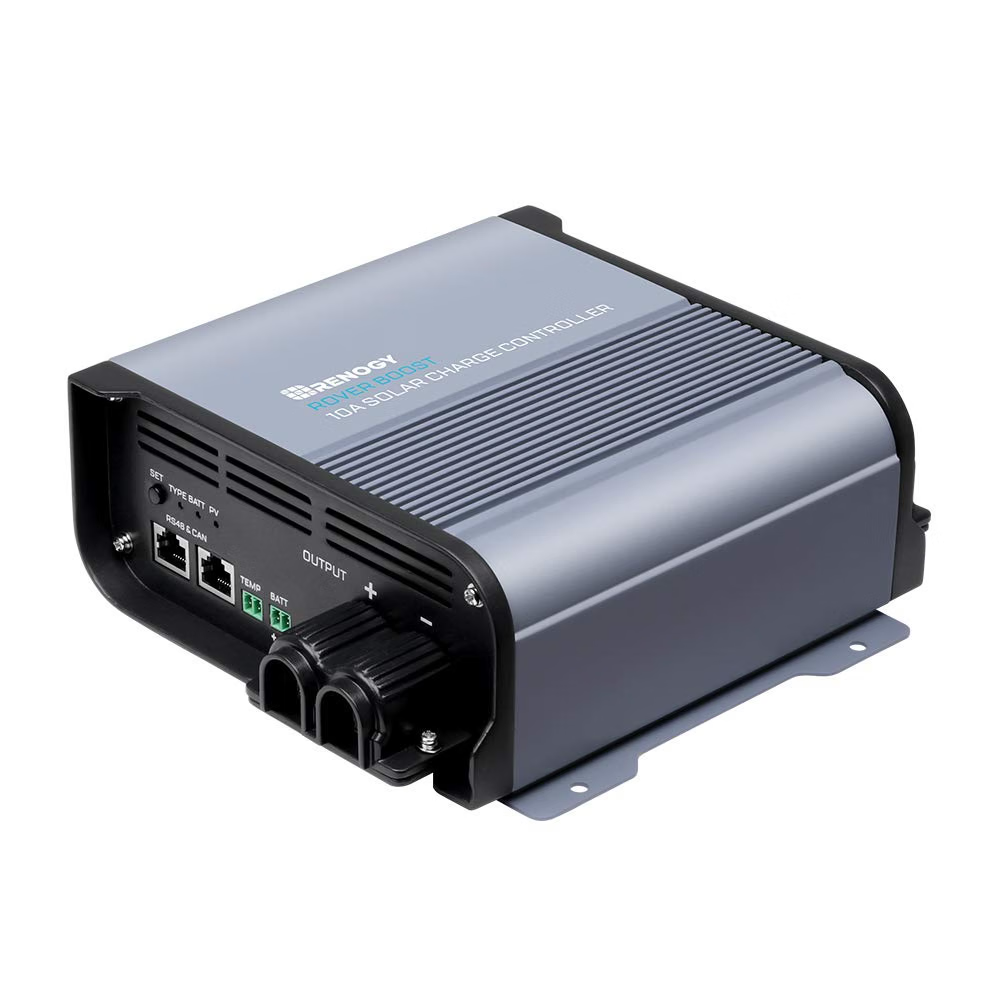
This is a purpose-built tool for a specific job — if you’re wiring a standard off-grid solar setup at 12V or 24V, this isn’t the controller you want. If you’re trying to keep a golf cart or small EV’s high-voltage battery topped off from a compact panel, it’s exactly right.
Full details and current price: Renogy Rover Boost 10A Charge Controller on Amazon
Frequently Asked Questions
What does the Rover Boost controller actually do?
It boosts the voltage from a 12V or 24V solar panel so it can charge a 36V or 48V battery bank — typically used for golf carts and electric vehicles.
How many solar panels can I connect?
Up to 500W total for a 36V battery bank or 650W for a 48V bank, with panels wired in parallel rather than series.
Does it work with lithium batteries?
Yes, but you need to manually select the lithium preset — automatic battery detection doesn’t apply to lithium chemistry on this controller.
Do I need to buy anything extra for app monitoring?
Yes, Renogy’s BT-2 Bluetooth module is sold separately and required for remote monitoring through the Renogy app.
Is this the right controller for a standard RV or cabin solar setup?
No — this is purpose-built for boosting low-voltage panels to charge high-voltage golf cart or EV battery banks, not general off-grid use.
Final Verdict
This is a genuinely narrow tool, and that’s exactly its strength — if you own a golf cart or small EV with a 36V or 48V battery bank and limited panel space, it solves a problem most standard charge controllers can’t touch.