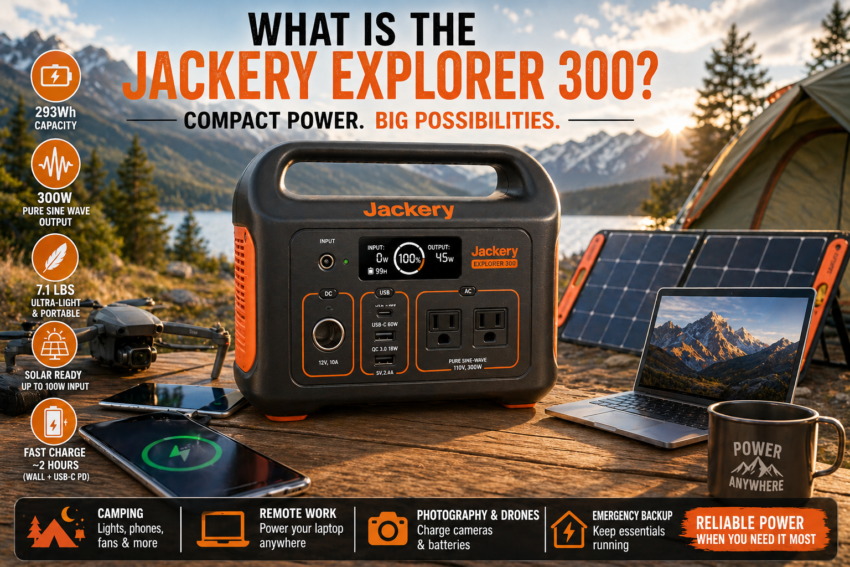
What Is the Jackery Explorer 300?
The Jackery Explorer 300 is the entry point into Jackery’s portable power station lineup — and it’s been one of the most popular starter units on the market since it launched. It’s compact, lightweight, and surprisingly capable for its size.
At 293Wh capacity and 300W output, it won’t run your home during a blackout or power your RV air conditioner. But that’s not what it’s designed for. The Explorer 300 is built for people who need reliable, portable power for phones, laptops, cameras, drones, CPAP machines, and small fans — whether they’re camping for the weekend, working remotely outdoors, or keeping essentials running during a short power outage.
At just 7.1 lbs, it’s one of the lightest power stations in its class. You can carry it in a backpack, set it up in a tent, or tuck it under the passenger seat of a car without any hassle. That portability is its defining feature — and it delivers on it completely.
Jackery Explorer 300 Specs — Full Breakdown
Here are the complete specs for the Explorer 300:
| Spec | Detail |
|---|---|
| Capacity | 293Wh |
| Battery Type | Lithium-Ion |
| Life Cycles | 800 cycles to 80% capacity |
| AC Output | 2 × 110V pure sine wave (300W total, 500W peak surge) |
| USB-C | 1 × 60W PD (input/output) |
| USB-A (Fast Charge) | 1 × QC 3.0 18W |
| USB-A (Standard) | 1 × 5V/2.4A |
| DC Car Port | 1 × 12V/10A |
| Total Ports | 6 |
| AC Adapter Input | 90W max |
| Solar Input | 100W max (compatible with SolarSaga panels) |
| Car Input | 12V/24V |
| Fastest Charge | ~2 hours (wall + USB-C PD combined) |
| Solar Charge Time | ~3.5–5.5 hours (SolarSaga 100W, ideal conditions) |
| Car Charge Time | ~4–4.5 hours |
| Weight | 7.1 lbs (3.2 kg) |
| Display | LED screen (wattage + battery %) |
| Pass-Through Charging | Yes |
| Waterproof | No |
| App Control | No |
| Price | ~$279–$299 |
| Warranty | 2 years (extendable to 5 years with registration) |
The numbers that matter most here: 300W output is enough for most small electronics but not high-draw appliances. 293Wh capacity is modest — plan your power needs accordingly. And 7.1 lbs is genuinely impressive for what you get.
What Can the Jackery Explorer 300 Power?
This is always the most important question. Let’s answer it honestly.
The quick formula for estimating runtime:
Working time = 293Wh × 0.85 ÷ device wattage
The 0.85 accounts for real-world inverter efficiency losses. Here’s how that plays out across common devices:
| Device | Power Draw | Estimated Runtime |
|---|---|---|
| Smartphone (charging) | 15W | ~16 charges |
| Laptop | 60W | ~4 hours |
| Drone (charging) | 50W | ~5 charges |
| CPAP machine (no heat) | 30–40W | ~6–8 hours |
| LED camp lights | 10W | ~24 hours |
| Mini fan | 20W | ~12 hours |
| Mini fridge (60W avg) | 60W | ~3–4 hours |
| Router/modem | 10W | ~24 hours |
| Small TV | 50W | ~5 hours |
| Coffee maker | 800W+ | ❌ Exceeds 300W limit |
| Hair dryer | 1,200W+ | ❌ Exceeds 300W limit |
| Electric heater | 1,500W+ | ❌ Exceeds 300W limit |
Real-world use cases:
- Weekend camping: Charge your phone 10–15 times, run LED lights all night, power your laptop for 3–4 hours. That covers a full 2-night trip comfortably.
- Emergency home backup: Keep your router up, phone charged, and a small fan running during a short outage. Not for fridge backup — for that you’d need a much larger unit.
- Remote work outdoors: A full laptop workday (8hrs at 30–40W power saving mode) plus phone charging. Solid performance for a digital nomad setup.
- Drone photography: Charge a DJI-style battery 4–5 times. Great for a day’s shoot without access to power.
What it honestly can’t do: run a refrigerator overnight, power kitchen appliances, or handle anything above 300W. If those are your needs, you’re looking at the wrong size unit — the Jackery Explorer 1000 Plus or 2000 v2 would be more appropriate.
Charging the Jackery Explorer 300 — How Fast Is It?
For a sub-300Wh unit, the Explorer 300 charges impressively quickly when you use the right method.
Wall outlet (AC adapter — 90W): Slowest standalone method. Charges to full in approximately 5–5.5 hours on its own.
Dual charging — wall + USB-C PD (60W) combined: This is the fastest method. Using both simultaneously pushes around 150W total input, bringing the station to 80% in roughly 2 hours and fully charged in about 2.5 hours. This is the method to use at home before heading out.
Car charging (12V/24V): Convenient on road trips, but slow. Expect around 4–4.5 hours via the cigarette lighter port.
Solar charging (SolarSaga 100W): Under ideal conditions — clear sky, panels angled directly at the sun — expect around 3.5 hours to reach 80% and 5.5 hours for a full charge. On partly cloudy days, budget 8–9 hours. Solar is best used as a top-up method rather than your primary charging source.
Best practice: Charge fully at home via dual charging before your trip, then use solar to maintain and top up in the field. That combination gives you essentially unlimited runtime on sunny multi-day camping trips.
Design and Portability — Built to Go Anywhere

The Explorer 300’s design philosophy is clear: maximum portability, minimum fuss.
Weight and dimensions: At 7.1 lbs, this is one of the lightest power stations in its capacity range. It’s roughly the size of a hardback book — compact enough to fit in a large daypack, sit comfortably on a passenger seat, or tuck under a campsite table.
Handle: The built-in carry handle folds flat when not in use and feels solid in hand. It makes one-handed carry genuinely comfortable, which matters more than it sounds when you’re setting up camp.
Display: The LED screen shows input/output wattage and remaining battery percentage. It’s functional but basic. One notable gap — it doesn’t show estimated remaining runtime when discharging, which would be very useful when you’re trying to manage power on a long trip. Most competing units in this price range do show discharge time.
Build quality: The casing is solid and the ports are protected by rubber covers that keep out dust and minor moisture. It’s not waterproof — don’t leave it in the rain — but it’s well-built enough for normal outdoor use.
Overall: The Explorer 300 looks and feels premium for its price point. Nothing feels cheap or flimsy. Jackery clearly prioritizes build quality even at the entry level.
Outputs and Ports — What’s Available
Six output ports total — here’s the breakdown:
- 2 × AC outlets (110V, 300W total): Pure sine wave, safe for sensitive electronics like laptops and medical devices
- 1 × USB-C 60W PD: Fast charging for modern phones, tablets, and many laptops
- 1 × USB-A QC 3.0 (18W): Fast charging for compatible devices
- 1 × USB-A standard (5V/2.4A): Standard charging for older devices
- 1 × DC car port (12V/10A): For car-compatible accessories like mini coolers and fans
You can run all six simultaneously — the 300W AC limit applies to the combined load across all ports. As long as everything together stays under 300W, you’re fine.
Pure sine wave explained: Some cheaper power stations use modified sine wave inverters, which can damage or reduce efficiency on sensitive electronics like laptops, medical devices, and certain motors. Pure sine wave mimics grid power exactly — which is what the Explorer 300 uses. Everything that runs on wall power will run correctly and safely on this unit.
Jackery Explorer 300 vs. 300 Plus vs. 300 v2 — Which Should You Buy?
Jackery now has three models in the “300 range.” Here’s how they compare:
| Feature | Explorer 300 | Explorer 300 Plus | Explorer 300 v2 |
|---|---|---|---|
| Capacity | 293Wh | 288Wh | 288Wh |
| Battery Type | Lithium-Ion | LiFePO4 | LiFePO4 |
| Life Cycles | 800 | 3,000+ | 4,000+ |
| AC Output | 300W | 300W | 300W |
| USB-C | 60W | 100W | 100W |
| UPS Function | No | No | Yes (20ms) |
| App Control | No | Yes | Yes |
| Fastest Charge | ~2.5 hrs | ~2 hrs | ~1.2 hrs |
| Weight | 7.1 lbs | 8.3 lbs | 8.1 lbs |
| Price (approx.) | ~$279 | ~$349 | ~$299 |
Explorer 300 (original): Best value if you’re on a budget and don’t need LiFePO4 longevity. Perfect for occasional use — camping weekends, emergency backup a few times a year.
Explorer 300 Plus: Worth the upgrade for the LiFePO4 battery alone — it lasts 3–4x longer. The 100W USB-C and app control are nice bonuses. Best for regular users who want the unit to last 10+ years.
Explorer 300 v2: The most advanced of the three — fastest charging, highest cycle count, UPS functionality (switches to battery power in just 20ms during outages). Best for people who also want a home UPS for their router and PC.
For the solar generator bundle (the Explorer 300 + SolarSaga 100W kit) — this is the original Explorer 300’s sweet spot purchase. If you’re buying it specifically for solar-powered camping, the bundle makes sense and gives you everything you need in one box.
Jackery Explorer 300 vs. Competitors
| Feature | Jackery Explorer 300 | Bluetti EB3A | EcoFlow River 2 | Goal Zero Yeti 200X |
|---|---|---|---|---|
| Capacity | 293Wh | 268Wh | 256Wh | 187Wh |
| AC Output | 300W | 600W | 300W | 200W |
| Battery | Li-Ion | LiFePO4 | LiFePO4 | Li-Ion |
| Life Cycles | 800 | 2,500+ | 3,000+ | 500+ |
| Weight | 7.1 lbs | 10.2 lbs | 7.7 lbs | 5.0 lbs |
| Solar Input | 100W | 200W | 110W | 60W |
| UPS | No | No | Yes | No |
| App Control | No | Yes | Yes | Yes |
| Price (approx.) | ~$279 | ~$249 | ~$249 | ~$299 |
vs. Bluetti EB3A: The EB3A costs less and outputs double the AC wattage (600W) with a much longer-lasting LiFePO4 battery. On pure specs it wins — but the Jackery 300 is lighter and Jackery’s ecosystem of solar panels is more developed. A close call depending on your priorities.
vs. EcoFlow River 2: Very similar in price and capacity, but the River 2 has LiFePO4 cells (3x longer lifespan) and UPS functionality. The Jackery 300 edges it on weight by a few ounces. If battery longevity matters to you, the River 2 is the smarter long-term buy at the same price.
vs. Goal Zero Yeti 200X: The Yeti 200X is lighter but has significantly less capacity, lower output, and fewer cycles. The Jackery 300 is the better buy unless you need every possible ounce off your pack weight.
Honest verdict: The Jackery Explorer 300 wins on brand reliability, portability, and ecosystem compatibility. On pure specs per dollar, the EcoFlow River 2 and Bluetti EB3A are slightly stronger. But Jackery’s track record, support, and solar panel compatibility keep the Explorer 300 highly competitive.
Who Should Buy the Jackery Explorer 300?
It’s perfect for:
- First-time power station buyers who want something simple and reliable
- Weekend campers needing device charging and light power for 1–3 days
- Digital nomads who work outdoors on laptops
- Drone and camera photographers needing a portable charging hub
- CPAP users who want off-grid power for 6–8 hours per night
- Anyone wanting emergency backup for phones, lights, and a router
You should look at a bigger unit if you:
- Need to run a refrigerator, microwave, or any appliance over 300W
- Plan full-time off-grid living or extended van life
- Want to power your home through a multi-day outage
- Need more than 3–4 days of power without recharging
In those cases, step up to the Jackery Explorer 1000 Plus or the 2000 v2 for serious capacity.
Frequently Asked Questions
How many times can the Jackery 300 charge my phone? A typical smartphone has a 15–18Wh battery. With 293Wh capacity at 85% efficiency, you get approximately 14–16 full phone charges. More than enough for a weekend trip.
Can it run a mini fridge? Sort of. A small 12V cooler drawing around 45–60W can run for 3–4 hours on the Explorer 300. A full compressor mini fridge typically pulls 60–80W average but spikes higher on startup — the 500W surge capacity handles that spike, but runtime is still limited to 3–4 hours. It’s usable for short trips, not overnight fridge backup.
Does it work with all Jackery solar panels? It’s compatible with Jackery’s SolarSaga series — the 40W, 60W, and 100W panels all work. The 100W SolarSaga is the best pairing for fastest solar charging (~3.5 hours in ideal conditions). Panels with MC4 connectors from third-party brands may also work within the voltage specs.
Is the Jackery Explorer 300 waterproof? No. It’s not rated for water resistance. Keep it sheltered from rain and avoid humid environments when storing. The port covers provide minor splash protection but nothing more.
Can I charge it while using it (pass-through charging)? Yes. You can charge devices from the Explorer 300 while it’s simultaneously being charged from the wall or solar. Useful for keeping a laptop running while topping up the battery.
Final Verdict
The Jackery Explorer 300 is exactly what it claims to be — a compact, reliable, easy-to-use portable power station for camping, remote work, and light emergency backup.
What it does really well:
- Ultra-portable at just 7.1 lbs — genuinely one of the lightest in class
- Pure sine wave output safe for all sensitive electronics
- Fast dual charging (2.5 hours) for a quick pre-trip top-up
- Solar-ready out of the box with the SolarSaga bundle
- Solid build quality with Jackery’s trusted brand backing
- 2-year warranty extendable to 5 years
Where it falls short:
- 800 cycle battery lifespan is lower than LiFePO4 competitors
- No app control or UPS functionality
- Display doesn’t show remaining discharge time
- 100W solar input cap means slower solar charging than some rivals
- Not waterproof
Bottom line: If you want a no-fuss, well-built starter power station for camping and occasional backup use — the Jackery Explorer 300 delivers. It won’t impress you with specs, but it will show up reliably every time you need it. And for most people getting started with portable power, that’s exactly what matters.
If you’re buying primarily for solar charging and outdoor adventures, the Explorer 300 + SolarSaga 100W bundle is the smart move — everything you need in one purchase, ready to go straight out of the box.
👉 Check the current price and bundle options for the Jackery Explorer 300 here