This post contains affiliate links. If you buy through our links we may earn a small commission — at no extra cost to you. This never influences our recommendations.
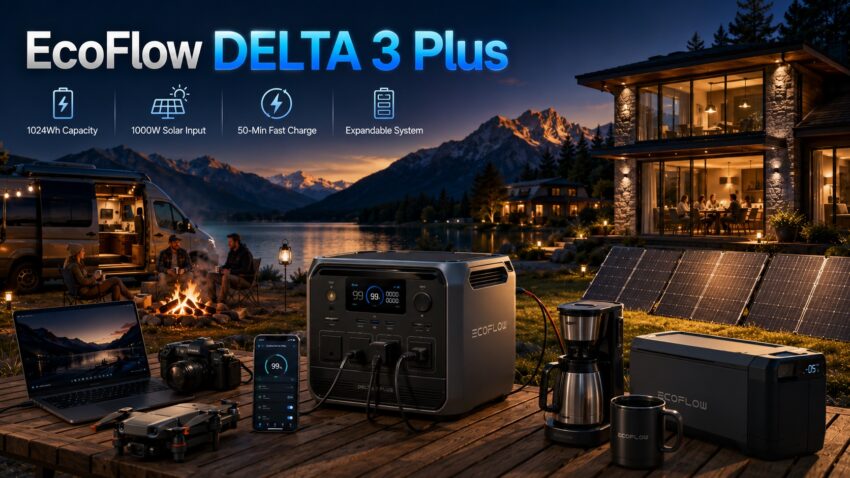
The DELTA 3 Plus is EcoFlow’s answer to the sweet spot most buyers actually live in — not the biggest, not the cheapest, but the capacity and portability combination that covers the most real-world use cases without painful compromises. Independent testing consistently praises its charging speed and build quality. But five separate reviewers, testing independently, converged on the same concerning finding under sustained heavy loads: a cooling fan that doesn’t always do its job. This review covers the full spec sheet, what’s genuinely excellent, and that issue in detail.
Full Specifications
| Spec | EcoFlow DELTA 3 Plus |
|---|---|
| Capacity | 1,024Wh |
| Battery chemistry | LiFePO4 (LFP), 3rd-generation |
| Cycle life | 4,000 cycles to 80% capacity |
| AC output | 1,800W continuous (2,200W with X-Boost) |
| Surge output | 3,600W rated; independently tested holding ~2,600W for about a minute before shutdown |
| AC charge (0-80%) | ~50 minutes |
| Full AC charge | ~60-70 minutes |
| Solar input (max) | 1,000W (double the base DELTA 3’s 500W) |
| Weight | 27-27.6 lbs |
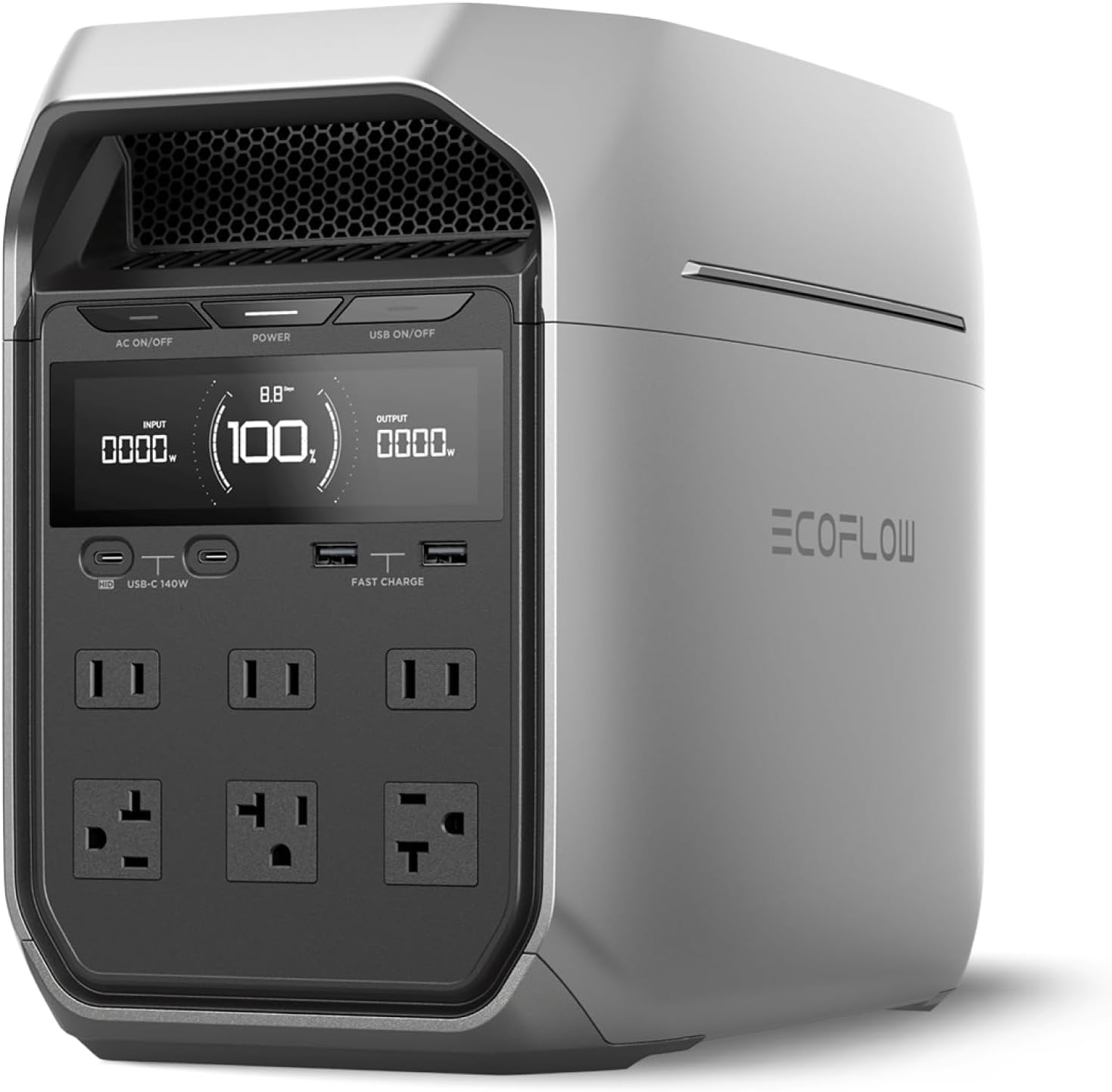
| Output ports | 13 total, including USB-C and USB-A (only 3 three-pronged AC outlets) |
| UPS switchover | Sub-10ms |
| Expandability | Up to ~5,120Wh with Smart Extra Batteries |
| Rated noise | 30dB (see honest fan behavior section below) |
| Price | ~$699-899, often bundled with a 400W solar panel |
Charging Speed — Genuinely Best-in-Class
This is where the DELTA 3 Plus earns unanimous praise. EcoFlow’s X-Stream charging technology delivers on its promise: independent testing confirmed 0-80% in approximately 50 minutes via AC, with a full charge in roughly 60-70 minutes. One reviewer specifically noted this means plugging in Friday evening after work leaves you fully charged well before a weekend camping trip. Solar charging is equally strong — with two 500W panels, a full charge takes about 70 minutes; with a single 500W panel, roughly 2 hours. The 1,000W max solar input is double the base DELTA 3’s 500W ceiling, the primary functional difference between the two models.
Real-World Runtime
Inverter efficiency runs 85-90% in practice, so expect usable capacity closer to 870-920Wh rather than the full 1,024Wh rating. Based on this, independent runtime calculations show approximately 14 hours for a mini fridge drawing 60W on average, over 85 hours for LED lighting, and around 14 full laptop charges. One extended real-world test running a CPAP and small devices overnight achieved roughly 28 hours of runtime at light loads before hitting 10% battery — closely matching the theoretical calculation.
The Honest Fan Issue — What Multiple Independent Tests Found
This is the section worth reading carefully before buying. Under sustained heavy loads — one tester specifically ran a 1,573W appliance — the unit heats up as expected, but multiple reviewers independently found the cooling fans don’t consistently ramp up to full capacity in response the way they should. The unit stays quieter than expected specifically because the loudest internal cooling mechanism isn’t always doing its job, which is the opposite of reassuring. A separate outlet described the fans as cycling on and off erratically under load rather than running steadily, and explicitly noted this “raises the risk of the unit overheating when running heavy loads.”
When the fans do run at full capacity, multiple reviewers found the noise genuinely bothersome for anything positioned as a home UPS — one review’s headline specifically called out “lightning-fast charging with a noisy flaw.” A separate outlet’s star rating (8/10) reflected this as the single reason for docking points, describing it as “a fickle fan and temperature control [that] may spell trouble down the road.”
The balanced take: for light-to-moderate use — camping, device charging, running a small fridge — most testers reported quiet, unremarkable operation with no issue at all. The concern is specifically under sustained heavy loads (well above 1,000W) or for anyone hoping to use this as a set-and-forget home UPS running hot appliances continuously. Multiple reviewers speculated EcoFlow could resolve this with a firmware update, noting the company has done so for other units after release — worth checking current firmware version and recent owner reports before buying if this is a dealbreaker concern for your use case.
Build Quality and Design
Outside of the fan behavior, build quality is consistently praised — one detailed long-term test called it “otherwise well-designed,” highlighting the fast recharge times and genuinely seamless sub-10ms UPS switchover for uninterrupted power during outages. At 27-27.6 lbs, it remains realistically portable for camping and van use, and the compact footprint compared to the original DELTA 2 was specifically noted as a meaningful size improvement.
One minor design complaint across reviews: only 3 standard three-pronged AC outlets, which can feel limiting given the unit’s otherwise generous 13 total output ports. Face buttons were also described by one reviewer as difficult to see in certain lighting.
Expandability
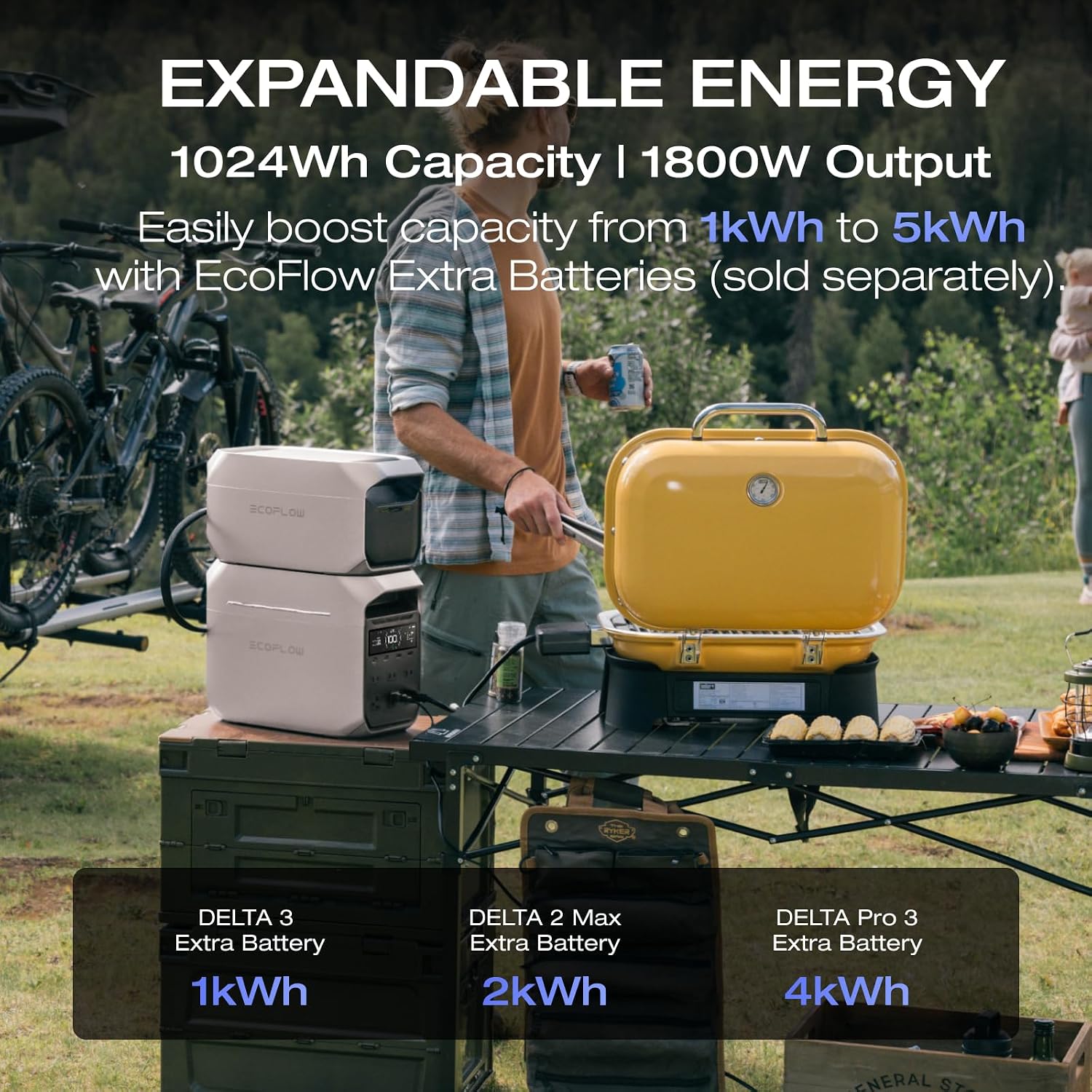
The DELTA 3 Plus supports EcoFlow’s Smart Extra Batteries, scaling to approximately 5,120Wh total capacity — a meaningful advantage over similarly-sized competitors like the Bluetti AC180, which offers no external expansion path at all. This matters for a specific buying pattern: start with the base unit for camping, then add capacity later if you get an RV, build a cabin, or want more home backup runway, without replacing the core unit. Not every EcoFlow expansion battery is cross-compatible, so confirm compatibility with the specific Smart Extra Battery model before buying one.
DELTA 3 Plus vs the Base DELTA 3 — Is the Upgrade Worth It?
| Spec | DELTA 3 | DELTA 3 Plus |
|---|---|---|
| Capacity | 1,024Wh | 1,024Wh (same) |
| Cycle life | 3,000 cycles | 4,000 cycles |
| Solar input | 500W | 1,000W |
| Price | ~$519 | ~$699 |
| Fan behavior under load | Reported as effectively silent under light loads | Fans cycle erratically under heavy load per multiple reviewers |
Both units land at roughly the same cost-per-lifetime-kWh once the extra cycle life is factored against the higher price — meaning the Plus isn’t cheaper to own, just pricier upfront. The genuine reason to pay more is the doubled solar input (1,000W vs 500W), useful if you’re pairing with a larger panel array for faster off-grid recharge. If you don’t specifically need that faster solar charging, the base DELTA 3 is the better value, and at least one comparison specifically noted it runs quieter under light loads than the Plus.
Honest Pros and Cons
Pros: Genuinely best-in-class AC charging speed (50 min to 80%), doubled solar input over the base DELTA 3, expandable to ~5,120Wh, sub-10ms UPS switchover, 4,000-cycle LFP battery, compact and portable at 27 lbs, 13 output ports
Cons: Multiple independent tests found cooling fans behave erratically under sustained heavy loads, raising overheating risk; loud fan noise when it does engage at full capacity; only 3 standard AC outlets; face buttons hard to see in some lighting; not meaningfully cheaper to own than the base DELTA 3 on a per-kWh basis
Who Should Buy the DELTA 3 Plus
Best for:
- Car camping, light RV use, and weekend cabin trips — the primary use cases it was independently tested against
- Buyers who specifically want the faster 1,000W solar input for a larger panel array
- Anyone planning to expand capacity later via Smart Extra Batteries as their needs grow
- Light-to-moderate home backup — routers, lighting, a small fridge, medical devices
Consider alternatives if:
- You want to run sustained heavy loads (1,500W+) for extended periods — the fan issue is specifically a concern here
- You want a genuinely silent home UPS running continuously — check recent firmware/owner reports first, or consider the quieter base DELTA 3 if you don’t need the extra solar input
- You don’t need faster solar charging — the base DELTA 3 offers the same core capacity at a lower price
Frequently Asked Questions
Does the EcoFlow DELTA 3 Plus have a cooling fan problem?
Multiple independent reviewers found the cooling fans don’t consistently run at full capacity under sustained heavy loads (well above 1,000W), which can raise overheating risk, and the fans can be notably loud on the occasions they do ramp up. For light-to-moderate use like camping and device charging, most testers reported no issue at all. Reviewers have speculated a firmware update could resolve this, since EcoFlow has addressed similar issues on other units post-release — check current firmware and recent owner reports before buying if this concerns you.
How long does the EcoFlow DELTA 3 Plus take to charge?
Via AC, approximately 50 minutes to 80% and 60-70 minutes for a full charge — among the fastest in its capacity class. Solar charging takes about 70 minutes with two 500W panels, or roughly 2 hours with a single 500W panel.
Is the DELTA 3 Plus worth the extra cost over the base DELTA 3?
Only if you specifically need the doubled solar input (1,000W vs 500W) for a larger panel array — both units land at roughly the same cost-per-lifetime-kWh once cycle life is factored in, so the Plus isn’t cheaper to own overall. The base DELTA 3 was also reported as running quieter under light loads in at least one direct comparison.
Can the DELTA 3 Plus run high-wattage appliances?
It handles moderate loads well, but independent testing found it struggles under sustained high loads specifically due to the fan behavior issue — one test running a 1,573W appliance triggered the concerning thermal pattern. For short bursts, the unit tested holding around 2,600W (above its 1,800W rating) for about a minute before shutting down.
How much can the DELTA 3 Plus expand to?
Up to approximately 5,120Wh total with EcoFlow’s Smart Extra Batteries. This is a genuine advantage over similarly-sized competitors like the Bluetti AC180, which has no external expansion option at all. Confirm specific battery pack compatibility before purchasing, since not all EcoFlow expansion batteries are cross-compatible.
The Bottom Line
The DELTA 3 Plus delivers genuinely best-in-class charging speed, a useful expansion path, and solid build quality — for light-to-moderate use, it’s an excellent, well-reviewed choice. The fan behavior issue under sustained heavy loads is real, independently confirmed across five separate reviews, and worth taking seriously if you’re considering this as a primary home UPS running demanding appliances continuously. For camping, RV use, and typical home backup scenarios most buyers actually face, it remains a strong recommendation — just go in aware of the one caveat that multiple independent testers flagged consistently.
Check the EcoFlow DELTA 3 Plus on Amazon →
For the full EcoFlow lineup, see our best EcoFlow solar generator guide. For a comparison against the larger DELTA 2 Max, see our EcoFlow DELTA 2 Max review. For use-case-specific sizing, our solar generator for camping guide and solar generator for home backup guide cover the details.