This post contains affiliate links. If you buy through our links we may earn a small commission — at no extra cost to you. This never influences our recommendations.
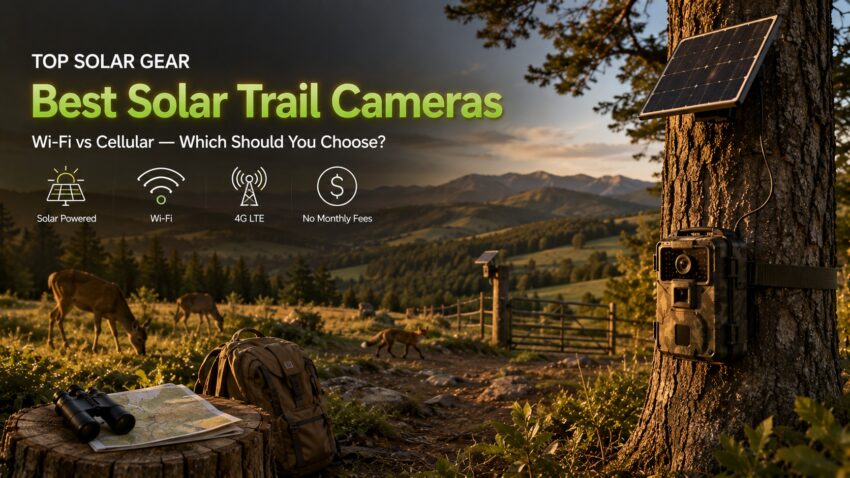
A solar panel on a trail camera solves exactly one problem — power — the same way it does on a security camera. It doesn’t automatically mean remote viewing, and cellular models rarely mean truly free forever, whatever the marketing implies. This guide covers the real distinction between WiFi-only and cellular trail cameras, an honest look at what “free” actually means on cellular models, and the best picks for each use case.
WiFi/Bluetooth vs Cellular — The Decision That Actually Matters
WiFi/Bluetooth trail cameras create their own local hotspot — you walk within range (typically 50-65 feet), connect via an app, and download photos directly from the camera’s SD card without ever removing it. Nothing leaves the camera unless you’re standing near it. This is genuinely, permanently free — there’s no cellular connection at all, so there’s no subscription to gate anything behind.
Cellular trail cameras use a 4G/5G SIM card to transmit photos to your phone from anywhere, without needing to physically visit the camera at all — genuinely valuable for a remote hunting lease, a distant property line, or any location you can’t check regularly. The trade-off is that cellular transmission costs money somewhere in the chain, and this is where it pays to read the actual pricing structure carefully.
An Honest Look at Cellular Trail Camera Pricing
This is worth understanding clearly before buying any cellular model. Established brands are generally upfront about this rather than hiding it: SPYPOINT, for example, states directly that you get 100 free photos per camera on their free app tier, with optional paid transmission plans if you want more volume or HD photo/video requests. That’s a real, honest free tier — not unlimited, but clearly stated and genuinely free for moderate use.
The practical takeaway: a cellular trail camera advertising a specific free photo allotment (like SPYPOINT’s 100/month) is a more verifiable claim than vague “lifetime free data” language from lesser-known brands, since the terms are explicit and don’t require digging through fine print to understand what you’re actually getting.
Best Solar Trail Cameras — Verified Picks
| Product | Connection | Resolution | Battery Life | Best For |
|---|---|---|---|---|
| MAXDONE Solar WiFi Trail Camera | WiFi/Bluetooth, no cellular | 4K, 64MP photos | 5200mAh | Genuinely zero-cost forever, no data plan complexity |
| SPYPOINT Flex-S-Dark | 4G LTE cellular, dual-SIM | 40MP photos, 1080p video | Up to 11 months | Remote property, no regular site visits possible |
Best for Genuinely Zero Ongoing Cost: MAXDONE Solar WiFi Trail Camera

With no cellular component at all, this camera has no data plan to worry about, ever — WiFi and Bluetooth connect directly to the TrailCam GO app within about 55 feet, letting you preview, download, and share photos and videos without removing the SD card. All processing happens locally with no cloud dependency, a genuine privacy advantage alongside the zero-cost angle. 4K video and 64MP photos with a 100° wide-angle lens deliver real image quality, and the included 5200mAh battery paired with the solar panel is designed for extended unattended deployment. A 32GB SD card comes included, supporting up to 256GB if you want more storage.
The trade-off: no remote access. You need to be within Bluetooth/WiFi range to retrieve photos — this is a scouting and property-monitoring camera you check periodically in person, not a live remote-viewing system.
Best for Remote Property: SPYPOINT Flex-S-Dark Solar Cellular Trail Camera

SPYPOINT is one of the more established names in cellular trail cameras, and the Flex-S-Dark’s built-in solar panel and internal lithium battery claim up to 11 months of power on a single setup — replacing what would otherwise mean roughly 1,000 standard AA batteries over the same period. Dual-SIM connectivity means it can latch onto virtually any carrier for reliable coverage in remote areas, and no-glow LEDs keep it completely invisible to wildlife and people at night, with the option to switch to low-glow remotely if you want slightly better night image quality instead.
40MP photos and 1080p video with sound, plus on-demand photo and video requests and live streaming through the SPYPOINT app, make this a genuinely capable remote-monitoring tool. The free tier includes 100 photos per camera per month — real, usable free capacity for moderate scouting — with optional paid plans available if you need more volume or HD video requests.
Other Specs Worth Checking
Trigger speed: Faster is better for capturing fast-moving game — look for 0.1-0.5 second trigger speeds. Multiple PIR (motion) sensors working together typically deliver faster, more reliable triggering than a single sensor.
Detachable vs integrated solar panel: If your camera location is shaded — deep woods, dense tree cover — a detachable panel lets you position it separately in direct sun while keeping the camera itself in the ideal viewing spot. Integrated panels work fine in open fields or feeder setups with direct sun exposure.
No-glow vs low-glow night vision: No-glow infrared is completely invisible to wildlife and people, the better choice for security applications or skittish game. Low-glow shows a faint red light but often provides marginally better night image quality.
Battery backup: Even solar-powered units benefit from a backup battery option for extended cloudy stretches. Lithium AA batteries perform better than alkaline in cold weather and resist leakage — worth using specifically if your camera has a removable battery backup slot.
Frequently Asked Questions
Do solar trail cameras really have no subscription fees?
It depends entirely on whether the camera is WiFi-only or cellular. WiFi/Bluetooth trail cameras genuinely have no subscription possible, since there’s no cellular connection involved at all. Cellular trail cameras typically offer a free tier with a specific photo allotment, with optional paid plans for higher volume — read the exact terms on the listing rather than assuming based on marketing language alone.
What’s the difference between WiFi and cellular trail cameras?
WiFi/Bluetooth cameras require you to be within roughly 50-65 feet to connect and download photos via an app — genuinely free forever, but no remote access. Cellular cameras transmit photos over 4G/5G to your phone from anywhere, useful for remote properties you can’t visit regularly, typically with a free monthly photo allotment and paid options for more.
How long does a solar trail camera battery last without sun?
It depends on battery capacity and usage frequency, but quality units with solar assistance can run for months with minimal manual intervention in areas with reasonable sun exposure — some cellular models claim up to 11 months on a single setup. Extended cloudy stretches or heavily shaded placement will draw down the battery faster than the solar panel can replenish it.
Should I get a camera with a detachable solar panel?
Yes, if your camera will be mounted somewhere shaded — deep forest, dense canopy — since a detachable panel lets you position it in direct sun separately from the camera itself. For open fields, feeders, or clearings with reliable direct sun, an integrated panel works just as well and simplifies setup.
Is a higher megapixel count actually better for trail cameras?
Higher megapixel counts (40-64MP) genuinely deliver more detail for identifying specific animals, antler scoring, or license plate/face identification in security contexts. That said, trigger speed and night vision quality often matter more for actually capturing usable images in the first place — a high-resolution photo of an empty trail because the trigger was too slow isn’t useful.
Final Verdict
| Your Situation | Best Pick |
|---|---|
| Genuinely zero cost forever, check in person periodically | MAXDONE Solar WiFi Trail Camera |
| Remote property, need live phone alerts | SPYPOINT Flex-S-Dark |
The Bottom Line
Match the connection type to how often you can actually visit the camera’s location — WiFi/Bluetooth cameras like the MAXDONE deliver genuinely permanent zero-cost operation for properties you check regularly, while cellular cameras like the SPYPOINT Flex-S-Dark earn their place specifically for locations you can’t visit often, with a clearly stated free tier that’s honest about its limits. Whichever direction you go, read the specific listing’s data or photo allotment terms carefully before assuming unlimited free access.
For general property monitoring beyond wildlife scouting, see our best solar security cameras guide. For other rural and homestead solar equipment, see our best solar fence charger guide.