This post contains affiliate links. If you buy through our links we may earn a small commission — at no extra cost to you. This never influences our recommendations.
EcoFlow RIVER 2 Review — The Short Version
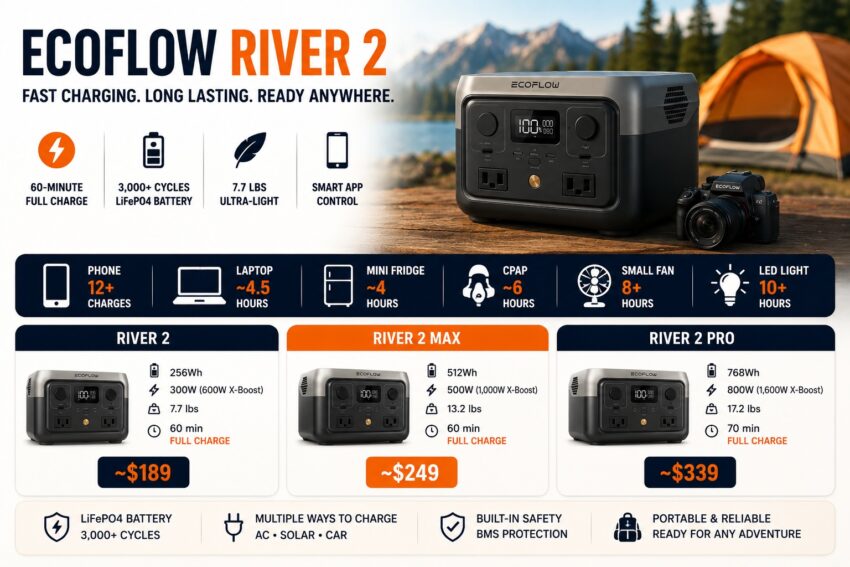
The EcoFlow RIVER 2 is the best-selling entry-level portable power station under $200 for good reason: its 60-minute recharge, 3,000-cycle LFP battery, app control, and 7.7 lb form factor deliver a package that punches well above its price class. If you want a compact, fast-charging, long-lived power station for camping, travel, or light home backup — this is likely the right answer.
But the RIVER 2 is one of three units in EcoFlow’s RIVER 2 family. And in 2026, the newer RIVER 3 is also on shelves at a similar price. This review covers the RIVER 2 in depth, compares it to the RIVER 2 Max and RIVER 2 Pro, and answers the RIVER 3 question directly — so you know exactly which unit to buy.
EcoFlow RIVER 2: Specs at a Glance
| Spec | EcoFlow RIVER 2 |
|---|---|
| Battery Capacity | 256Wh |
| Battery Chemistry | LiFePO4 (LFP) |
| Cycle Life | 3,000+ cycles (~10 years) |
| AC Output | 300W continuous |
| X-Boost Output | 600W (powers devices up to 600W) |
| AC Outlets | 2× |
| USB-C Output | 1× 100W |
| USB-A Output | 2× |
| Solar Input | 110W max |
| AC Charge Time | 60 minutes (0–100%) |
| Solar Charge Time | ~3 hours (at 110W) |
| Weight | 7.7 lbs (3.5 kg) |
| App | EcoFlow app (iOS + Android) |
| Warranty | 30 months |
| Current Price | ~$189 |
The Killer Feature: 60-Minute Charging
The EcoFlow RIVER 2’s fastest recharge from 0% to 100% takes just 60 minutes — the main reason to buy this unit. Most competitors like Jackery take 2–4 hours to charge via wall outlet. The technology behind this is EcoFlow’s X-Stream charging — it pulls up to 360W from the wall, more than the battery’s own capacity per hour. The internal AC-to-DC converter runs at 92% efficiency, so less energy turns into heat. The fan kicks in above 200W input but stays quiet at around 35dB.
In practice this means you plug it in during breakfast and it’s full before you finish coffee. At a campground with power hookups, you restore a full charge in one hour before heading out. No other power station under $200 matches this charging speed.
Real-World Performance — What It Actually Powers
| Device | Draw | Runtime |
|---|---|---|
| Smartphone (full charges) | 15W | 12+ charges |
| Laptop (14-inch) | 45W | ~4.5 hours |
| LED work light | 20W | 10+ hours |
| Mini fridge (12V) | 45W avg | ~4 hours |
| CPAP (no humidifier) | 30W | ~6 hours |
| Electric blanket (low) | 60W | ~3.5 hours |
| Drone battery charges | 50W | ~4 full charges |
| Small fan | 25W | 8+ hours |
The honest capacity limitation: 256Wh is enough for a weekend camping trip with phones, a laptop, lights, and camera charging. It’s not enough for a 12V camping fridge running overnight — you’d need 400–500Wh minimum for that. If a fridge is in your plans, the RIVER 2 Max is the right unit.
What X-Boost Actually Does — And Its Limits
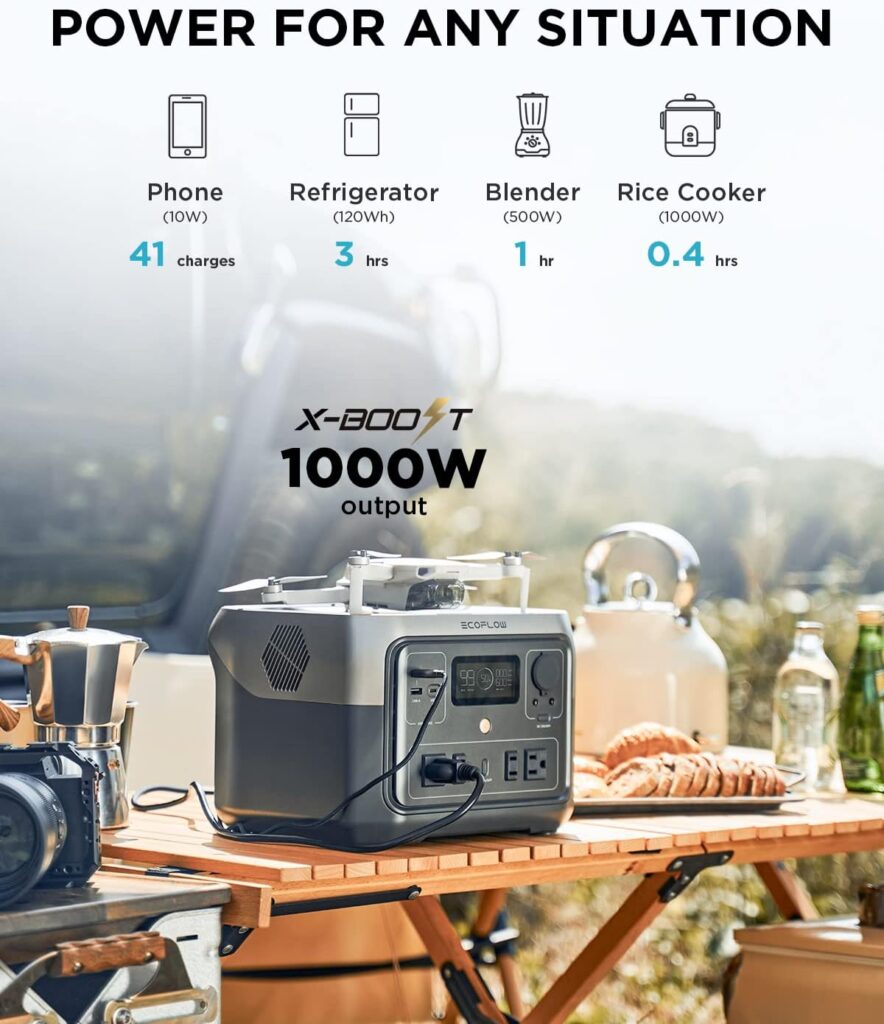
X-Boost is EcoFlow’s most marketed feature and one of the most misunderstood. The RIVER 2’s inverter outputs 300W continuously. X-Boost works around this by reducing the output voltage — so a device rated up to 600W draws less than 300W at reduced voltage. The device runs, but potentially at reduced performance.
Works well with X-Boost: Small appliances with variable performance (fans, lights), phone and laptop chargers, camera equipment, most 12V devices.
Doesn’t work well with X-Boost: Resistive heating elements (need full voltage for full heat), precision medical equipment requiring stable voltage, devices where reduced performance is unacceptable.
For most camping use cases, X-Boost is genuinely useful. Just understand that it manages voltage rather than delivering more power — it doesn’t turn a 300W inverter into a 600W inverter for all purposes.
RIVER 2 vs. RIVER 2 Max vs. RIVER 2 Pro — Which Is Right for You?
| RIVER 2 | RIVER 2 Max | RIVER 2 Pro | |
|---|---|---|---|
| Capacity | 256Wh | 512Wh | 768Wh |
| AC Output | 300W (600W X-Boost) | 500W (1,000W X-Boost) | 800W (1,600W X-Boost) |
| AC Outlets | 2 | 2 | 4 |
| AC Charge Time | 60 min | 60 min | 70 min |
| Solar Input Max | 110W | 220W | 220W |
| Weight | 7.7 lbs | 13.2 lbs | 17.2 lbs |
| Price | ~$189 | ~$249 | ~$339 |
Choose the RIVER 2 if: You need a portable power station under $200 for phones, laptops, cameras, lights, and CPAP. Weight matters. You don’t need to run a fridge overnight.
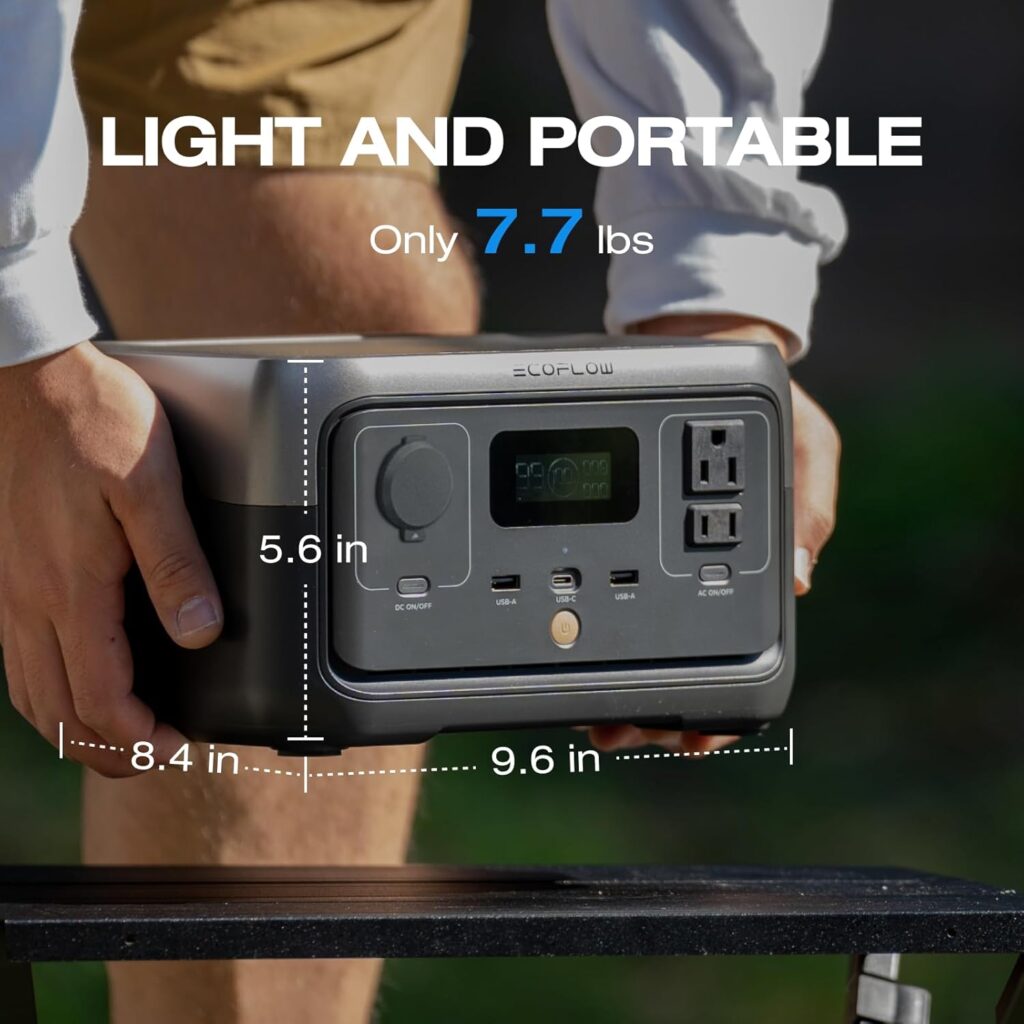
Choose the RIVER 2 Max if: At 13.2 lbs it strikes a solid balance between capacity and portability — light enough to carry one-handed, yet powerful enough for a full weekend of moderate use including a 12V fridge during daytime hours. Double the capacity for $60 more is excellent value.
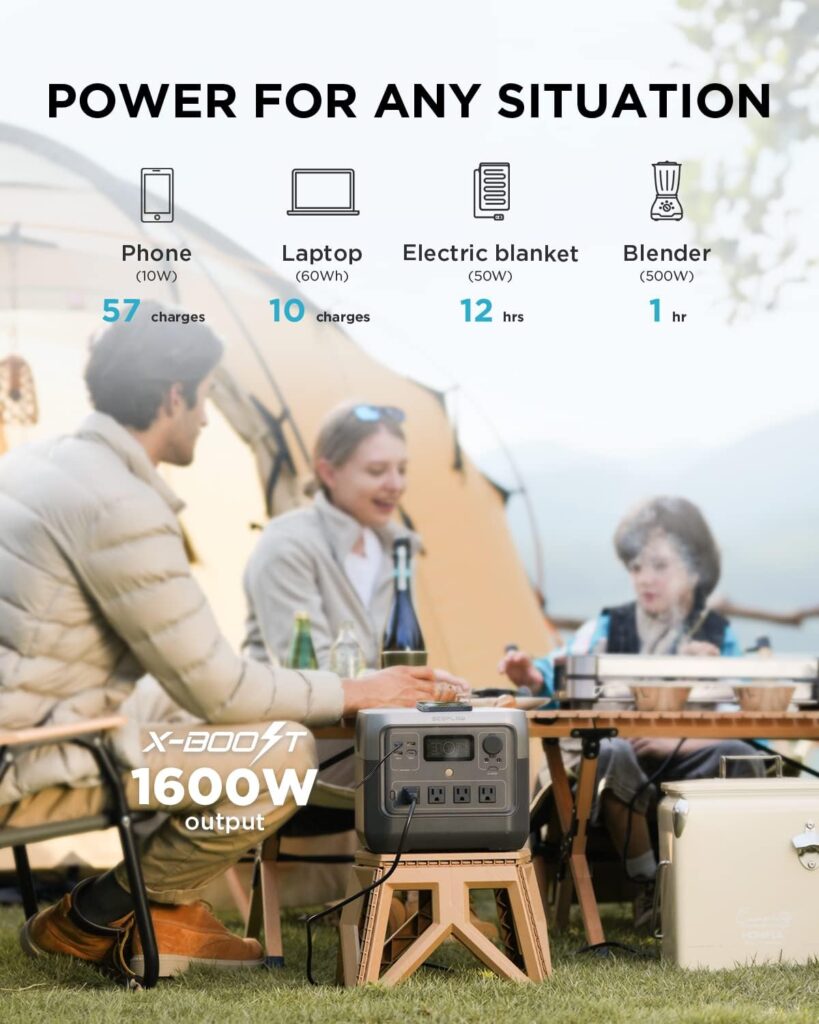
Choose the RIVER 2 Pro if: You want 768Wh capacity in a unit light enough to carry to a picnic table but powerful enough to keep a fridge cold all weekend. The 4× AC outlets and 800W continuous output handle more demanding loads — the “Goldilocks” unit for serious weekend campers.
The RIVER 3 Question — Should You Buy the RIVER 2 in 2026?
Any honest 2026 RIVER 2 review must answer this. At the current $189 sale price, the RIVER 2 remains the smarter value pick — the RIVER 3 for $10 more buys you only 30Wh more capacity and 4 minutes faster charging. Unless the RIVER 3 drops to the same price, the RIVER 2 remains the better value for most buyers.
The RIVER 3 Plus is a more meaningful upgrade — it adds expandability to 858Wh, 3 AC outlets, and <10ms UPS capability. If those specific features matter, the RIVER 3 Plus is worth the step up. For basic fast-charging compact power, the RIVER 2 at $189 is still the buy.
Charging the RIVER 2 — All Your Options
Wall outlet (fastest): 60 minutes from 0–100%. The X-Stream technology pulls 360W from a standard household outlet. This is so fast it changes how you use the unit — charge it during meals, at work, or at the campground office.
Solar panels: Up to 110W solar input. At 110W in 5 peak sun hours, charges in approximately 2.5–3 hours. A single 100W foldable panel is the practical sweet spot for the RIVER 2’s solar input. For foldable panel options that work with the RIVER 2 via MC4 adapters, see our foldable solar panels guide.
12V car adapter: Charges from your vehicle’s 12V outlet during drives — slower (typically 3–6 hours) but useful for road trips between destinations without grid access.
Who the RIVER 2 Is Designed For — And Who It Isn’t
Right choice for: Weekend campers covering phones, laptops, cameras, and lighting. Travelers who want emergency backup power. Students who need laptop backup during outages. CPAP users wanting reliable overnight power. First-time portable power station buyers entering the category without overspending. Anyone who wants the fastest-charging compact power station under $200.
Not the right choice if: You need to run a full-size 12V camping fridge overnight (→ RIVER 2 Max or Jackery Explorer 500 v2). You need to power tools or high-wattage appliances (300W/600W ceiling is too low). You need 240V output. Serious home backup is the goal (→ see our home battery backup guide).
EcoFlow RIVER 2 vs. Jackery Explorer 300
| EcoFlow RIVER 2 | Jackery Explorer 300 | |
|---|---|---|
| Capacity | 256Wh | 292Wh |
| AC Output | 300W (600W X-Boost) | 300W |
| AC Charge Time | 60 minutes | ~2 hours |
| Weight | 7.7 lbs | 6.1 lbs |
| Cycle Life | 3,000+ | 3,000+ |
| Solar Input | 110W | 100W |
| Price | ~$189 | ~$199 |
RIVER 2 wins: 60-minute charging is a significant practical advantage. 110W solar input and app functionality are comparable advantages.
Jackery Explorer 300 wins: At 6.1 lbs vs 7.7 lbs it’s meaningfully lighter for backpacking. 292Wh gives 14% more capacity. We cover the Explorer 300 in our solar power for camping guide.
The verdict: If charging speed is your priority, the RIVER 2 wins. If minimum weight for backpacking is the priority, the Jackery Explorer 300 is worth considering.
The Honest Limitations
256Wh is limited for extended use. Right for its price point, but you will outgrow it if needs expand. The RIVER 2 Max at $249 offers double the capacity for $60 more.
Two AC outlets. The RIVER 2 Pro has four. For camping with multiple AC devices simultaneously, two outlets is tight. A power strip expands this but adds weight.
No modular expandability. Unlike the RIVER 3 Plus, the RIVER 2 doesn’t have a clean expansion battery path. The RIVER 2 Extra Battery exists but is a specific paired accessory rather than a modular system.
30-month warranty. Shorter than Jackery’s 36-month standard. Not a dealbreaker at this price, but worth noting.
Frequently Asked Questions
Can the EcoFlow RIVER 2 charge a laptop?
Yes — the 100W USB-C output charges any modern laptop at full speed. The RIVER 2 provides approximately 4–5 hours of laptop use from a full charge based on 45–60W draw. It handles MacBooks, Dell XPS, Lenovo ThinkPad, and other USB-C laptops without issue.
Can the RIVER 2 power a CPAP machine?
Yes — at 30W draw without humidifier, it provides approximately 6 hours of CPAP runtime. For a full 8-hour night, start at 70%+ or choose the RIVER 2 Max. The EPS function switches to battery power in under 30ms — below the threshold where most CPAP machines detect an interruption.
How long does the RIVER 2 battery last?
The LFP battery is rated for 3,000+ cycles before reaching 80% capacity — approximately 10 years of regular daily use. LFP chemistry is inherently more thermally stable than NMC lithium-ion, with significantly lower thermal runaway risk.
Does the RIVER 2 work as a UPS for a computer?
The EPS function provides switchover in under 30ms — below the threshold where most computers detect an interruption and shutdown. It works as a basic UPS for computers during momentary power fluctuations and short outages. For a more capable UPS solution, the RIVER 3 Plus (<10ms) is the better option.
Can I take the RIVER 2 on a plane?
At 256Wh, the RIVER 2 exceeds the 100Wh unrestricted threshold but falls below the 160Wh maximum that most airlines permit with approval. Check your specific carrier’s policy before flying. Do not check it in luggage — lithium batteries must travel carry-on.
Is the RIVER 2 waterproof?
No — the RIVER 2 is not rated for water resistance. Keep it dry and covered during wet weather. It handles normal sheltered outdoor use but should not be left in rain.
Final Verdict
The EcoFlow RIVER 2 is the best entry-level LFP portable power station under $200. Its 60-minute recharge, 3,000-cycle battery, app control, and 7.7 lb form factor deliver a package that punches well above its price class. The 256Wh capacity and two AC outlets are real constraints — but for the buyer who needs a compact, fast-charging power station for camping, travel, or emergency backup of light loads, the RIVER 2 delivers exactly what it promises.
| Unit | Best For | Price |
|---|---|---|
| RIVER 2 | Light camping, travel, first power station | ~$189 |
| RIVER 2 Max | Weekend camping, fridge-compatible | ~$249 |
| RIVER 2 Pro | Extended camping, heavier loads, 4× AC | ~$339 |
For solar panels to pair with any RIVER 2 unit, see our foldable solar panels guide — the EcoFlow 110W panel is the natural pairing, but third-party 100W options with adapters provide comparable charging at lower cost. For larger home backup needs, our home battery backup system guide covers the DELTA-class systems designed for that job. And for how the RIVER 2 compares to Jackery’s camping power station lineup, see our solar power for camping guide.