If you’ve heard the words “azimuth” and “declination” thrown around in solar conversations and nodded along without really knowing what they mean — you’re not alone. These two angles sound technical, but once you understand them, they’re actually pretty straightforward. And getting them right can make a real difference in how much power your solar panels produce.
This guide breaks it all down in plain English. No engineering degree required.
What Are Azimuth and Declination? (Simple Explanation)
Let’s clear up the terminology first.
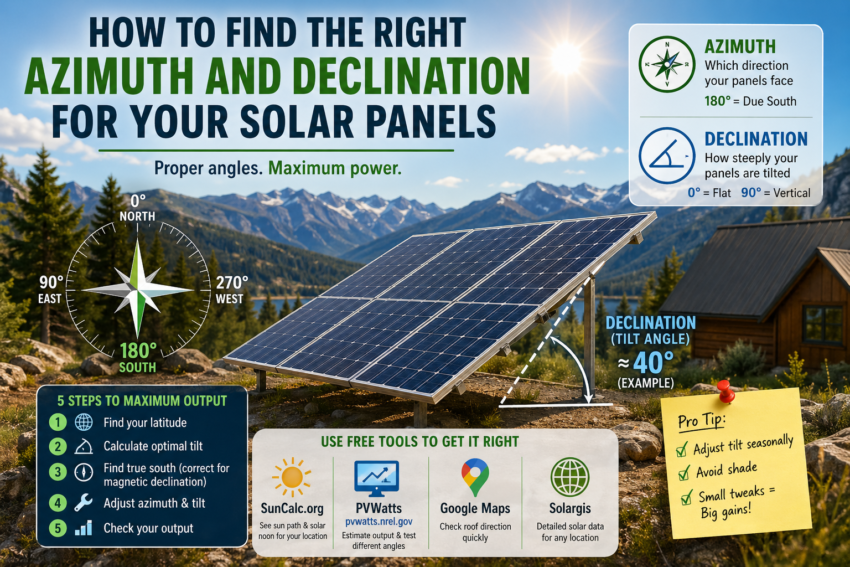
Azimuth is the horizontal direction your solar panels face. Think of it like a compass reading. If your panels face directly south, that’s an azimuth of 180°. East is 90°, west is 270°. In simple terms, azimuth answers the question: which direction are my panels pointing?
Declination (also called tilt angle) is how steeply your panels are angled upward from flat ground. A panel lying completely flat has a tilt of 0°. A panel standing completely vertical has a tilt of 90°. Most solar panels sit somewhere in between. Declination answers the question: how steep is the angle of my panels?
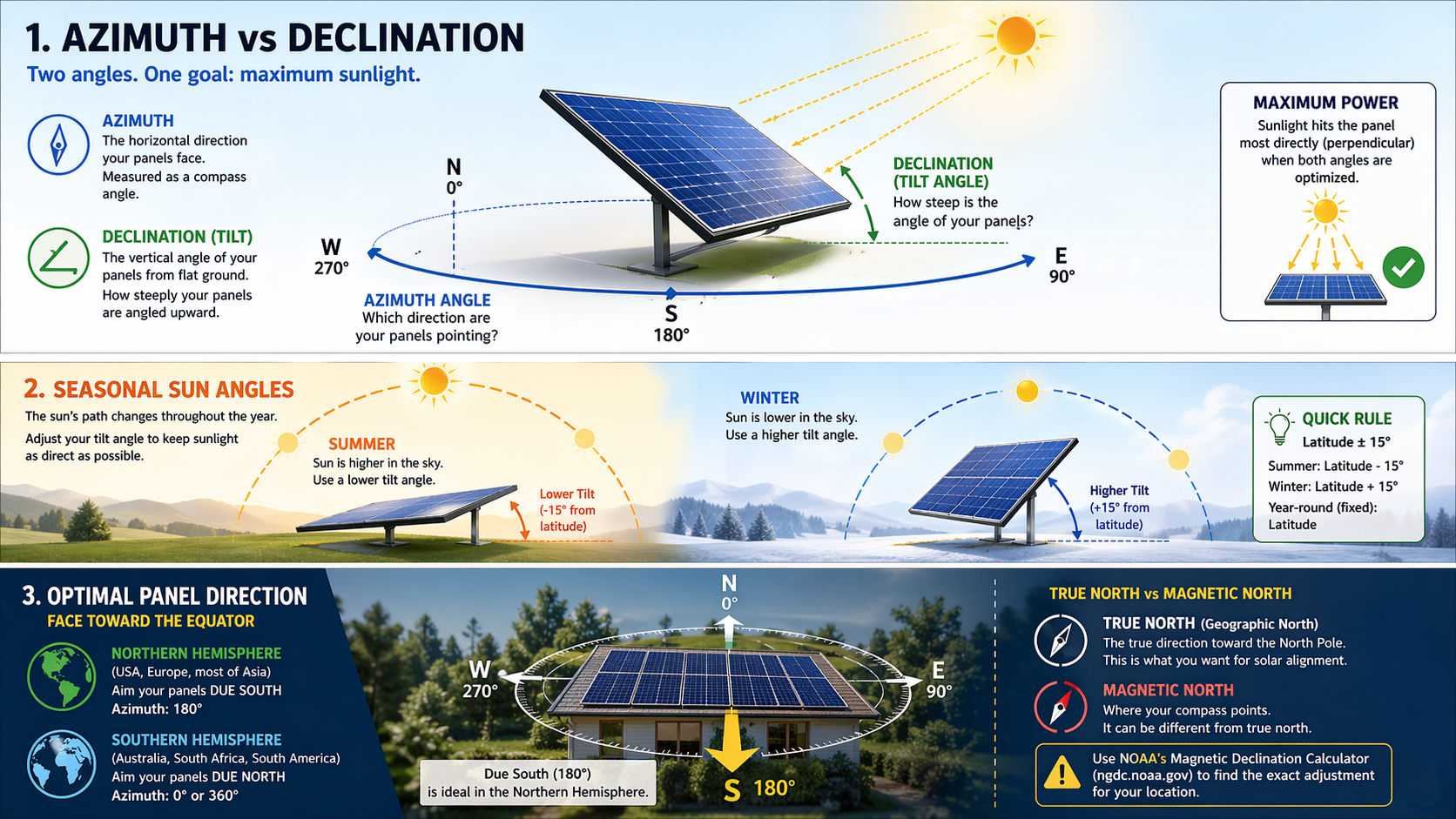
Here’s an easy way to picture it: imagine you’re lying in a reclining chair facing the sun. The direction the chair faces is your azimuth. How far back the chair is reclined is your declination.
Both angles work together. Get one wrong and you leave power on the table — sometimes a lot of it.
Why Getting These Angles Right Actually Matters
Solar panels produce the most electricity when sunlight hits them at a direct, perpendicular angle. The further off that angle you are, the less power you get.
Studies from the National Renewable Energy Laboratory (NREL) show that a panel facing the wrong direction by as little as 30° can reduce annual output by 10–15%. A panel that’s tilted at the wrong angle can cost you a similar amount. Combined, poor positioning can slash your production by 20–25% or more.
That’s a significant loss — especially if you’re relying on solar for off-grid living or trying to offset your electricity bill.
There’s also a seasonal angle (pun intended). The sun sits higher in the sky during summer and lower during winter. That means the ideal tilt for your panels actually changes throughout the year.
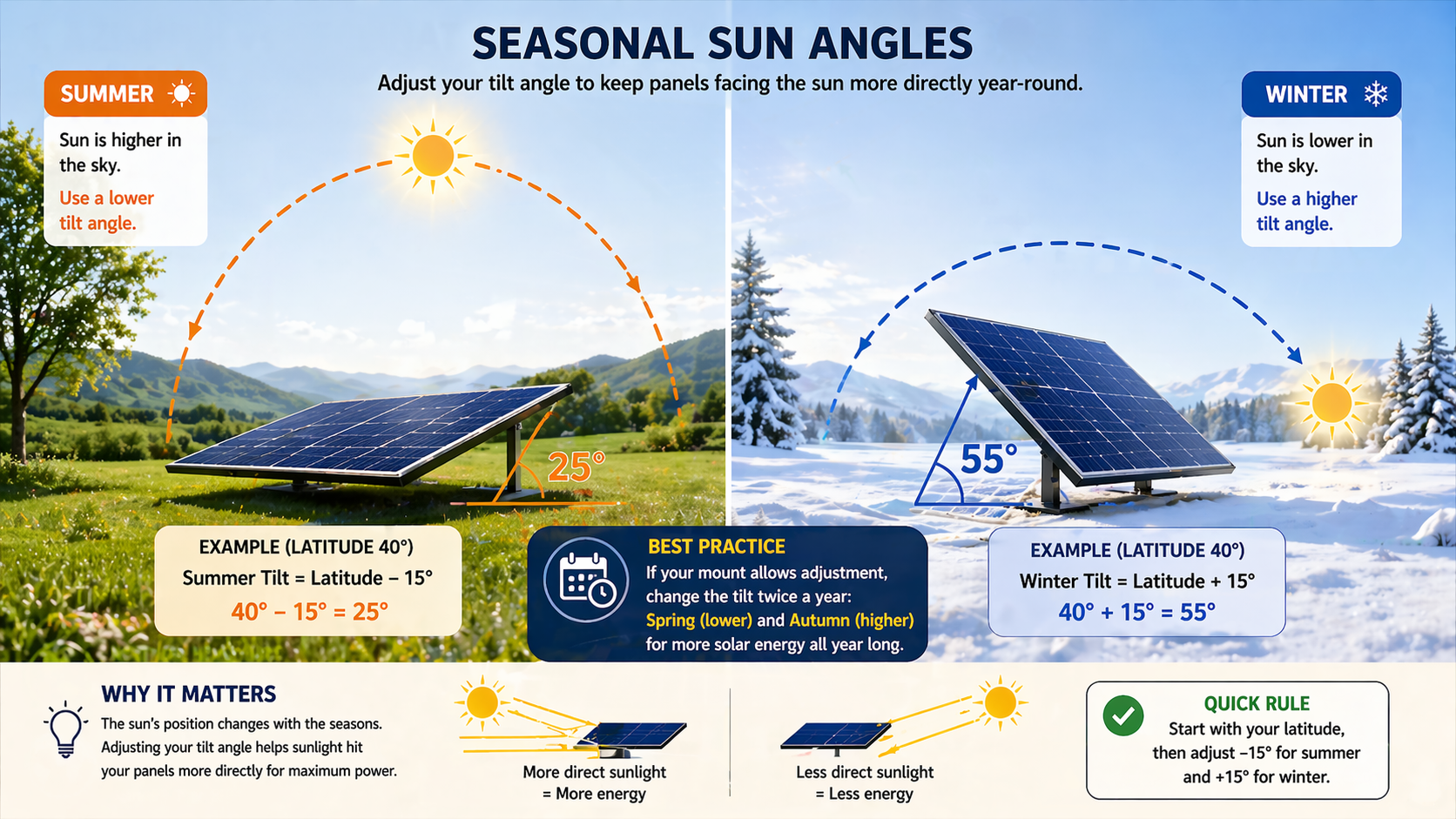
If your setup allows for seasonal adjustments, making them twice a year can noticeably boost your output.
How to Find Your Solar Panel Azimuth
The simple rule: face your panels toward the equator.
- If you’re in the Northern Hemisphere (USA, Europe, most of Asia), aim your panels due south — an azimuth of 180°.
- If you’re in the Southern Hemisphere (Australia, South Africa, South America), aim your panels due north — an azimuth of 0° or 360°.
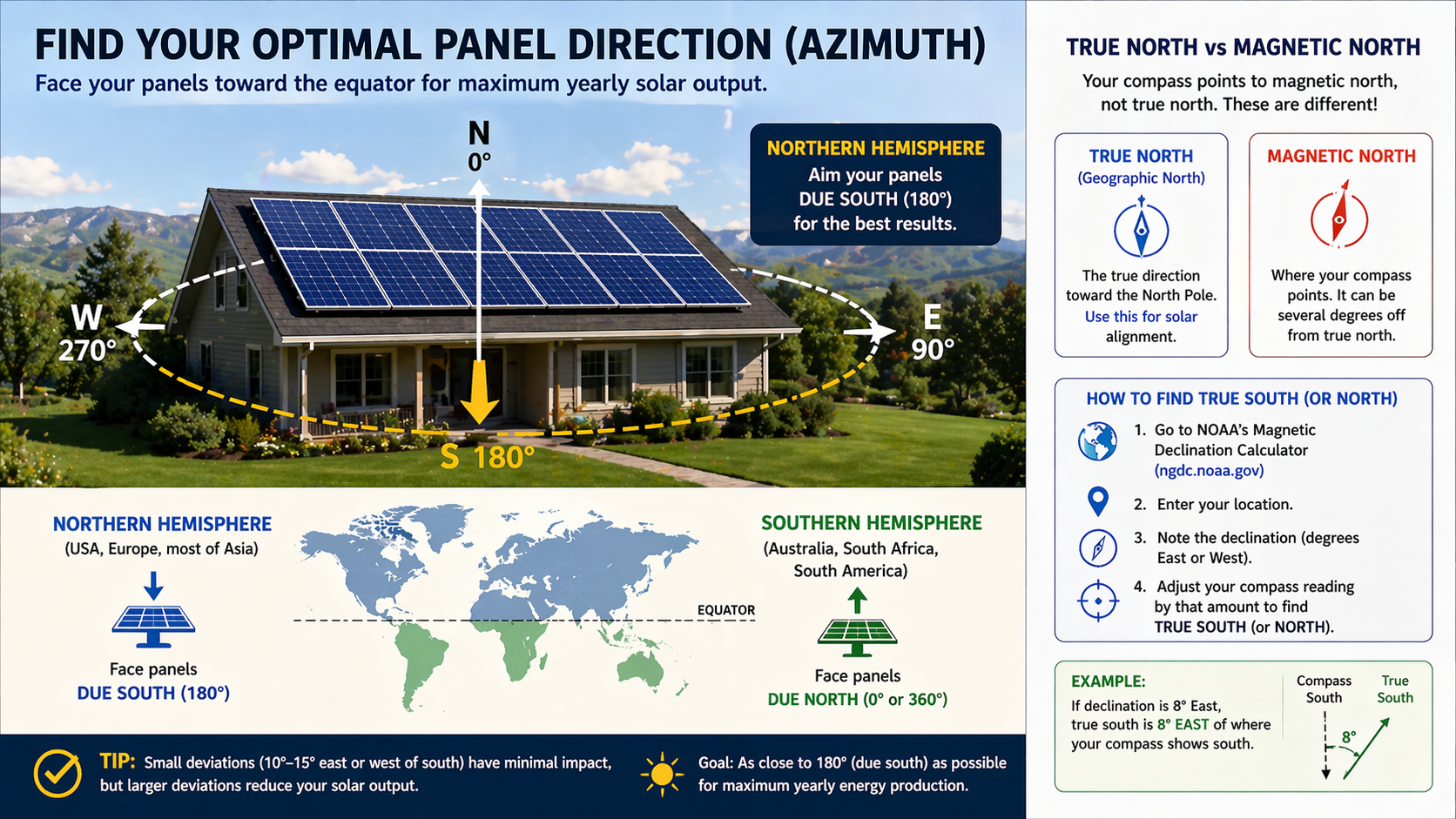
Sounds easy, right? The tricky part is the difference between magnetic north and true north.
Magnetic north is what your compass points to. True north (also called geographic north) is the actual direction of the North Pole. These two are not the same. Depending on where you live, the difference — called magnetic declination — can be anywhere from a few degrees to more than 20°.
To find true south (or true north) for your location:
- Go to NOAA’s magnetic declination calculator at ngdc.noaa.gov
- Enter your location
- It’ll tell you exactly how many degrees to adjust your compass reading
For example, if you’re in Denver, Colorado, the magnetic declination is about 8° east. That means true south is 8° east of where your compass says south is. Small adjustment, but worth making.
How to Calculate Your Solar Panel Declination (Tilt Angle)
This one has a simple starting formula:
Optimal tilt angle ≈ your latitude
If you live at 40° latitude (roughly Denver, Madrid, or Beijing), your base tilt should be around 40°.
But you can refine it seasonally:
- Summer: subtract 15° from your latitude → 40° − 15° = 25° tilt
- Winter: add 15° to your latitude → 40° + 15° = 55° tilt
These adjustments track the sun’s lower position in winter and higher position in summer, keeping your panels aimed as directly at the sun as possible year-round.
How to measure your current tilt angle:
You don’t need fancy equipment. A simple smartphone app like Clinometer (iOS/Android) or even a standard protractor can measure the angle of your panel surface. Place it on the panel, take a reading, and compare it to your target tilt.
Best Free Tools to Find Azimuth and Declination for Your Location
You don’t have to do all of this manually. There are some excellent free tools that crunch the numbers for you.
SunCalc.org
One of the easiest tools out there. Just drop a pin on your location on the map and it shows you the sun’s path throughout the day and year. You can see exactly where the sun rises and sets, and where it sits at solar noon — which tells you your optimal panel direction.
PVWatts Calculator (pvwatts.nrel.gov)
Built by the National Renewable Energy Laboratory, this is the gold standard for solar calculations. Enter your address, panel size, and current tilt/azimuth, and it tells you your estimated annual energy output. Tweak the angles and watch the numbers change — it’s a great way to find your optimal setup.
Google Maps Compass Trick
Open Google Maps, find your location, and use the satellite view to check which way your roof faces. It’s not super precise, but it gives you a quick directional check without any extra tools.
Solargis (solargis.com)
More advanced, but incredibly detailed. Solargis provides solar irradiance maps and location-specific data used by solar installers and energy companies. Great if you want to go deep.
Step-by-Step: Setting the Right Azimuth and Declination
Here’s the whole process in one place:
Step 1: Find your latitude.
Google “[your city] latitude” — it takes two seconds. Write it down. That’s your baseline tilt number.
Step 2: Calculate your optimal tilt.
Use the latitude formula above. Adjust up or down by 15° depending on the season if your mount allows it.
Step 3: Find true south (or north).
Use a compass and correct for magnetic declination using NOAA’s tool. Mark the direction clearly before you start adjusting panels.
Step 4: Adjust your panels.
Set the azimuth by physically rotating your panel mount to face the correct direction. Set the tilt by adjusting the angle bracket or kickstand to match your calculated number. Use your phone’s clinometer app to verify the tilt.
Step 5: Run a quick output check.
After adjusting, check your solar controller or power station display during peak sun hours (10 AM–2 PM). Compare the output to what you were getting before. Even a small adjustment can produce a noticeable bump.
Common Mistakes to Avoid
Confusing magnetic north with true north.
This is the most common error. Always correct for magnetic declination — especially if you’re more than 10° off, it can meaningfully impact your output.
Setting the angle once and forgetting it.
The sun’s position changes significantly between seasons. If your mount allows adjustment, update your tilt at least twice a year — once in spring and once in autumn.
Ignoring shade.
Even perfect azimuth and tilt won’t help if a tree or chimney casts a shadow on your panels during peak sun hours. Do a shading check at solar noon before committing to a location.
Assuming your roof angle is good enough.
Many people just lay panels flat on whatever surface is available. Even a rough tilt adjustment can recover meaningful output. Don’t skip it just because it’s inconvenient.
Frequently Asked Questions
What is the best azimuth angle for solar panels?
For anyone in the Northern Hemisphere, due south (180°) is ideal. Small deviations of 10–15° east or west have minimal impact, but anything beyond that starts to reduce output noticeably.
Does declination change throughout the year?
The sun’s declination changes, which means your optimal tilt angle changes too. For fixed panels, use your latitude as the tilt — it’s the best year-round compromise. If you can adjust seasonally, do it.
What if my roof won’t allow the ideal angle?
Don’t stress too much. A panel at 20° instead of 35° still produces a lot of power. Suboptimal is not the same as bad. Use PVWatts to estimate the actual impact at your specific tilt before deciding if a fix is worth the effort.
How much output do I lose with the wrong angle?
It depends on how far off you are. A 10° deviation might cost you 3–5%. A 45° deviation could cost 15–20% or more. The azimuth direction (east/west vs. south) tends to matter more than the tilt.
Final Thoughts
Azimuth and declination sound intimidating, but they really just come down to two questions: which way are your panels pointing, and how steep is the angle? Answer those correctly for your location, and you’ll squeeze the most power out of every hour of sunlight.
Start with the latitude formula for tilt. Use a compass corrected for magnetic declination for direction. Then verify with PVWatts or SunCalc. The whole process takes maybe 20 minutes — and the payoff in improved solar output is worth every second.
Adjust seasonally if you can. Check for shading. And don’t be afraid to fine-tune as you go.