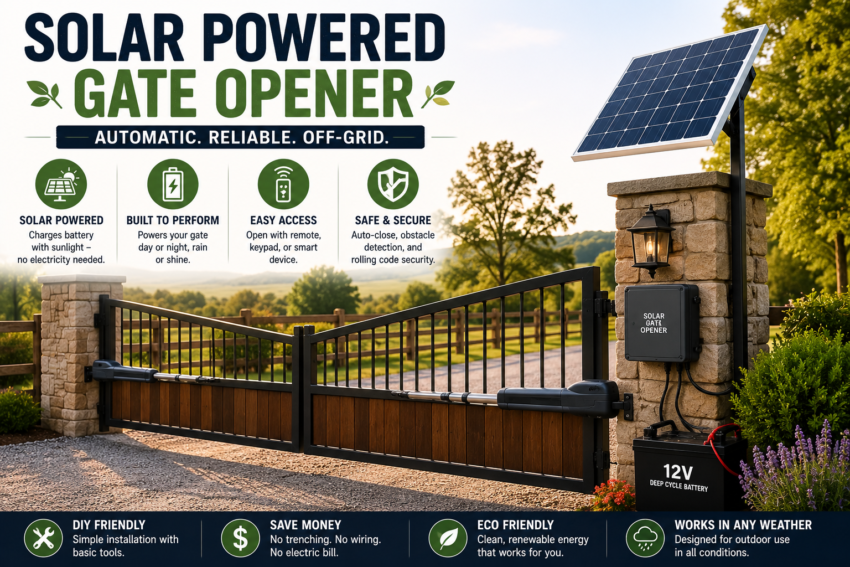
What Is a Solar Powered Gate Opener?
If your gate is more than a hundred feet from your house, running cable to it is either expensive, impractical, or both. Trenching alone can cost thousands of dollars before you’ve even bought the opener. Solar gate openers solve that problem cleanly — no trenching, no electrician, no ongoing electricity bill.
The way it works is simple. A small solar panel charges a battery throughout the day. That battery powers the motor every time the gate opens or closes. The whole system runs independently of your home’s power — which means it keeps working even when the grid goes down.
They work with most gate types: swing gates, sliding gates, steel, wood, vinyl, chain-link, tube steel. The one thing they don’t handle well is solid panel gates — the kind that act like a sail in the wind. The extra resistance is too much for most residential motors, so those are best avoided.
How Solar Gate Openers Actually Work
There are four parts to every solar gate opener system, and understanding what each one does makes it a lot easier to buy the right one.
The solar panel is the power source. Most residential kits come with a 10W to 30W panel — small by home solar standards, but more than enough for a gate motor that only runs for a few seconds at a time.
The battery is what actually runs the gate. The panel charges it during daylight, and the battery powers the motor whenever you open or close the gate — day or night, sun or cloud. Most systems use a standard 12V deep-cycle marine battery, the same type used in boats.
The motor and arm do the physical work. Residential solar openers typically use a linear actuator — a motorized arm that extends to push the gate open and retracts to pull it closed. It draws 3–5 amps while running, which is why even modest solar setups can handle dozens of daily cycles.
The control board ties it all together. It processes signals from remotes and keypads, manages the auto-close timer, triggers safety reversals if something blocks the gate, and handles battery charging from the panel.
Here’s the thing people often don’t realize: gate openers are actually one of the best applications for solar power. A single open-close cycle uses about 0.003 kWh — barely anything. A 10W panel on a decent sunny day generates enough energy for 30–50 gate cycles. Most residential driveways don’t come close to that.
Types of Solar Gate Openers
Single Swing Gate Openers
The most common setup for residential driveways. One gate leaf swings open from a hinged post — like a large door. One motor arm, one remote receiver, one control box. Simple to install and the cheapest option if a single gate is all you need.
Dual Swing Gate Openers
Two gate leaves that meet in the middle and swing open in opposite directions — like a pair of French doors on your driveway. Dual openers include two motor arms wired to a single control box. They handle wider driveways and are the standard choice for decorative estate-style entrances.
Sliding Gate Openers
Instead of swinging, sliding gates roll sideways along a track. They’re a good option when you don’t have room for a swing arc — steep driveways, tight setbacks, narrow lots. Solar sliding gate openers use a rack-and-pinion or chain-drive system to move the gate along the track.
Barrier Arm Gate Openers
The rising arm barriers you see at parking garages and gated communities. Rarely used in residential settings but available in solar configurations for commercial or community access control.
What to Look for Before You Buy
Gate weight and length — check both
Every opener has a maximum weight AND a maximum length — and they trade off against each other. A heavy gate needs to be shorter; a longer gate needs to be lighter. Always measure your actual gate and compare both numbers to the spec sheet. Running a motor beyond its rating is the fastest way to kill it early.
Cycle rate
How many times a day does your gate actually open and close? For most homes, 10–20 cycles is realistic. Most residential solar openers handle 30–60 per day comfortably. If you have a busy property — deliveries, multiple drivers, commercial use — look at the cycle rating before buying.
Solar panel wattage
The included panel is usually enough for normal residential use. But if you’re in the Pacific Northwest, the UK, or anywhere with limited winter sun, a 20W or 30W panel gives you more buffer. Most systems let you add a second panel if needed.
Battery capacity
The battery is often not included — always check the listing. A 7Ah battery is the bare minimum; 12Ah is the practical starting point for reliable all-weather performance. If you live somewhere that gets consecutive cloudy days in winter, go bigger.
Opening speed
Actuators typically move at 0.5 to 1 inch per second. An 18-foot gate takes 12–20 seconds to open fully. That’s fine for most people, but worth knowing if you’re used to something faster.
Safety features
Auto-reverse when the gate hits an obstruction is non-negotiable — for both safety and liability reasons. Also look for manual release in case of power failure, and photocell compatibility if you want to add sensors later.
Remote range
Standard remotes work to about 100–300 feet. Ghost Controls and Mighty Mule long-range remotes push up to 1,000 feet — genuinely useful if your gate is at the end of a long driveway and you want it open before you get there.
Smart home compatibility
A few brands now offer WiFi add-on kits that let you control the gate from your phone, share access with guests, and get open/close alerts. Usually sold separately — worth checking if that matters to you.
Warranty
Ghost Controls backs their motor and gear assembly with a lifetime warranty. TOPENS and Mighty Mule offer 12–18 months. For something that lives outside 365 days a year, warranty length is worth paying attention to.
The Best Solar Gate Openers Right Now
Every product below has been verified on Amazon or direct from the manufacturer. Specs are pulled from official listings — no guessing.
| Model | Type | Max Gate | Solar Included | Remote Range | Smart Ready | Price |
|---|---|---|---|---|---|---|
| TOPENS A8S | Single swing | 880lbs / 18ft | 20W ✅ | 100ft | Add-on | ~$350 |
| Ghost Controls TSS1XP | Single swing | 900lbs / 20ft | 10W ✅ | 1,000ft | Add-on | ~$400 |
| Ghost Controls TDS2XP | Dual swing | 900lbs / 24ft total | 10W ✅ | 1,000ft | Add-on | ~$550 |
| Mighty Mule MM571W Solar | Single swing | 850lbs / 18ft | 20W ✅ | 2,640ft | ✅ Built-in ready | ~$500 |
| TOPENS AD8S | Dual swing | 880lbs / 18ft per arm | 20W ✅ | 100ft | Add-on | ~$550 |
TOPENS A8S — Best Overall for Single Swing Gates
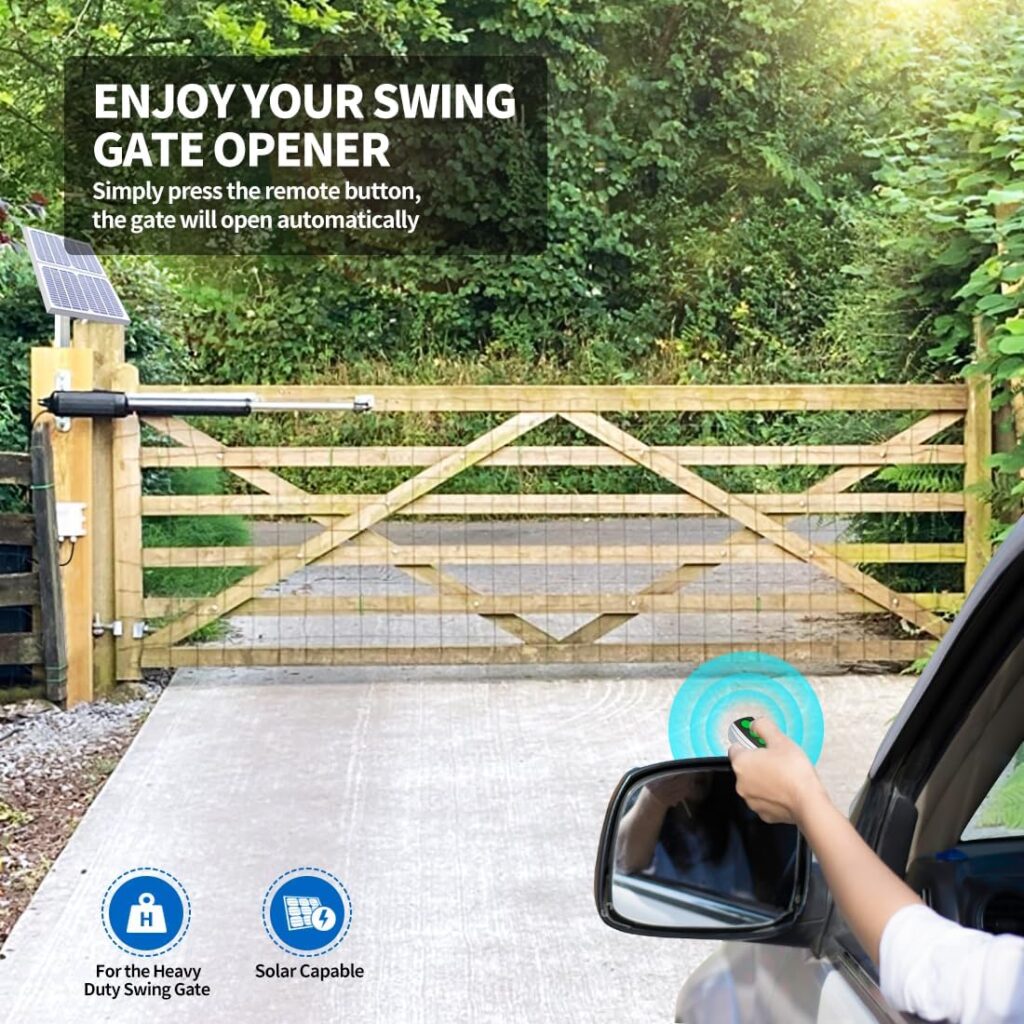
The A8S is TOPENS’ solar-ready version of their popular A8 opener — and the key difference matters. Where the base A8 requires you to source your solar panel and charge controller separately, the A8S bundles a 20W panel kit and controller right in the box. You still need to add a 24V 12Ah battery, but that’s a straightforward purchase.
The 80W motor handles gates up to 880lbs or 18 feet with quiet soft-start and soft-stop that prevents the jarring bang you get from cheaper openers. Auto-close is adjustable anywhere from 3 to 120 seconds. Rolling code remotes mean nobody can clone your signal. TOPENS has been doing this for over 25 years and their installation guides and tech support are genuinely good.
The one thing to know: the standard remote range is 100 feet. That’s fine for most suburban driveways but short for rural properties. You can expand it with their external receiver module, sold separately.
Pros: Solar panel included, heavy-duty 80W motor, quiet operation, 25+ years brand reliability, solid accessories ecosystem
Cons: Short standard remote range, battery not included, 12-month warranty
Best for: Residential single swing gates up to 18ft where you want everything solar-ready without piecing together components
Ghost Controls TSS1XP — Best Warranty and Longest Range
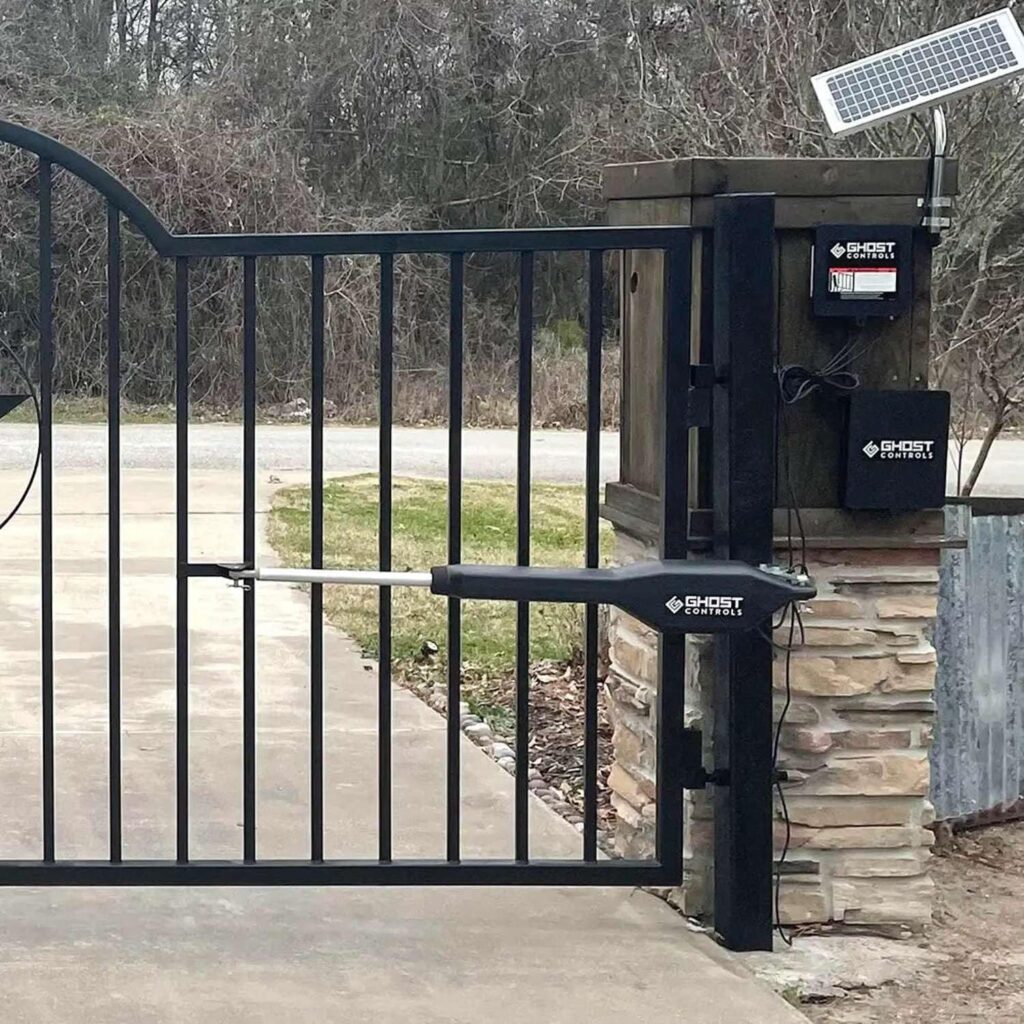
Ghost Controls has been building gate openers for 70+ years and the TSS1XP is their flagship solar single-gate kit. What makes it stand out from the competition is two things: a 1,000-foot remote range and a lifetime warranty on the motor and gear assembly. For something permanently installed outdoors, that warranty is genuinely meaningful — it’s not a marketing statement, it’s a real difference in long-term value.
The kit comes with a 10W monocrystalline solar panel, which is on the lean side for low-sun climates. You can add up to 30W total by plugging in additional panels — a straightforward upgrade if needed. Battery not included; Ghost Controls recommends a 12V deep-cycle marine battery.
Their patented Safe Force technology automatically limits the force on the gate’s leading edge — preventing the opener from crushing anything (or anyone) that gets in the way. It’s a real safety feature, not just a label.
Pros: Lifetime motor warranty, 1,000ft remote range, Safe Force safety system, smart compatible, 70+ years industry experience
Cons: 10W panel is minimal — budget for a second panel in low-sun areas, battery sold separately
Best for: Rural properties with long driveways, anyone who wants maximum warranty protection, farm and ranch gate applications
Ghost Controls TDS2XP — Best for Double Swing Gates
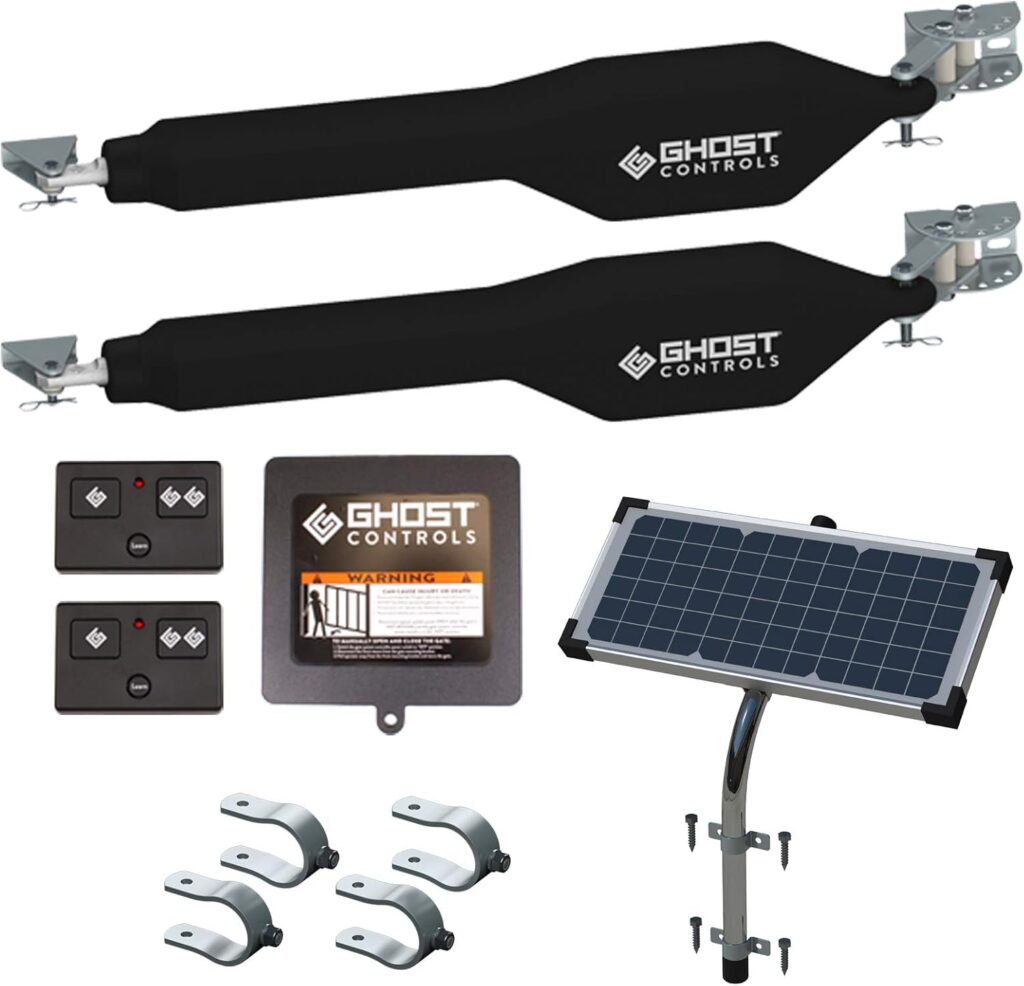
Everything that makes the TSS1XP a strong buy carries over to the TDS2XP — the lifetime motor warranty, the 1,000-foot remote range, Safe Force technology — just with two opener arms instead of one for dual swing gates up to 24 feet total.
Both remotes are included (one per gate arm), and the single control box manages both arms in sequence. The 10W solar panel powers both arms — adequate for normal residential use but again worth upgrading if your climate is cloudy or your usage is heavy.
Pros: Lifetime motor warranty on both arms, 1,000ft remote range, Safe Force on both gates, smart compatible
Cons: 10W solar for two arms is tight — plan to add panels in low-sun areas, two batteries recommended
Best for: Double swing gates on residential estates, farms, and ranches where range and long-term reliability matter most
Mighty Mule MM571W Solar Package — Best for Smart Home Control
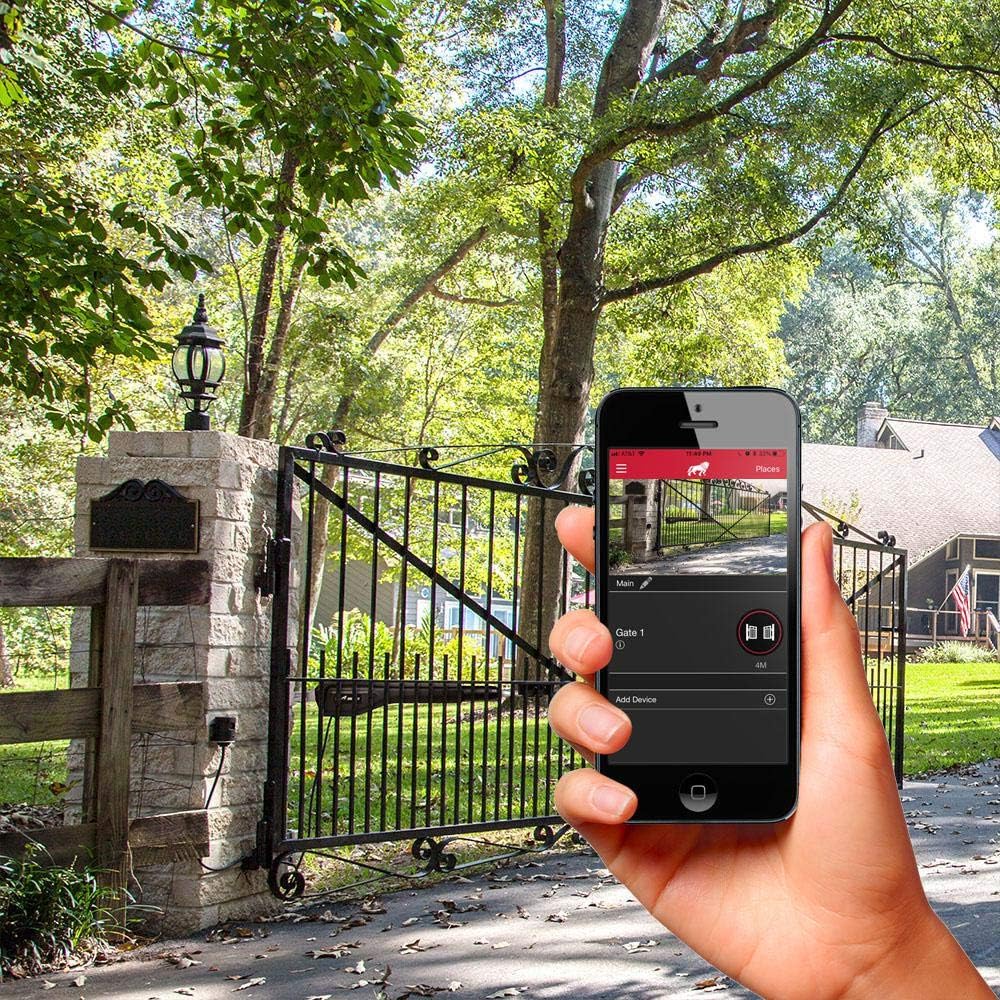
Mighty Mule has been making DIY gate openers for decades and the MM571W Solar Package is their most complete offering. It’s one of the only kits that actually includes the battery — so when it says “solar package,” it means it. You get the opener, a 20W solar panel, and a 12V battery in one purchase.
What sets it apart from everything else on this list is the smart home setup. Pair it with Mighty Mule’s MMS100 Wireless Connectivity Kit (sold separately) and you can control the gate from your phone anywhere within half a mile — the longest smart control range in the residential category. It also integrates with HomeLink, so you can open your gate from your car’s built-in garage button. UL325 certified and designed in North America.
Pros: Solar panel AND battery included, half-mile smart range, HomeLink compatible, UL325 certified, BILT app for installation guidance
Cons: Smart kit sold separately, 18-month warranty
Best for: Homeowners who want full smartphone control, HomeLink integration, and a genuinely complete out-of-the-box package
TOPENS AD8S — Best Heavy Duty Dual Swing Opener
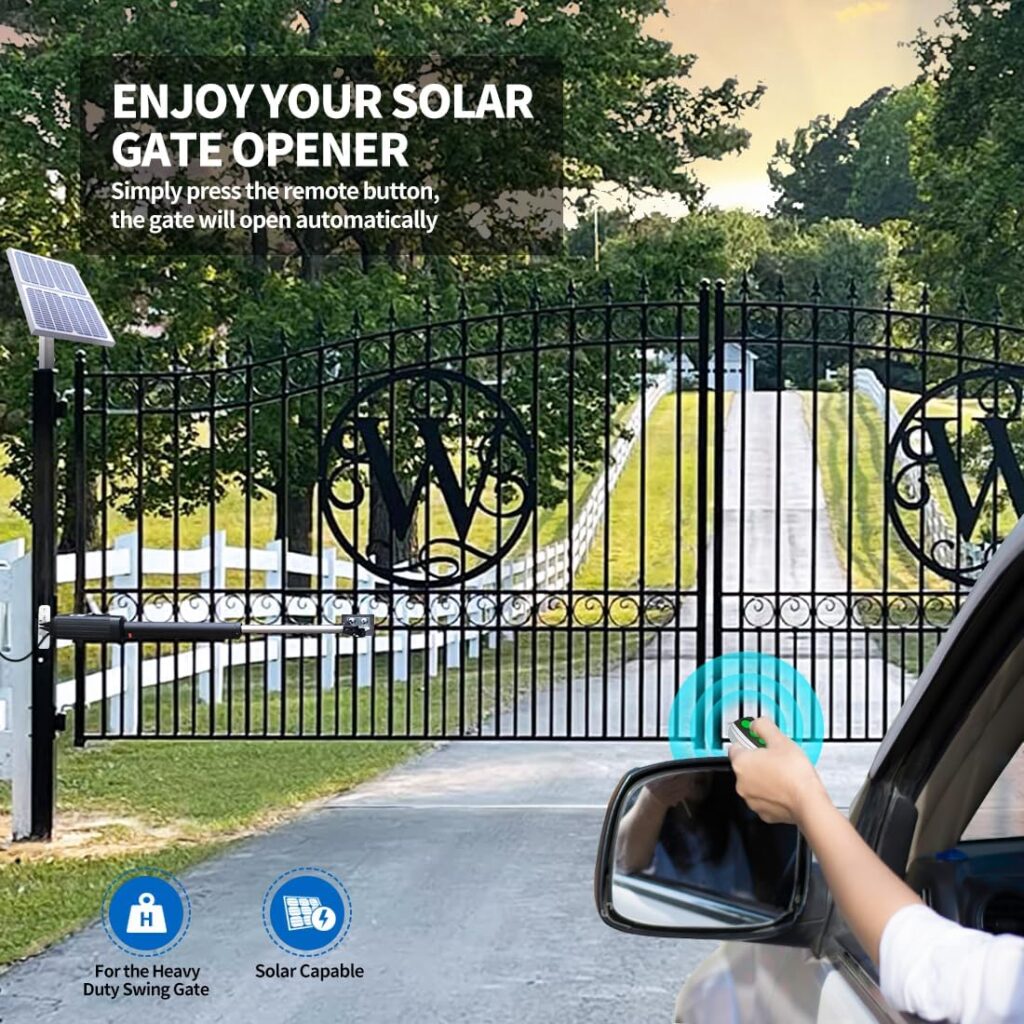
The AD8S is TOPENS’ solar dual-gate opener and it’s built for gates that mean business. Two separate 80W motors — one per gate leaf — handle up to 880lbs or 18 feet per arm, with the same quiet soft-start and rolling code security as the A8S. The 20W solar kit is included; add a 24V battery and you’re ready to go.
One thing the TOPENS ecosystem does well is accessories. You can add a Tuya WiFi control module for smartphone access, a wireless keypad, electric gate lock, vehicle sensor exit wand, and more — all from the same brand, all designed to work together.
Pros: Two powerful 80W motors, solar included, extensive accessories, WiFi app control available, 25+ years TOPENS experience
Cons: Battery not included, base remote is 100ft, WiFi control requires separate module
Best for: Heavy double swing gates on farms, estates, and ranches where both arms need serious pulling power
How Much Solar Does a Gate Opener Actually Need?
Less than you’d think. A single gate cycle uses roughly 0.003Wh of energy — almost nothing. Even including the standby power draw of the control board and electronics running 24/7, total daily consumption usually lands between 5 and 15Wh. A 10W panel in four hours of decent sun produces about 40Wh. The math works out comfortably in most climates.
Where it starts to get tighter is in winter. Shorter days, lower sun angles, and cold temperatures all reduce effective output. If you live somewhere that gets less than three peak sun hours per day for months at a time, upgrading from a 10W to a 20W or 30W panel is worth doing upfront rather than troubleshooting later.
The same logic applies if you add a WiFi connectivity module — those draw constant power and can meaningfully increase daily consumption. Size your panel accordingly.
For the battery: a 12Ah deep-cycle battery gives you a comfortable reserve for 2–3 consecutive cloudy days at normal usage. If your winters are brutal and cloudy, go to 18–22Ah. It’s cheap insurance.
What Installation Actually Looks Like
All five openers in our picks are designed for DIY installation. No welding required, no high-voltage electrical connections — just low-voltage DC wiring and standard hand tools. A single gate opener on a straightforward post takes most people half a day. A dual gate system is closer to a full day.
The basic steps:
- Mount the post bracket to the hinge post
- Mount the gate bracket to the gate leaf
- Attach the opener arm between both brackets
- Mount the control box somewhere weather-protected
- Wire the arm to the control box
- Connect battery and solar panel to the control box
- Program remotes and set your auto-close timer
- Position the solar panel where it gets unobstructed sun
The mistakes that catch people out:
- Mounting the panel where afternoon shade hits it — check the full sun path across your property before drilling anything
- Using a standard car battery instead of a deep-cycle marine battery — car batteries aren’t designed for repeated charge/discharge cycles and fail much faster
- Not leaving enough cable slack for the full gate swing — measure twice
- Mounting the control box with the wiring exits pointing up — water gets in, things corrode. Always point exits down or to the side
As for permits — off-grid gate systems on private residential land typically don’t need one. If you’re in an HOA or have local fence/gate ordinances, check first.
Keeping It Running: Simple Maintenance
Solar gate openers are genuinely low-maintenance, but they’re not zero-maintenance. A quick seasonal check prevents most problems before they happen.
Clean the solar panel. Dust, pollen, and bird droppings can cut output by 10–20%. A damp cloth once a season keeps it working at full capacity. Also check that the mounting angle hasn’t shifted — wind is surprisingly good at rotating adjustable mounts over time.
Watch the battery. Most batteries last 2–5 years in this application. The early warning sign is slow gate operation — if your gate is moving noticeably slower than it used to, especially on consecutive cloudy days, the battery is the first thing to check. Replacing it is usually a 10-minute job and fully restores performance.
Lubricate the hardware. The hinge points, latch, and arm pivot connections benefit from a silicone spray or light grease once or twice a year. Check your manual for guidance on the actuator arm itself — lubricating the wrong part can cause problems.
In winter and snow: Clear the panel after heavy snowfall. Make sure the gate’s swing arc is clear before the first freeze — a gate stuck against frozen ground can damage the motor quickly.
Solar vs. Wired: Which Actually Makes More Sense?
| Factor | Solar Gate Opener | Wired Gate Opener |
|---|---|---|
| Installation cost | Low — no trenching | High — trenching + electrician |
| Ongoing electricity cost | $0 | Small but ongoing |
| Remote location suitability | ✅ Ideal | ❌ Often impractical |
| Works during power outages | ✅ Yes | ❌ No |
| Gate far from house | ✅ No cable needed | ❌ Expensive cable run |
| Battery replacement | Every 2–5 years | Not required |
The honest take: for most homes and rural properties, solar wins on cost and practicality. Running power cable to a gate 200 feet from the house can easily cost $1,000–$3,000 in trenching and electrical work alone. A good solar gate opener costs $350–$550 and gets installed in an afternoon.
The one scenario where wired makes more sense is very high-cycle commercial use — parking facilities, community entrances, anything opening hundreds of times a day. At that volume, solar struggles to keep up and a wired system earns its reliability advantage.
Frequently Asked Questions
Do solar gate openers work at night?
Yes — the battery handles night operation. Solar panels charge the battery during daylight hours and the battery runs the motor whenever you need it, day or night. As long as the battery is healthy and adequately charged, nighttime performance is identical to daytime.
How many times a day can a solar gate opener operate?
Most residential solar systems handle 30–60 open-close cycles per day without any issue. The average home uses far fewer than that. If you genuinely have very high traffic — multiple drivers, frequent deliveries, commercial activity — size up your panel and battery accordingly.
What happens in winter?
Two things work against you in winter: shorter days mean less solar charging time, and cold temperatures temporarily reduce battery capacity. Most well-sized systems manage fine. If you’re in a genuinely harsh climate — extended cloudy periods, temperatures regularly below -10°F — a 18–22Ah battery and an upgraded panel make a real difference.
Can I convert my existing wired gate opener to solar?
Often yes. Many gate openers are marketed as “solar compatible” and can be converted with the addition of a solar panel, charge controller, and battery. Check the specs on your existing control box and your opener manufacturer’s website for compatible solar add-on kits.
Do they work on cloudy days?
Yes, though at reduced charging efficiency — typically 15–30% of full-sun output on an overcast day. The battery absorbs the shortfall. A fully charged 12Ah battery can cover 3–5 days of normal usage without any meaningful sun, which handles most stretches of bad weather comfortably.
How long does the battery last?
Two to five years is typical for a quality 12V deep-cycle battery in this application. You’ll know it’s time to replace it when gate operation slows noticeably, especially after cloudy days. A new battery usually costs $30–$60 and takes 10 minutes to swap in — it’s the most common maintenance item on any solar gate system.
So Which One Should You Buy?
| What You Need | Best Pick |
|---|---|
| Best overall single swing | TOPENS A8S |
| Best warranty + long range | Ghost Controls TSS1XP |
| Best dual swing gate | Ghost Controls TDS2XP |
| Best smartphone control | Mighty Mule MM571W Solar Package |
| Best heavy duty dual swing | TOPENS AD8S |
| Best for farm or ranch | Ghost Controls TSS1XP or TDS2XP |
| Most complete kit (battery included) | Mighty Mule MM571W Solar Package |
For most homeowners with a single swing gate, the Ghost Controls TSS1XP is the one to buy. The lifetime motor warranty and 1,000-foot remote range are real advantages that hold up over years of outdoor use — and that’s what matters for something permanently bolted to your gate post.
For double gates, the Ghost Controls TDS2XP carries over everything that makes the TSS1XP good. For the smartest setup — phone control, HomeLink, battery included — go with the Mighty Mule MM571W Solar Package. And if you need serious power for heavy dual gates, the TOPENS AD8S is the one that won’t let you down.
Whatever you choose, the solar route saves you the trenching cost, keeps your gate running through power outages, and costs nothing to run once it’s up. That’s a hard combination to argue with.