This post contains affiliate links. If you buy through our links we may earn a small commission — at no extra cost to you. This never influences our recommendations.
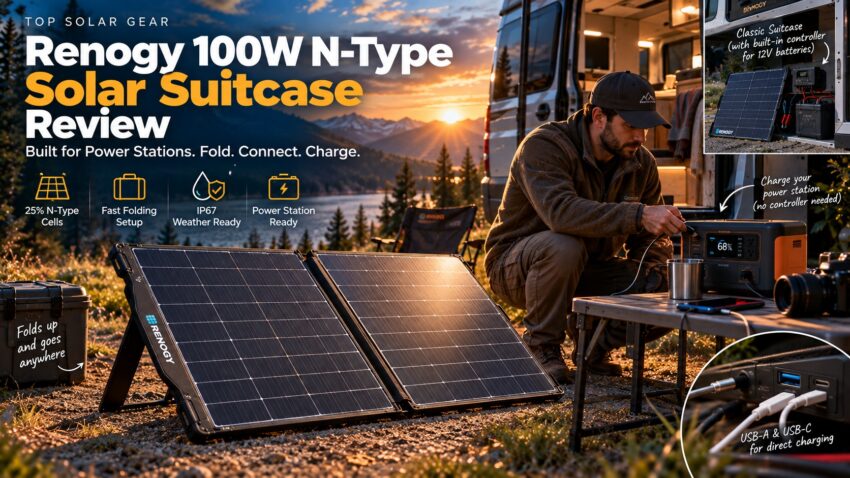
Renogy actually sells two different things under “Solar Suitcase,” and which one you want depends on what you’re charging.
The classic version pairs two 50W panels with a built-in PWM controller and battery alligator clips — built to charge a 12V battery bank directly. The newer N-Type version drops the built-in controller and adds USB-A/Type-C output instead, built specifically to pair with a portable power station.
If you own a Jackery, EcoFlow, Bluetti, or similar power station, the N-Type is the one you want.
| Spec | Renogy 100W N-Type Solar Suitcase |
|---|---|
| Output | 100W, N-Type monocrystalline, 25% cell efficiency |
| Weight | 19% lighter than the previous generation |
| Build | IP67 waterproof, fiberglass reinforced |
| Setup | Sets up in about a minute, sturdy built-in kickstands |
| Outputs | USB-A and USB-C, plus standard solar connector |
| Expandable | Yes, parallel two panels for double the output |
Classic vs. N-Type: The Two Suitcases, Side by Side
| Feature | Classic Suitcase | N-Type Suitcase |
|---|---|---|
| Charge controller | Built-in PWM (Voyager 20A or Adventurer 30A) | None — pairs with your power station’s own charging |
| Connection | Alligator clips to a 12V battery | USB-A / Type-C to a power station |
| Cell efficiency | Standard monocrystalline | 25% efficient N-Type cells |
| Weatherproofing | Not waterproof (controller specifically) | IP67 rated throughout |
| Best for | Direct battery bank charging — RV house batteries, marine, off-grid cabins | Portable power stations — Jackery, EcoFlow, Bluetti, and similar |
If you’re building out an RV or boat electrical system around a battery bank, the classic version’s built-in controller genuinely earns its keep.
If a power station is the whole point, that controller is dead weight — your power station already has its own, and the N-Type skips it entirely to save size and cost.
Real-World Output: What 100W Actually Gets You
Renogy’s own math lands around 500 watt-hours a day, based on 100W across roughly 5 hours of usable sunlight — that’s the textbook number, not the guaranteed one.
Clouds, panel angle, and morning or evening sun at a shallow angle all cut into that. Treat 500Wh as the ceiling on a good day, not the average.
Need more? These panels are built to parallel together — run two of them and you’re looking at roughly double the wattage and daily output, which matters if you’re charging a larger power station.
Before You Buy: Check Your Power Station’s Input
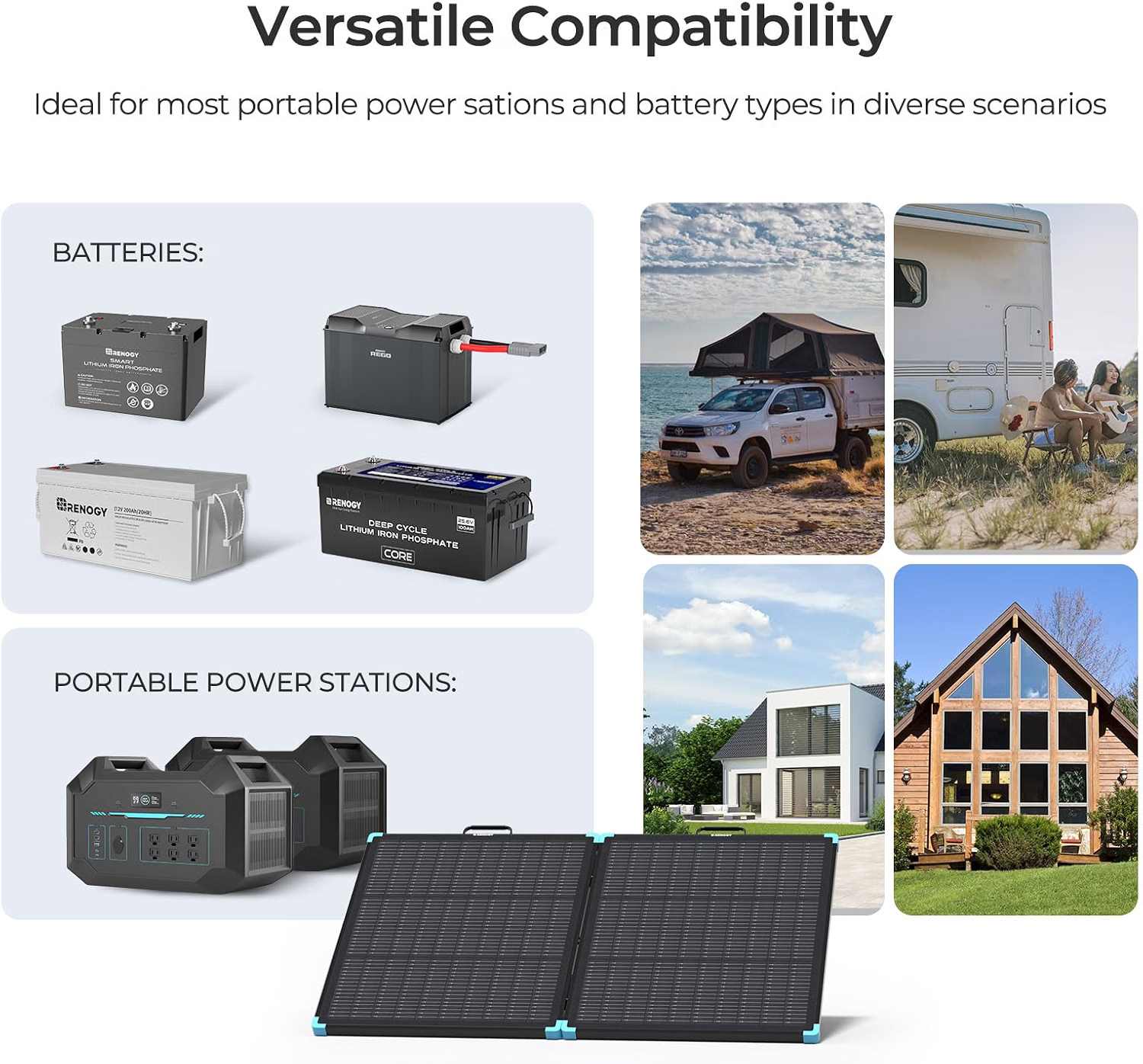
The N-Type Suitcase is built to work with most portable power stations, but “most” isn’t “all” — confirm your power station’s DC input voltage range lines up before ordering.
This is the same connector-compatibility issue we’ve flagged with other panels — check our solar panel wire and connector guide if you’re not sure what your specific power station accepts.
| Pros | Cons |
|---|---|
| Genuinely lightweight and fast to set up | No built-in charge controller — needs a power station or separate controller |
| IP67 waterproof, sturdier build than older canvas suitcases | Real-world output depends heavily on sun conditions, not just the 100W rating |
| USB-A and USB-C outputs for direct device charging | Renogy also sells an older, differently-equipped “Solar Suitcase” — easy to buy the wrong one |
| Parallels with a second panel for double output |
Best for: Portable power station owners who want a fast-folding, weatherproof panel without also needing a separate charge controller.
Renogy 100W N-Type Solar Suitcase
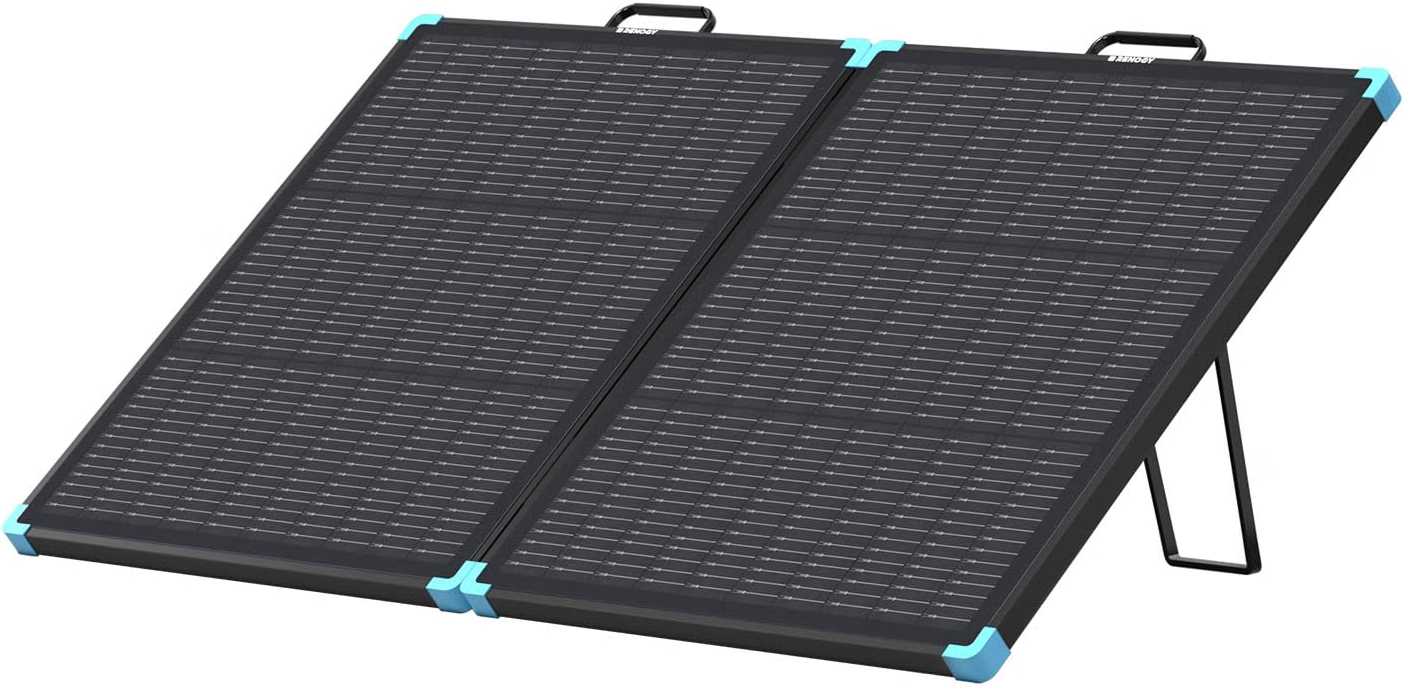
Full details and current price: Renogy 100W N-Type Solar Suitcase on Amazon
Looking for a rigid, permanent-mount panel instead? See our Renogy N-Type 16BB 24V panel review.
Frequently Asked Questions
Does the Renogy Solar Suitcase come with a charge controller?
The N-Type version doesn’t — it’s built to charge power stations directly through USB-A/Type-C. The older classic version does include a PWM controller for direct 12V battery charging.
How much power will a 100W suitcase actually generate per day?
Around 500 watt-hours on a good day with roughly 5 hours of usable sun — expect less on cloudy days or with imperfect panel angle.
Can I connect two Renogy Solar Suitcases together?
Yes, they’re designed to parallel together for roughly double the wattage and daily output.
Will this work with my specific power station brand?
Most portable power stations are compatible, but always check your unit’s DC input voltage range before buying to avoid a mismatch.
Is the Renogy Solar Suitcase waterproof?
The N-Type version is IP67 rated, a real step up from older canvas-cased suitcases that weren’t built for direct rain exposure.
Final Verdict
If you’re charging a portable power station, the N-Type Solar Suitcase is the right buy — just make sure it’s this one and not Renogy’s older battery-clip version before you check out.