This post contains affiliate links. If you buy through our links we may earn a small commission — at no extra cost to you. This never influences our recommendations.
What Makes a Flashlight “Solar” — And What That Actually Means
The term “solar flashlight” covers products with genuinely different designs, capabilities, and use cases. Before buying, it’s worth understanding what the solar charging function delivers in practice — because the expectations gap is wide.
Type 1: Solar + hand crank emergency flashlights
Compact, lightweight flashlights with a small built-in solar panel and a hand crank for backup power generation. Designed as emergency and survival tools. The solar panel generates meaningful charge only over many hours of direct sun. The hand crank is the faster power source: one minute of cranking typically delivers 5–10 minutes of light. Think of these as “you will always have light available” tools, not powerful camping flashlights.
Type 2: Solar rechargeable LED flashlights
Full-sized LED flashlights with a built-in solar panel as one of their charging methods — alongside USB-C charging, which is the primary fast-charge option. The solar panel supplements battery life rather than being the sole power source. These are capable everyday flashlights that happen to have solar backup — often combined with floodlight modes, power bank function, and IP67 weatherproofing. Goal Zero’s Torch series is the benchmark.
Both types are genuinely useful. The right choice depends entirely on what you need it for.
What to Look for in a Solar Flashlight
Lumens — how much light you actually get. 100 lumens is adequate for close-range camp tasks; 300–500 lumens illuminates a campsite or trail well; 1,000+ lumens is appropriate for searching and large areas. Many budget solar flashlights advertise high lumen counts that aren’t sustained — they hit peak lumens briefly at full charge and drop significantly as the battery drains.
Charging methods. The best solar flashlights have multiple charging paths: solar panel (slow, free, always available), USB-C or micro-USB (fast), and often hand crank (immediate power with no charge needed). For emergency use, hand crank is the most important backup — it works with a completely dead battery, in any weather, anywhere.
IP waterproof rating. IP65 resists water jets and rain — the minimum for outdoor use. IP67 withstands 1-metre submersion for 30 minutes — worth the small premium for camping and field use. Budget crank+solar units are typically weather-resistant rather than IP-rated — fine for rain, not for submersion.
Battery capacity (mAh). Larger batteries run longer and have more charge available for phone charging (if the flashlight has a power bank function). Budget solar flashlights typically have 300–600mAh. Mid-range: 1,500–2,000mAh. The Goal Zero Torch 500 has 5,200mAh — enough to charge a smartphone multiple times.
Power bank function. Several solar flashlights charge phones via USB output — turning the flashlight into an emergency power bank. Genuinely useful in blackouts and camping scenarios. The Goal Zero Torch 500 includes this alongside spotlight and floodlight modes.
Beam type. A spotlight projects a concentrated beam at distance — useful for trail navigation and signalling. A floodlight produces wide, diffuse light — useful for illuminating a campsite or tent. The best solar flashlights include both modes.
The Best Solar Flashlights on Amazon Right Now — Verified Picks
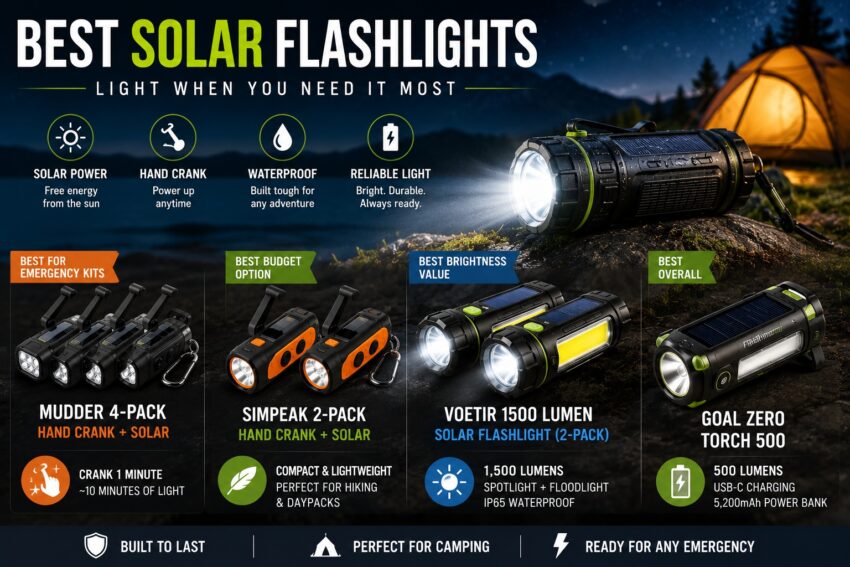
| Product | Lumens | Charging | IP | Battery | Price |
|---|---|---|---|---|---|
| Mudder 4-Pack Crank + Solar | Low LED | Solar + crank | Weather-resistant | Small NiMH | ~$12–$15 |
| Simpeak 2-Pack Crank + Solar | Low LED | Solar + crank | Weather-resistant | Small NiMH | ~$10–$12 |
| VOETIR 1500 Lumen (2-pack) | 1,500 lumen | Solar + USB | IP65 | 2,000mAh | ~$20–$25 |
| Goal Zero Torch 500 | 500 lumen | Solar + USB-C | IP67 | 5,200mAh | ~$60 |
Mudder 4-Pack Hand Crank Solar Flashlight — Best for Emergency Kits and Go-Bags
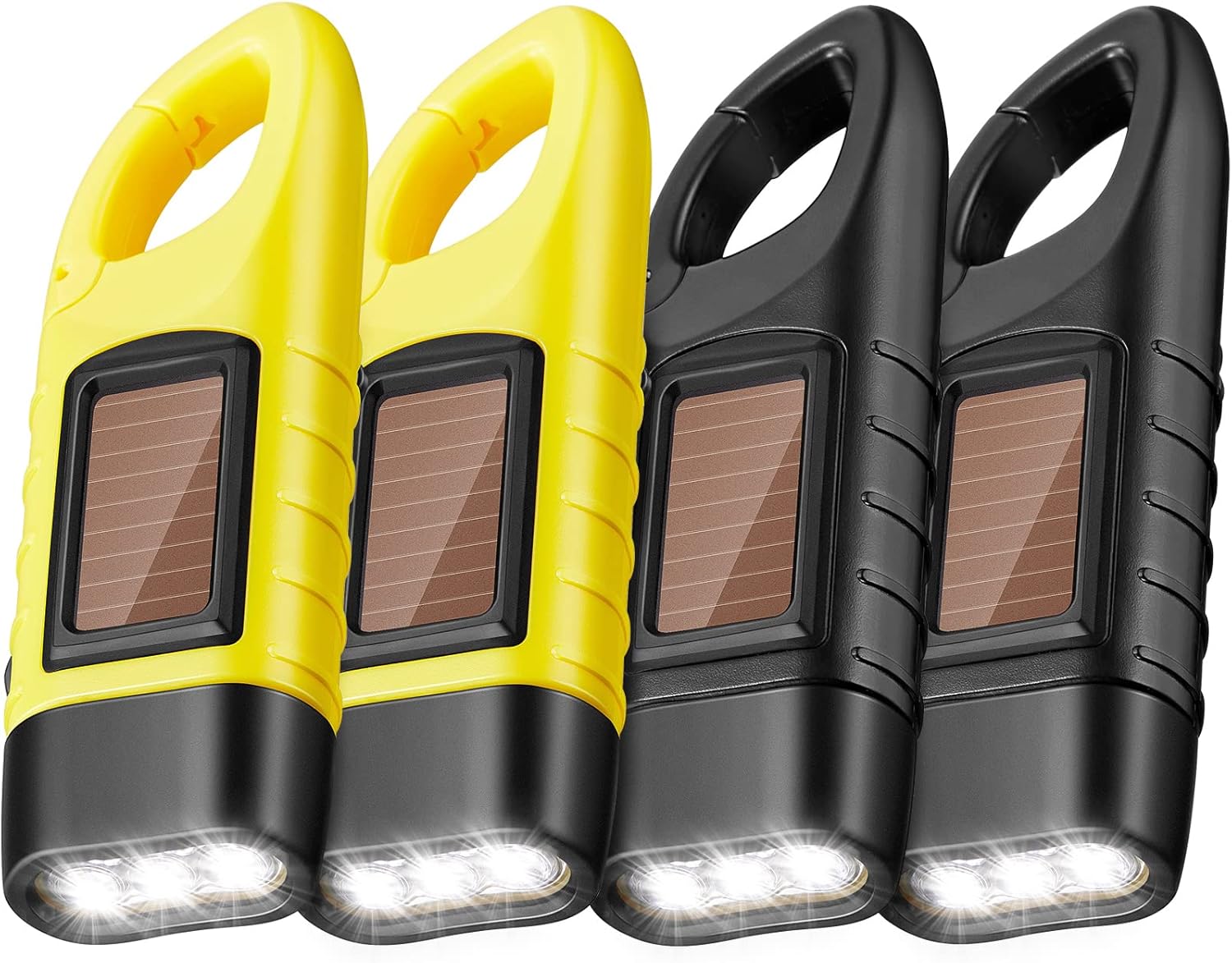
The Mudder 4-pack is the right answer for a specific but extremely common use case: you want multiple reliable emergency light sources that cost almost nothing per unit, will always work regardless of battery condition, and can be distributed across a household, vehicles, or a bug-out kit. Each flashlight contains a small solar panel for passive charging and a hand crank generator for active power — just crank for one minute to produce approximately 10 minutes of light. The compact, carabiner-equipped design clips to a backpack, keychain, or belt loop. Weather-resistant ABS plastic handles outdoor conditions without concern.
The honest performance assessment: these are not powerful flashlights. The LED output is basic — adequate for close-range visibility in a dark tent or during a power outage, not for illuminating a trail at distance. The hand crank is the reliable backup, and it works every time regardless of battery state. For what they’re actually designed for — affordable, always-available emergency light in multiple locations — the Mudder 4-pack delivers exactly what it promises.
Pros: Four units for ~$12–$15 (excellent per-unit value), hand crank works with no battery charge, solar panel provides passive top-up, carabiner clip, compact, no batteries required
Cons: Low lumen output (not a serious camping flashlight), small battery (10 minutes per minute of cranking), solar panel requires hours of bright sun for meaningful charge, no USB charging
Best for: Emergency preparedness kits, vehicle glove boxes, go-bags, household power outage backup
Simpeak 2-Pack Hand Crank Solar Flashlight — Best Budget Compact Option
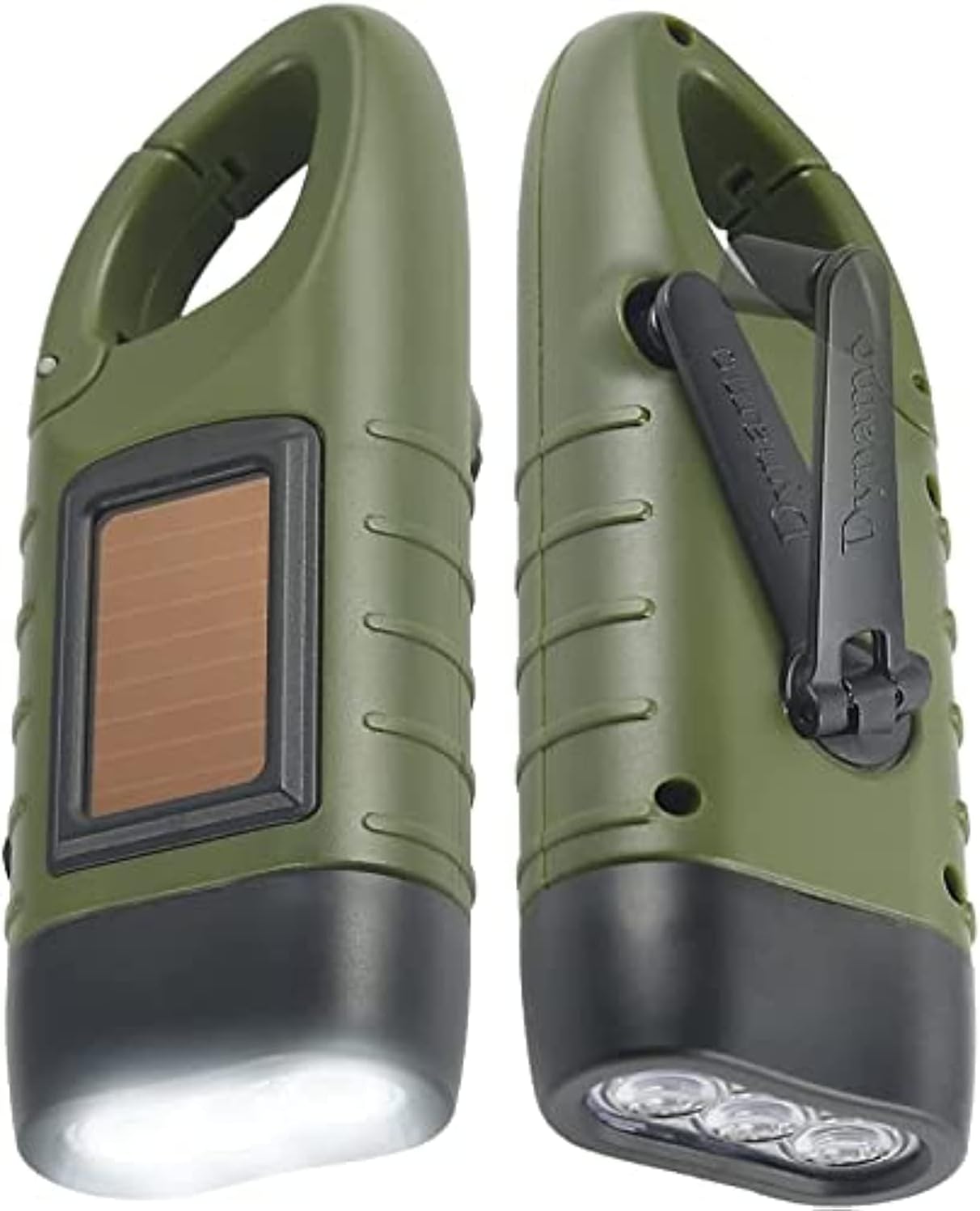
The Simpeak 2-pack follows the same design principle as the Mudder — hand crank + solar panel, compact form, carabiner clip — in a marginally more compact format (approximately 4.9″×1.8″×1.3″, weighing just 86g each). The quick-snap carabiner makes it particularly convenient for attaching to hiking packs or daypacks as a backup light source. The same performance reality applies: this is a backup emergency light, not a primary hiking flashlight. For trail use after dark, step up to the VOETIR or Goal Zero picks.
Pros: Ultra-compact at 86g, quick-snap carabiner, 2-pack value, hand crank + solar, no batteries required
Cons: Low lumen output, small battery, solar charging requires strong direct sun
Best for: Hiking pack backup light, compact emergency addition to a daypack or survival kit
VOETIR 1500 Lumen Solar Flashlight (2-pack) — Best Mid-Range Solar Flashlight
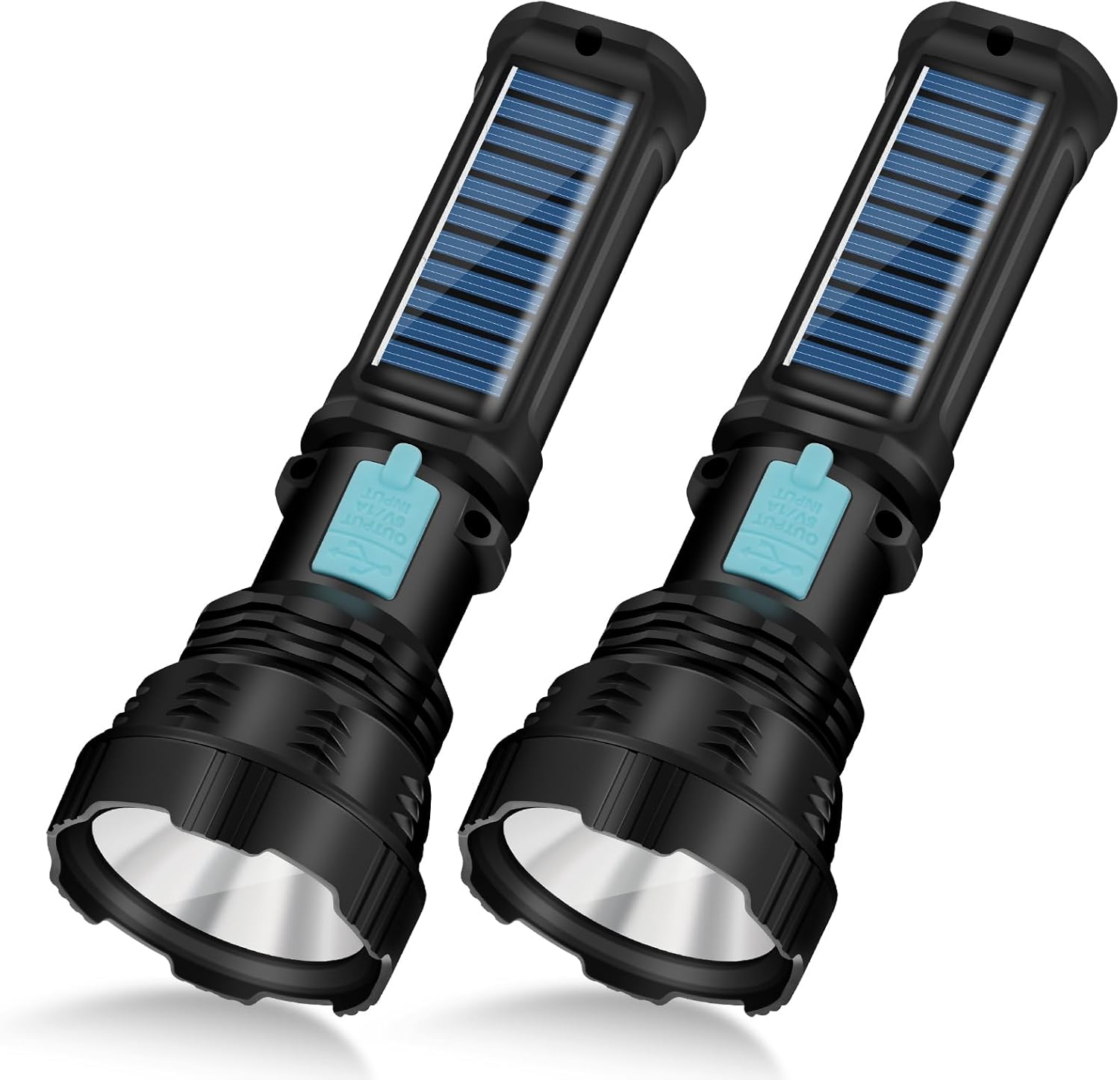
The VOETIR represents a genuinely different category from the crank-and-solar budget picks — it’s a capable LED flashlight that can be solar-charged, not a survival tool that also makes light. At 1,500 lumens peak output, IP65 waterproofing, 2,000mAh battery, and USB charging alongside the built-in solar panel, it sits in the practical middle of the solar flashlight market. The 2,000mAh battery provides meaningful runtime across multiple brightness modes, and IP65 waterproofing handles rain and outdoor conditions reliably.
At ~$20–$25 for two units, the value-per-feature ratio is strong. These are capable camping flashlights that happen to have solar charging — not survival tools with marginal lumen output. The built-in solar panel recharges the battery passively in direct sun — genuinely useful for camping trips where you’re in the sun during the day and want the flashlight ready for evening.
Pros: 1,500 lumen output (genuinely bright), IP65 waterproof, 2,000mAh battery, USB + solar charging, 2-pack value, multiple light modes
Cons: Solar is supplementary — primary charging via USB is faster; IP65 not IP67; 1,500 lumen peak not fully sustained
Best for: Camping and hiking where you want a capable LED flashlight with solar backup charging
Goal Zero Torch 500 — Best Overall Solar Flashlight
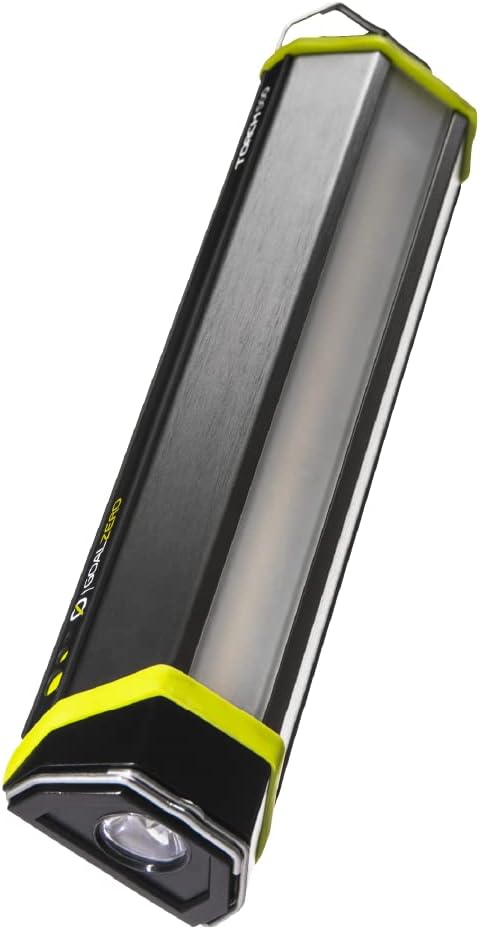
The Goal Zero Torch 500 is in a different category from the other picks — it’s a multi-function outdoor tool that happens to include a flashlight. At ~$60 it’s the most expensive pick, but the feature set justifies every dollar for the buyer who wants the most capable, versatile, best-built solar flashlight available.
Designed for multi-functional use, the Torch 500 boasts 500 lumens in both spotlight and floodlight modes. The IP67 rating ensures protection against dust, sand and debris, and withstands submersion up to 1 metre for 30 minutes. The 5,200mAh battery gives you enough power to charge phones and headlamps multiple times or boost a tablet. Recharge via the built-in solar panel from the sun, or via USB-C input from any power source.
The dual-mode design — spotlight (concentrated beam) and floodlight (wide dispersal) — each with three brightness settings (high, medium, low) — makes this one of the most versatile outdoor lights available. The 5,200mAh power bank function is genuinely useful in the same emergencies where the flashlight itself is needed. The solar charging reality is honest in the specs: 23–46 hours via built-in solar panel for a full charge. USB-C via an external panel or wall charger takes 4–6 hours. Solar is passive maintenance; USB-C is the primary charge method.
Goal Zero is a Utah-based outdoor company with a strong reputation in solar energy — the same brand behind the Yeti power stations and Nomad solar panels. Their Torch line is tested in genuine field conditions globally. Quality and warranty support reflect that standard.
Pros: IP67, 5,200mAh power bank (charges phones multiple times), spotlight + floodlight with 3 settings each, USB-C + solar charging, magnetic base, hanging loop, Goal Zero quality and warranty
Cons: Most expensive at ~$60; solar recharge takes 23–46 hours; no hand crank; 500 lumens is less than VOETIR’s 1,500 peak (though Goal Zero’s 500 is sustained output)
Best for: Camping, outdoor adventures, emergency go-bags, anyone who wants one light that functions as flashlight + lantern + power bank with IP67 protection
Solar Flashlight Charging — Setting Honest Expectations
How long does it take to charge from the sun? For compact crank+solar flashlights: many hours of direct bright sun for a meaningful charge — the hand crank is faster and more reliable. For mid-range units (VOETIR): several hours of direct sun to reach a full charge. For the Goal Zero Torch 500: 23–46 hours of direct sun exposure for a full 5,200mAh charge. The pattern: solar charging is always slower than USB charging, and the smaller the solar panel relative to the battery, the slower it is.
The hand crank reality: One minute of vigorous cranking typically produces approximately 5–10 minutes of LED light at low output. The crank doesn’t charge the battery meaningfully — it generates power directly. You always have light available even from a completely dead battery. Don’t think of the crank as a battery charger; think of it as an emergency generator that runs the light directly.
The practical approach: For outdoor camping — position the flashlight in direct sun during the day for incremental charging, charge fully via USB-C before the trip, use solar to maintain charge over multi-day trips. For emergency kits — plug in and fully charge via USB once or twice a year. The solar panel provides passive maintenance if it occasionally sees indirect light. The hand crank provides reliable emergency power regardless of battery condition.
Solar Flashlights for Emergency Preparedness
For a household emergency kit: A multi-pack of hand crank + solar flashlights (Mudder 4-pack) — one per key room, one in the car, one in a go-bag. At ~$3 per unit they’re cheap enough to stock liberally. Supplement with one capable unit like the Goal Zero Torch 500 that also charges phones during an extended outage.
For a go-bag or 72-hour kit: The Goal Zero Torch 500 is the strongest single unit — IP67, 5,200mAh power bank, spotlight + floodlight, solar + USB-C. Add a Mudder or Simpeak crank unit as a redundant backup for a few dollars.
For a vehicle: A Mudder or Simpeak crank + solar unit in the glove box. No battery to die, no charging required, available whenever needed.
Frequently Asked Questions
How long does a solar flashlight last?
The LED bulbs themselves last 50,000+ hours — effectively the life of the product. The battery degrades over time — typically 2–4 years of regular cycling for budget units, 3–5 years for quality Li-ion batteries. For crank+solar units, the crank mechanism is the most failure-prone component.
Can a solar flashlight charge in indirect light or indoors?
Very slowly. Built-in solar panels in solar flashlights are small and require direct, bright sun for meaningful charge rates. Indirect light, cloudy conditions, and indoor window light produce minimal charging. Never expect an indoor window to meaningfully charge a solar flashlight.
What is the difference between a solar flashlight and a solar lantern?
A flashlight produces a directional beam — useful for spotlighting and close-range tasks. A lantern produces omnidirectional light — illuminating a wider area with less concentrated brightness. Many quality outdoor solar lights combine both modes (like the Goal Zero Torch 500 with spotlight + floodlight). For camp lighting specifically, a solar lantern often provides more useful ambient light. See our solar lanterns guide for dedicated lantern options.
Are solar flashlights good for camping?
For casual camping: yes — the VOETIR 1,500 lumen model provides genuine brightness with solar supplementary charging. For serious backpacking where sustained high lumen output matters most, purpose-designed LED flashlights optimised for pure performance may be better suited. Solar charging is most useful for car camping and base camps where the flashlight can charge in the sun during the day.
Can I use a solar flashlight underwater?
Only with an appropriate IP rating. Budget crank+solar models are weather-resistant but not waterproof — don’t submerge them. The VOETIR at IP65 handles rain but not submersion. The Goal Zero Torch 500 at IP67 handles submersion to 1 metre for 30 minutes — appropriate for accidental drops in water.
Final Verdict
| Your Situation | Best Pick |
|---|---|
| Emergency kit on a budget | Mudder 4-Pack (~$12–$15) |
| Compact hiking backup | Simpeak 2-Pack (~$10–$12) |
| Camping / outdoor, bright light | VOETIR 1500 lumen 2-pack (~$20–$25) |
| Best overall, power bank, IP67 | Goal Zero Torch 500 (~$60) |
| Go-bag single unit | Goal Zero Torch 500 |
| Vehicle / car kit | Mudder or Simpeak crank unit |
| Multiple locations, household coverage | Mudder 4-Pack |
For most buyers, the practical combination is a Mudder 4-Pack for emergency kit coverage at minimal cost, and a Goal Zero Torch 500 as the primary flashlight for camping and serious use. For ~$75 total, you have reliable emergency light in every room and a premium multi-function light for outdoor adventures.
For more solar lighting options, see our guides to solar lanterns for camp and garden lighting, solar deck lights for outdoor home lighting, and outdoor solar flood lights for security and area lighting.