“Lithium Solar Battery” — What the Term Actually Covers
“Lithium battery” is not a single technology. It’s a family of chemistries sharing the same fundamental lithium-ion mechanism but differing significantly in implementation. For solar storage specifically, this distinction matters enormously — the wrong lithium chemistry results in a system that’s less safe, less durable, and more expensive over its lifetime.
There are two lithium chemistries relevant to solar storage:
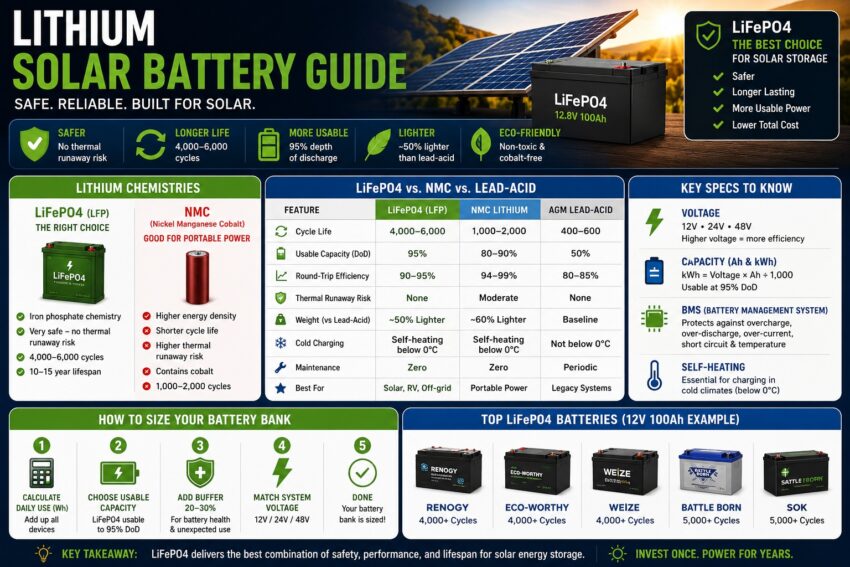
LiFePO4 (Lithium Iron Phosphate / LFP) — the correct choice for solar storage in virtually all applications. Cobalt-free, using iron and phosphate as cathode material. Exceptional thermal stability — no thermal runaway risk under normal conditions. LiFePO4 batteries typically offer between 3,000 and 7,000 cycles, compared to around 1,000 to 2,000 cycles for NMC under similar conditions. The chemistry behind every quality solar battery on this site.
NMC (Nickel Manganese Cobalt) — the chemistry in portable power stations, laptop batteries, and EV packs. Higher energy density than LiFePO4, but shorter cycle life, higher thermal runaway risk, and cobalt dependency. NMC offers higher energy density but shorter lifespan — ideal for portable or temporary solar setups, not stationary storage.
For 90% of residential and off-grid solar applications, LiFePO4 is the best lithium battery for solar — inherently stable, no thermal runaway risk, non-toxic materials, and 4,000–6,000 charge-discharge cycles lasting 10–15 years of daily use. Everything in this guide focuses on LiFePO4.
Why LiFePO4 Dominates Solar Storage
Safety — the primary advantage
LiFePO4 uses iron and phosphate — materials that are abundant, cheaper to source, cobalt-free, and much easier to recycle. More practically: LiFePO4 cells do not experience thermal runaway — the failure mode where an overheated cell triggers neighbouring cells in a chain reaction. NMC cells can experience thermal runaway from overcharging, physical damage, or manufacturing defects. For a battery installed indoors — in a basement, RV, van, or cabin — the LiFePO4 safety margin is meaningful and real.
Cycle life — the economics driver
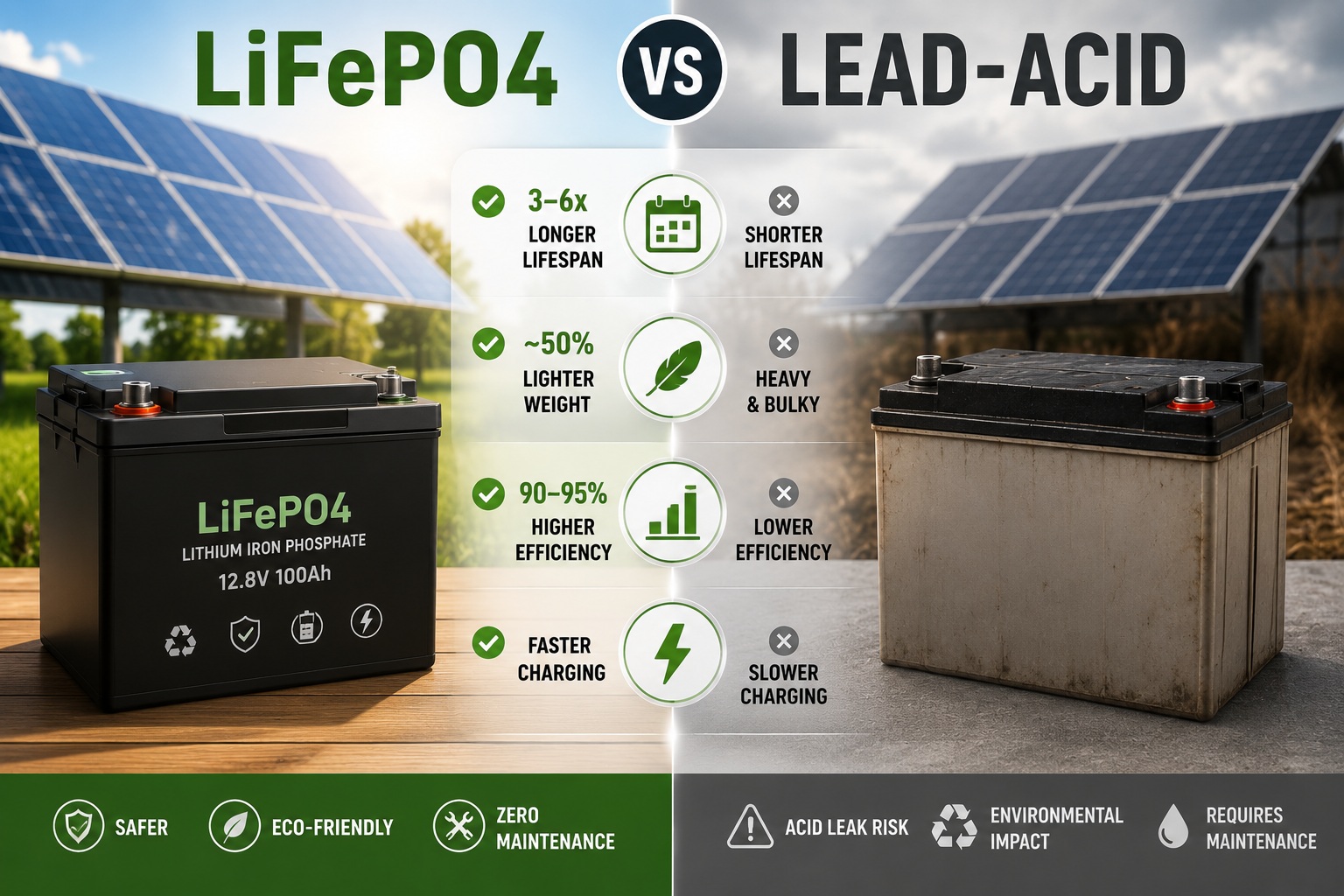
At 4,000–6,000 cycles versus 1,000–2,000 for NMC and 400–600 for AGM lead-acid, LiFePO4 delivers 3–10× more energy over its lifetime from the same physical battery. A 10 kWh LiFePO4 system used for off-grid living will maintain 80% of its capacity after a decade — far outperforming NMC (5–7 years) or lead-acid (3–5 years). Fewer replacements and lower total cost of ownership.
Usable capacity — the practical advantage
LiFePO4 can be discharged to 95–100% depth of discharge without cell damage. AGM lead-acid should only be discharged to 50% — meaning a 100Ah lead-acid battery only delivers 50Ah usable. A 100Ah LiFePO4 delivers 95–100Ah usable. You need roughly half as many lithium amp-hours as lead-acid amp-hours for the same usable storage.
Flat discharge curve — consistent power
LiFePO4 batteries provide a very flat voltage discharge curve, delivering consistent power until the battery is nearly depleted. Lead-acid and NMC show a declining voltage curve — your inverter and electronics experience lower voltage as the battery drains. LiFePO4 maintains near-nominal voltage throughout the discharge cycle.
Weight — approximately 50% lighter than equivalent lead-acid capacity, meaningful for RV and van applications.
LiFePO4 vs. NMC vs. Lead-Acid — Complete Comparison
| Factor | LiFePO4 | NMC Lithium | AGM Lead-Acid |
|---|---|---|---|
| Cycle life | 4,000–6,000 cycles | 1,000–2,000 cycles | 400–600 cycles |
| Usable capacity (DoD) | 95% | 80–90% | 50% |
| Round-trip efficiency | ~90–95% | ~94–99% | ~80–85% |
| Thermal runaway risk | None | Moderate | None |
| Cobalt dependency | No | Yes | No |
| Weight (vs lead-acid) | ~50% lighter | ~60% lighter | Baseline |
| Cold charging | Needs self-heating below 0°C | Same | Not below 0°C |
| Maintenance | Zero | Zero | Periodic (flooded) |
| Best for | Solar storage, RV, off-grid | Portable power stations | Legacy systems only |
On round-trip efficiency: NMC batteries have a slight efficiency advantage at 94–99% vs LiFePO4’s 90–95%. The difference is real but small — and completely offset by LiFePO4’s 3–5× longer cycle life. Over the full system lifetime, LiFePO4 delivers far more energy per dollar invested.
Understanding Lithium Solar Battery Specifications
Voltage: 12V, 24V, or 48V
The most important system architecture decision — battery voltage determines the rest of the system design.
- 12V systems: Entry-level standard. Widely compatible with RV, van, and marine components. Best for smaller systems under 3kWh.
- 24V systems: Twice the voltage means half the current for the same power — thinner wire and more efficient charging. Two 12V batteries in series = 24V. Appropriate for 3–10kWh systems.
- 48V systems: Standard for larger residential and off-grid systems. Four 12V batteries in series = 48V. Required for most hybrid inverters and home battery systems above 5kWh.
Amp-hours (Ah) and kilowatt-hours (kWh)
Capacity = Voltage × Amp-hours ÷ 1,000 = kWh.
100Ah at 12V = 1.28kWh. 100Ah at 24V = 2.56kWh. 100Ah at 48V = 5.12kWh.
Usable at 95% DoD: 100Ah 12V → 1.22kWh per cycle.
BMS — the brain of the battery
The Battery Management System prevents over-charge, over-discharge, over-current, short circuit, and temperature damage. BMS quality is the most important differentiator between cheap and quality LiFePO4 batteries. Key specs: continuous discharge current, peak discharge current, charge current limit, and temperature cutoff thresholds.
Self-heating — critical for cold climates
LiFePO4 cannot be charged below 0°C (32°F) without a self-heating function — doing so causes permanent lithium plating damage to the anode. For RV, van, or outdoor installations in cold climates, a battery with built-in self-heating is essential, not optional.
How to Size a Lithium Solar Battery Bank
Step 1 — Calculate daily consumption in Wh
| Appliance | Watts | Hours/Day | Daily Wh |
|---|---|---|---|
| Compressor fridge | 45W avg | 24 hrs | 1,080Wh |
| LED lighting | 20W | 5 hrs | 100Wh |
| Laptop | 60W | 4 hrs | 240Wh |
| Phone charging ×2 | 30W | 2 hrs | 60Wh |
| Water pump | 60W | 0.5 hrs | 30Wh |
| Typical RV/cabin total | ~1,510Wh |
Step 2 — Determine days of autonomy
Daily consumption × desired days of autonomy = raw battery requirement.
For 2 days: 1,510Wh × 2 = 3,020Wh.
Step 3 — Account for DoD
3,020Wh ÷ 0.95 = 3,179Wh of rated LiFePO4 capacity needed.
Step 4 — Convert to Ah at your system voltage
At 12V: 3,179Wh ÷ 12V = 265Ah → three 100Ah 12V LiFePO4 batteries in parallel.
At 24V: 3,179Wh ÷ 24V = 133Ah → two pairs of 12V batteries in series.
Step 5 — Match to solar charging
3,179Wh ÷ 5 peak sun hours ÷ 0.80 efficiency = 794W of solar panels minimum.
For our complete system sizing walkthrough — panels, charge controllers, inverters, and wiring — see our off-grid solar system guide.
Best Lithium Solar Batteries — Quick Reference
Our complete product reviews and specific purchase recommendations are in our solar battery guide. Here’s the quick reference for each use case:
| Battery | Cycles | Key Feature | Price | Best For |
|---|---|---|---|---|
| Renogy 100Ah LiFePO4 Standard | 4,000+ | FCC+UL, RS485 monitoring | ~$180 | Best value, most applications |
| Renogy 100Ah Pro (BT + Self-Heat) | 5,000+ | IP67, 200A BMS, self-heating | ~$270 | Cold climates, marine |
| LiTime 100Ah Bluetooth | 4,000+ | Bluetooth, budget-first | ~$170 | Budget buyers wanting BT monitoring |
| Battle Born 100Ah | 3,000+ | 10-year warranty, USA assembled | ~$950 | Premium RV/marine, warranty priority |
Charge Controller Settings for LiFePO4 Batteries
A LiFePO4 battery requires different charge voltage settings than lead-acid. Connecting a LiFePO4 battery to a charge controller still set to lead-acid profiles overcharges the battery — causing BMS disconnections and cell degradation.
Most MPPT charge controllers (Renogy Rover, Victron SmartSolar, Epever Tracer) include a dedicated LiFePO4 preset. Always verify your controller has this before connecting.
Required settings for 12V LiFePO4:
- Bulk/Absorption voltage: 14.2–14.6V (most manufacturers specify 14.4V)
- Float voltage: 13.5–13.8V (some recommend disabling float entirely)
- Equalisation: Disable completely — LiFePO4 does not require equalisation; it can damage cells
- Temperature compensation: Disable — LiFePO4 does not use temperature-compensated charging
For 24V LiFePO4: double the 12V values. For 48V: quadruple. See our MPPT charge controller guide for compatible controllers and full configuration guidance for every major brand.
Series and Parallel Wiring for Lithium Solar Battery Banks
Parallel wiring (adds capacity, keeps voltage): Two 12V 100Ah batteries in parallel = 12V 200Ah. Always use matched batteries — same brand, model, age, and state of charge before connecting.
Series wiring (adds voltage, keeps capacity): Two 12V 100Ah batteries in series = 24V 100Ah. Four in series = 48V 100Ah. All batteries in a series string must be identical.
Series-parallel: Four 12V 100Ah batteries — two pairs in series (24V), then the pairs in parallel = 24V 200Ah. Standard configuration for a 4-battery bank.
Fusing is essential: Each parallel connection requires an inline fuse. Never connect batteries in parallel without individual fusing — a failed battery without a fuse will discharge all others into it uncontrolled. Our off-grid solar system guide covers fuse sizing for every configuration.
LiFePO4 Safety — What You Need to Know
LiFePO4 chemistry is inherently stable, does not produce hydrogen gas during charging (unlike lead-acid), and has no risk of thermal runaway under normal operating conditions. It is safe for indoor installation without ventilation requirements.
Never do with LiFePO4:
- Charge below 0°C (32°F) without self-heating function — causes permanent lithium plating
- Use a charger set to lead-acid voltage profile — overvoltage stresses the BMS and cells
- Mix batteries of different ages or capacities in the same series/parallel bank
- Leave at 0% state of charge for extended periods — deep over-discharge damages cells
- Store at 100% state of charge long-term — store at 50–60% for extended storage
The BMS handles automatically: Over-voltage, under-voltage, over-current, short circuit, and temperature protection. These are automatic disconnections — no owner intervention required.
Frequently Asked Questions
What is a lithium solar battery?
In the context of solar storage, a lithium solar battery is almost always a LiFePO4 (Lithium Iron Phosphate) battery — the lithium chemistry appropriate for stationary solar energy storage. The term “lithium battery” technically includes NMC (used in portable power stations and EVs), but LiFePO4 is the correct chemistry for solar battery banks due to its superior safety, longer cycle life, and flat discharge curve.
How long do lithium solar batteries last?
Quality LiFePO4 solar batteries are rated for 4,000–6,000 cycles before reaching 80% of original capacity. At one cycle per day, that’s 11–16 years. A 10 kWh LiFePO4 system used daily will maintain 80% of its capacity after a decade. In practice, most solar applications cycle less than once per day, extending actual lifespan further. The Renogy Pro series (5,000+ cycles) and Battle Born (10-year warranty) represent the top longevity options in the consumer market.
Can I replace my lead-acid solar batteries with lithium?
Yes — and it’s one of the most impactful upgrades possible. Key requirements: your charge controller must support LiFePO4 charging profiles (verify and update settings before connecting), your inverter’s low-voltage cutoff must be compatible with LiFePO4 discharge range, and the new bank must be the same voltage as the old. Because LiFePO4 is usable to 95% DoD versus 50% for lead-acid, you need roughly half the amp-hours of lithium to match the same usable capacity. See our solar battery guide for specific replacement recommendations.
Do lithium solar batteries work in cold weather?
Yes — for discharge, down to -20°C (-4°F), though capacity is reduced at extreme cold. For charging: LiFePO4 cannot be charged below 0°C (32°F) without a self-heating function — the BMS disconnects charging in sub-freezing conditions to protect cells. For cold climate installations, a self-heating battery (Renogy Pro series) is essential to maintain winter charging capability.
What size lithium battery do I need for solar?
Depends on your daily energy consumption and desired days of autonomy — the full calculation is in this article. As a rough guide: for a typical RV or cabin (fridge + lights + device charging ≈ 1,200–1,500Wh/day), two to three 100Ah 12V LiFePO4 batteries provide 1–1.5 days of autonomy when paired with 200–400W of solar panels.
Is LiFePO4 the same as lithium-ion?
LiFePO4 is one type of lithium-ion battery — it uses the same fundamental electrochemical mechanism. The distinction is the cathode material: LiFePO4 uses iron phosphate (safer, longer cycle life, lower energy density), while NMC uses nickel manganese cobalt (higher energy density, shorter cycle life, thermal runaway risk). When someone says “lithium solar battery,” they should mean LiFePO4.
Final Thoughts
The shift from lead-acid to LiFePO4 is the single highest-impact upgrade you can make to a solar power system. The batteries cost more upfront, but they last longer, weigh less, deliver more usable capacity, and require zero maintenance. There is no longer a compelling reason to build a new solar system on lead-acid chemistry.
The decision within the lithium solar battery market is simpler than it appears: LiFePO4 for any stationary storage application. Renogy’s lineup for value and proven performance. Battle Born for premium domestic support and warranty confidence. Self-heating models (Renogy Pro) for cold climates. And always an MPPT charge controller — not PWM — to extract the full benefit of LiFePO4’s superior charging efficiency.
For complete product reviews and specific purchase recommendations, see our solar battery guide. For the charge controllers that connect these batteries to your solar panels, see our MPPT charge controller guide. For complete off-grid system design integrating lithium batteries, panels, and inverters, see our off-grid solar system guide.