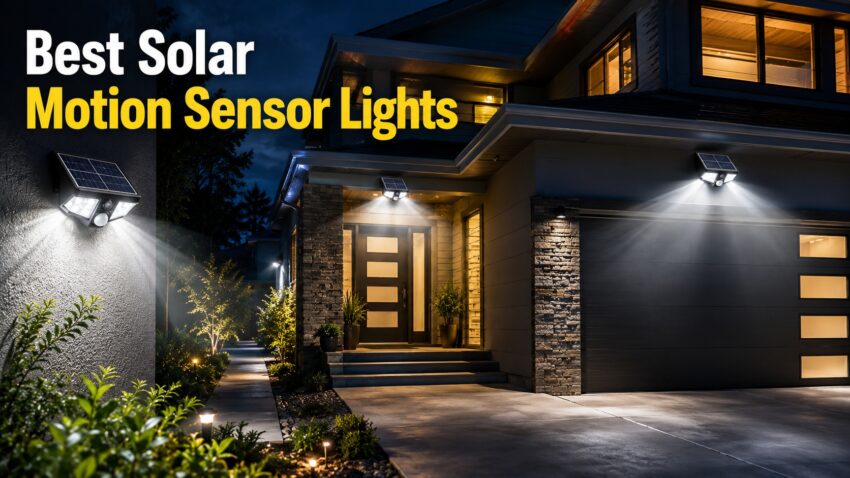
This post contains affiliate links. If you buy through our links we may earn a small commission — at no extra cost to you. This never influences our recommendations.
Solar Motion Sensor Lights — What Actually Makes One Work
The difference between a solar motion sensor light that genuinely secures your property and one that’s a deterrent-shaped decoration comes down to four specifications most buyers overlook: detection range, coverage angle, lumen output at the mounting height, and sensitivity adjustment. Get those right for your specific locations, and even a $25 light provides real security value. Get them wrong, and a $60 light leaves blind spots in all the wrong places.
How Solar Motion Sensor Lights Work — The Technology Behind the Trigger
Every solar motion sensor light contains a PIR sensor — Passive Infrared. Understanding how PIR detection works explains both why these lights perform the way they do and how to position them correctly.
PIR sensors detect heat differential, not movement. A PIR sensor doesn’t see movement — it detects the change in infrared radiation (heat) across its field of view. When a warm body (person, animal, vehicle) moves through the sensor’s detection zone, it creates a temperature differential between adjacent detection cells, triggering the light. This is why cold nights make PIR sensors more sensitive (greater contrast between body heat and ambient temperature), hot summer afternoons can reduce sensitivity, and a stationary person doesn’t trigger the light — no movement means no heat differential change.
Detection range vs. illumination range — the most misunderstood distinction. Detection range is how far the PIR sensor detects movement. Illumination range is how far the beam extends. These are completely different numbers. Detection ranges of 10–16 feet suit entries or small yards, while 26–33 feet cover driveways or large areas. A light with a 16-foot detection range mounted at 8 feet illuminates a specific cone — the person outside that cone is in darkness until they move closer.
Coverage angle — 120° vs. 270°. The coverage angle determines the width of the detection cone. A 120° sensor covers a roughly triangular zone directly in front — useful for focused doorway or path coverage. A 270° sensor covers nearly a full semicircle — appropriate for building corners and large yards where threats can approach from multiple directions. A bright light with a narrow sensor is useless for a wide driveway; match the sensor coverage to your actual space first, then worry about lumens.
Lumen Output — How Bright Is Actually Bright Enough?
| Location | Recommended Lumens | Why |
|---|---|---|
| Doorways and entries | 400–800 lumens | Close range, focused coverage |
| Side passages and gates | 600–1,000 lumens | Moderate range, deterrence |
| Driveways | 1,200–2,500 lumens | Wide area, vehicle detection |
| Large yards and perimeters | 2,000–4,000 lumens | Maximum coverage, deterrence |
| Stairways and paths | 200–400 lumens | Navigation, not security |
Mounting height matters. A 1,600-lumen light at 6 feet produces intense direct illumination but a narrow ground footprint. The same light at 12 feet spreads wider but with slightly less intensity at ground level. The security sweet spot for most residential use is 8–12 feet — high enough for wide coverage, low enough that the beam is still intense at face level. Higher mounting points give better coverage; if you want your motion sensor to detect movement from farther away, place it higher up.
Honest note on solar lumen ratings. Solar security lights often advertise peak lumen figures achievable only at full charge under ideal conditions. Real-world output degrades as battery depletes — a light rated at 800 lumens may produce 500–600 lumens midway through the night. Choose units with larger battery capacity (2,000mAh+) for locations where consistent all-night output is critical.
The Three Lighting Modes — Which to Use Where
Mode 1 — Motion Sensor Only (security mode): Light stays off until motion is detected, then triggers to full brightness for a set duration. Conserves battery most effectively and provides maximum deterrent impact — a sudden bright light is more alarming to an intruder than one that was already on. Best for: secondary entrances, garage approaches, areas where continuous lighting isn’t needed.
Mode 2 — Dim Continuous + Motion Boost: Light runs at reduced brightness (10–30% output) continuously, boosting to full brightness when motion is detected. Provides ambient lighting plus security trigger. Best for: front paths, steps, primary entrances where continuous low-level lighting is useful.
Mode 3 — Continuous Full Brightness: Light stays at full brightness all night. Maximum battery draw — typically 2–4 hours before battery depletes on most units. Best for: temporary use during outdoor events, not for overnight security.
For pure security applications, Mode 1 is the correct choice in almost every location.
Avoiding False Triggers — The Most Common Complaint
Passing vehicles on a nearby road. A 270° sensor facing a street picks up every car. Solution: adjust the sensor angle away from traffic, or reduce sensitivity until passing vehicles no longer trigger it but approaching pedestrians do.
Animals. Most PIR sensors detect animals reliably — they’re warm-bodied. Raising mounting height to 10–12 feet and angling the sensor slightly downward reduces sensitivity to small animals while maintaining human detection.
Overhanging vegetation. Branches moving in wind across a PIR sensor’s field of view trigger false activations. Trim vegetation within the detection cone, or choose a location where the sensor faces an unobstructed zone.
The sensitivity dial. Most quality motion sensor lights include an adjustable sensitivity dial. Start at medium sensitivity and reduce until false triggers stop — while confirming a person still triggers reliably. Spend 10 minutes on this after installation to dial in the correct sensitivity for each specific location.
Where to Mount Solar Motion Sensor Lights
Front door and entry: Mount at 8–10 feet on either side of the door, angled slightly downward to cover the approach path. 270° sensors cover the full door approach from a single mounting point. Two units — one on each side — eliminate all blind spots.
Garage approach and driveway: The highest-priority security location for most homes. A high-lumen unit (1,600–2,500 lumens) with 26–33 foot detection range mounted at 10–12 feet provides the necessary coverage. A 3-head adjustable unit allows aiming individual heads at the driveway entry, garage door, and side approach simultaneously.
Side passages and gates: Typically narrow channels where a single 270° unit mounted at the passage midpoint covers the full width. Lower lumen requirements (400–800 lumens) — the close range compensates. A multi-pack compact unit provides redundancy across multiple side passages.
Backyard and rear of property: The most commonly neglected security zone. A 270° unit at each rear corner provides overlapping coverage with no dead zones between them. Choose units with larger battery capacity for rear perimeter coverage where ambient darkness is greatest.
Building corners — the most important locations. Building corners are the most common blind spots. 270° sensors mounted at corners solve this: a single unit sees both the front approach and the side approach simultaneously. Four corner-mounted 270° units on a rectangular property provide complete perimeter detection with overlapping fields.
The Best Solar Motion Sensor Security Lights — Verified Picks
| Product | Lumens | Detection | Angle | IP | Pack | Price |
|---|---|---|---|---|---|---|
| BAXIA BX-SL-101 28 LED | 400 | 10–16 ft | 120° | IP65 | 4-pack | ~$20–$25 |
| Aootek 120 LED | High | 26 ft | 270° | IP65 | 6-pack | ~$30–$40 |
| Tuffenough 2500LM 3-Head | 2,500 | 26 ft | 270° | IP65 | 2-pack | ~$27–$35 |
| LEPOWER 1600LM 3-Head | 1,600 | 72 ft | Adjustable | IP65 | 1 unit | ~$35–$45 |
BAXIA TECHNOLOGY BX-SL-101 4-Pack — Best for Entries, Steps, and Passages
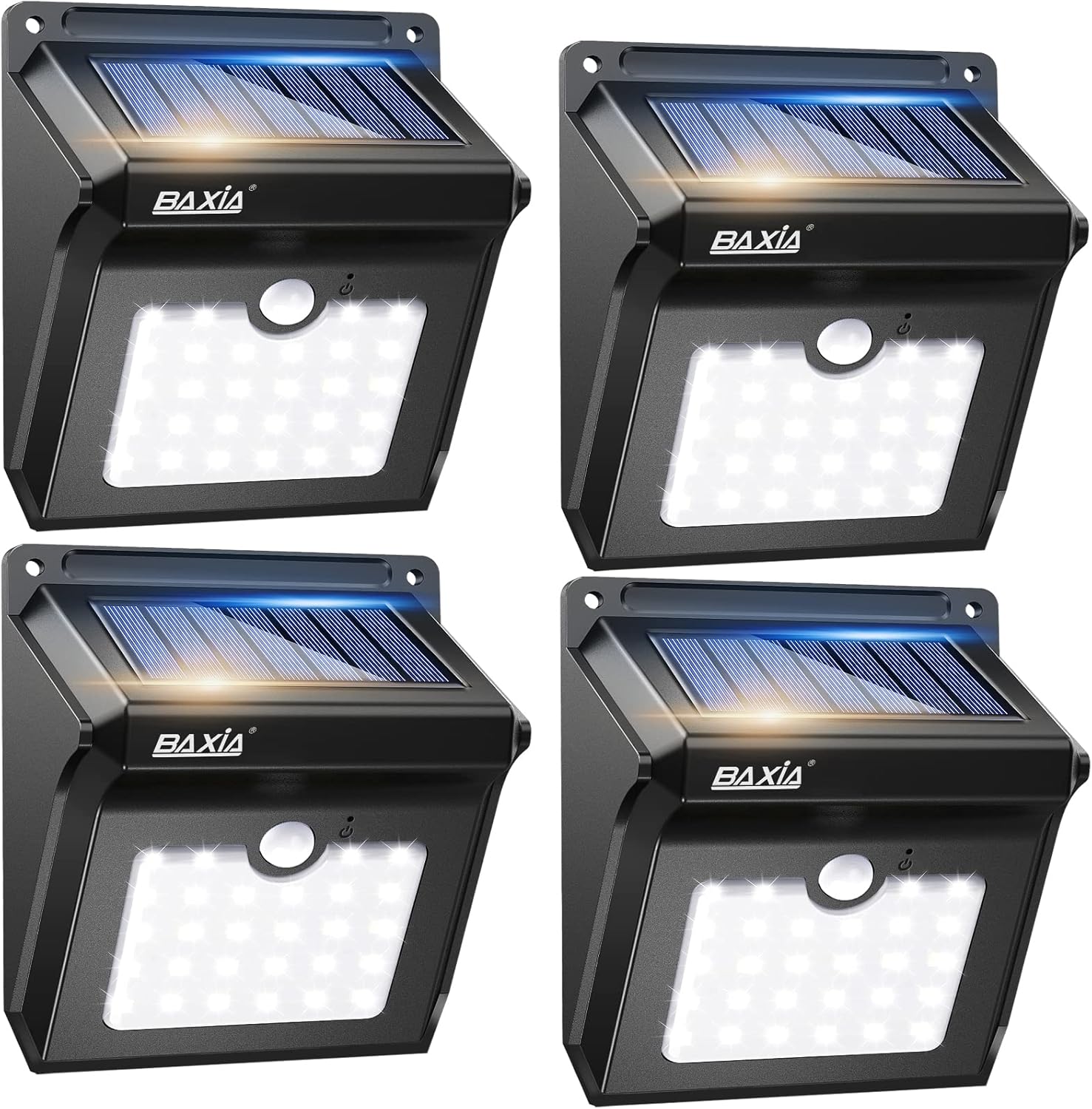
The BAXIA BX-SL-101 is the most compact and affordable security light in our picks — and the right tool for locations where output requirements are modest and covering multiple access points from one purchase is the priority. BAXIA’s solar security lights use a “no dark” design that skips the dim mode entirely, which helps extend overall lifespan. The PIR motion sensor activates in darkness and detects movement from 3 to 5 metres (10–16 feet) with a 120-degree angle. IP65 waterproof and weatherproof, handling rain and heat without trouble. 180-day warranty, 30-day full return.
The 120° detection angle and 10–16 foot range are correctly sized for doorways, side passages, stairways, and fences. The compact form allows adhesive installation where drilling isn’t possible. At approximately $5–$6 per light the 4-pack provides comprehensive coverage of multiple secondary access points.
Pros: 4-pack value (~$5–$6 per unit), compact, adhesive installation option, no dim mode extends battery life, IP65, 180-day warranty
Cons: 400 lumens insufficient for large areas or driveways, 120° angle (not 270°), 10–16 ft range limits usefulness for wide spaces
Best for: Side doors, passages, gates, garden paths, stairways, fences — multiple low-traffic access points from one purchase
Aootek 120 LED Motion Sensor Lights 6-Pack — Best for Comprehensive Perimeter Coverage
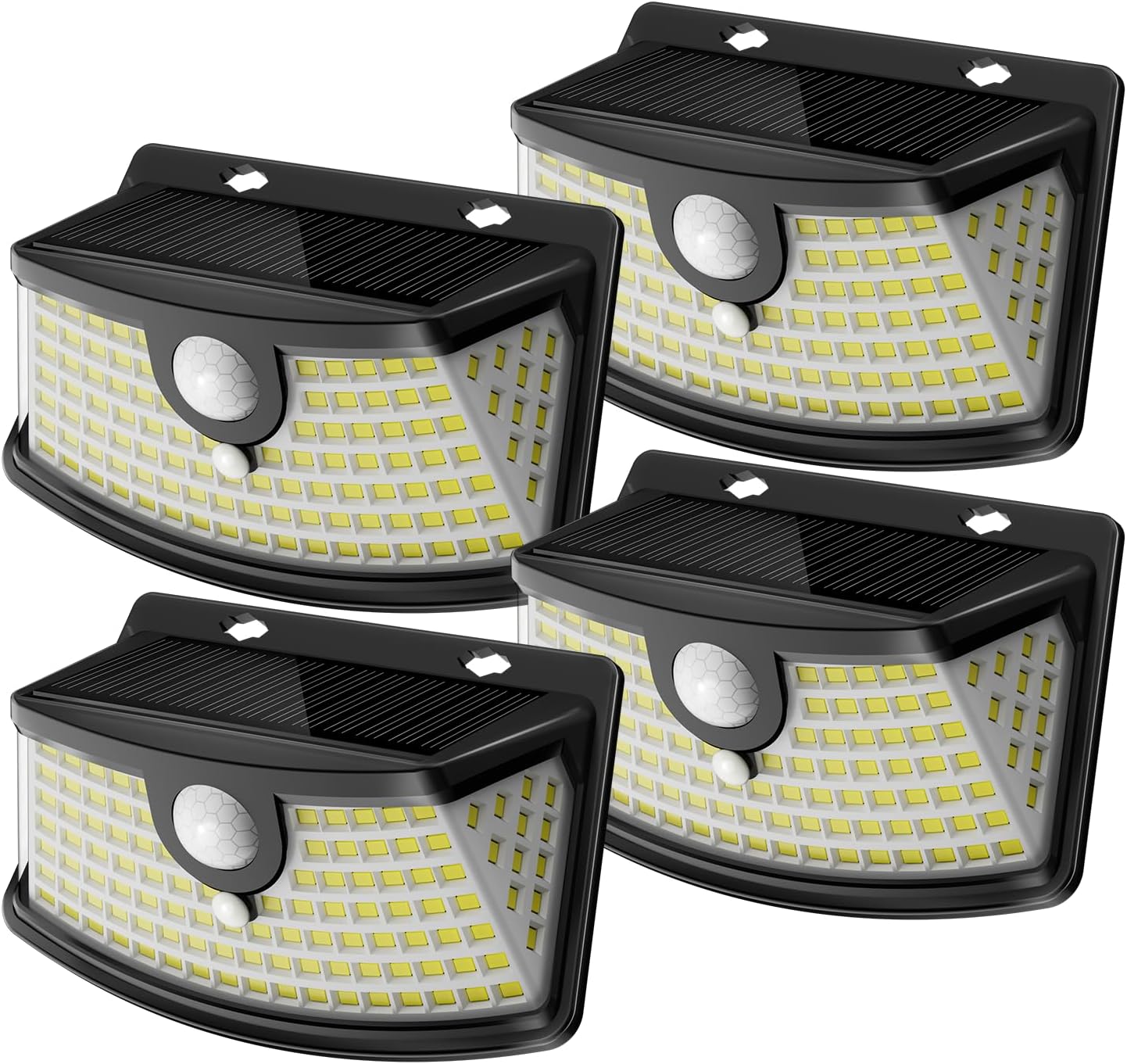
The Aootek 6-pack is the benchmark for covering an entire property perimeter from a single purchase — six units with 270° wide-angle detection, 26-foot range, IP65, and three modes. Already covered in detail in our best outdoor solar lights guide, the Aootek earns its consistent Amazon bestseller status through a combination of wide-angle coverage, reliable motion triggering, and per-unit economics that make full property coverage affordable.
The 270° angle from each unit covers building corners comprehensively — the most common blind spot in residential security lighting. Mount one at each corner of the property and the overlapping detection fields leave no undetected approach path. Three modes cover every use case from pure security to ambient pathway lighting.
Pros: 6-pack value (~$5–$7 per unit), 270° wide angle, 26-foot detection, 3 modes, IP65, well-documented real-world performance
Cons: No remote control (mode selection via physical switch), cool white light, lower lumen output than flood-style units
Best for: Comprehensive perimeter coverage of a full property, building corners, garage approaches, backyard perimeter
Tuffenough 2500LM 3-Head Solar Flood — Best for Driveways and Large Areas
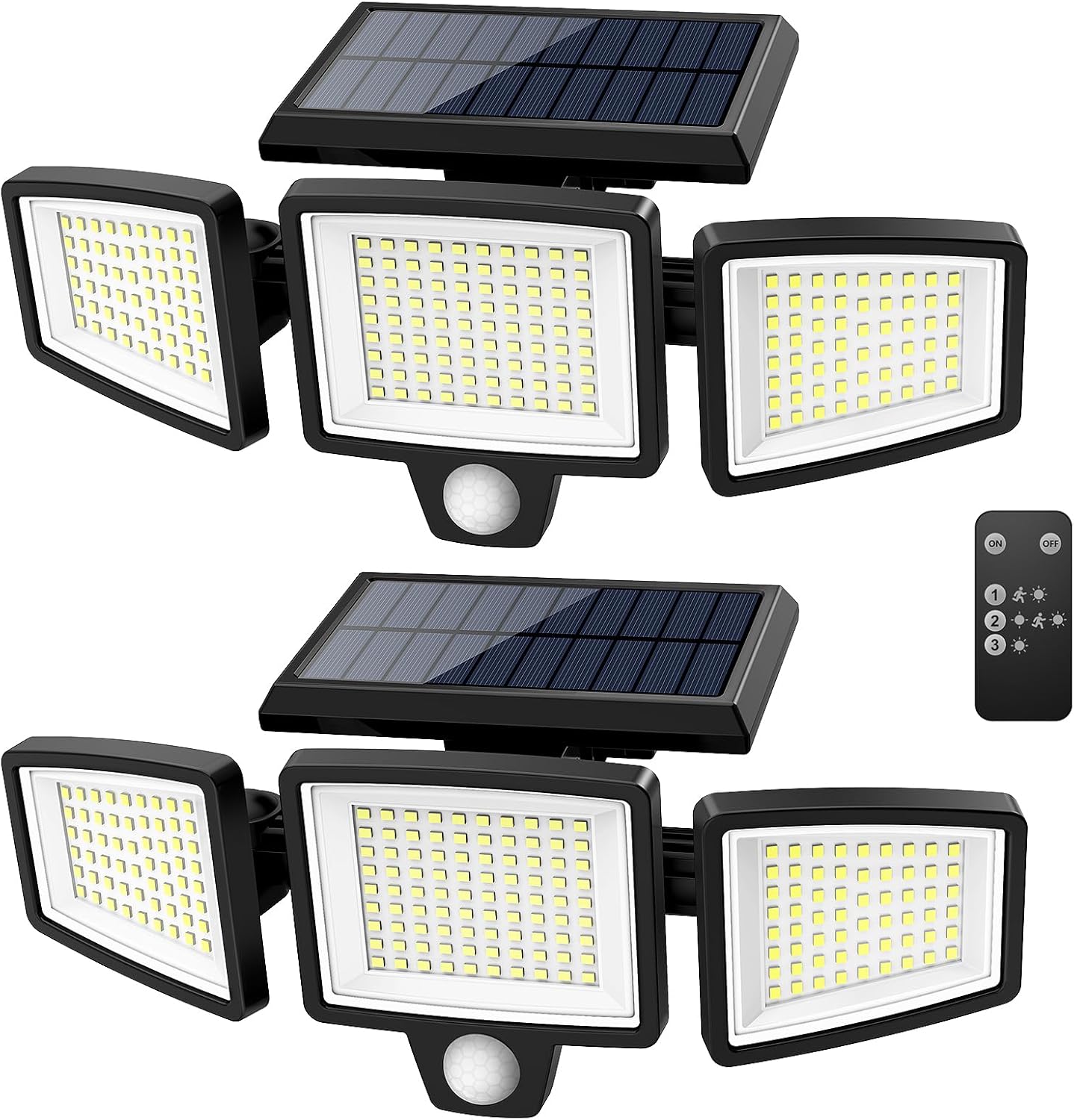
The Tuffenough 2500LM stands out for one practical feature above its specification: the included wireless remote control. Remote mode selection allows changing between modes without physically accessing the light — a driveway unit mounted at 12 feet can be adjusted from the ground at any time without a ladder. The remote also allows manual override to turn the light fully on or off during deliveries, events, or outdoor work.
At 2,500 lumens across three independently adjustable heads covering 270° combined, the Tuffenough delivers the coverage needed for driveways, large yards, and house fronts. Customisable motion sensor sensitivity settings and adjustable duration prevent the most common complaints about false triggers and battery depletion. Over 37,000 verified Amazon reviews confirm real-world reliability.
Pros: 2,500 lumens for large areas, 3 independently adjustable heads, remote control, adjustable sensitivity and duration, 37,000+ reviews, IP65
Cons: Cool white light, 2,000mAh battery adequate but not the largest
Best for: Driveways, large yards, house fronts, garages — maximum flood coverage from a single mounting point
LEPOWER 1600LM 3-Head Solar Security Light — Best for Shaded Locations and Long-Range Detection
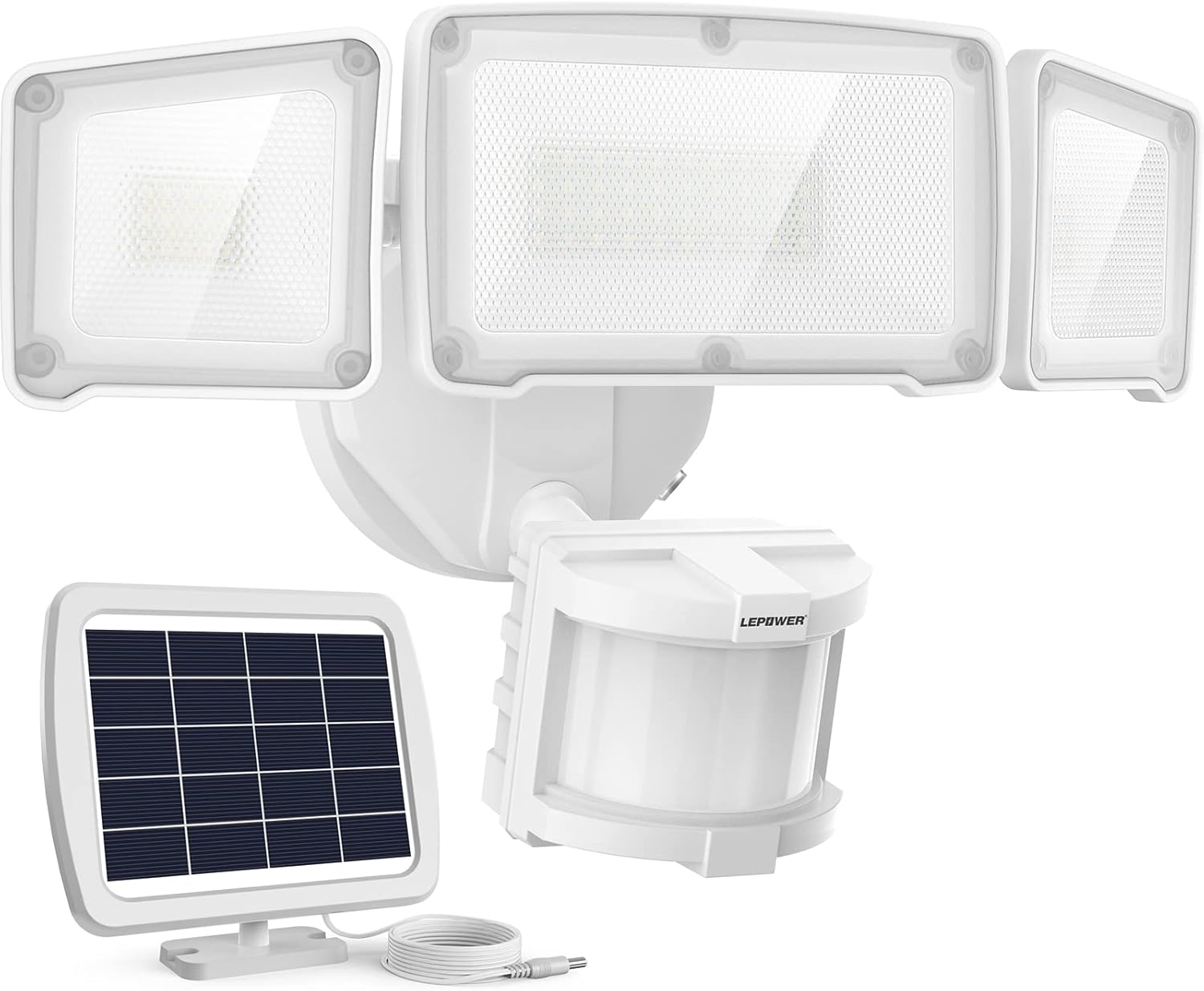
The LEPOWER 1600LM stands apart through one distinctive feature: a 15-foot cable between the solar panel and the light unit. This cable separation solves one of the most persistent problems with integrated solar security lights — the location with the best security coverage is often not the location with the best solar panel exposure. A shaded north-facing wall may be the correct security position but a terrible solar charging position. The 15-foot cable allows mounting the light where security demands while the panel faces south.
The 72-foot motion detection range — the longest in our picks — makes it the correct choice for long driveways, large yard perimeters, and any location where early detection is the priority. At 72 feet, the light triggers when someone is still far from the property — genuine early warning rather than proximity detection. Die-cast aluminium housing provides better heat dissipation and durability than ABS plastic at the same price point.
Pros: Separated solar panel on 15-foot cable, 72-foot detection range (longest in our picks), 1,600 lumens, 3 adjustable heads, die-cast aluminium housing, IP65
Cons: Single unit (no multi-pack value), some reported inconsistency in sensor performance
Best for: Shaded locations where solar panel placement is challenging, long driveways, early-detection perimeter coverage
Solar vs. Wired Motion Security Lights — The Honest Comparison
Solar wins when: No wired power at the mounting location, installation cost of wired power exceeds light budget, rented property where wiring modification isn’t permitted, or temporary security coverage is needed.
Wired wins when: Maximum sustained brightness is the priority (wired lights maintain rated output regardless of battery state), extreme cold climates where battery efficiency is significantly reduced, or 24/7 continuous high-lumen operation is required.
For most homeowners installing security lighting without existing wired infrastructure at the mounting locations, solar motion sensor lights provide a fully adequate solution at a fraction of the installation cost.
Frequently Asked Questions
How far can a solar motion sensor light detect movement?
Detection ranges vary from 10–16 feet for compact models like the BAXIA BX-SL-101, to 26 feet for wide-coverage models like the Aootek and Tuffenough, up to 72 feet for the LEPOWER. Always check detection range (not illumination range) — a doorway needs 10–16 feet; a driveway needs 26+ feet.
Why does my solar motion sensor light keep coming on?
The most common causes are passing vehicles triggering the sensor, animals in the detection zone, overhanging vegetation moving in wind, and sensitivity set too high. Adjust the sensitivity dial down until false triggers stop while confirming a person walking through still triggers reliably. Reposition if a heat source or traffic route falls in the detection zone.
Do solar motion sensor lights work in winter?
Yes — PIR sensors work year-round. Battery performance reduces in sustained cold below 14°F (-10°C). Detection sensitivity actually improves in cold weather as the contrast between body heat and ambient temperature increases. For extreme cold climates, choose units with larger battery capacity (2,200mAh+) to compensate for reduced battery efficiency.
How long do solar motion sensor lights stay on after triggering?
Typically 10–120 seconds depending on model and duration setting. Most quality lights allow adjusting this via a dial or switch — shorter durations conserve battery; longer durations provide extended coverage after triggering. 30 seconds is the standard default and appropriate for most security applications.
Will solar security lights deter burglars?
Motion-triggered security lighting is documented as a significant deterrent to opportunistic crime — sudden illumination of an approach reduces concealment and can startle potential intruders. Security lighting is most effective as part of a layered security approach: combined with cameras, visible deterrent signs, and properly secured entry points. Lighting alone deters opportunistic intruders; determined criminals are less deterred.
Can I use solar motion sensor lights indoors?
No — they require outdoor solar panel exposure to charge. Solar panel exposure through windows is significantly reduced by glass filtering. Solar security lights are designed exclusively for outdoor installation.
Final Verdict
| Your Location | Best Pick |
|---|---|
| Side doors, steps, passages | BAXIA BX-SL-101 4-Pack (~$20–$25) |
| Full perimeter coverage | Aootek 120 LED 6-Pack (~$30–$40) |
| Driveway, large yard, house front | Tuffenough 2500LM 3-Head (~$27–$35) |
| Shaded locations, long detection | LEPOWER 1600LM Separate Panel (~$35–$45) |
| Budget full property coverage | Aootek 6-Pack + BAXIA 4-Pack combined |
For a complete property security light plan, the most practical starting combination is the Aootek 6-pack for perimeter corners and the Tuffenough 2500LM for the driveway — together providing comprehensive coverage of the highest-priority security zones for under $75.
For more outdoor solar lighting options beyond security, see our best outdoor solar lights guide covering path, patio, and decorative options, and our outdoor solar flood lights guide for the highest-output flood light options for large areas and commercial properties.