
This post contains affiliate links. If you buy through our links we may earn a small commission — at no extra cost to you. This never influences our recommendations.
Flexible vs Rigid — The Decision That Determines Everything Else
Most van roofs curve. A Sprinter, Transit, or ProMaster roof is not flat — it has a gentle arch from side to side, plus vents, fan cutouts, and antennas in the way. That single fact drives nearly every solar panel decision for a van build.
Flexible panels conform to the curve, weigh 70–80% less than rigid alternatives, and can be installed with adhesive tape — no drilling, no rack, no roof penetrations. A 200W flexible panel typically weighs 8–12 lbs. The equivalent rigid panel weighs 40–50 lbs and needs Z-brackets or a full roof rack to sit flat.
Rigid panels are not wrong — they’re just a different situation. If you have a flat-topped van with a roof rack already fitted, rigid panels last longer (25+ years vs 10–20 for flexible) and cost less per watt. For a bare curved roof on any standard cargo van, flexible panels are the practical choice.
The short version: curved roof or stealth build → flexible. Flat roof with rack → either works.
How Much Solar Do You Need for Van Life?
Start with your actual daily loads, not a rule of thumb. That said, here’s a realistic breakdown by lifestyle:
| Van Life Style | Daily Use | Recommended Solar | Battery |
|---|---|---|---|
| Weekend tripper / stealth camper | 300–500Wh | 100–200W | 50–100Ah LiFePO4 |
| Part-time (a few weeks/month) | 500–800Wh | 200W | 100Ah LiFePO4 |
| Full-time, no AC | 800–1,200Wh | 400W (2×200W) | 200Ah LiFePO4 |
| Full-time with fridge + Starlink | 1,200–1,800Wh | 400–600W | 200–300Ah LiFePO4 |
The honest numbers: A 12V compressor fridge draws roughly 40–50Ah per day. Starlink in portable mode uses 65–75Wh per hour. Running both is already 800–1,000Wh before charging a single device. For full-time van life, 400W of roof solar and 200Ah of lithium is the practical starting point — not 200W.
ETFE vs PET Coating — Why It Matters More Than Wattage
Not all flexible panels age the same way. The surface coating determines how long a panel survives on a van roof exposed to UV, road vibration, and temperature extremes every day.
ETFE-coated panels are the only type worth buying for a permanent van install. ETFE is harder, more UV-resistant, and doesn’t yellow or delaminate after a few seasons. Expect 10–20 years of usable life from a quality ETFE panel installed correctly.
PET-coated panels are cheaper but degrade noticeably faster — some owners report significant output loss within 3–5 years of outdoor exposure. Fine for occasional-use portable panels. Not for something glued to your roof.
The Air Gap Problem Most Van Builders Miss
When a flexible panel is glued flush to a van roof with no airflow underneath, heat builds between the panel and the metal. Output can drop 10–20% on hot sunny days — exactly when you want the most power. It also accelerates degradation.
The fix is simple: use VHB tape standoffs or thin foam strips along the edges to create a few millimetres of gap. This allows convective airflow and keeps panel temperatures closer to rated operating range. Small detail, real-world difference — and almost never mentioned in product listings.
The Best Solar Panels for Van Builds — Verified Picks
| Product | Type | Efficiency | Weight | Flex | Best For |
|---|---|---|---|---|---|
| Renogy 200W Flexible | Mono PERC ETFE | 22% | ~11 lbs | 240° | Best overall, most trusted brand |
| BougeRV Arch Pro 200W N-Type | N-Type 16BB ETFE | 25% | 7.94 lbs | 270° | Best performance, max output |
| BougeRV Arch 200W 10BB | Mono 10BB ETFE | 23% | ~8 lbs | 270° | Best value flexible |
| BougeRV Yuma 200W CIGS | CIGS thin-film | ~17% | ~7 lbs | 360° | Sharply curved roofs only |
Best Overall: Renogy 200W Flexible Solar Panel
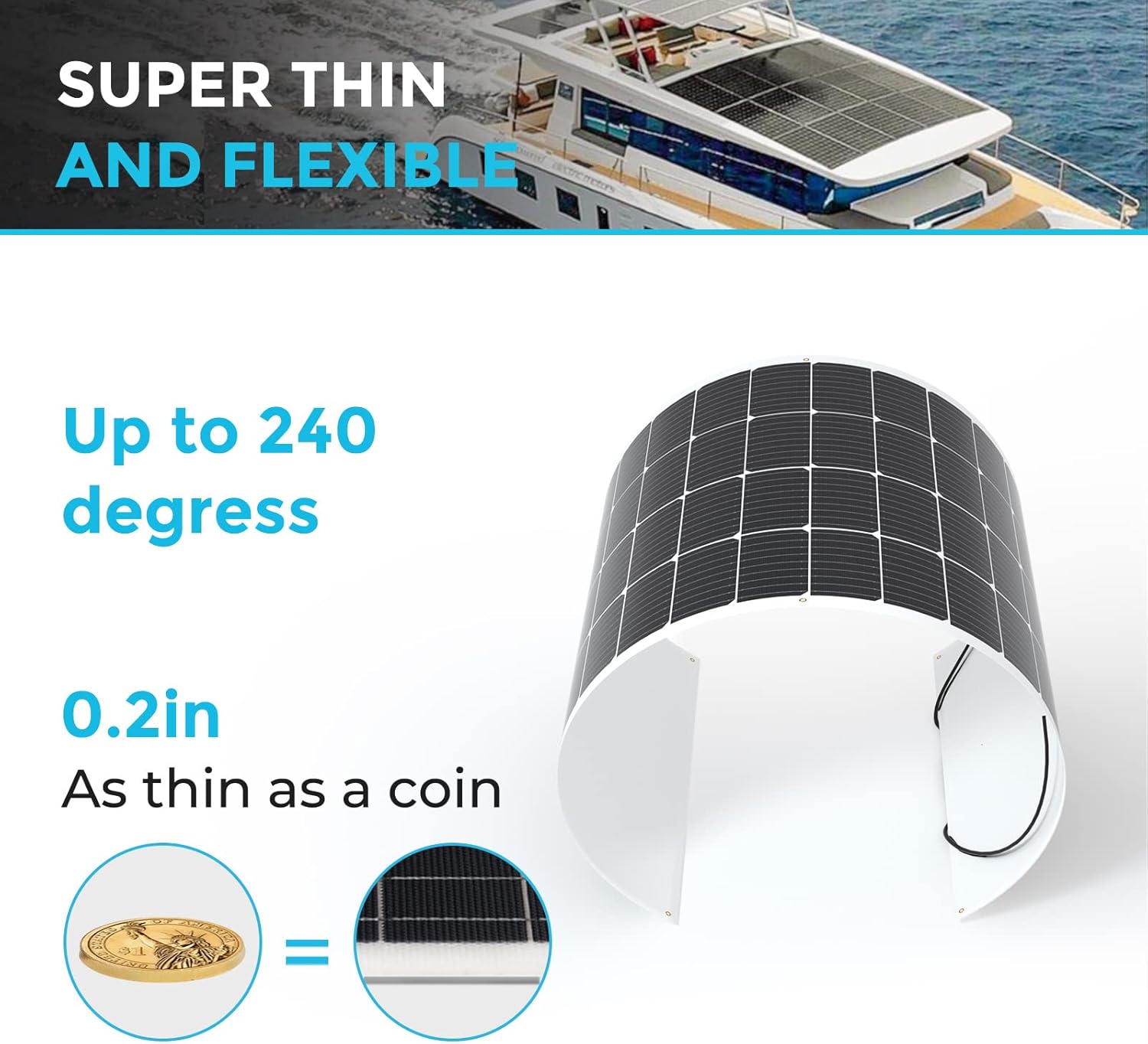
Renogy is the most established name in van and RV solar, and their 200W flexible panel is the category benchmark. Half-cut PERC cells at 22% efficiency, ETFE surface coating, IP67 waterproof junction box, and a 25-year output warranty — unusually long for a flexible panel and a genuine quality signal.
It bends up to 240° and pre-drilled mounting holes give you the choice of screws or adhesive. Compatible with 12V systems and all standard MPPT charge controllers. For van builders who want a proven product from a brand with US-based support, this is the one to start with. See our 200 watt solar panel guide for a full breakdown of what 200W delivers in real conditions.
Pros: Proven reliability, 25-year output warranty, ETFE coated, IP67, wide availability of compatible accessories
Cons: 22% efficiency — lower than N-Type competitors, 240° flex slightly less than BougeRV options
Best for: First-time van builders, anyone who wants brand reliability and long warranty coverage
Best Performance: BougeRV Arch Pro 200W N-Type
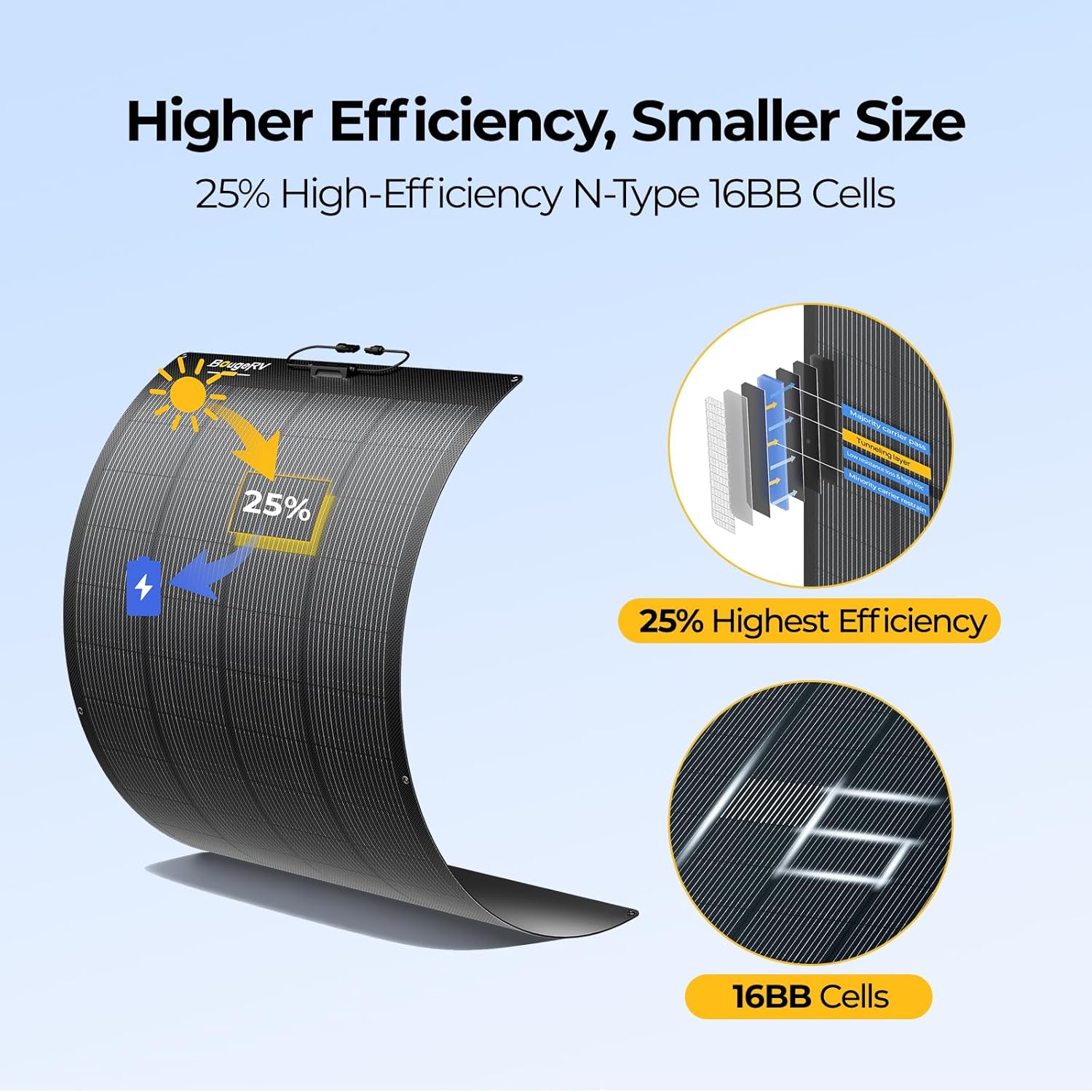
The current efficiency leader for flexible van panels. N-Type 16BB cells hit 25% efficiency — three percentage points above the Renogy — in a panel that weighs just 7.94 lbs and is only 2.5mm thick. That’s the most watts per kilogram of any flexible panel in this category.
Upgraded bypass diode design handles partial shading better than standard panels — relevant on a van roof where trees and buildings cast shadows at unpredictable angles. ETFE coating, IP68 junction box, 270° flex. Note: this is a 24V panel — confirm your MPPT charge controller is rated for 24V input before ordering.
Pros: 25% efficiency, lightest option at 7.94 lbs, 270° flex, upgraded shade tolerance, IP68
Cons: 24V output requires compatible charge controller, premium price
Best for: Builders who want maximum output from limited roof space and already run a 24V system
Best Value: BougeRV Arch 200W 10BB
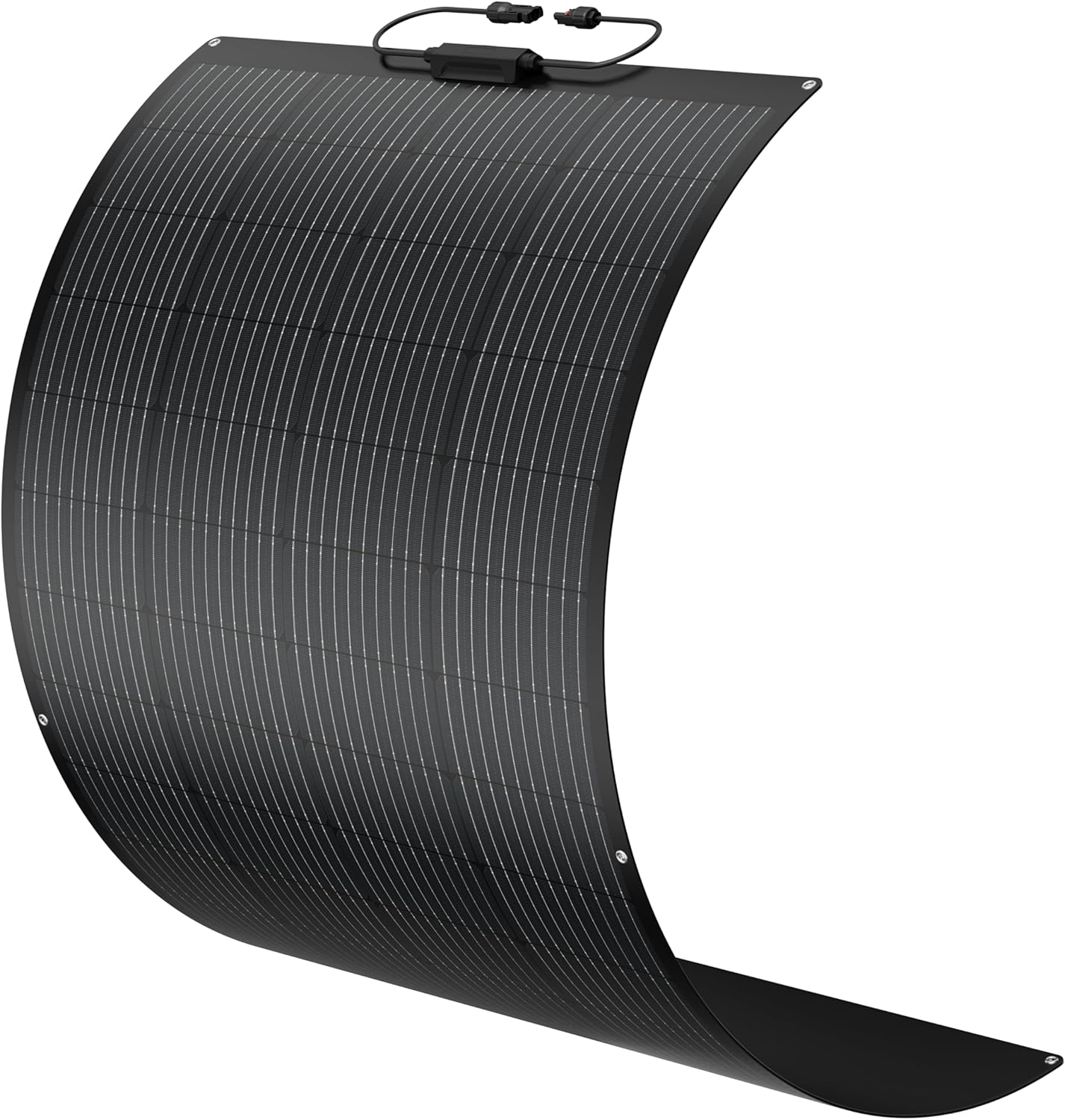
The standard BougeRV Arch (non-Pro) delivers 23% efficiency at a lower price point than the Arch Pro. The 270° flex radius, IP68 junction box, and ETFE coating are identical to the Pro. The step down is from 16BB N-Type to 10BB mono cells — real but modest in everyday conditions.
This version ships as 2×100W panels, each weighing around 4 lbs. If your roof gets consistent unshaded sun and you want to maximise coverage per dollar, the standard Arch is the smart pick. The 12V output also makes it simpler to wire into most van battery systems without upgrading a charge controller.
Pros: 23% efficiency, 270° flex, IP68, lightweight 4 lbs per panel, 12V compatible, lower price
Cons: Slightly lower performance in partial shade versus Arch Pro, older cell technology
Best for: Budget-conscious builds, roofs with consistent unshaded exposure, 12V systems
Best for Sharply Curved Roofs: BougeRV Yuma 200W CIGS
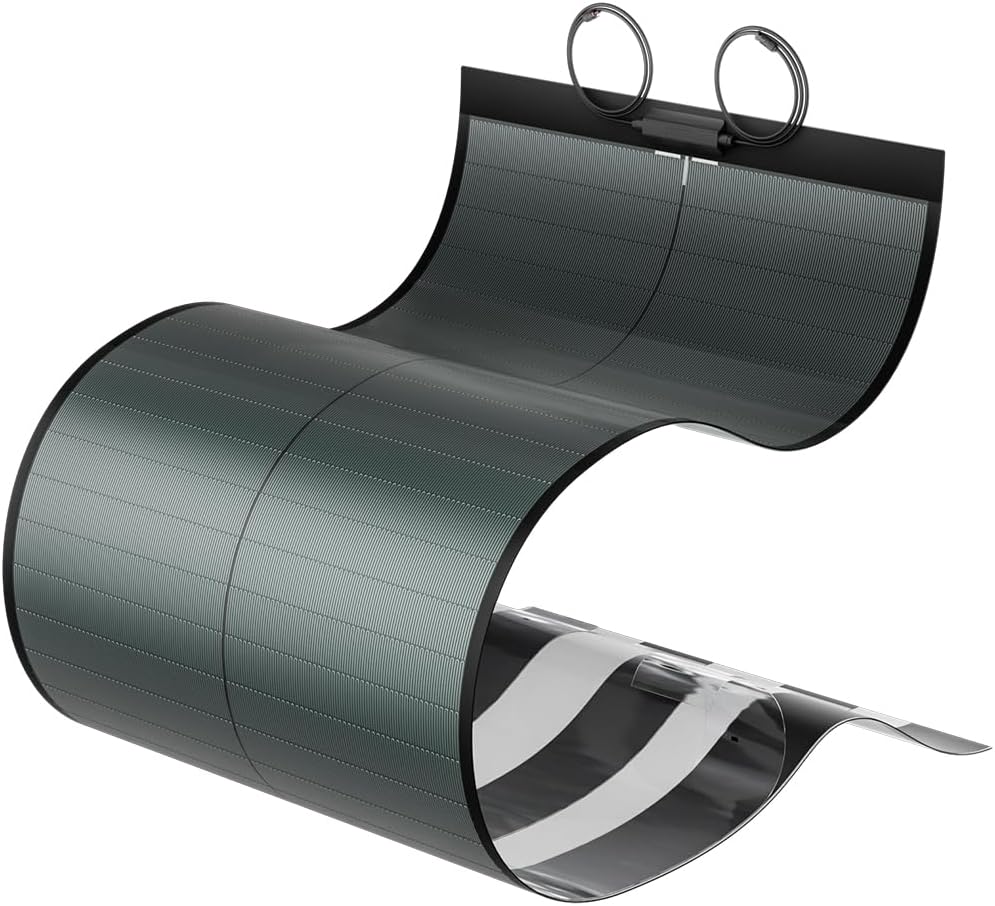
The Yuma is in a category of its own. CIGS (Copper Indium Gallium Selenide) thin-film technology delivers 360° bendability — it can conform to surfaces that would crack any monocrystalline panel. For Airstream-style rounded roofs or vans with pronounced compound curves where no standard flexible panel will lay flat, this is the only option that works.
Trade-offs are real: CIGS efficiency is lower (~17%), price per watt is higher, and the technology is less proven long-term than mono flexible panels. For 95% of van builds, the mono flexible panels above are the better choice. The Yuma is for the other 5% with genuinely difficult roof geometry.
Pros: 360° flex — truly conforms to any curve, IP68, better shade and heat tolerance than mono
Cons: ~17% efficiency (significantly lower), higher price per watt, shorter proven track record
Best for: Sharply curved roofs where mono flexible panels won’t sit flat
What Charge Controller Do You Need?
Always use an MPPT controller with van solar panels — not PWM. MPPT recovers 20–30% more power from the same panels, which on a van roof running hot in summer makes a measurable daily difference.
Single 200W panel (12V system): 20A MPPT minimum. A 30A controller gives room to add a second panel without upgrading.
Two 200W panels — 400W total (12V system): 40A MPPT minimum.
BougeRV Arch Pro (24V): Requires a controller rated for 24V input — verify max PV voltage exceeds the panel’s Voc before buying.
See our MPPT charge controller guide for full sizing tables and product recommendations.
How Many Panels Fit on a Van Roof?
A standard Transit or Sprinter 148 roof offers roughly 60–80 square feet of usable panel area after accounting for the MaxxAir fan (14″×14″), roof vents, and edge clearance. A 200W flexible panel is typically around 58″×27″ — about 11 square feet. Most Transit-sized roofs fit two 200W panels comfortably with careful layout.
Map your roof before ordering. Mark every obstacle — fan cutout, antenna mount, any skylights or rails. Two well-placed 200W panels (400W total) is the practical ceiling for most cargo van builds. See our off-grid solar system guide for wiring layouts and battery sizing around a 400W array.
Installation: Adhesive vs Screws
For van builds, adhesive installation is the standard approach — no roof penetrations, cleaner look, and easier to reposition if your layout changes. Use VHB (Very High Bond) tape rated for outdoor automotive use, or butyl rubber tape which also provides a weatherproof seal. Clean the roof surface thoroughly with isopropyl alcohol first — adhesion fails on oily or dusty metal.
If you prefer mechanical mounting, all the panels above have pre-drilled holes for M4/M5 stainless bolts. Seal every penetration with self-levelling lap sealant. One missed seal will find you eventually — roof leaks on vans are miserable to diagnose and fix.
Frequently Asked Questions
Can I use rigid solar panels on a van roof?
Yes, if you have a flat roof section and a roof rack. Rigid panels last 25+ years, cost less per watt, and deliver identical efficiency. They need Z-brackets or a rack system and weigh 40–50 lbs each. For curved roofs without a rack, flexible panels are the only practical choice.
How do I attach flexible solar panels to a van roof without drilling?
VHB tape or butyl rubber tape are the standard no-drill methods. Clean the roof with isopropyl alcohol first, then apply tape strips along the panel edges. Use tape rated for outdoor automotive use — standard craft VHB won’t hold long-term at highway speeds. BougeRV sells butyl rubber tape specifically sized for their panels.
Do flexible solar panels work on cloudy days?
Yes, but output drops to 10–25% of rated wattage under heavy overcast. CIGS thin-film panels (BougeRV Yuma) perform slightly better in diffuse light due to a broader spectral response. For consistently cloudy regions, plan for more panel capacity and larger battery storage to bridge multi-day low-light periods.
What’s the best single panel wattage for a van?
200W is the sweet spot. It fits most van roofs without dominating the entire surface, produces enough daily energy for essential loads, and is available in quality flexible form from multiple brands. 100W often leaves full-time builders short. A single 300W rigid panel is harder to position around roof obstacles than two narrower 200W flexible panels.
Is 200W enough for full-time van life?
For light use — devices, lighting, no fridge — yes. For full-time van life with a compressor fridge running 24/7, 200W is the minimum and often not enough in winter or cloudy climates. Two 200W panels (400W) with 200Ah of LiFePO4 is the practical full-time baseline for a comfortable build.
Final Verdict
| Your Situation | Best Pick |
|---|---|
| Best overall, most trusted brand | Renogy 200W Flexible (B0BF4VHWJP) |
| Maximum output, limited roof space | BougeRV Arch Pro 200W N-Type (B0FDB5PX9J) |
| Best value, 12V system, good sun | BougeRV Arch 200W 10BB (B0CP29YQCK) |
| Sharply curved or compound roof | BougeRV Yuma 200W CIGS (B0BJJV9PS4) |
For most van builds, the Renogy 200W Flexible is the right starting point — proven reliability, 25-year warranty, and the widest accessory compatibility. If maximum efficiency from a tight roof footprint is the priority, the BougeRV Arch Pro is the current performance leader at 25% efficiency and 7.94 lbs. For a budget-friendly 12V build with good sun exposure, the BougeRV Arch 10BB delivers 23% efficiency for less.
For complete system design around any van solar setup — battery sizing, charge controller selection, wiring, and component pairing — see our off-grid solar system guide. For the next step up in output, our 300 watt solar panel guide covers what’s possible when roof space allows for it.