This post contains affiliate links. If you buy through our links we may earn a small commission — at no extra cost to you. This never influences our recommendations.
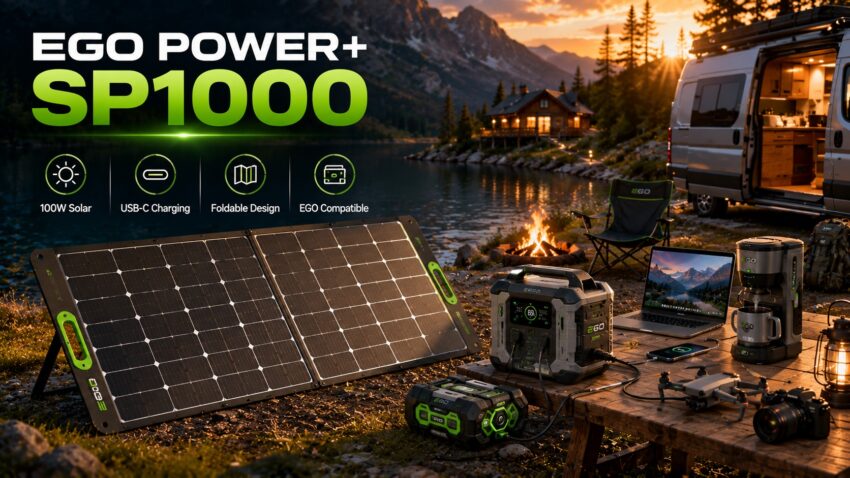
EGO’s 100W solar panel (SP1000) occupies an unusual niche — it’s built specifically for EGO’s own power station and battery ecosystem rather than as a general-purpose panel, and that focus brings real advantages alongside some genuine limitations worth understanding before you buy. This guide covers what the SP1000 actually does, how it compares to a generic third-party 100W panel, and whether it’s the right choice for your setup.
What the EGO 100W Solar Panel Actually Is
The SP1000 is a foldable monocrystalline solar panel rated for 100W peak output, built around two distinct use cases: charging devices directly via built-in USB ports, or feeding into EGO’s Nexus Portable Power Station ecosystem via a separate charger accessory. This dual-purpose design is what sets it apart from most generic 100W panels, which typically only offer a single DC or MC4 output.
Full Specifications
| Spec | EGO POWER+ SP1000 |
|---|---|
| Rated output | 100W (peak, rarely achieved in real conditions) |
| Cell type | Monocrystalline |
| Direct device charging | Yes — built-in USB-A and USB-C ports |
| EGO battery charging | Direct, via included MC4 connector to compatible EGO batteries |
| Nexus Power Station compatibility | Requires CH1800 Solar Panel Charger (sold separately) |
| Design | Foldable, two kickstands for angle adjustment |
| Compatible power stations | PST3040, PST3041, PST3042 (3000W Nexus series) |
| Warranty | 1 year |
The Real-World Output Gap
Like virtually every solar panel on the market, the SP1000’s 100W rating is a peak figure under ideal lab conditions — direct overhead sun, optimal temperature, and perfect panel angle. In practical outdoor use, owners and reviewers consistently report closer to 75W of actual output even in good sunlight. This isn’t a defect specific to EGO’s panel — it’s standard across the solar panel industry — but it’s worth factoring into your charging time expectations rather than planning around the rated 100W figure.
Two Ways to Use It — And an Important Limitation
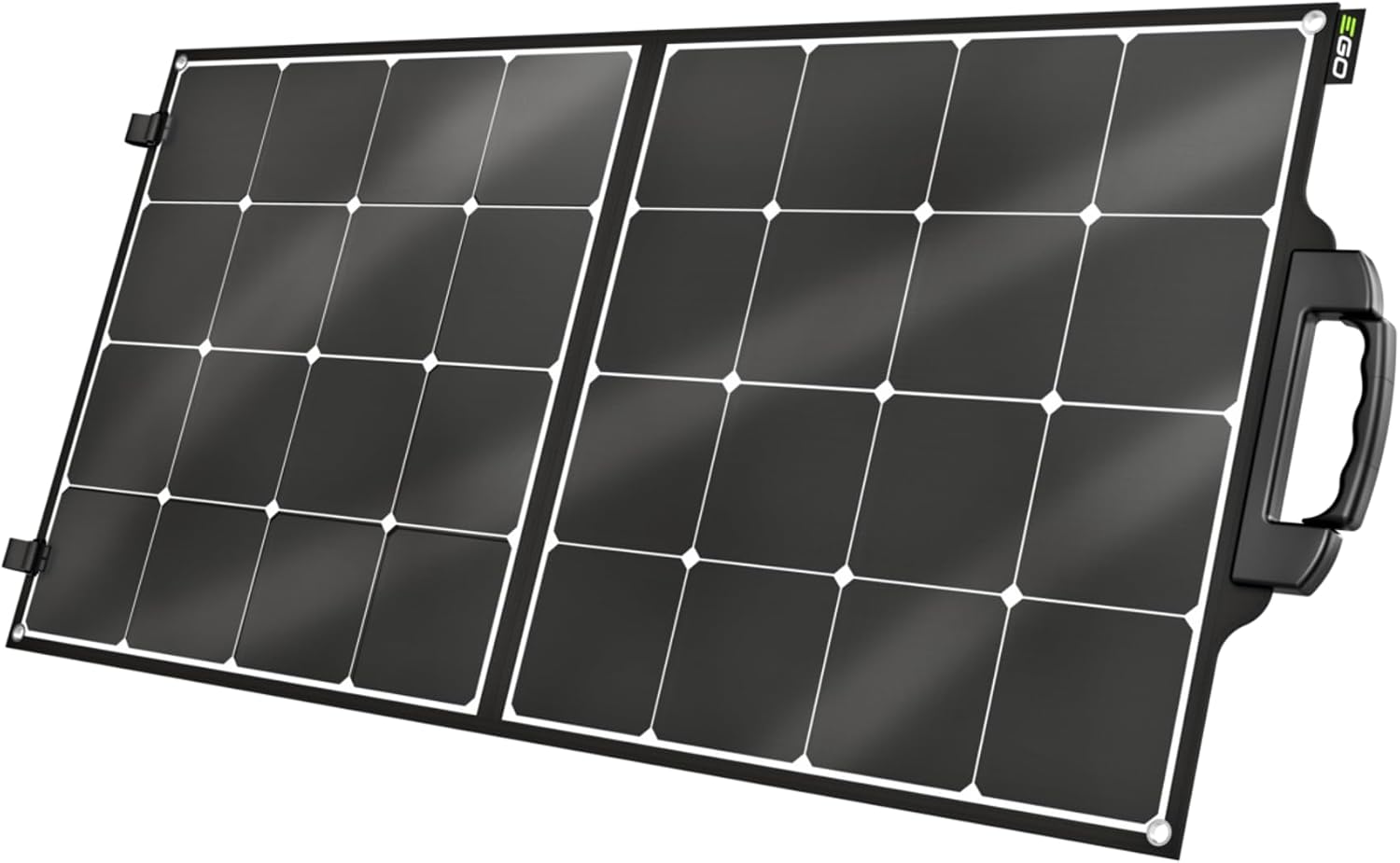
Direct device and battery charging works independently of any other EGO hardware — the built-in USB-A and USB-C ports let you charge phones, tablets, and similar devices straight from the panel, and the included MC4 connector charges compatible EGO 56V ARC Lithium batteries directly without needing the power station at all. This is the panel’s most flexible mode and works essentially like any standalone portable solar charger.
Charging the Nexus Power Station itself requires purchasing EGO’s CH1800 POWER+ Nexus Solar Panel Charger separately — a roughly $150 accessory that occupies the same slot the power station’s normal charging brick uses. This is the detail that catches some buyers off guard: the SP1000 panel alone does not charge the Nexus power station out of the box. Budget for the CH1800 as a required additional purchase if solar-charging your Nexus unit is the goal.
A genuine usability limitation reported by owners: when charging the Nexus power station via the CH1800 solar charger, the unit becomes unusable for powering devices during that charging window — you can’t run appliances and solar-charge simultaneously the way many competing power stations allow. For anyone who needs to use their power station and charge it from solar at the same time, this is a real practical drawback worth knowing before buying into the EGO ecosystem specifically for this purpose.
Solar Input Ceiling and Multi-Panel Setups
The CH1800 charger accepts up to 180W of combined solar input. Since a single SP1000 realistically delivers around 75W, running two panels in parallel (roughly 150W combined) stays safely under that ceiling and meaningfully speeds up charging compared to a single panel. Connecting panels requires purchasing separate Y-branch/parallel connectors, since the SP1000 doesn’t ship configured for multi-panel setups out of the box.
EGO SP1000 vs a Generic Third-Party 100W Panel
| Factor | EGO SP1000 | Generic 100W Panel (e.g., Renogy) |
|---|---|---|
| Price | ~$298 | Typically $100–150 |
| Built-in USB charging | Yes | Rarely included |
| Direct EGO battery charging | Yes, via included MC4 | No — requires adapter and isn’t officially supported |
| Nexus power station compatibility | Yes, with CH1800 charger | Works with CH1800 if within voltage spec — EGO explicitly supports generic panels here too |
| Warranty | 1 year | Varies, often 2–5 years on quality brands |
Here’s the detail worth knowing: EGO’s own documentation confirms the CH1800 solar charger works with third-party panels too, as long as they stay within the 12V input voltage spec and under the 180W combined ceiling. EGO explicitly lists compatible generic panels including standard Renogy and Grape Solar 100W monocrystalline models on their support materials. This means the SP1000’s real added value over a cheaper generic panel comes down to the built-in USB ports and direct EGO battery charging — genuine conveniences, but not the only way to solar-charge your Nexus system.
Who Should Buy the EGO SP1000
Best for:
- Existing EGO Nexus power station owners who want the simplest, most integrated solar solution with no compatibility guesswork
- Anyone who also owns EGO 56V ARC Lithium tool batteries and wants to trickle-charge them directly from solar without the power station in the loop
- Buyers who value the built-in USB-A/USB-C ports for direct device charging without any other hardware
Consider a generic third-party panel instead if:
- Budget is the priority — a comparable-output Renogy or similar panel typically costs $100–150 less
- You want a longer warranty — most quality third-party panels offer 2–5 years versus EGO’s 1-year term
- You don’t need the direct-USB or direct-EGO-battery charging features and only care about feeding the Nexus power station through the CH1800 charger, which accepts compatible generic panels anyway
Frequently Asked Questions
Does the EGO 100W solar panel charge the Nexus power station directly?
No — charging the Nexus Power Station requires EGO’s CH1800 POWER+ Nexus Solar Panel Charger, sold separately. The SP1000 panel alone connects directly to USB devices and EGO 56V batteries, but reaching the power station itself requires the additional charger accessory.
Can I use a cheaper third-party solar panel with my EGO Nexus power station instead?
Yes — EGO’s own support documentation confirms the CH1800 charger works with third-party 12V monocrystalline panels, including common brands like Renogy and Grape Solar, as long as combined input stays under 180W. The SP1000’s main advantages over a generic panel are its built-in USB ports and direct EGO battery charging capability, not exclusive Nexus compatibility.
How much real-world power does the EGO SP1000 actually produce?
Despite the 100W rating, real-world output in good sunlight is typically closer to 75W — consistent with how solar panels generally perform outside of controlled lab test conditions. Plan your charging time expectations around this more realistic figure rather than the rated peak wattage.
Can I use the EGO Nexus power station while it’s solar charging?
According to owner reports, no — the power station becomes unusable for running devices while charging via the CH1800 solar charger. This is a genuine limitation compared to some competing power stations, which support simultaneous pass-through charging and device use.
Do I need the CH1800 charger even for direct USB device charging?
No — the SP1000’s built-in USB-A and USB-C ports work independently, letting you charge phones, tablets, and similar devices directly from the panel without any other EGO hardware. The CH1800 is only required specifically to charge the Nexus power station itself.
The Bottom Line
The EGO SP1000 is a solid, purpose-built solar panel for EGO Nexus and 56V battery ecosystem owners who want the simplest possible integration with no compatibility research. Its built-in USB ports and direct EGO battery charging are genuine conveniences a generic panel doesn’t offer. But the premium price, 1-year warranty, and the “unusable while charging” quirk of the Nexus system are worth weighing against a lower-cost generic panel — especially since EGO’s own documentation confirms third-party panels work with the CH1800 charger too.
Check the EGO POWER+ SP1000 on Amazon →
For general-purpose 100W solar panels compatible with most power stations, see our 100 watt solar panel guide. For a broader look at portable power station options across brands, our portable power station guide covers the full landscape.