This post contains affiliate links. If you buy through our links we may earn a small commission — at no extra cost to you. This never influences our recommendations.
A well deeper than 90 feet needs a genuinely different type of pump than a shallow one — get this wrong and you end up with a pump that simply can’t lift water to the surface, no matter how much solar power you throw at it. This guide covers real sizing by depth and flow rate, an important electrical safety note worth taking seriously, and honest picks for both standalone pumps and complete starter kits.
The First Decision: Shallow Jet Pump or Submersible?
This determines everything else about your setup, so get it right first. Wells shallower than 90 feet can use a shallow well jet pump or convertible pump, mounted above ground and pulling water up via suction. Wells deeper than 90 feet require a true submersible pump — suction alone can’t reliably lift water from that depth, so the entire pump unit goes down into the well itself, pushing water up rather than pulling it. This guide focuses specifically on submersible pumps for deeper wells, the more common scenario for rural and off-grid properties.
Sizing by Depth and Flow — The Real Numbers
Two numbers determine which pump you need: total dynamic head (TDH — essentially your well’s depth plus any additional lift needed to reach a storage tank) and required flow rate (GPM — gallons per minute). These interact directly: the deeper the well, the harder the pump works, and the lower its flow rate becomes at that depth. A pump rated “12 GPM at 80 ft” might only deliver 6-8 GPM if your actual well is 150 ft deep — always check the manufacturer’s specific flow curve at your well’s actual depth, not just the headline spec.
| Well Depth | Typical Solar Power Needed | Realistic Flow Rate |
|---|---|---|
| Under 100 ft | 100-200W | 1.6-3.2 GPM |
| 100-200 ft | 200-400W | 1-2 GPM |
| 200-500 ft | 400-800W+ | 2-4.5 GPM |
DC Direct-Drive vs Battery-Backed Systems — The “Tank as Battery” Approach
This is a genuinely useful concept worth understanding, since it changes how you think about system cost. Purpose-built DC solar well pumps often skip a battery bank entirely — they draw power directly from the solar panels and pump whenever the sun is shining, filling a storage tank. The tank itself becomes your “battery,” providing gravity-fed water pressure day and night regardless of weather, without the cost and complexity of a separate battery bank and charge controller sized for the pump’s full draw.
This approach only works if you have (or install) adequate storage tank capacity — size the tank for at least 1-2 days of household or livestock water demand, so a stretch of cloudy weather doesn’t leave you without water pressure. If you specifically want the pump to run on demand regardless of sunlight (rather than only while the sun shines), a battery-backed system is the alternative, at a real added cost.
An Important Safety Note on AC Well Pumps
If you’re considering powering a standard AC well pump through an inverter rather than a purpose-built DC solar pump, this deserves direct attention: an AC well pump runs at lethal voltage, and the circuit must be wired to code — a properly sized breaker, a fused and grounded disconnect, GFCI protection where required, and a control box rated for the specific motor, per NEC Article 4 requirements. This isn’t a DIY wiring project to approach casually. If you’re not confident in electrical work at this level, hire a licensed electrician for the AC pump circuit specifically, even if you’re comfortable handling the solar panel and DC side of the system yourself.
Best Solar Well Pumps — Verified Picks
| Product | Flow Rate | Max Lift | Includes Battery/Panel | Best For |
|---|---|---|---|---|
| Amarine Made 12V Submersible Pump | 3.2 GPM | 230 ft | No — pump only | Adding to existing solar/battery setup |
| ECO-WORTHY Complete Kit | 1.6 GPM | 230 ft (rated) | Yes — 200W panel + 30Ah LiFePO4 battery | Starting from scratch, no existing infrastructure |
Best Standalone Pump: Amarine Made 12V DC Submersible Deep Well Pump
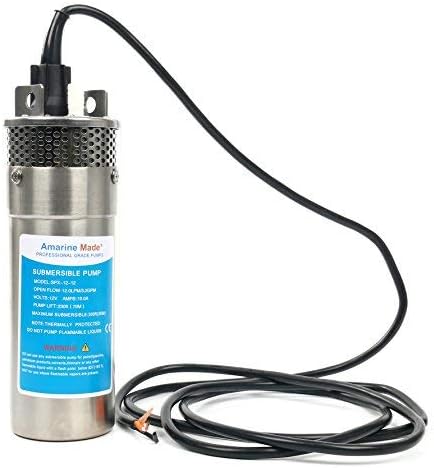
If you already have solar panels or a battery bank in place and just need the pump itself, this delivers real capability at 3.2 GPM open flow with a maximum lift of 230 ft — genuinely deep-well capable, with a maximum submersible depth of 100 ft. The stainless steel shell and waterproof cable connection are built for genuine full-time submersion, and the motor includes thermal overload protection that automatically pauses operation if it starts overheating, then resumes once cooled — a real protective feature rather than a permanent failure. Connects directly to most existing 12V solar panel or wind generator setups without requiring a specific matched controller.
Worth noting: the manufacturer specifically states the 230 ft max lift is laboratory data, and recommends operating within 10-20% of that maximum for realistic long-term performance — plan your actual well depth with that margin in mind rather than assuming you’ll get the full rated lift in practice.
Best Complete Starter Kit: ECO-WORTHY Solar Well Pump Kit with 30Ah Battery
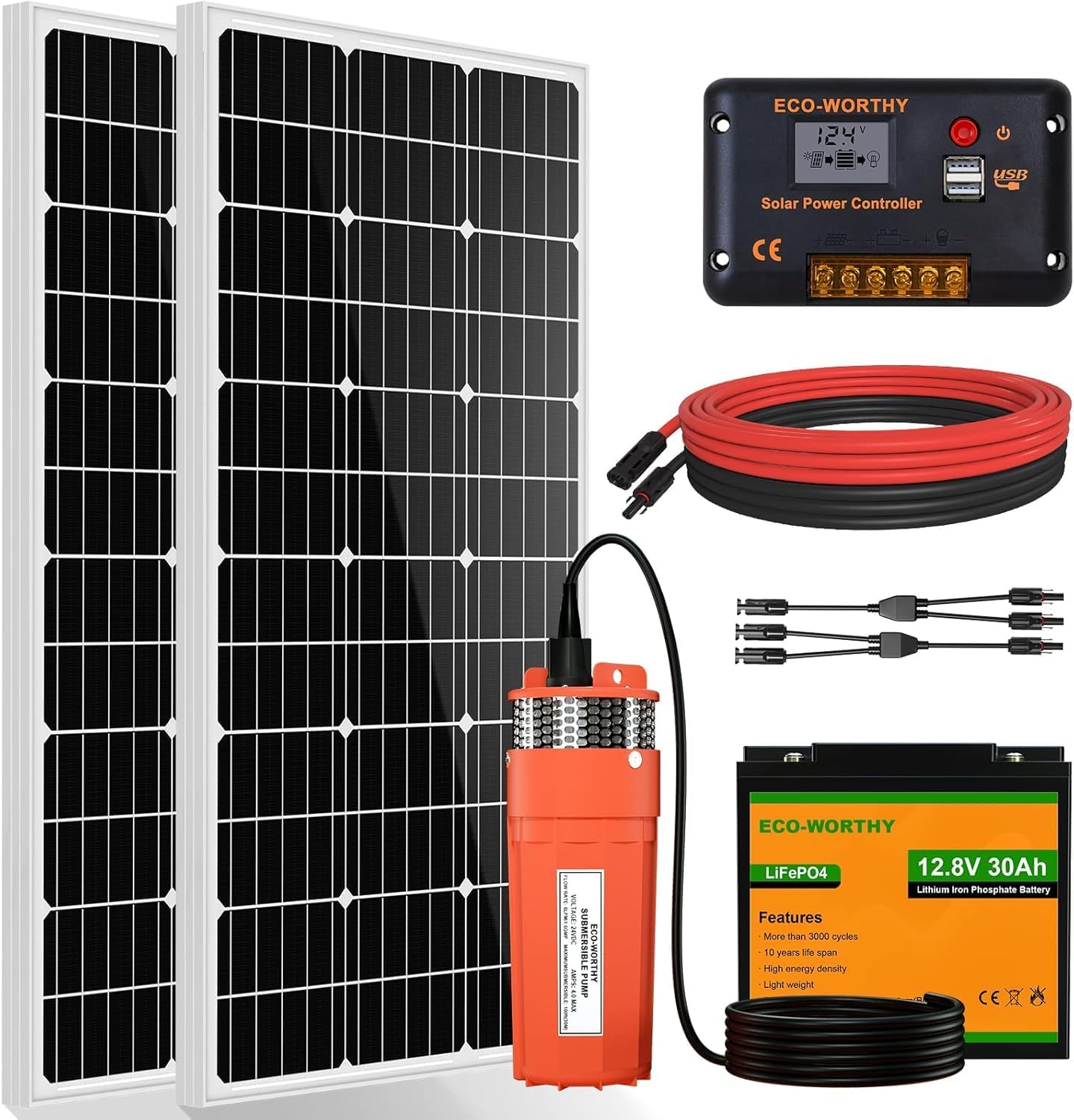
For anyone starting completely from scratch, this kit bundles everything needed in one purchase — a 96W deep well pump, 200W solar panel, 30Ah LiFePO4 lithium battery, and charge controller. The lithium battery is rated for 3,000+ deep cycles with a built-in BMS protecting against overcharge, over-discharge, and short circuit, and at just 7.2 lbs, it’s genuinely portable if you need to reposition the system. The battery-backed design means the pump can run on stored power even after the sun goes down, rather than being limited strictly to daylight hours the way a pure direct-drive system would be.
The manufacturer specifically recommends against running the pump for more than 4 hours continuously and advises regular cleaning to avoid premature wear — reasonable maintenance guidance worth following for long-term reliability rather than a limitation unique to this kit.
Installation Basics
Never let the pump run dry. Running a submersible pump without water for extended periods significantly shortens its lifespan — most manufacturers explicitly warn against this, and some pump controllers include dry-run protection specifically to prevent it.
Use a properly sized MPPT controller for anything beyond the smallest direct-drive setups — see our MPPT vs PWM charge controller guide for sizing guidance, since well pumps often represent a larger, more variable load than typical solar applications.
Size storage tank capacity to your actual water demand, not just pump flow rate — a tank that’s too small defeats the purpose of the “tank as battery” approach covered above, leaving you without water pressure during any stretch of poor sun.
Frequently Asked Questions
What size solar well pump do I need for a 150-foot well?
Generally 200-400W of solar power, with realistic flow rates in the 1-2 GPM range at that depth — always check the specific pump’s flow curve at your actual well depth rather than relying on the headline maximum lift figure, since flow rate drops meaningfully as depth increases.
Do I need a battery for a solar well pump, or can it run directly off panels?
Both approaches work. Direct-drive systems (no battery) pump only while the sun shines, filling a storage tank that then provides water pressure day and night via gravity — the tank essentially replaces the battery’s function. Battery-backed systems let the pump run on demand regardless of sunlight, at additional cost and complexity.
Is it dangerous to wire an AC well pump myself?
Yes, genuinely — AC well pumps run at lethal voltage, and proper wiring requires a correctly sized breaker, a fused and grounded disconnect, GFCI protection, and a control box rated for the specific motor, per NEC Article 4. This isn’t a casual DIY project; hire a licensed electrician for this specific part of the installation if you’re not confident in electrical work at this level.
Can I use a shallow well pump in a deep well?
No — wells deeper than roughly 90 feet require a true submersible pump, since suction-based shallow well jet pumps can’t reliably lift water from that depth. Confirm your well’s actual depth before choosing a pump type.
How do I know the actual flow rate my pump will deliver?
Check the manufacturer’s flow curve, which lists flow rate at multiple different depths (for example, “12 GPM at 80 ft, 8 GPM at 150 ft”) rather than a single number. Flow rate always decreases as depth increases — the maximum lift figure alone doesn’t tell you what flow you’ll actually get at your specific well’s depth.
Final Verdict
| Your Situation | Best Pick |
|---|---|
| Already have solar panels or battery bank | Amarine Made 12V Submersible Pump |
| Starting from scratch, want a complete kit | ECO-WORTHY Solar Well Pump Kit with Battery |
The Bottom Line
Get your well’s actual depth right first — that single number determines whether you need a shallow jet pump or a true submersible pump, and it should drive every other sizing decision that follows. For anyone already running solar infrastructure, the Amarine Made pump delivers genuine deep-well capability as a standalone addition. For a complete start-from-zero setup, the ECO-WORTHY kit’s included battery and panel remove the guesswork of matching components yourself. Whichever route you take, if any part of your system touches AC voltage, treat that wiring with the seriousness it genuinely requires.
For complete off-grid system design beyond just the well pump, see our off-grid solar system guide. For surface pump options in shallower applications, see our solar water pump guide.