This post contains affiliate links. If you buy through our links we may earn a small commission — at no extra cost to you. This never influences our recommendations.
Hanging solar bulb lights are the easiest upgrade you can make to a patio, pergola, or backyard. No electrician, no outdoor outlet, no running power cables through walls. You position the solar panel, hang the lights, and they turn on automatically at dusk every night. The hard part is telling the quality sets apart from the ones that stop working after two seasons — which is what this guide covers.
Edison Bulbs vs Globe Bulbs — Which Style Is Right for You?
The two main styles of hanging solar bulb lights look very different and suit different spaces.
Edison bulbs (S14 style) have an elongated shape with a visible LED filament inside. They produce a warm, vintage bistro look — the kind you see strung across restaurant patios and rooftop bars. The filament design makes them look almost identical to old incandescent bulbs but run on a fraction of the power. Best suited for pergolas, covered patios, and any space where you want a sophisticated, upscale feel.
Globe bulbs (G40 style) are round, spherical, and produce a softer, more diffused glow. They’re slightly more casual and versatile — works equally well over a bistro table, a garden fence, or wrapped around a gazebo. At 2700K warm white, globe bulbs give a cozy amber tone that looks great in photos and sets a relaxed mood. Best suited for backyards, casual outdoor dining, and larger open spaces where you want more visual pop.
Both styles use LED technology — they never get hot to the touch, last 20,000–30,000 hours, and use very little power, which is why solar charging works so well for them.
What to Look for Before Buying
IP rating: Look for IP44 minimum for sheltered patios, IP65 for fully exposed outdoor use. IP65 handles direct rain without issue. Sets with no IP rating stated are a red flag.
Shatterproof bulbs: Plastic LED bulbs won’t shatter if they fall or swing in wind. Glass bulb sets look marginally better but crack when they hit a deck. For a permanent outdoor install, shatterproof plastic is the practical choice.
Runtime: Most quality solar hanging bulb lights deliver 5–8 hours of runtime after a full day’s charge. Budget sets often claim more but deliver less in real conditions. Sets with a USB backup port are the safest bet — if the panel undercharges on a cloudy day, you can top it up via USB.
Dusk-to-dawn sensor: All the sets below include an automatic light sensor that turns the lights on at sunset and off at dawn. Some also include a remote control for manual brightness adjustment and mode switching — useful for dimming during late evenings.
Bulb spacing: Closer spacing (1–2ft) gives a fuller, more continuous curtain of light. Wider spacing (3ft) creates a more spread-out, airy look. Match spacing to the size of your space — tight spacing on a short run creates a dense glow; wide spacing on a long run gives elegant separation between each bulb.
Best Hanging Solar Bulb Lights
| Product | Style | Length | Bulbs | Runtime | Best For |
|---|---|---|---|---|---|
| Brightech Ambience Pro Solar 27ft | Edison S14 | 27ft | 12 | 5–6 hrs | Best overall, commercial grade |
| Brightech Ambience Pro Solar 48ft | Edison S14 | 48ft | 15 | 5–6 hrs | Best for large spaces |
| Joomer Solar G40 26.4ft | Globe G40 | 26.4ft | 25 | 6–8 hrs | Best budget globe pick |
| Minetom Solar G40 38ft + USB | Globe G40 | 38ft | 15 | 6–8 hrs | Best with USB backup charging |
Best Overall: Brightech Ambience Pro Solar 27ft
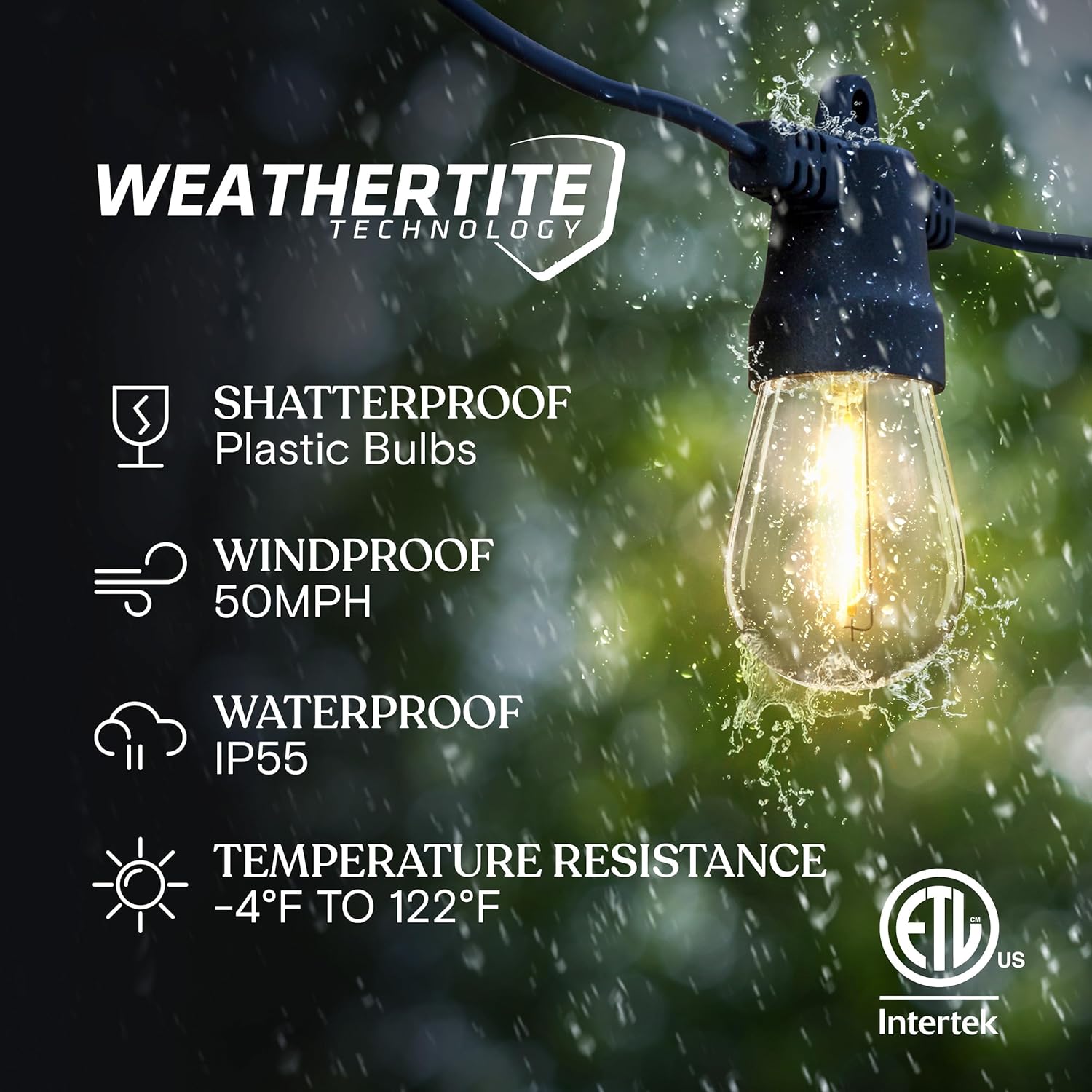
Brightech is the most trusted name in commercial-grade outdoor string lights, and the Ambience Pro Solar is the benchmark Edison-style set. The WeatherTite cord has been tested at winds up to 50MPH — this is not a claim most budget sets can make. Shatterproof S14 plastic bulbs with LED filaments produce a warm 3000K glow that’s bright enough to grill and eat by without being overpowering.
The 27ft strand has 12 bulbs spaced 1.6ft apart — a dense, full curtain of light that covers a standard patio or pergola end-to-end with no dark gaps. The solar panel attaches via stake or clip, giving you three positioning options depending on your setup. Auto dusk-to-dawn activation, 5–6 hours runtime on a full charge, and an industry-leading 2-year warranty make this the set to buy if you want lights that will still be working three years from now.
Pros: Commercial grade WeatherTite construction, 50MPH wind rated, shatterproof Edison bulbs, 3000K warm white, auto dusk-to-dawn, 2-year warranty
Cons: 5–6hr runtime is honest but shorter than some budget sets claim (though actually deliver less), 27ft may not reach large pergolas — see the 48ft version below
Best for: Covered patios, pergolas, and porches where you want a quality Edison bistro look that lasts
Best for Large Spaces: Brightech Ambience Pro Solar 48ft
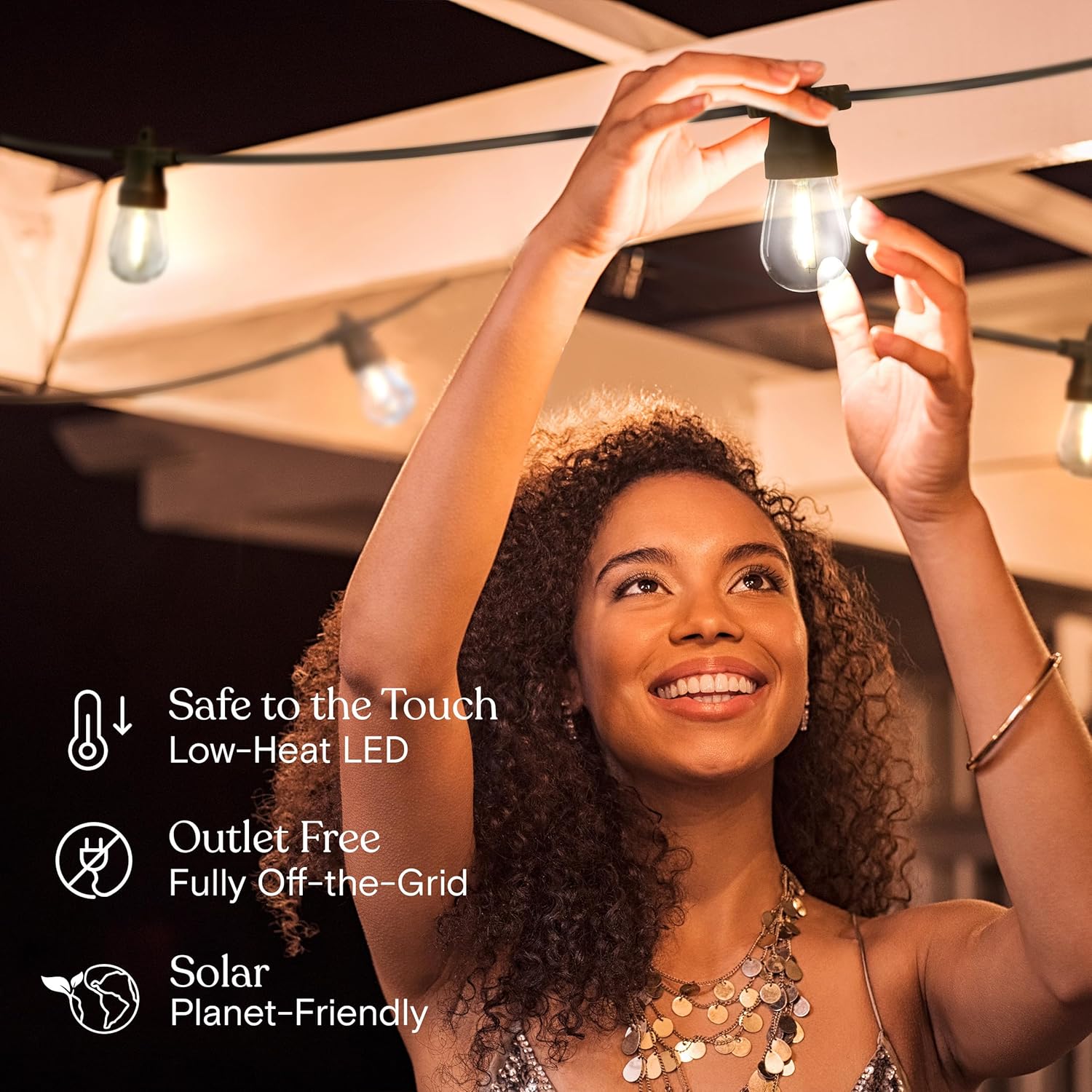
The same commercial-grade construction as the 27ft version — WeatherTite cord, shatterproof Edison bulbs, 3000K soft white, auto dusk-to-dawn — but stretched to 48ft with 15 bulbs at 3ft spacing. This is the right choice for a large pergola, a long fence run, or wrapping around a bigger deck where the 27ft strand runs short.
The 3ft bulb spacing creates a more open, airy look compared to the tighter 1.6ft spacing of the shorter model. Both styles work — it comes down to personal preference and the size of your space. Two strands can be connected for even longer runs. The solar panel and 2-year warranty are identical to the 27ft version.
Pros: Same commercial grade as 27ft, covers large spaces in one strand, 3ft spacing creates elegant airy look, connectable for longer runs
Cons: At wider bulb spacing, the glow is less dense — if you want a full wall of light, the 27ft tighter spacing may look better in a small space
Best for: Large pergolas, long fence runs, wide decks, or any space where 27ft falls short
Best Budget Globe Pick: Joomer Solar G40 26.4ft
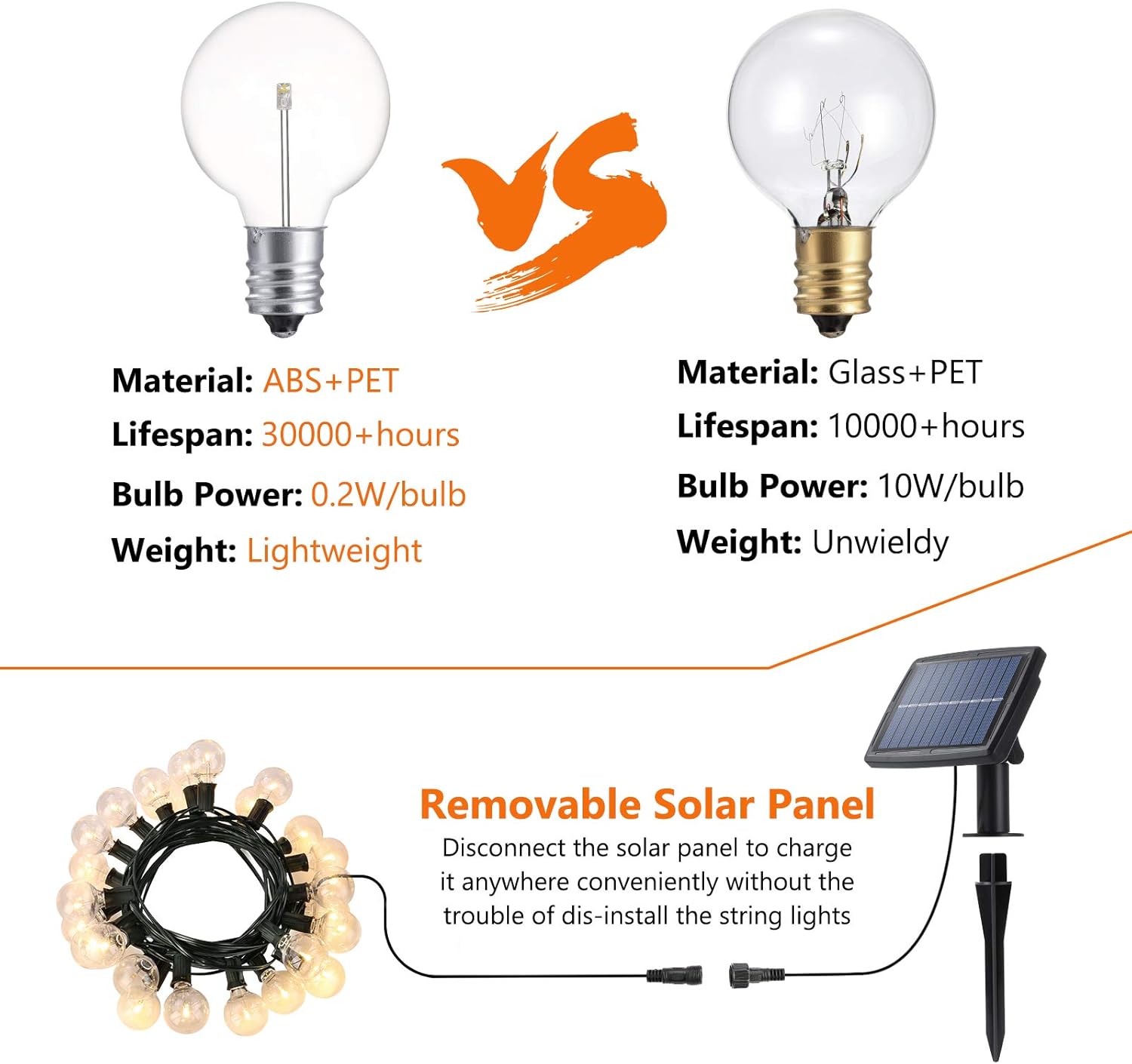
The Joomer G40 is the cleanest budget option for globe-style solar bulb lights. 25 shatterproof G40 bulbs across 26.4ft, 2700K warm white, four lighting modes (steady, flash, fade, slow flash), and automatic dusk-to-dawn activation at E12 base. The globe shape creates a softer, rounder glow than Edison bulbs — more diffused, less directional, and very photogenic over an outdoor dining table or garden fence.
Runtime of 6–8 hours is a realistic claim for this style of light. The auto on/off works reliably and the 2700K colour temperature is noticeably warmer and cozier than the 3000K Brightech sets — a matter of preference, but worth noting if you want a deeper amber tone. Waterproof, lightweight, and easy to hang with the included hardware.
Pros: 25 globe bulbs in 26.4ft (dense coverage), 2700K warm amber tone, 4 lighting modes, 6–8hr runtime, affordable price point
Cons: Not commercial grade — cord and panel are lighter duty than the Brightech; warranty shorter than the Ambience Pro
Best for: Casual backyard use, outdoor dining, anyone who wants globe style at a budget price and doesn’t need commercial-grade durability
Best with USB Backup: Minetom Solar G40 38ft
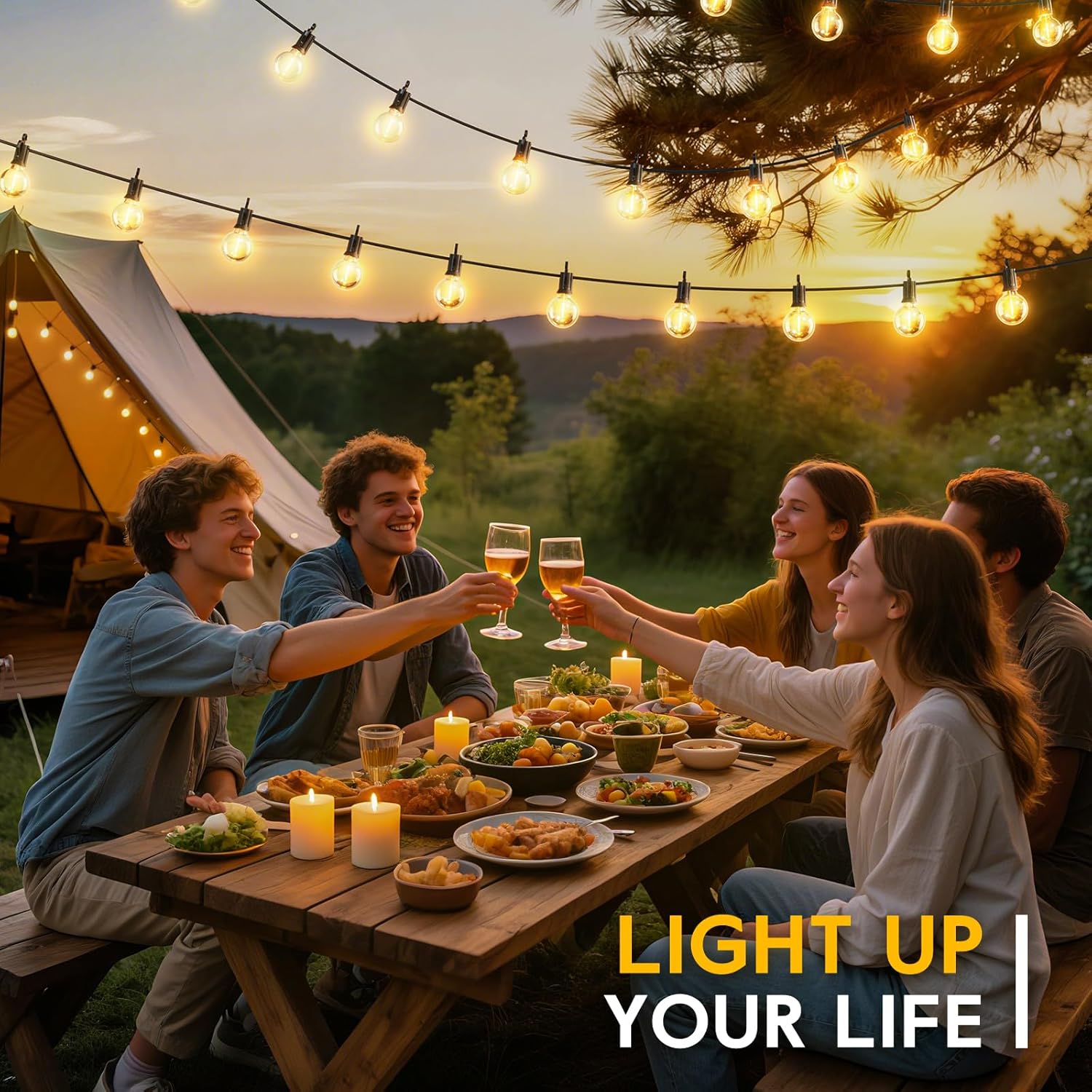
The Minetom’s standout feature is the USB port on the solar panel — a genuine practical advantage. On cloudy days when the panel undercharges, you can plug in via USB and top up the battery to ensure a full evening of light. This makes it the most reliable option for locations with inconsistent sun, or for anyone who has been burned by solar lights fading out before midnight.
38ft with 15 G40 commercial shatterproof bulbs at 2.5ft spacing, fully waterproof, and includes cable ties for clean installation. The panel stakes into the ground or clips to a structure. Auto dusk-to-dawn activation. At 38ft it covers more ground than the Joomer without the jump to the premium Brightech 48ft price.
Pros: USB backup charging ensures reliable runtime even on cloudy days, 38ft covers mid-to-large spaces, commercial shatterproof G40 bulbs, cable ties included for clean install
Cons: 15 bulbs across 38ft means wider 2.5ft spacing — less dense than Joomer’s 25 bulbs across 26.4ft
Best for: Partially shaded locations, areas with less reliable sun, anyone who wants solar with a USB fallback safety net
How to Hang Solar Bulb Lights — The Right Way
Most failed installs come down to two mistakes: the solar panel in the wrong spot, and the wire strung too tight. Here’s how to avoid both.
Solar panel placement: The panel needs direct sunlight for at least 6 hours per day. On a covered pergola, this usually means positioning the panel on the roof edge or on a stake in the garden nearby — not under the shade of the pergola itself. A panel in partial shade will charge to 40–60% on a good day, which translates to 3–4 hours of light instead of 6+. Most sets come with a 6–10ft lead wire between panel and first bulb specifically to allow flexible panel placement.
Hanging hardware: For runs under 20ft, screw hooks or cup hooks into wood posts or fascia boards at 6–8ft intervals. Use outdoor-rated hardware — indoor hooks rust quickly in wet conditions. For longer spans over 30ft, the guide wire method (1/8-inch stainless steel cable, zip ties) prevents sagging and keeps the strand level year-round.
Don’t pull the strand tight: Leave a gentle droop between attachment points. Tight strands put mechanical stress on bulb sockets and wire connections — the most common cause of bulb failures in the first season. A soft catenary curve looks better anyway and lasts longer.
Test before finalising: Cover the solar panel for 60 seconds (tricking the sensor into thinking it’s dark) to test the lights before drilling a single hook. Confirm all bulbs are working and the panel is charging correctly before committing to the install.
Solar Hanging Lights vs Plug-In: When to Choose Each
Solar wins when there’s no outdoor outlet nearby, when you’re lighting a gazebo, pergola, or garden area away from the house, or when you want zero ongoing electricity cost. The trade-off is 5–8 hours of runtime — enough for most evenings, but not if you’re entertaining past midnight regularly.
Plug-in wins when you need all-night runtime without exception, or when you want dimmable control via a standard dimmer switch. If you have an outdoor outlet on the patio, a plug-in set from the same Brightech Ambience Pro line gives identical looks with unlimited runtime.
For most patios and gardens without a conveniently placed outlet, solar is the right answer — especially if you pair it with a set that has USB backup charging like the Minetom.
Frequently Asked Questions
How long do solar hanging bulb lights last each night?
Quality sets like the Brightech Ambience Pro deliver 5–6 hours on a full charge. Globe-style sets like the Joomer and Minetom typically deliver 6–8 hours due to lower per-bulb wattage. Budget sets that claim 10–12 hours rarely achieve it in real conditions. If runtime is your priority, choose a set with USB backup charging — like the Minetom — so you can top up the battery on low-sun days.
Do solar string lights work in winter?
Yes, but runtime shortens significantly due to shorter days and lower sun angle. In northern states with 3–4 peak sun hours in December, expect 3–5 hours of runtime rather than the summer peak. Sets with USB backup charging handle this better than pure-solar sets. Cold temperatures don’t damage the LED bulbs or the solar panels themselves.
Can I connect multiple strands together?
Some sets are designed to be connectable — the Brightech Ambience Pro supports strand linking. Check the product listing before buying if you need more than one strand’s worth of coverage. Most solar sets are not designed for series connection because each strand runs on its own panel — you’d position two panels and run two strands rather than daisy-chaining.
What’s the difference between 2700K and 3000K warm white?
Both are warm white — 2700K is a deeper, more amber tone (the classic incandescent look), and 3000K is slightly whiter and crisper. For outdoor ambiance, most people prefer 2700K. The Joomer and Minetom sets are 2700K; the Brightech Ambience Pro is 3000K. Neither is wrong — it comes down to whether you want a richer amber glow or a slightly brighter, cleaner white.
Why do my solar string lights stop working?
The most common causes: solar panel in a shaded location (most common), battery worn out after 2–3 seasons, moisture in the junction box on a non-waterproof set, or a single blown bulb in a series circuit killing the whole strand. Check panel placement first — it’s the fix for most underperformance complaints. For sets with shatterproof bulbs and IP65 ratings, failures in the first 1–2 years are usually covered under warranty.
Final Verdict
| Your Situation | Best Pick |
|---|---|
| Best overall — commercial grade Edison style | Brightech Ambience Pro Solar 27ft (B075NS8YXG) |
| Best for large pergolas and long fence runs | Brightech Ambience Pro Solar 48ft (B07XC78KJC) |
| Best budget globe style, 25 bulbs | Joomer Solar G40 26.4ft (B08RRQDC4T) |
| Best with USB backup, cloudy climates | Minetom Solar G40 38ft (B08QDVS44N) |
The Brightech Ambience Pro is the pick for anyone who wants lights that genuinely hold up through seasons of outdoor use — the commercial-grade construction and 2-year warranty set it apart from budget alternatives. For globe-style lights at a more accessible price, the Joomer G40 delivers 25 bulbs and 6–8 hours of runtime at a fraction of the Brightech price. And if your location gets inconsistent sun, the Minetom’s USB port is the practical solution that budget and premium solar sets both lack.
For more solar lighting options, see our guides on solar motion sensor lights for security and pathway coverage, and our solar generator guide if you’re looking to power more than just ambient lighting from the sun.