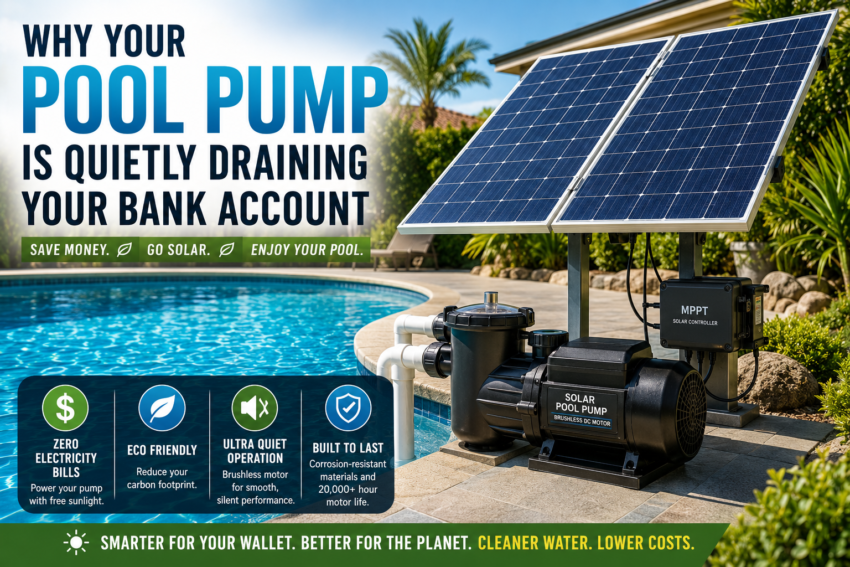
Why Your Pool Pump Is Quietly Draining Your Bank Account
A pool pump is one of the biggest electricity consumers in any home with a pool. Running a standard 1HP single-speed pump 8 hours a day costs roughly $800–$1,200 per year in electricity depending on where you live. Over 10 years, that’s the price of a decent car — just to keep the water moving.
Solar pool pumps solve that. Instead of drawing power from the grid, they run directly off solar panels mounted near the pool. No electricity bill for the pump, no grid connection needed, and in most climates they run 6–8 hours a day — which is exactly how long a pool pump needs to run anyway.
It’s one of those rare cases where the sustainable option and the economical option are the same thing.
How a Solar Pool Pump Actually Works
The setup is simpler than most people expect. Here’s the chain of events every time your pool pump runs:
Solar panels convert sunlight into DC electricity. For most residential pool pumps, you need between 300W and 1,200W of panels depending on the pump size — more on sizing shortly.
The MPPT controller sits between the panels and the motor. MPPT (Maximum Power Point Tracking) continuously optimizes the power drawn from the panels, extracting maximum output even when sun conditions change. It’s the reason solar pool pumps run well on partially cloudy days rather than cutting in and out every time a cloud passes.
The pump motor receives power from the controller and circulates water through your filtration system. Most modern solar pool pumps use brushless DC (BLDC) motors — quieter, more efficient, and rated for 20,000–30,000 hours of operation. That’s 10–15 years of daily use.
The filtration system does the actual cleaning — removing debris, distributing chemicals, and keeping the water clear. The pump is just what moves the water through it.
One thing that surprises people: solar pool pumps don’t need batteries. They run directly from the panels during daylight hours — which is fine, because that’s when the sun heats the pool and when most people use it. Run the pump during the day, enjoy a clean pool in the evening.
DC vs. AC Solar Pool Pumps — Which Do You Need?
This is the first decision you’ll need to make, and it matters.
DC solar pool pumps run directly from solar panels without needing an inverter. They’re more efficient, simpler to install, and cost less to run. The trade-off is they only operate during daylight hours and output varies with sunlight. They’re the right choice for most residential solar pool setups.
AC solar pool pumps use an inverter to convert DC solar power into the standard AC electricity your existing pump already uses. This lets you connect solar panels to almost any existing pool pump. The disadvantage is that inverters add cost and energy loss — more common in retrofit situations.
Hybrid AC/DC pumps run on DC solar during the day and can switch to AC grid power automatically when sun isn’t available. This gives you the benefits of solar without worrying about cloudy days or nighttime filtration needs.
Solar Pool Pump vs. Standard Electric Pool Pump
| Factor | Solar Pool Pump | Standard Electric Pump |
|---|---|---|
| Running cost | $0 (daytime solar) | $800–$1,200/year |
| Installation cost | Higher upfront | Lower upfront |
| Grid dependency | None (DC models) | Full |
| Works at night | DC models: No / Hybrid: Yes | Yes |
| Motor lifespan | 20,000–30,000 hrs (BLDC) | 2,000–5,000 hrs (brushed) |
| Noise | Very quiet | Moderate |
| ROI period | 3–5 years | N/A |
The math generally works in solar’s favour within 3–5 years. After that, every year of operation is essentially free pump power. The longer you own the pool, the better the economics look.
Types of Solar Pool Pumps
DC Brushless Solar Pool Pumps
The main category for residential use. These run directly from solar panels via an MPPT controller, use brushless DC motors for long life and low noise, and are sized from small above-ground pool units (400GPH) all the way up to large in-ground pool systems (136GPM+). No inverter needed. No battery needed.
AC Solar Pool Pumps (With Inverter)
For retrofitting solar onto an existing AC pool pump. A solar inverter converts panel output into AC power for the pump. More expensive and slightly less efficient than a direct DC setup, but lets you use your existing pump and filtration infrastructure.
Solar Pool Circulation Pumps (Small Pools)
For small above-ground pools up to about 1,500 gallons. These are compact, self-contained units that include a small solar panel, a filter cartridge, and a low-flow pump motor. Setup takes 15 minutes and requires no technical knowledge.
High-Power DC Solar Pool Pumps (Very Large Pools)
For pools over 20,000 gallons, standard residential DC pumps don’t have enough flow rate. Larger 72V DC units in the 1,200W range deliver 136 GPM — enough to turn over a 30,000-gallon pool in under 4 hours. These require 6× 300W solar panels and are the most powerful DC solar pool pumps available on Amazon.
What to Look for When Buying a Solar Pool Pump
Flow rate (GPH or GPM)
This is the most important spec. Your pump needs to turn over your entire pool volume at least once every 8 hours. Divide your pool volume by 8 to get the minimum GPH you need. Example: 15,000-gallon pool ÷ 8 hours = 1,875 GPH minimum.
Head pressure
Head is the vertical distance the pump needs to push water — accounting for pipe length, bends, and filter resistance. If your pump is significantly below or above pool level, factor head into your sizing.
Solar panel wattage
Most DC solar pool pumps don’t include panels — you source them separately based on the pump’s voltage and watt requirements. The pump manufacturer will specify the exact panel configuration required.
MPPT controller
Non-negotiable. A pump without an MPPT controller will cut out every time a cloud reduces solar output. MPPT smooths the variable input and keeps the motor running consistently.
Saltwater compatibility
If you have a saltwater pool, check that the pump body and impeller materials are rated for it. Look for stainless steel shafts and salt-resistant polypropylene bodies.
Warranty
The PWS brand offers a 3-year warranty — the best in the DC solar pump category on Amazon. SunRay offers longer coverage on their higher-end kits. Warranty matters for equipment that runs outdoors in all weather.
How Much Solar Does a Pool Pump Need?
| Pool Size | Pump Power | Solar Panels Needed |
|---|---|---|
| Up to 1,500 gal (small above-ground) | 12–20W | 1× 20W panel (included in kit) |
| Up to 10,000 gal | 300–500W | 2× 250–330W panels |
| 10,000–20,000 gal | 600–900W | 3× 300–400W panels |
| 20,000–30,000 gal | 900–1,200W | 6× 300W panels |
In most US locations, a properly sized solar pool pump runs 6–8 hours per day during summer — which is the standard recommended filtration time. It’s a natural match.
The Best Solar Pool Pumps Right Now
Every product below has been verified on Amazon or direct from the manufacturer with specs confirmed from official listings.
| Model | Pool Size | Flow Rate | MPPT | Saltwater | Warranty | Price |
|---|---|---|---|---|---|---|
| OYOWATER 400GPH | Up to 1,300 gal | 400 GPH | ❌ | ❌ | 1 year | ~$140 |
| WaterRebirth FP1600WR | Up to 1,320 gal | 400 GPH | ❌ | ❌ | 18 months | ~$150 |
| PWS JP17-15/500 | Up to 16,000 gal | 75 GPM (4,500 GPH) | ✅ | ✅ | 3 years | ~$400 |
| PWS JP21-19/900 | Up to 21,000 gal | 92 GPM (5,520 GPH) | ✅ | ✅ | 3 years | ~$600 |
| PWS JP31-19/1200 | Up to 30,000 gal | 136 GPM (8,160 GPH) | ✅ | ✅ | 3 years | ~$900 |
OYOWATER 400GPH Solar Cartridge Pump — Best for Small Above-Ground Pools
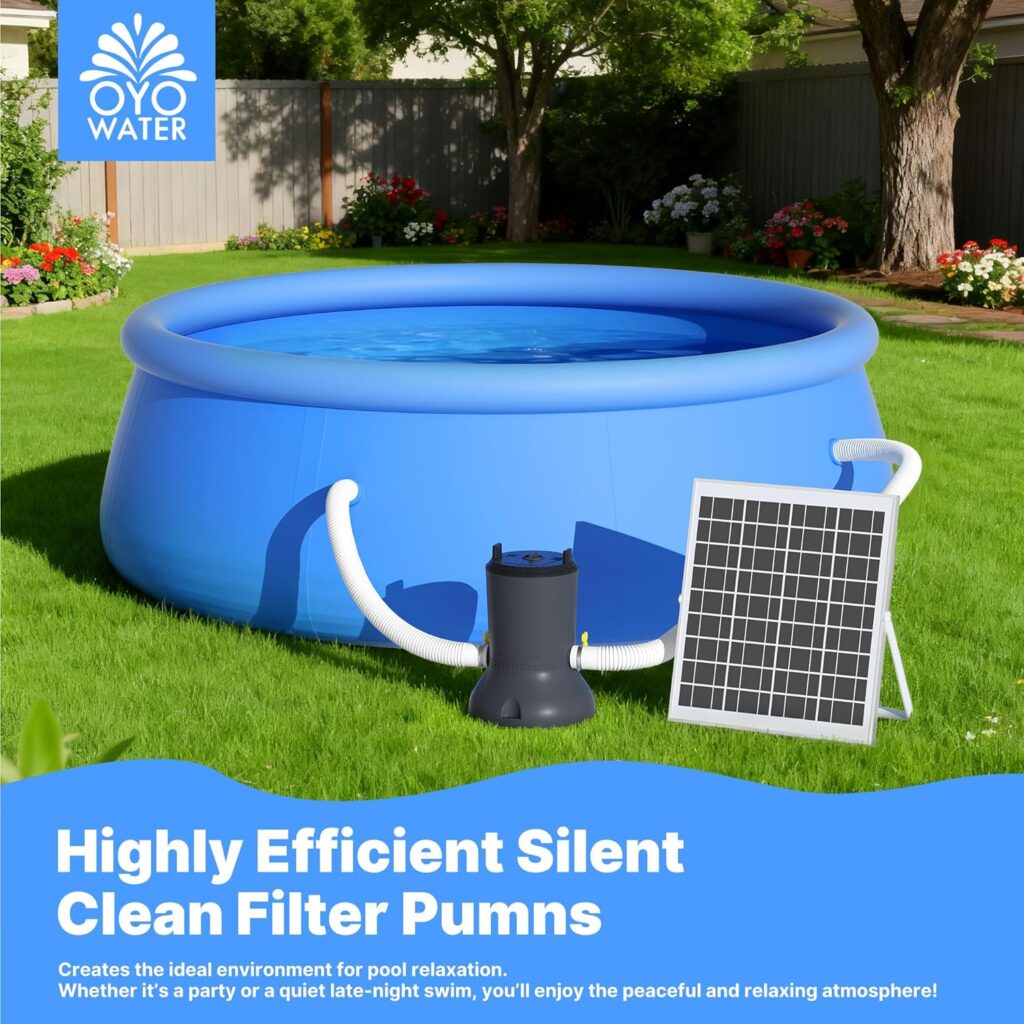
If you have a small above-ground pool — the kind families set up in the backyard for summer — the OYOWATER 400GPH is the most straightforward solar option on Amazon. It’s a self-contained unit: the 20W solar panel connects directly to the pump, a filter cartridge traps debris, and the whole thing sets up in under 30 minutes.
It delivers a 400 GPH flow rate with a 1.8m lift, handles pools up to 1,300 gallons, and the ABS construction is corrosion-resistant for outdoor use. The honest limitation is it’s daytime solar only — no AC backup. For a small pool used primarily in summer sun, that’s usually fine.
Pros: Simple self-contained setup, solar panel included, genuine filtration (not just circulation), affordable entry price
Cons: Daytime solar only, 1,300-gallon limit, no saltwater rating
Best for: Small above-ground pools up to 1,300 gallons, summer use in sunny climates
WaterRebirth FP1600WR Dual-Power Solar Pool Filter Pump — Best for Reliability
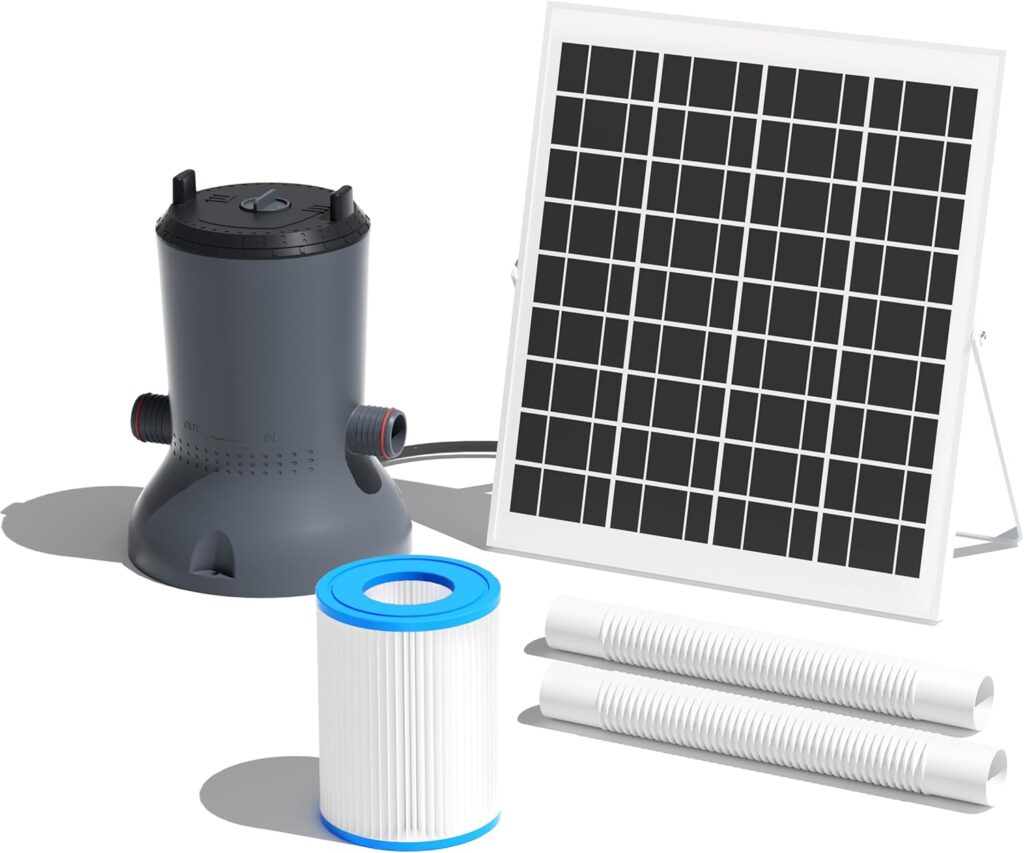
The WaterRebirth FP1600WR solves the main problem with pure solar pool pumps — what happens when the sun isn’t shining. It features a dual-power design: use the 20W solar panel during the day, or switch to the included 120V AC transformer for 24/7 continuous filtration. You never have to worry about a cloudy day stopping your pool from filtering.
The pump is IPX8 rated, the solar panel is IP65, and the power adapter is IP67 — serious weather protection at every connection point. Setup requires no tools: connect the hoses, place the panel, and it’s running in minutes. The 18-month warranty (extendable with product registration) and US-based support make it a cut above the no-name competition at this price.
Pros: Dual solar/AC power runs day and night, IPX8 waterproof, US-based customer support, 18-month warranty, hoses and cable included
Cons: 1,320-gallon limit only, no saltwater rating
Best for: Small above-ground pools where you want 24/7 filtration reliability regardless of weather
PWS JP17-15/500 — Best Mid-Range for Medium Pools
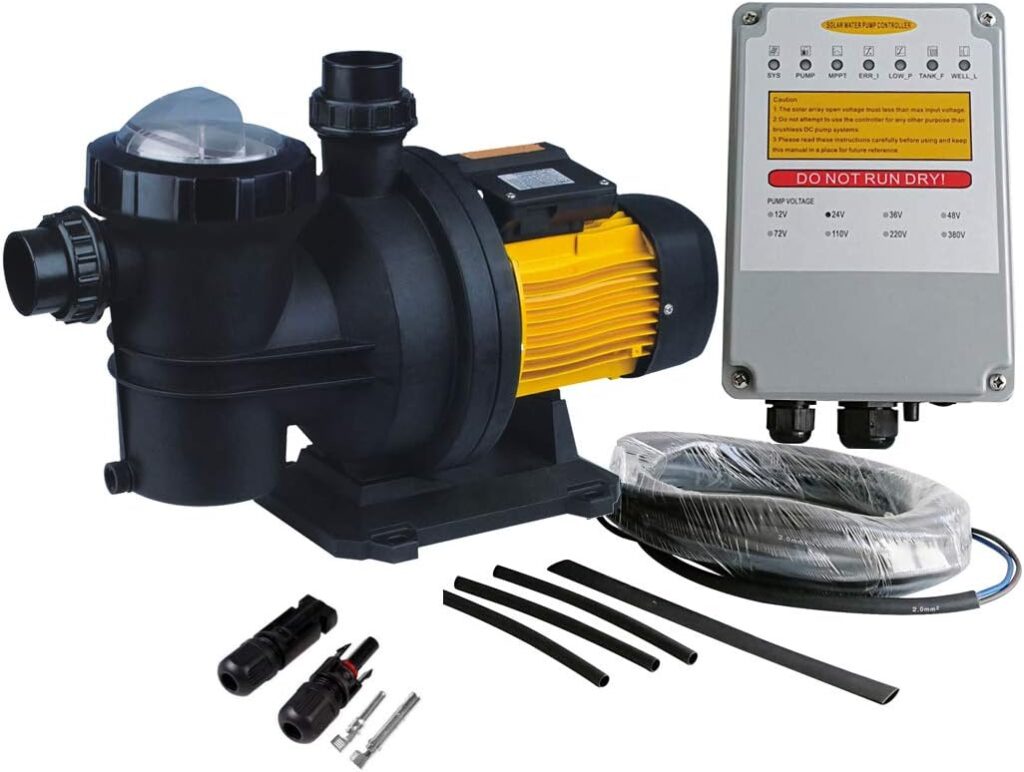
The JP17-15/500 is where solar pool pumping gets serious. It’s a 48V DC, 3/4HP brushless motor pump rated for pools up to 16,000 gallons, delivering 75 GPM with a 49ft total head and a 3-year warranty — the longest in its class on Amazon.
Saltwater-resistant construction throughout: stainless steel AISI 316 motor shaft, PPO impeller, polypropylene pump body. MPPT controller included. It requires 2× 330W solar panels wired in series (not included) — budget for those separately. This is a proper replacement for a grid-powered pump, not a supplementary circulation device.
Pros: MPPT controller, saltwater resistant, 3-year warranty, handles pools to 16,000 gallons, quiet BLDC motor, dry-run protection
Cons: Panels not included (2× 330W required), higher upfront cost, DC daytime operation only
Best for: Medium in-ground or large above-ground pools 8,000–16,000 gallons in sunny climates
PWS JP21-19/900 — Best for Large Pools
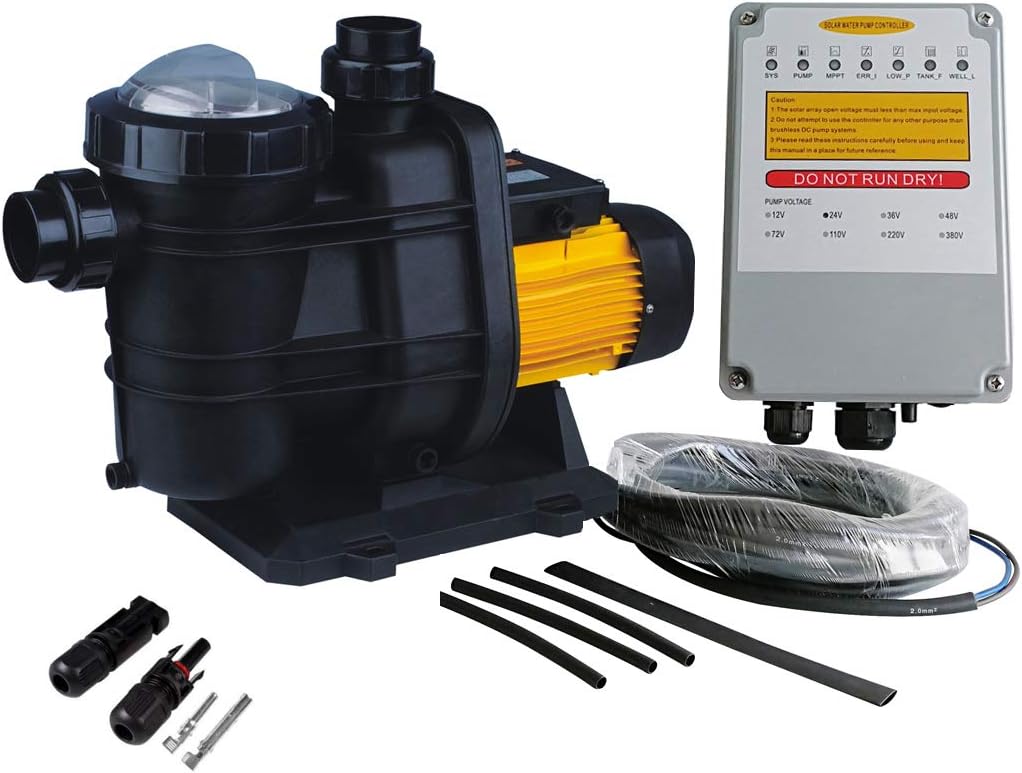
The JP21-19/900 steps up to 72V DC and 900W, delivering 92 GPM for pools up to 21,000 gallons with a 62ft head. The MPPT controller keeps it running smoothly under variable sunlight and built-in protections cover low-light start-ups, overheating, and dry running. It turns over a 20,000-gallon pool in under 4 hours — giving you comfortable margin even on partially cloudy days.
Three 400W panels wired in series are required (not included). At this scale you’re building a real solar pool system, not just adding a solar accessory. The 3-year warranty and direct manufacturer parts supply mean long-term support if anything ever needs attention.
Pros: 92 GPM for large pools, MPPT, saltwater rated, 3-year warranty, dry-run protection, 10–15 year motor lifespan
Cons: Panels not included (3× 400W required), significant upfront investment, daytime DC operation only
Best for: Large in-ground pools 15,000–21,000 gallons where you want a complete solar replacement for a grid pump
PWS JP31-19/1200 — Best for Very Large Pools
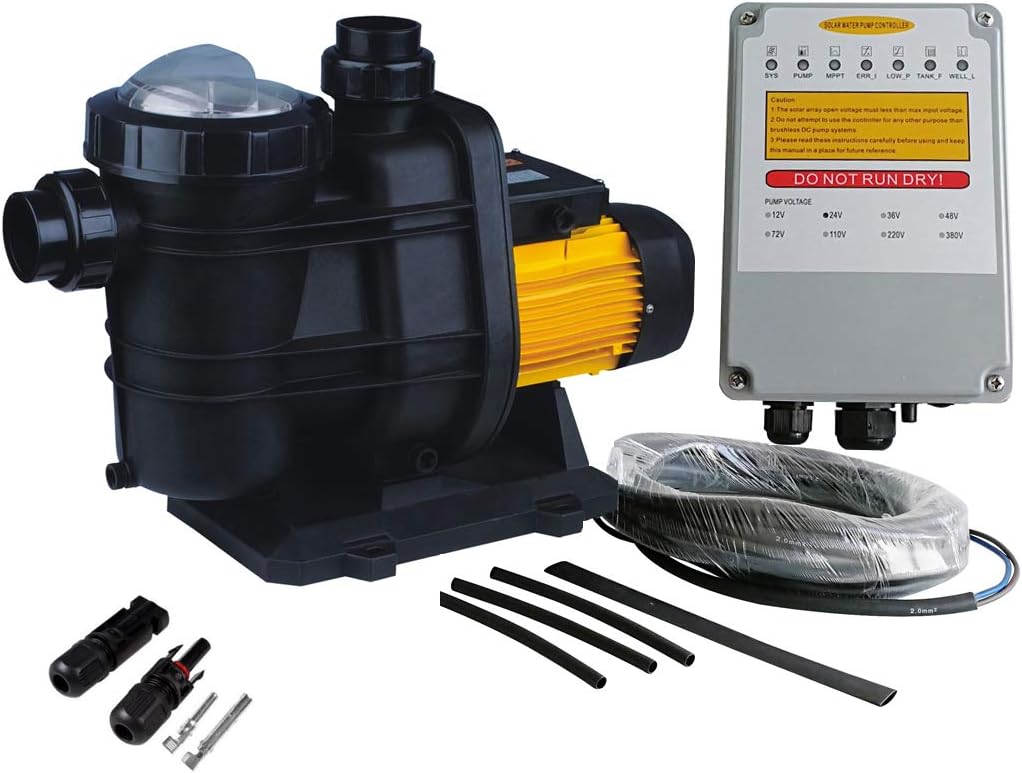
The JP31-19/1200 is the most powerful solar pool pump in the PWS range — and on Amazon. At 72V DC and 1,200W, it delivers 136 GPM for pools up to 30,000 gallons with a 62ft total head. It uses the same proven brushless DC motor and MPPT controller as the JP21-19/900, just with more power behind it.
At 136 GPM it turns over a 30,000-gallon pool in under 4 hours — leaving comfortable margin even when reduced by cloud cover or seasonal sun angle. Six 300W solar panels wired in series are required (not included). The same saltwater-resistant construction applies: stainless steel AISI 316 shaft, PPO impeller, polypropylene body. Three-year warranty and direct manufacturer parts support.
This is the right choice when the JP21-19/900 isn’t big enough — large residential pools, commercial pools, and anyone running a system where maximum flow rate matters.
Pros: 136 GPM — highest flow rate on Amazon for a solar pool pump, MPPT, saltwater rated, 3-year warranty, dry-run protection, same proven PWS build quality
Cons: Requires 6× 300W panels (significant solar investment), largest upfront cost in the lineup, DC daytime operation only
Best for: Very large in-ground pools 20,000–30,000 gallons where maximum flow rate is the priority
Installation — What You’re Actually Getting Into
Small above-ground pools (OYOWATER, WaterRebirth): Genuinely plug-and-play. Connect the hoses to your pool’s inlet and outlet, plug the solar panel into the pump, place the panel in sun. No tools, no wiring, 15–20 minutes.
Medium to large DC pumps (PWS models): More involved. You’re wiring solar panels in series, connecting to an MPPT controller, then to the pump. The connections are low-voltage DC — not dangerous, but you need basic solar wiring knowledge. Budget a half-day and follow the included documentation carefully.
Very large DC pumps (PWS JP31-19/1200): Same approach as the medium/large PWS models but with six panels to wire. More solar panels means more connections to manage — still low-voltage DC, but take extra care with the wiring sequence and panel series configuration. Budget a full day and double-check all connections before first run.
Common mistakes to avoid:
- Undersizing the pump for your pool volume — always calculate minimum GPH before buying
- Placing panels where afternoon shade hits them — pool areas often have trees that cast shade by 2–3pm. Check your sun path across the whole day first
- Using incompatible pipe sizes — measure your existing inlet/outlet before ordering
- Skipping the MPPT controller — a pump without one will cycle on and off with cloud cover and wear the motor prematurely
Maintenance — Keeping It Running
Clean the solar panels. Sunscreen residue, pollen, and dust reduce output over a season. A quick wipe every few weeks keeps them at full efficiency.
Clean the filter cartridge. Small pool pumps use replaceable cartridge filters — check them weekly during heavy use and replace when flow rate drops noticeably.
Check inlet baskets. Larger DC pumps have a debris basket that needs periodic emptying — the transparent lid on PWS models makes it easy to see when it needs attention.
Winterize properly. In cold climates, drain the pump completely before first frost. Water left in the pump body will freeze and crack the housing. Store the MPPT controller indoors over winter.
Motor longevity: BLDC motors in the PWS range are rated for 20,000–30,000 operational hours. At 8 hours daily, that’s 7–10 years before the motor reaches its service life — far longer than a standard brushed AC pool pump.
Frequently Asked Questions
Can a solar pool pump run a filter?
Yes — but it depends on the pump. The small above-ground units (OYOWATER, WaterRebirth) include their own cartridge filter. The larger DC pumps (PWS models) connect to your existing filtration system and circulate water through it exactly the same way a standard electric pump does.
Do solar pool pumps work on cloudy days?
Yes, at reduced output. The MPPT controller adjusts pump speed proportionally to available solar power rather than shutting off. On heavily overcast days, flow rate drops significantly. If you need 24/7 filtration regardless of weather, the WaterRebirth FP1600WR with its built-in AC backup is the most practical solution for smaller pools.
Can I use a solar pump for an above-ground pool?
Yes — and it’s one of the best use cases. The small self-contained units (OYOWATER, WaterRebirth) are specifically designed for above-ground pools up to 1,300 gallons. The larger PWS models work for bigger above-ground pools too.
How many solar panels do I need for a pool pump?
It depends entirely on your pump’s power requirements. Small kit pumps include a 20W panel. The PWS 48V model needs 2× 330W panels. The PWS 72V model needs 3× 400W panels. Always follow the manufacturer’s panel specification for your specific model.
Will a solar pool pump keep my pool clean?
Yes — as long as it’s properly sized for your pool volume and runs enough hours to achieve the required water turnover. The standard target is turning over your full pool volume once per 8 hours. Size correctly, run it during peak sun hours, and your pool stays as clean as with a grid-powered pump.
So Which Solar Pool Pump Should You Buy?
| What You Need | Best Pick |
|---|---|
| Small above-ground pool, sunny climate | OYOWATER 400GPH Solar Cartridge Pump |
| Small pool, want 24/7 reliability | WaterRebirth FP1600WR Dual-Power |
| Medium pool 8,000–16,000 gal | PWS JP17-15/500 Solar Pool Pump |
| Large pool 16,000–21,000 gal | PWS JP21-19/900 Solar Pool Pump |
| Very large pool 20,000–30,000 gal | PWS JP31-19/1200 Solar Pool Pump |
| Saltwater pool | PWS JP17-15/500, JP21-19/900 or JP31-19/1200 |
For small above-ground pools, the choice comes down to one question: do you want daytime-only solar (OYOWATER, simpler and cheaper) or 24/7 hybrid solar/AC filtration (WaterRebirth, more reliable)?
For medium and large in-ground pools, the PWS range is the clear choice on Amazon. The 3-year warranty, MPPT controller, and saltwater-resistant construction put them ahead of anything else at these price points. Budget for the solar panels separately and you have a proper solar pool pump system that will run for a decade.
Need maximum flow for a very large pool? The PWS JP31-19/1200 at 136 GPM is the most powerful solar pool pump available on Amazon — the same proven PWS build quality scaled up for pools to 30,000 gallons.
Running your pool on solar isn’t a compromise. For most people in most climates, it’s simply the smarter way to do it.