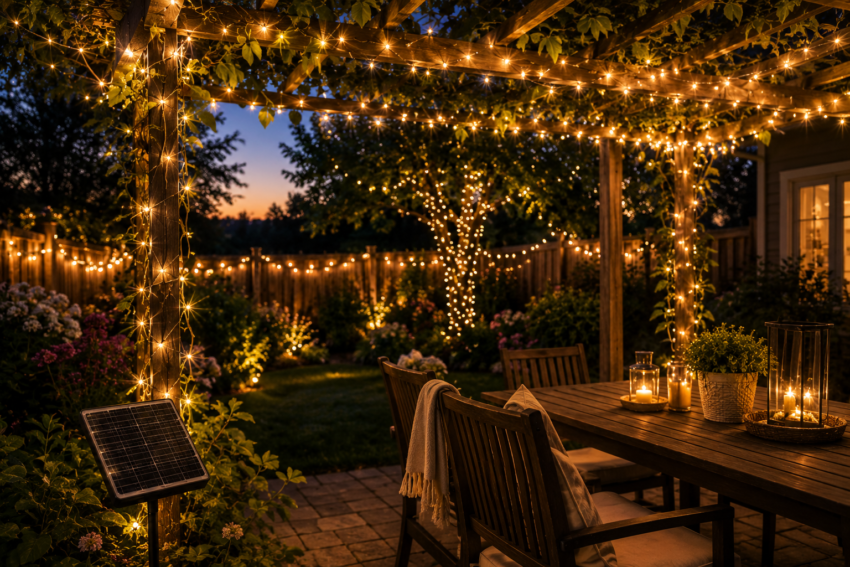
Why Solar Fairy Lights Have Got So Much Better
A few years ago, solar fairy lights had a reputation for being dim, dying by 10pm, and giving up entirely after a few weeks. That reputation was largely deserved. The solar cells were small and inefficient, the batteries were NiMH AA cells that degraded quickly, and the LEDs weren’t particularly bright.
That’s genuinely changed. The solar cells in today’s better fairy lights are monocrystalline — the same technology used in home solar panels — which means they charge effectively even in partial shade and on overcast days. The batteries have shifted to lithium-ion in premium models, which hold charge better, perform in cold weather, and last longer over hundreds of charge cycles. And LED efficiency has improved to the point where 200 tiny LEDs can run all night on what amounts to a few hours of sun.
The result is that a decent set of solar fairy lights bought today — positioned correctly — will genuinely stay lit from dusk until past midnight, night after night, without touching a plug. That’s not marketing anymore. It’s just how the technology works now.
How Solar Powered Fairy Lights Work
The system is simple. During daylight hours, a small solar panel converts sunlight into electricity and stores it in a rechargeable battery inside the panel housing. When it gets dark, a light sensor triggers the lights to switch on automatically, drawing from that stored energy until either dawn or the battery runs flat.
The dusk-to-dawn sensor is what makes solar fairy lights genuinely low-effort. You set them up, switch the panel to ON, and they handle themselves from there. No timers to set, no remembering to switch them on and off.
Why panel placement matters more than people realise. The solar panel and the fairy lights are connected by a cable — usually 1–2 metres long. This means you can position the panel in full sun while the lights hang in shade. Most people clip the lights to a shaded fence or tree and leave the panel dangling somewhere nearby — which is exactly the wrong approach. The panel needs direct, unobstructed sun for at least 6 hours. If it doesn’t get that, runtime drops sharply.
What happens on cloudy days. The panel still charges — just more slowly. On a fully overcast day you might get 30–40% of a full charge, which usually means 3–5 hours of light rather than 8–10. A string of partly cloudy days gradually depletes the battery until a sunny day replenishes it. In consistently cloudy climates or winter months, some sets will struggle. The ones with larger panels and lithium batteries handle it better than the rest.
What to Look for Before You Buy
LED count and string length
More LEDs means denser, fuller light along the string. 100 LEDs on 33ft is standard entry level. 200 LEDs on 66ft gives noticeably more coverage and a fuller look. Multi-packs (2 or 4 strings) extend your total length significantly and are usually better value than buying single strings multiple times.
Battery type
NiMH rechargeable batteries are common in budget sets. They work but degrade faster in cold weather and lose capacity after 200–300 charge cycles. Lithium batteries last significantly longer, perform better in winter, and are worth paying a small premium for if you’re planning year-round outdoor use.
IP rating
IP44 is fine for most garden and patio use. IP65 — protected against water jets and dust — is better for exposed positions, fences, and anywhere that gets direct rain. For general outdoor use, IP65 is the minimum worth buying.
Light modes
Most sets offer 8 modes: steady on, slow fade, twinkle, flash, wave, combination, sequential, and chasing. Steady on and slow fade are the most popular for everyday use. The mode button is usually on the back of the solar panel — worth knowing before you’ve installed the panel somewhere hard to reach.
Colour temperature
Warm white (2700–3000K) gives that soft golden glow most people associate with fairy lights — cosy, flattering, works with almost any outdoor space. Cool white is crisper but less atmospheric. For general outdoor ambience, warm white is almost always the right choice.
Runtime claims — how to read them honestly
“Up to 8–10 hours” means after a full 6–8 hour charge in direct sun. In practice — partial shade on the panel, partly cloudy day, or a flashing mode (which uses more power than steady) — expect 5–7 hours. That’s still enough to take you from sunset to midnight in most seasons.
The Best Solar Powered Fairy Lights Right Now
Every product below is verified on Amazon with specs confirmed from official listings.
| Product | LEDs / Length | IP Rating | Modes | Price | Best For |
|---|---|---|---|---|---|
| Brightown 2-Pack 200 LED | 200 LED / 66ft × 2 | IP65 | 8 | ~$14 | Best overall |
| Joomer 2-Pack 240 LED | 240 LED / 80ft × 2 | IP65 | 8 | ~$16 | Best value / longest |
| Brightown 72ft 200 LED | 200 LED / 72ft | IP65 | 8 | ~$13 | Best single pack |
| Ankway 200 LED 72ft | 200 LED / 72ft | IP65 | 8 | ~$17 | Best for tree wrapping |
| Brightech Ambience Pro | 12 Edison bulbs / 27ft | Weatherproof | Steady | ~$70 | Best premium patio |
Brightown 2-Pack 200 LED Solar Fairy Lights — Best Overall
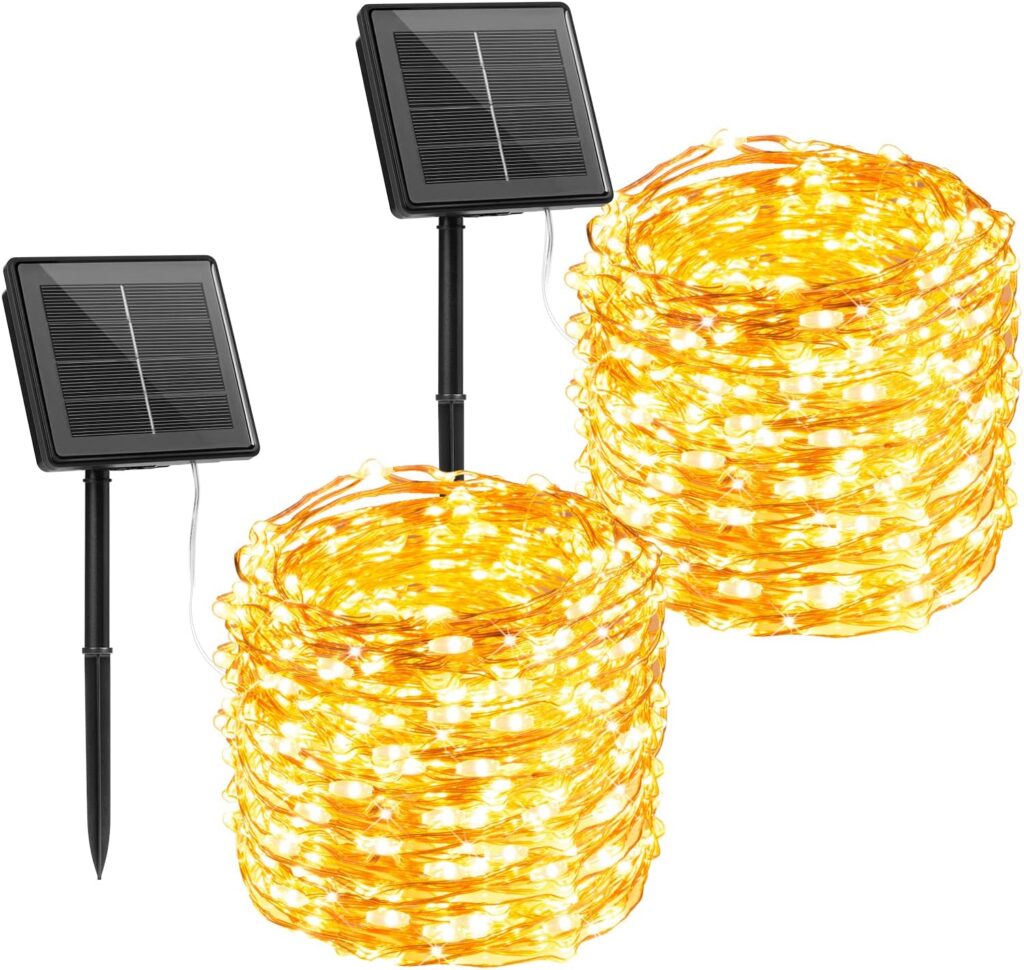
Brightown is one of the most consistently reviewed solar fairy light brands on Amazon, and the 2-pack 200 LED set is their most popular product for good reason. Each set includes 33 feet of string with 100 bright LED bulbs producing a warm soft white glow, IP65 waterproof, and eight lighting modes including combination, waves, sequential, slow glow, chasing/flash, slow fade, twinkle/flash, and steady on.
The monocrystalline silicon solar panel is 120-degree adjustable and paired with a 1200mAh rechargeable battery — giving 8 to 10 hours of light after a full charge. Two strings totalling 66 feet covers a medium garden, fence run, or patio pergola generously. The flexible copper wire shapes easily around posts, branches, and railings without kinking. At around $14 for two strings, the value is exceptional.
Pros: Proven brand with thousands of verified reviews, monocrystalline panel, 1200mAh battery, IP65, 8 modes, flexible copper wire, exceptional value in 2-pack
Cons: Individual strings are 33ft each — for a long unbroken run, see the single 72ft option below
Best for: Gardens, patios, fences, balconies, and anyone wanting reliable solar fairy lights at the best price
Joomer 2-Pack 240 LED Solar Fairy Lights — Best Value / Longest String
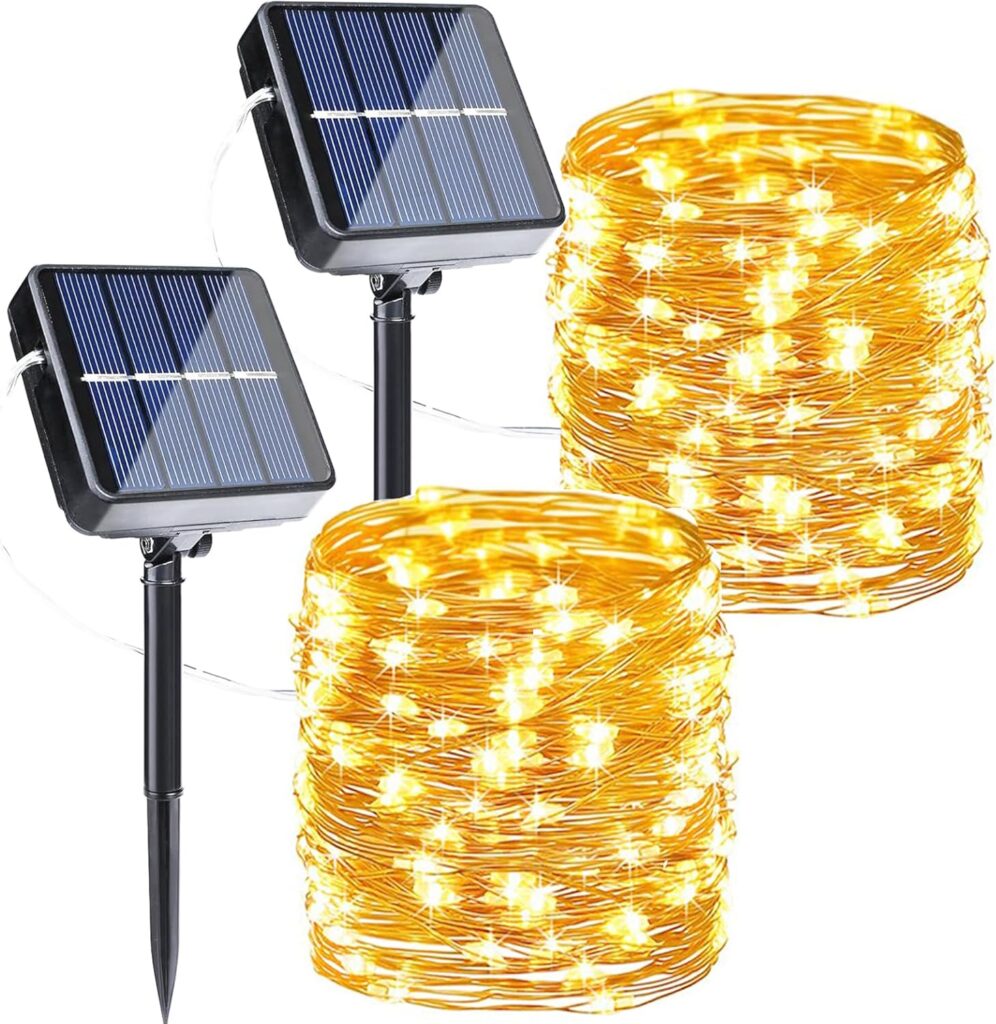
The Joomer 2-Pack gives you 80 total feet and 240 LEDs across ultra-thin bendable silver wire, IP65 waterproof, with 8 lighting modes and a built-in memory chip that saves your last mode setting — so you don’t need to reset it every day.
The memory chip is worth calling out. With most fairy lights, every time the panel resets at dawn you go back to mode 1 (usually combination/flash) regardless of what you had set. Joomer’s memory function keeps your preferred mode — a small thing that genuinely improves daily use. At 80 total feet and 240 LEDs, this is the longest and most LED-dense pack at this price point, with more than 8 hours of light after a full charge.
Pros: Longest total string (80ft), most LEDs (240), mode memory chip, IP65, auto dusk-to-dawn sensor, clean silver wire
Cons: Silver wire is less flexible than copper — slightly harder to shape tightly around curved objects
Best for: Long fence runs, large garden perimeters, anywhere you want maximum coverage from a single purchase
Brightown 72ft 200 LED Solar String Lights — Best Single Pack
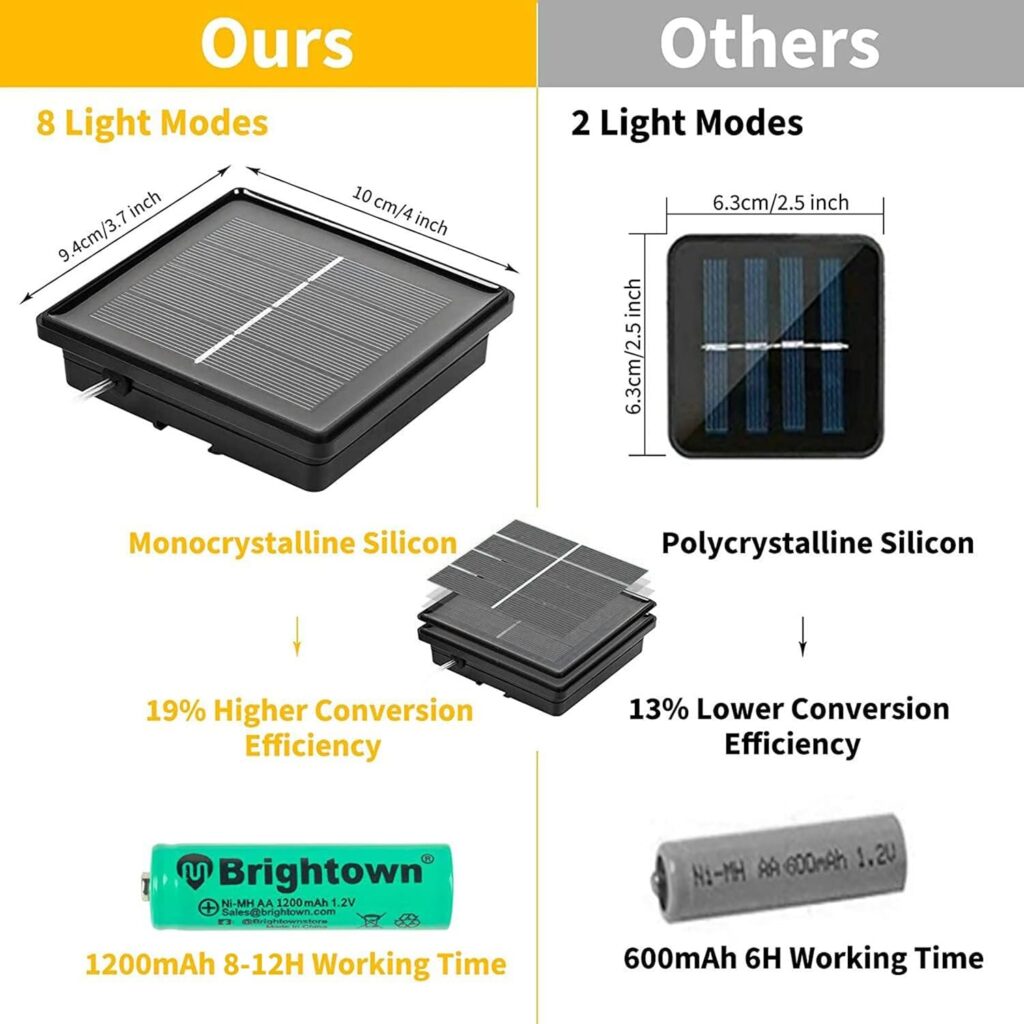
If you want a single unbroken 72-foot run rather than two separate 33-foot strings, this is the one. The same proven Brightown monocrystalline panel and 1200mAh battery powers 200 LEDs along 72 feet of flexible copper wire, delivering 8 to 10 hours of warm white light after a full charge.
A single string means no junction in the middle — cleaner for wrapping around a pergola, along a roofline, or creating one continuous sweep across a garden. Eight modes, IP65 waterproofing, and lights that stay cool to the touch even after hours of use.
Pros: Single 72ft unbroken run, proven Brightown panel and battery, IP65, flexible copper wire, cool to the touch
Cons: Single string only — for wider coverage you’d need to buy multiple
Best for: Pergolas, gazebo rooflines, long fence runs, and anywhere a single unbroken string is cleaner than two joined together
Ankway 200 LED 72ft Solar Fairy Lights — Best for Tree and Garden Wrapping
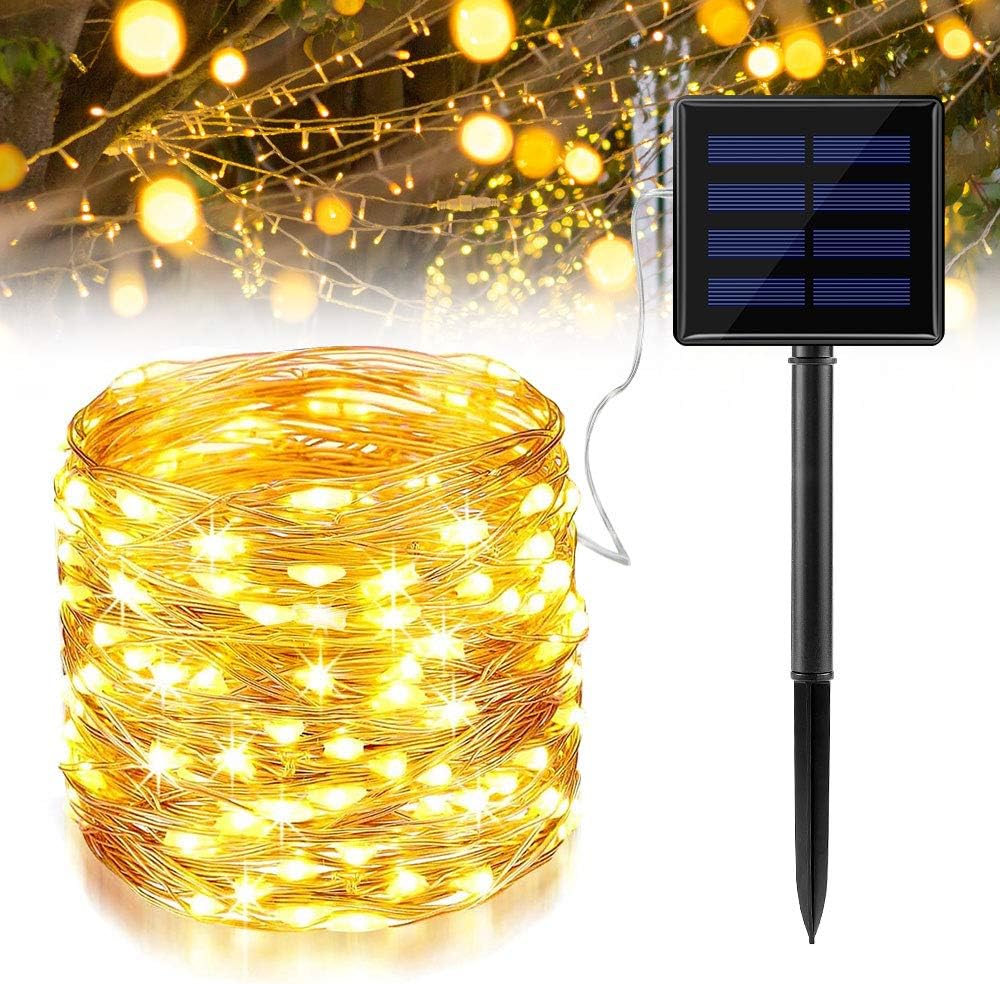
The Ankway 200 LED comes on a three-strand copper wire design — rather than a single wire, the strands splay out from the main line, making it noticeably better for filling out trees, bushes, and shrubs where you want the lights to look dense and three-dimensional rather than a single line of dots.
IP65 rated with 8 lighting modes and a 12-month warranty. The 72ft length and 200 LEDs give solid coverage, and the three-strand design means less visible wire when wrapped around foliage. For garden trees and large hedges, this design makes a meaningful visual difference over a standard single-wire string.
Pros: Three-strand design fills trees and bushes beautifully, 200 LEDs on 72ft, IP65, 8 modes, 12-month warranty
Cons: Three-strand design is less suitable for fence lines or linear runs where single-wire looks cleaner
Best for: Garden trees, large hedges, shrubs, and any application where you want a full, lush look rather than a single string line
Brightech Ambience Pro Solar String Lights — Best Premium Patio Pick
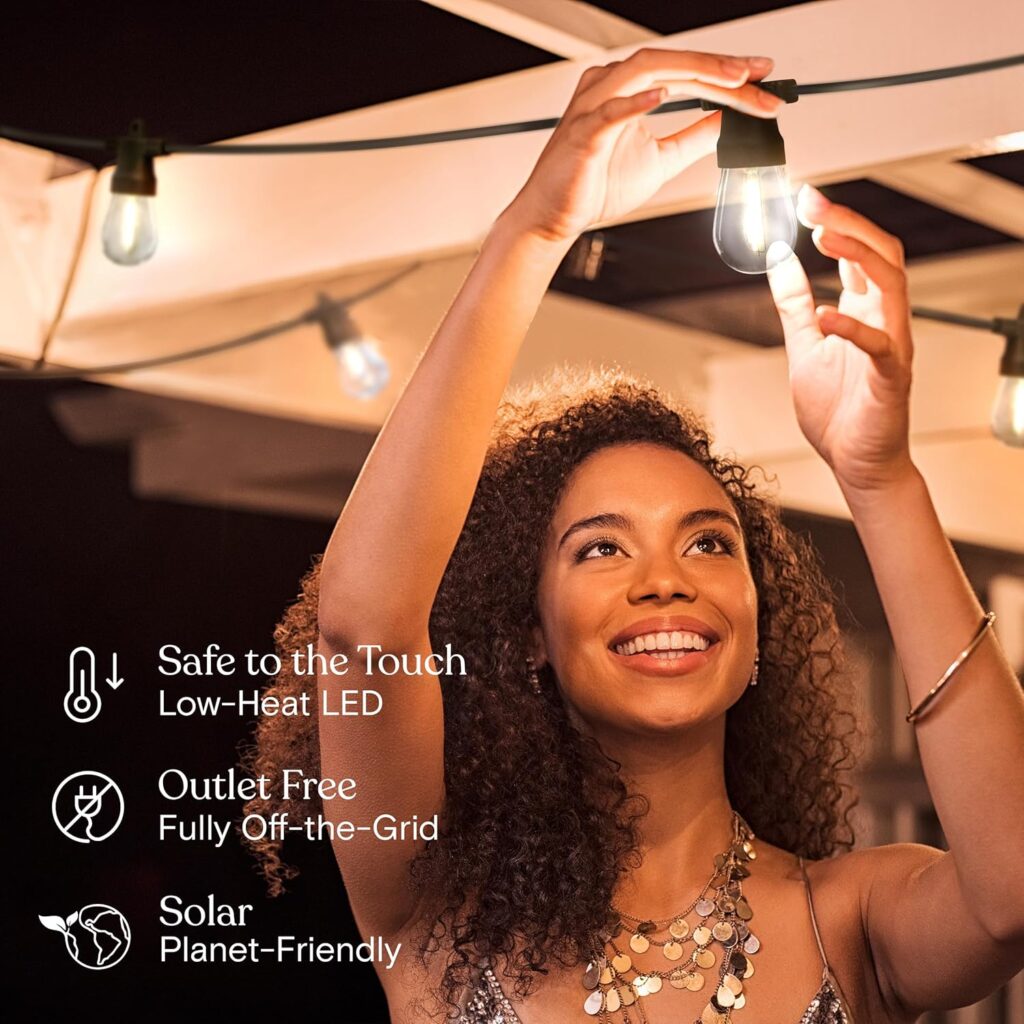
The Brightech Ambience Pro is a different category of product from the copper wire fairy lights above — and it’s worth including because it answers a different question. If you want proper outdoor patio ambience rather than delicate fairy lights, this is the one.
It’s the consistently top-rated solar patio string light on Amazon with over 36,000 reviews and a 4.4-star rating. The 27ft strand of 12 Edison-style shatterproof LED bulbs creates a warm, commercial-grade glow across a patio or pergola — the kind of lighting you’d see at an outdoor restaurant. The separate solar panel on a 15-foot cable lets you position it in full sun even if the lights hang under a covered area.
Pros: Premium shatterproof Edison bulbs, 36,000+ Amazon reviews, 4.4 stars, separate positionable solar panel, genuinely commercial-grade build, 2-year warranty
Cons: Much higher price, 27ft is short for large spaces (buy two for bigger patios), Edison style isn’t for everyone
Best for: Patios, pergolas, outdoor dining areas, and anyone who wants premium patio ambience rather than delicate fairy string lights
Best Uses for Solar Fairy Lights
Garden and patio. The most natural application. Draped along a fence, wrapped around posts, or hung across a pergola — solar fairy lights transform an outdoor space after dark without any wiring. Warm white works with almost any planting scheme.
Balcony and terrace. Balconies are often far from outdoor sockets. Solar fairy lights solve that completely — wrap them along the railings, hang them above a bistro table, and enjoy a lit outdoor space with zero installation effort.
Pergola and gazebo. Hang strings along the roof beams or weave them through lattice panels. If your pergola has a roof that shades the panel, use the cable to position the panel in an adjacent sunny spot.
Fence and hedges. Clip strings along a fence top or weave through hedge growth. The Ankway three-strand design is particularly good for hedges — it fills the foliage naturally. IP65 rated lights are important here since fences take direct rain.
Bedroom and indoor use. Solar fairy lights can technically be used indoors if the panel gets enough light through a window. South or west-facing windows in summer work reasonably well. In winter or north-facing rooms, solar fairy lights won’t charge adequately. Battery-operated fairy lights are genuinely better for bedrooms and consistent indoor use.
Camping and outdoor events. Solar fairy lights are ideal for camping — no power source needed, they charge during the day while you’re out, and they light up your tent or camping area in the evening. Keep the panel from shade during the day and they’ll reliably run for 6–8 hours each night.
Getting the Most Out of Solar Fairy Lights
Position the panel in direct sun. The panel needs unobstructed sun — not dappled light through leaves, not north-facing shade. South-facing, angled toward the sky, clear of overhangs. Get this right and runtime climbs noticeably.
Charge before first use. Before your first night, leave the panel in full sun for a complete 6–8 hour charge with the switch in the ON position. Some sets ship with the battery partially discharged — a full initial charge sets a good baseline.
Winter use. Shorter days mean less charging time. In northern climates from November through February, expect reduced runtime — perhaps 4–6 hours rather than 8–10. Storing the lights indoors during the coldest months and redeploying in spring extends battery lifespan significantly.
When runtime drops noticeably. The most common cause is battery degradation after 1–2 years of daily use. Most sets use a standard 1.2V 1200–2000mAh NiMH rechargeable battery inside the panel housing. Replacing it with a fresh battery of the same specification usually fully restores runtime at a fraction of the cost of a new set.
Cleaning the panel. Dust, pollen, and bird mess reduce charging efficiency. A quick wipe with a damp cloth every few weeks keeps output at maximum.
Solar vs. Plug-In Fairy Lights — Which Makes More Sense?
| Factor | Solar Fairy Lights | Plug-In Fairy Lights |
|---|---|---|
| Installation | Zero — no sockets needed | Needs outdoor socket nearby |
| Running cost | $0 | Very low (LEDs are efficient) |
| Brightness | Good for ambience | Brighter and more consistent |
| Winter reliability | Reduced | Full — unaffected by weather |
| Placement flexibility | Anywhere with sun | Tied to socket location |
| Indoor use | Limited — needs sunlight | Much better |
| Price | Lower | Similar or slightly higher |
Solar wins on convenience and placement flexibility. Plug-in wins on consistency and brightness. For most garden, patio, and balcony applications, solar is the smarter choice — no extension cords, no outdoor socket required, genuinely set-and-forget. For indoor use or year-round reliability in low-sun climates, plug-in is better.
Frequently Asked Questions
How long do solar fairy lights stay on at night?
After a full 6–8 hour charge in direct sun, most quality solar fairy lights run for 8–10 hours. In practice — accounting for partial shade on the panel, partly cloudy days, or flashing modes — expect 5–7 hours reliably. That’s typically dusk to midnight or beyond, which covers most evening use comfortably.
Do solar fairy lights work in winter?
Yes, but with reduced performance. Shorter days and lower sun angles mean less charging time. Cold temperatures also reduce battery capacity temporarily. In mild winter climates, performance holds up reasonably well. In climates with extended grey winters, expect 3–5 hours of light per night rather than 8–10.
Can solar fairy lights be used indoors?
Technically yes, if the solar panel can receive adequate light through a south or west-facing window. In practice, indoor solar lighting is unreliable — too many variables affect panel performance. Battery-operated fairy lights are genuinely better for consistent indoor use.
How long do the batteries last in solar fairy lights?
The rechargeable battery inside the panel housing typically lasts 1–3 years of daily use before capacity drops noticeably. When your lights stop lasting through the evening, replacing the battery (usually a standard 1.2V NiMH AA or AAA cell) is cheaper than buying a new set and usually fully restores performance.
Why do my solar fairy lights keep turning off?
The most common causes: panel not getting enough direct sun, a degraded battery that can’t hold a full charge, or the switch being in the wrong position. Most sets need the switch set to ON — not AUTO — for the dusk sensor to work. Check panel positioning first, then battery condition.
So Which Solar Fairy Lights Should You Buy?
| What You Need | Best Pick |
|---|---|
| Best overall, best value | Brightown 2-Pack 200 LED |
| Longest string, most LEDs | Joomer 2-Pack 240 LED |
| Single unbroken long run | Brightown 72ft 200 LED Single Pack |
| Wrapping trees and bushes | Ankway 200 LED 72ft (3-strand) |
| Premium patio ambience | Brightech Ambience Pro |
For most people, the Brightown 2-Pack 200 LED is the answer. Two strings totalling 66 feet, a proven monocrystalline panel, 1200mAh battery, IP65 waterproofing, and a brand with years of solid Amazon reviews — all for around $14. It’s hard to beat on value.
If you want more coverage, the Joomer 2-Pack gives you 80 feet and 240 LEDs with the added bonus of a mode memory chip — no resetting every morning.
For a premium patio feel that looks genuinely good up close, the Brightech Ambience Pro is in a different league from everything else on this list. Higher price, considerably higher quality.
Position the panel well, give it a full first charge, and you’ll have warm twinkling light every evening without touching a switch or paying a penny in electricity.